The Truth about Their Oil and Ours

I try to avoid Republican nonsense, partly by avoiding TV, but some of it gets through. In what’s below, our congressman, Tom Malinowski, one of the smartest and most productive Democrats in the House of Representatives, demolishes some Republican talking points regarding Russia and oil:

Of course we should stop buying Russian oil.

But please stop pretending this is a silver bullet, or that we could somehow “replace” all the Russian oil by drilling in America.

Please follow along for a few facts . . .

Last year, the US bought $17 billion worth of oil from Russia. That’s not a huge number, and many US refiners are already ending their purchases anyway.

In comparison, Biden’s sanctions cost Russian energy companies over $190 billion just this week.

https://oilprice.com/Energy/Energy-General/Russian-Oil-Gas-Giants-Lose-95-of-Their-Market-Cap-On-London-Exchange.html

If we really wanted to deny Putin oil revenue, we’d try to stop all his oil and gas exports, not just the puny ones to the U.S.

But Russia is the world’s #2 oil exporter — second only to Saudi Arabia. Taking all that oil off the market overnight would explode gas prices.

Republicans have been arguing that we could make up for losing Russian energy by stopping “Biden’s war on oil” at home.

Huh?

In fact, there are 248 more active oil and gas rigs in the US today than when Biden took office, a 62% increase.

https://rigcount.bakerhughes.com/

Meanwhile, Biden is approving oil and gas drilling permits on public lands at a faster rate than T____, and has been criticized for it by environmental groups.

https://www.washingtonpost.com/politics/2021/12/06/biden-is-approving-more-oil-gas-drilling-permits-public-lands-than-trump-analysis-finds/washingtonpost.com/politics/2021/…

If on top of all that, you also want to drill in the Arctic National Wildlife Refuge, know that it wouldn’t produce oil till 2031. The Keystone Pipeline also would take years to come online.

These projects would have no impact on gas prices today.

https://www.eia.gov/outlooks/aeo/anwr.php

If you want to shield American gas consumers from the impact of Russia’s war, your problem is not Biden; it’s Saudi Crown Prince MBS. This supposed US ally could produce more oil today but refuses, to protect a production agreement he made with Putin!

https://www.wilsoncenter.org/article/saudi-arabia-chooses-putin-over-biden-ukraine-keep-oil-prices-high

Back to politics: many Republicans privately admit we can’t “replace” all the Russian oil, but they want Biden to ban it all anyway, and then criticize him for the inevitable increase in gas prices.

We can’t afford that kind of cynical partisanship right now.

Democrats and Republicans need to lock arms and say: “As we sanction Russian oil, we must increase oil & gas production in the short run (including by pressuring the Saudis). But there will still be sacrifice at home, and we agree freedom and security are worth the price.”

And let’s agree that so long as we are dependent on oil, every country that influences its price can blackmail us.

Let’s become the world’s clean energy superpower, and tell Putin, MBS, and the leader of every other “gas station masquerading as a country” to go to hell.

Unquote.

This being a crazy timeline, Rep. Malinowski is expected to have a tough election in November, given that his opponent has nothing going for him except his ability to avoid answering questions about the previous president/unindicted co-conspirator D____ T____ and his having the same name as his dad, a moderate Republican who was a popular New Jersey governor.

Why Putin and the Other Oligarchs May Prefer War to Peace

Everything that’s happening indicates that Russia will soon invade Ukraine (possibly after China’s Olympics ends tomorrow). The Russians will blame the Ukrainian government for provocations the Russians and their Ukrainian supporters have themselves caused and even claim it’s the Ukrainians who have attacked the Russians.

An invasion may not make much sense to the rest of the world, but Alexander Gabuev, a senior fellow at the Carnegie Moscow Centre, argues for The Economist that “elites have hijacked Russia and conflated the country’s interests with their own” and that’s “why Vladimir Putin and his entourage want war”. Further economic sanctions might even be in the Russian oligarchy’s interests:

. . . When it comes to Ukraine, people in Moscow and the West can be forgiven for assuming that the Kremlin’s policy is informed by a dispassionate strategy derived from endless hours of interagency debate and the weighing of pros and cons. What actually drives the Kremlin are the tough ideas and interests of a small group of longtime lieutenants to President Vladimir Putin, as well as those of the Russian leader himself. Emboldened by perceptions of the West’s terminal decline, no one in this group loses much sleep about the prospect of an open-ended confrontation with America and Europe. In fact, the core members of this group would all be among the main beneficiaries of a deeper schism.

Consider Mr Putin’s war cabinet, which is the locus of most decision-making. It consists of Nikolai Patrushev, the head of the Security Council; Alexander Bortnikov, the head of the FSB (the main successor agency of the KGB intelligence service); Sergei Naryshkin, the head of Russian Foreign Intelligence Service; and Defence Minister Sergei Shoigu. Their average age is 68 years old and they have a lot in common. The collapse of the Soviet Union, which Mr Putin famously described as the greatest geopolitical catastrophe of the 20th century, was the defining episode of their adult lives. Four out of five have a KGB background, with three, including the president himself, coming from the ranks of counterintelligence. It is these hardened men, not polished diplomats like Foreign Minister Sergey Lavrov, who run the country’s foreign policy.

In recent years members of this group have become very vocal. Messrs Patrushev and Naryshkin frequently give lengthy interviews articulating their views on global developments and Russia’s international role. According to them, the American-led order is in deep crisis thanks to the failure of Western democracy and internal conflicts spurred by the promotion of tolerance, multiculturalism and respect for the rights of minorities. A new multipolar order is taking shape that reflects an unstoppable shift in power to authoritarian regimes that support traditional values. A feisty, resurgent Russia is a pioneering force behind the arrival of this new order, along with a rising China. Given the state of affairs in western countries, the pair contend, it’s only natural that they seek to contain Russia and to install pro-Western regimes in former Soviet republics. The West’s ultimate goal of a Colour Revolution in Russia itself would lead to the country’s conclusive collapse.

Washington sees unfinished business in Russia’s persistence and success, according to Mr Putin’s entourage. As America’s power wanes, its methods are becoming more aggressive. This is why the West cannot be trusted. The best way to ensure the safety of Russia’s existing political regime and to advance its national interests is to keep America off balance.

Seen this way, Ukraine is the central battleground of the struggle. The stakes could not be higher. Should Moscow allow that country to be fully absorbed into a western sphere of influence, Russia’s endurance as a great power will itself be under threat. On a personal level, the world view of the hard men is an odd amalgam of Soviet nostalgia, great-power chauvinism and the trappings of the Russian Orthodox faith. The fact that the new elite in Kyiv glorifies the Ukrainian nationalists of the 20th century and thumb their noses at Moscow is a huge personal affront.

Why then are the people around Putin not scared about possible fallout from a new round of far-reaching economic sanctions? In their eyes, the sanctions that the West imposed to punish Russia for the annexation of Crimea and the war in Donbas were intended largely to check Russia’s rise. America and its allies would have found a way to introduce them one way or another, they were just looking for an excuse. Since 2014 such views have solidified. Messrs Patrushev, Bortnikov and Naryshkin all find themselves on the U.S. Treasury’s blacklist already, along with many other members of Mr Putin’s inner circle. There is no way back for them to the West’s creature comforts. They are destined to end their lives in Fortress Russia, with their assets and their relatives alongside them.

As for sanctions by sector, including those that President Joe Biden’s team plans to impose should Russia invade Ukraine, these may end up largely strengthening the hard men’s grip on the national economy. Import substitution efforts have generated large flows of budget funds that are controlled by the coterie and their proxies, including through Rostec. The massive state conglomerate is run by a friend of Mr Putin’s from his KGB days in East Germany, Sergey Chemezov. In a similar vein, a ban on food imports from countries that have sanctioned Russia has led to spectacular growth in Russian agribusiness. The sector is overseen by Mr Patrushev’s elder son Dmitry, who is Mr Putin’s agriculture minister.

Similarly much-touted financial sanctions have led to a bigger role for state-owned banks which, unsurprisingly enough, are also filled with KGB veterans. If anything, further sanctions wouldn’t just fail to hurt Mr Putin’s war cabinet, they would secure its members’ place as the top beneficiaries of Russia’s deepening economic autarky. The same logic is true of domestic politics: as the country descends into a near-permanent state of siege, the security services will be the most important pillar of the regime. That further cements the hard men’s grip on the country.

After two years of Covid-induced self-isolation for Kremlin bosses, there is a clear tendency toward tunnel vision and a dearth of checks and balances. Russia’s interests are increasingly becoming conflated with the personal interests of the people at the very top of the system.

Maybe the Biggest Secret in Politics

A Democratic strategist (they have one?) named Simon Rosenberg claims that “the most important, least understood story in US politics” is that the “economy does so well under Democrats and so poorly under Republicans”. He cites the following statistics:

16 years of Clinton and Obama yielded 34 million jobs

1 year of Biden yielded 6 million jobs

16 years of G. Bush, G. W. Bush and T____ yielded 1 million jobs.

40 million jobs added vs. 1 million? That sounded suspicious, so I found a chart based on data from the St. Louis Federal Reserve. It shows “job growth by U.S. President, measured as cumulative percentage change from month after inauguration to end of term” for presidents going back to Jimmy Carter. According to the chart, jobs increased by 33% during the Clinton, Obama and Biden years vs. 1% during the Bush, Bush and T____ years. 

Reagan had the best job growth for a Republican (although not as good as Clinton). But even if you go back 46 years and include Carter’s and Reagan’s numbers, there’s a stark difference:

21 years of Carter, Clinton, Obama and Biden: 45%

24 years of Reagan, Bush, Bush and T_____: 18%.

Job_Growth_by_U.S._President_-_v1

Yet if you were to ask voters which party does best with the economy, most would say the Republicans. They’re seen as the party of business and low taxes, despite the fact that they’re the party of Big Business and low taxes for corporations and the rich, which they always claim will improve the economy, but which doesn’t. For instance, they always say raising the minimum wage or raising taxes on the rich are “job killers”. The evidence shows otherwise: increasing the incomes of the working class and increasing taxes on the rich benefits the economy, since giving average consumers the ability to buy stuff increases the need for workers and taxing the rich allows the government to provide more services.

It may be hard to believe that voters are so wrong about the two parties. But here’s one reason why: Republicans have a powerful propaganda network and Democrats don’t. The Republicans have networks like Fox “News” and OAN, popular sites like Breitbart and the Daily Caller, and heavily-followed Facebook accounts, plus talk radio, all of which deliver a pro-Republican message, often in concert. The Democrats don’t have anything that organized or efficient. Most Democrats who pay attention to current events rely on corporate media, big organizations like the New York Times and CNN, that don’t want to seem too pro-Democratic.

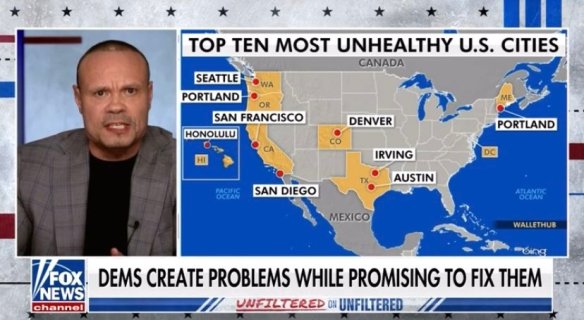
Here are two examples of what the Democrats are up against. Some clown on Fox claimed that Democrats don’t really care about people who live in cities, because the 10 unhealthiest cities in America are run by Democrats:

FK4VrP_UYBA1OH9

But the list of cities Fox used referred to the 10 healthiest cities!

FK4VrQBUcAA-iKV

Meanwhile, the NY Times put a story on the front page suggesting the January 6th committee isn’t acting normally:

The House committee investigating the assault on the Capitol and what led to it is employing techniques more common in criminal cases than in congressional inquiries.

The story is accurate. Since T___ and his allies aren’t cooperating, the committee has been forced to be aggressive. The article suggests this is a risky move and might backfire. It’s not normal for congressional committees! What’s especially weird, however, is that, as an example of normal practice, the article ignores Watergate and Iran-Contra and uses the Benghazi attack. The Republican House committee that “investigated” Benghazi went on for months in order to push a non-existent scandal. Their behavior apparently seemed normal to the Times:

By comparison, the House select committee that spent two and a half years investigating the 2012 Benghazi attack issued just a dozen or so subpoenas — a small fraction of the number issued by the Jan. 6 committee so far — and made no criminal referrals.

The author James Gleick sums up:

Did anyone at the Times think for a second before including this Benghazi comparison? Why so few subpoenas? Maybe because, even though it was a sham, everyone cooperated (remember Hillary?) [testifying for 11 hours] Why  no criminal referrals? Maybe because THERE WERE NO CRIMES.

Professor Krugman Says This Isn’t Ordinary Inflation

Paul Krugman is Distinguished Professor of Economics at the Graduate Center of the City University of New York and a columnist for The New York Times. He knows what he’s talking about but admits mistakes (this is from his Times newsletter):

Back in 2010 a group of conservative academics, economists and money managers signed an open letter warning that the efforts of the Federal Reserve to support the economy would be dangerously inflationary. But the inflation never came. So four years later, Bloomberg reached out to as many of the signatories as it could, to ask what happened.

Not one was willing to admit having been wrong.

I don’t want to be like those guys. So I’m currently spending a fair bit of time trying to understand why my relaxed view of inflation early last year has been refuted by events. What I want to do today is share where I am now on that topic and what my current take says about future policy.

Last spring the debate was focused on the American Rescue Plan, the Biden administration’s large spending package. A number of economists, including Larry Summers, Olivier Blanchard and Jason Furman, warned that it would overstimulate the economy — that output and employment would soar to levels that would create a lot of inflationary pressure.

Those of us on the other side argued that the risks of excess spending were much less than they warned — that large parts of the Biden package, like aid to state and local governments, would end up being disbursed gradually over time and therefore not have that much of an inflationary impact. To use the jargon, I argued that the [American Rescue Plan] would have a low “multiplier” [The multiplier effect measures the impact that a change in investment will have on final economic output, so that a low multiplier means less inflation.]

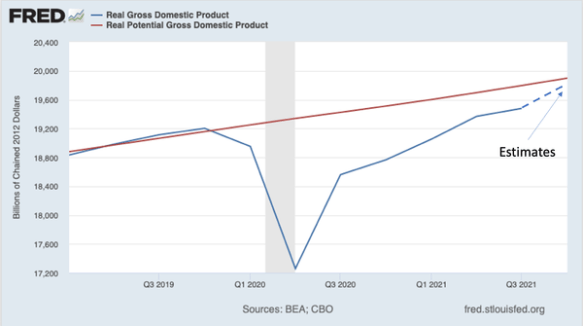
So here’s the funny thing: The multiplier does indeed seem to have been low. The economy has expanded fast, but it started in a deep hole and at this point is still if anything a bit below its pre-pandemic trend.

Here, for example, is real gross domestic product:

krugman210122_1-articleLarge

The Congressional Budget Office regularly publishes projections of “potential” G.D.P. — the level of output consistent with stable inflation. So far the official numbers through the third quarter of 2021, extended by private estimates of growth in the fourth quarter, still put us slightly below what we thought the economy’s potential was going to be.

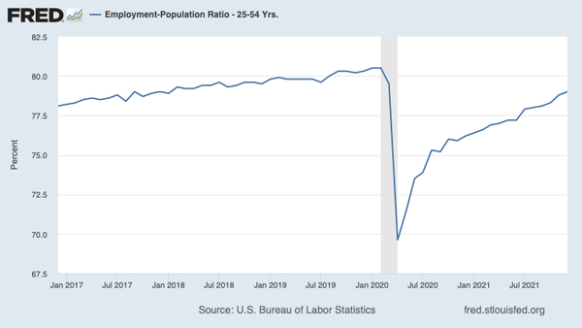
Here’s another number, the employment rate of prime-age adults, which has generally been a good indicator of the state of the labor market (probably better than the unemployment rate):

krugman210111_2-articleLarge

We’ve seen a strong recovery in employment, but we’re still significantly below pre-pandemic levels.

The point is that if you had told me a year ago that this is what current output and employment numbers would be, I wouldn’t have predicted soaring inflation. To put it another way, my expectations of a relatively muted effect of government outlays on demand were more or less vindicated. But of course my expectations of moderate inflation weren’t. So what happened?

Part of the answer lies in supply-chain issues. Overall demand hasn’t grown all that fast, but fear of face-to-face interactions has skewed demand away from services toward goods, overstraining shipping and in some cases manufacturing capacity. These issues account for a lot of recent inflation, but in a way they don’t worry me too much: The private sector has huge incentives to get stuff moving, so sooner or later supply-chain issues will fade away.

However, it’s not just the supply chain; it’s obvious that we’re now experiencing widespread labor shortages even though employment is still below its prepandemic level.

I mentioned that the employed percentage of prime-age adults has generally been a good indicator of the state of the labor market. Another good indicator is the rate at which workers are quitting their jobs: Quits are high when people believe that new jobs are easy to find. Normally these two measures move in tandem; but something has changed.

Here’s a scatter plot of the prime-age employment rate against the quit rate since 2001; the blue dots represent the pre-pandemic era, the red dots the era since early 2020:

[Krugman has a diagram that I totally fail to understand, so you’ll have to imagine it.]

You can see [or imagine] the close relationship between the two measures [the prime-age employment rate and quit rate] before 2020. Since then, however, the relationship seems to have shifted, so a labor market that seems only OK judging by the employment rate looks extremely tight judging by the number of people who are quitting. And wages are rising rapidly, which suggests that quits are telling the real story.

What we’re seeing, of course, is the Great Resignation — which is also, to an important extent, a Great Retirement. A recent blog post from the International Monetary Fund shows that there has been a surge in the number of older Americans (and Britons) choosing not to be in the labor force. . . . 

Now, a labor market in which jobs are easy to find and workers can bargain for higher wages is a good thing. But the fact that labor markets are so tight even though employment and real G.D.P. are below pre-pandemic projections suggests that we can’t rely on those projections to assess the economy’s productive capacity. For whatever reason or reasons — presumably linked to Covid-19 — the U.S. economy apparently can’t sustainably produce as much as we expected [and scarcity means rising prices].

And that in turn tells us that it’s time for policymakers to pivot away from stimulus — in particular, that the Federal Reserve is right to be planning to raise interest rates in the months ahead. As I read the data, it doesn’t call for drastic action: The Fed should be taking its foot off the gas pedal, not slamming on the brakes. But that’s a story for another day.

For now, the moral is that because of Covid-19, we can’t assess where we are simply by comparing our situation with the pre-pandemic trend [i.e. the normal state of affairs]. . . . 

Unquote.

In other words, inflation, a global phenomenon, not one restricted to the US, is principally an effect of economies adjusting to a fading pandemic, another global phenomenon, which is not business (or economics) as usual. 

Behind the Screaming Headlines About Inflation

Any commentary on inflation that doesn’t take into account the pandemic is worthless. With the Delta variant and now Omicron, the economy isn’t functioning normally. The virus is limiting the supply of goods and services, while Americans have more disposable income than before the pandemic. Reduced supply and increased demand means inflation. What will happen with inflation after Omicron peaks, sometime in the near future? Nobody knows, but perhaps inflation hysteria isn’t justified? 

What the Bureau of Labor Statistics reported today:

The Consumer Price Index for All Urban Consumers (CPI-U) increased 0.5 percent in December on a seasonally adjusted basis after rising 0.8 percent in November . . .  Over the last 12 months, the all items index increased 7.0 percent before seasonal adjustment. The energy index rose 29.3 percent over the last year and the food index increased 6.3 percent.

Increases in the indexes for shelter and for used cars and trucks were the largest contributors to the seasonally adjusted all items increase. The food index also contributed, although it increased less than in recent months, rising 0.5 percent in December. The energy index declined in December, ending a long series of increases; it fell 0.4 percent as the indexes for gasoline and natural gas both decreased. . . . 

A brief summary from Catherine Rampell of The Washington Post:

Since Covid began, consumer spending has risen a ton — especially for goods and especially for durable goods. Services up a little since February 2020, but not much.
At exactly the same time goods are in much higher demand, supply chains for goods have snarled. Hence, price spikes.

[Today’s report shows] once again, durable goods (cars, TVs, computers, appliances) in the lead for inflation, at 16.8% year-over-year, not seasonably adjusted.

Nondurables (food, clothing) in 2nd place at 10.2%. Services (travel, healthcare, education) with the least price growth at 4%, in part because so many services remain high risk.

Durables are by definition durable—we don’t need to buy/replace them often. Many expected that demand for durables (and therefore price pressures) would eventually run out of steam; how many fridges can people buy? Durable spending has slowed recently but is still way up compared to pre-Covid.

Maybe the demand for durables fades, supply chains unsnarl, price pressures recede. That would be good. Then the question becomes – what happens to services? Services inflation has generally been lower than goods inflation…but rents (a service) have been rising, and those are “sticky”.

Anther reason to worry that inflation might persist for a while yet, even as supply chains untangle themselves, is inflation expectations. Expectations of higher prices can become self-fulfilling.

An overview and the political context from Rep. Tom Malinowski (Democrat-NJ):

Virtually everyone agrees on the cause of the harmful inflation we’re experiencing: people have more money to spend, but that demand is chasing too little supply. But who we blame and how we propose to solve it reveals a lot about our political divide.

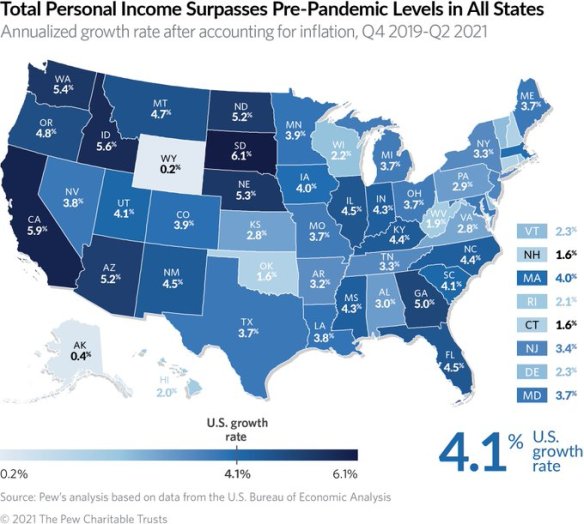
It’s an incredible fact that despite one of the worst economic crashes in our history, average Americans (not just the super rich) have more household wealth to spend today than they did before the pandemic. 

Government spending — bailing out small businesses and state & local governments, helping people who lost jobs, stimulus checks & the child tax cut — worked to rescue our economy and left Americans with the extra cash we are now trying to spend (i.e., higher demand).
FI6RegiXIAQwva9

Had the government not done those things, it’s absolutely true that there would [be less] inflation now. 

But we also wouldn’t have amazing economic growth with historically low unemployment [and higher wages across the country]. Millions of Americans would be destitute.

So when you hear people blame “Biden spending” for inflation, what they’re saying is that you should have less money to spend . . . that your wages should be lower; that your taxes should be higher; that the government should have let your employer or municipality go bankrupt.

What most Democrats are saying is that increased demand (more people with more money to spend) is a good thing!  And that the way to beat inflation is to help the supply of goods and services in the economy to catch up to healthy consumer demand.

We’re focused on improving efficiency of our ports and delivery systems, which helped greatly during the holiday season. Some good news: The port of New York/New Jersey is moving 20%+ more goods than before the pandemic without delays. . . . As Omicron passes in the US, our labor disruptions will ease. But we must also get more people vaccinated in countries where COVID has shut down factories critical to our supply chains.

Crushing COVID is obviously critical to fighting inflation. As Omicron passes in the US, our labor disruptions will ease. But we must also get more people vaccinated in the US and in countries where COVID has shut down factories critical to our supply chains.

If you’re concerned about inflation, you should also support letting employers legally hire people already in the US who desperately want to work the jobs now being unfilled — and back politicians who would rather fix the economy than demonize immigrants.

To sum up: The solution to inflation is not to squeeze middle class Americans as Republicans are suggesting, so that we have less to spend on cars, food, and travel. The solution is to build back supply chains resilient enough to meet American consumers’ post-pandemic needs.

Finally, from The Washington Monthly, how lack of competition (and missing anti-trust enforcement) has made the supply chain so vulnerable:

In recent weeks, senior Biden administration officials have been arguing that monopolization explains at least some of the inflation that is eroding the otherwise impressive wage gains average Americans are experiencing. The case they make is that firms in concentrated industries are using their excessive market power to raise prices and fatten their bottom lines at the expense of consumers. They point specifically to industries like oil and gas and meat processing, where corporate profits are skyrocketing.

. . . In the meat industry, thanks to lax antitrust enforcement, four companies now control 55 to 85 percent of the markets for beef, pork, and poultry. Since the fall of 2020, the price of beef has risen by more than 20 percent, far higher than the inflation rate. At the same time, the profits of the meat-packing industry are up more than 300 percent. Consolidation is hardly limited to the meat industry. It is rampant throughout the economy. So too are recent corporate profit rates . . .

But for argument’s sake, let’s say that . . . predatory pricing by oligopolistic firms isn’t driving the current inflation, but rather, “supply chain hiccups” brought on by pandemic induced labor shortages and high demand. The question is, why were the supply chains so fragile in the first place?

The answer is monopoly—in particular, the hollowing out of capacity as a result of industry consolidation and Wall Street’s demand for short term profits. Consider the case of semiconductors—crucial components in most of the products we use. As recently as a decade ago, America was producing vast numbers of cutting-edge semiconductors right here on our shores. Since then, . . . the federal government has allowed the biggest domestic manufacturer, Intel, to buy up or drive out most of its U.S. competitors. The firm then offshored or sold off its U.S. manufacturing capacity to reduce costs. That boosted Intel’s stock price and delighted investors. But it left the company with scant domestic capacity to increase supply when COVID-19 shut down Asian semiconductor factories. The falloff in semiconductor supply has led, in turn, to shortages of, and higher prices for, everything from cars to cell phones.

Or consider the cargo ships that haven’t been able to get products into and out of U.S. ports. That, too, is a problem exacerbated by monopoly. Ocean shipping was a highly regulated industry until a quarter century ago . . . That led to three vast carrier alliances, all foreign owned, gaining control of 80 percent of the ocean shipping market. These alliances then built super-sized cargo ships that can only dock in a few ports, like the ones in Los Angeles and Long Beach, which now service 40 percent of all U.S. traffic. This highly consolidated system kept shipping prices, and hence overall inflation, low for years. Now, its brittleness is contributing to inflation.

Once supplies do land in U.S. ports, there are not enough trucks and truck drivers to deliver products to our warehouses and stores. In the recent past, however, many of those goods were delivered by freight rail. Why aren’t those goods now moving on trains? Because . . . the federal government allowed the railroad industry to monopolize. And the Wall Street hedge funds that control those monopolies have more recently demanded that they rip up tracks, mothball rail cars, and lay off seasoned union employees to get costs down and stock prices up. Now our freight rail system doesn’t have the capacity to take up the slack. . . . 

Of course, it took decades, and countless bad decisions in Washington, for our supply chains to become as concentrated, uncompetitive, and breakable as they are now. It will take years of strong antitrust enforcement and other measures to set things right.