Where They Are in Ukraine Right Now

We’ll be learning more about Ukraine now that Putin has recognized two parts of it as “independent nations” and moved in Russian “peacekeeping” forces. They’re the so-called People’s Republics of Donetsk and Luhansk. I wondered what this meant in terms of Ukrainian geography. 

Legally speaking, Ukraine is divided into 27 administrative regions. There are 24 “oblasts” (a term inherited from the Soviet Union”), plus the Autonomous Republic of Crimea (which Russia has occupied since 2014) and two cities, the Crimean city of Sevastopol and Ukraine’s capital, Kiev (or Kyiv). Donetsk and Luhansk are the two oblasts at the eastern edge of Ukraine next to Russia. Their principal cities are also called “Donetsk” and “Luhansk” (like New York, New York). In addition, the Donetsk and Luhansk oblasts are collectively known as the “Donbas” region. Unlike Crimea, Donbas is mostly Ukrainians, not ethnic Russians.

provinces-of-ukraine-map

There’s been fighting between the Ukrainian government and Russian-backed rebels in the Donbas region since 2014 (the same year Russia took Crimea). Thousands have died. More than a million Ukrainians have been displaced — most of them have left the country. Lately, there’s been a stalemate between the two sides and a partial ceasefire.

In the map below showing recent ceasefire violations (the yellow dots), the darker gray area represents Donbas as a whole (or most of it). The Ukrainian government controls the area north and west of the red line; the rebels control area south and east of the line.

FMIf9ieXMAEzgFd

The current division raises an obvious question: what will happen to the parts of Donetsk and Luhansk now controlled by Ukraine? Well, the Russian puppets who now “lead” those two “independent nations” have declared all of Donetsk and Luhansk (the entire Donbas) to belong to their new “nations”. So will the Russians try to take control of the areas north and west of the red line? If the Russians agree that those parts of Donbas really do belong to the two new People’s Republics, they will have to take them by force. Ukraine will resist and the fighting will be much worse than it’s been.

Ukrainian resistance may then lead to Russia deciding to take Ukraine as a whole, carrying out the massive invasion everybody has been talking about. An article in The Guardian sums up the current situation:

[The decision to recognize Donetsk and Luhansk as independent nations] answers some questions but others remain. There is a chance Putin may simply recognise the two republics “as they are”. This, after months of apocalyptic scenarios, would probably be privately accepted as a good outcome by Ukraine and the west.

But it seems likely that Putin has much more in mind than simply taking a nibble out of Ukraine’s east and taking formal responsibility for territories he already de facto controlled.

Putin’s final words, that if Kyiv did not stop the violence [violence that Russian propaganda claims Kiev is committing, but isn’t], they would bear responsibility for the “ensuing bloodshed”, were ominous in the extreme. It sounded, quite simply, like a declaration of war.

Why Putin and the Other Oligarchs May Prefer War to Peace

Everything that’s happening indicates that Russia will soon invade Ukraine (possibly after China’s Olympics ends tomorrow). The Russians will blame the Ukrainian government for provocations the Russians and their Ukrainian supporters have themselves caused and even claim it’s the Ukrainians who have attacked the Russians.

An invasion may not make much sense to the rest of the world, but Alexander Gabuev, a senior fellow at the Carnegie Moscow Centre, argues for The Economist that “elites have hijacked Russia and conflated the country’s interests with their own” and that’s “why Vladimir Putin and his entourage want war”. Further economic sanctions might even be in the Russian oligarchy’s interests:

. . . When it comes to Ukraine, people in Moscow and the West can be forgiven for assuming that the Kremlin’s policy is informed by a dispassionate strategy derived from endless hours of interagency debate and the weighing of pros and cons. What actually drives the Kremlin are the tough ideas and interests of a small group of longtime lieutenants to President Vladimir Putin, as well as those of the Russian leader himself. Emboldened by perceptions of the West’s terminal decline, no one in this group loses much sleep about the prospect of an open-ended confrontation with America and Europe. In fact, the core members of this group would all be among the main beneficiaries of a deeper schism.

Consider Mr Putin’s war cabinet, which is the locus of most decision-making. It consists of Nikolai Patrushev, the head of the Security Council; Alexander Bortnikov, the head of the FSB (the main successor agency of the KGB intelligence service); Sergei Naryshkin, the head of Russian Foreign Intelligence Service; and Defence Minister Sergei Shoigu. Their average age is 68 years old and they have a lot in common. The collapse of the Soviet Union, which Mr Putin famously described as the greatest geopolitical catastrophe of the 20th century, was the defining episode of their adult lives. Four out of five have a KGB background, with three, including the president himself, coming from the ranks of counterintelligence. It is these hardened men, not polished diplomats like Foreign Minister Sergey Lavrov, who run the country’s foreign policy.

In recent years members of this group have become very vocal. Messrs Patrushev and Naryshkin frequently give lengthy interviews articulating their views on global developments and Russia’s international role. According to them, the American-led order is in deep crisis thanks to the failure of Western democracy and internal conflicts spurred by the promotion of tolerance, multiculturalism and respect for the rights of minorities. A new multipolar order is taking shape that reflects an unstoppable shift in power to authoritarian regimes that support traditional values. A feisty, resurgent Russia is a pioneering force behind the arrival of this new order, along with a rising China. Given the state of affairs in western countries, the pair contend, it’s only natural that they seek to contain Russia and to install pro-Western regimes in former Soviet republics. The West’s ultimate goal of a Colour Revolution in Russia itself would lead to the country’s conclusive collapse.

Washington sees unfinished business in Russia’s persistence and success, according to Mr Putin’s entourage. As America’s power wanes, its methods are becoming more aggressive. This is why the West cannot be trusted. The best way to ensure the safety of Russia’s existing political regime and to advance its national interests is to keep America off balance.

Seen this way, Ukraine is the central battleground of the struggle. The stakes could not be higher. Should Moscow allow that country to be fully absorbed into a western sphere of influence, Russia’s endurance as a great power will itself be under threat. On a personal level, the world view of the hard men is an odd amalgam of Soviet nostalgia, great-power chauvinism and the trappings of the Russian Orthodox faith. The fact that the new elite in Kyiv glorifies the Ukrainian nationalists of the 20th century and thumb their noses at Moscow is a huge personal affront.

Why then are the people around Putin not scared about possible fallout from a new round of far-reaching economic sanctions? In their eyes, the sanctions that the West imposed to punish Russia for the annexation of Crimea and the war in Donbas were intended largely to check Russia’s rise. America and its allies would have found a way to introduce them one way or another, they were just looking for an excuse. Since 2014 such views have solidified. Messrs Patrushev, Bortnikov and Naryshkin all find themselves on the U.S. Treasury’s blacklist already, along with many other members of Mr Putin’s inner circle. There is no way back for them to the West’s creature comforts. They are destined to end their lives in Fortress Russia, with their assets and their relatives alongside them.

As for sanctions by sector, including those that President Joe Biden’s team plans to impose should Russia invade Ukraine, these may end up largely strengthening the hard men’s grip on the national economy. Import substitution efforts have generated large flows of budget funds that are controlled by the coterie and their proxies, including through Rostec. The massive state conglomerate is run by a friend of Mr Putin’s from his KGB days in East Germany, Sergey Chemezov. In a similar vein, a ban on food imports from countries that have sanctioned Russia has led to spectacular growth in Russian agribusiness. The sector is overseen by Mr Patrushev’s elder son Dmitry, who is Mr Putin’s agriculture minister.

Similarly much-touted financial sanctions have led to a bigger role for state-owned banks which, unsurprisingly enough, are also filled with KGB veterans. If anything, further sanctions wouldn’t just fail to hurt Mr Putin’s war cabinet, they would secure its members’ place as the top beneficiaries of Russia’s deepening economic autarky. The same logic is true of domestic politics: as the country descends into a near-permanent state of siege, the security services will be the most important pillar of the regime. That further cements the hard men’s grip on the country.

After two years of Covid-induced self-isolation for Kremlin bosses, there is a clear tendency toward tunnel vision and a dearth of checks and balances. Russia’s interests are increasingly becoming conflated with the personal interests of the people at the very top of the system.

The Passing Parade

The year is almost over and so is the decade that’s strangely ending with a “19” instead of a nice, round “20”. There is lots of news and commentary out there. An extremely truncated summary:

It didn’t make a splash, because this is 2019, not 1971, but The Washington Post reported:

A confidential trove of government documents obtained by The Washington Post reveals that senior U.S. officials failed to tell the truth about the war in Afghanistan throughout the 18-year campaign, making rosy pronouncements they knew to be false and hiding unmistakable evidence the war had become unwinnable…

“We were devoid of a fundamental understanding of Afghanistan — we didn’t know what we were doing,” Douglas Lute, a three-star Army general who served as the White House’s Afghan war czar during the Bush and Obama administrations, told government interviewers in 2015. He added: “What are we trying to do here? We didn’t have the foggiest notion of what we were undertaking … Who will say this was in vain?”

The Afghanistan Papers won’t get as much publicity as the Pentagon Papers. They should have called them the “Afghan Papers”, more concise language now being the custom.

The Post also explained the history of the “It was Ukraine, not Russia” myth that has taken up permanent residence in what’s left of the Toddler’s brain and is so popular among right-wing politicians and propagandists everywhere. In a few words, the Russian government created the myth in order to cast blame on somebody else:

The president’s intense resistance to the assessment of U.S. intelligence agencies that Russia systematically interfered in the 2016 campaign — and the blame he cast instead on a rival country — led many of his advisers to think that Putin himself helped spur the idea of Ukraine’s culpability, said the officials, who spoke on the condition of anonymity [of course]. . .One former senior White House official said [the president] even stated so explicitly at one point, saying he knew Ukraine was the real culprit because “Putin told me.”

The Popular Information political newsletter summarized new analysis of the president’s high crimes and misdemeanors:

An extraordinary analysis by top legal experts, published by Just Security, clearly explains how the impeachment inquiry [implied] that [the pres] committed at least three (and probably more) federal crimes. All of these crimes involved him abusing his presidential powers, making them particularly relevant to impeachment….

  • Federal campaign finance law
  • Bribery
  • Honest services fraud

[This last one] occurs “when a public official breaches his duty to act in the best interests of his constituents by performing an official act in exchange for personal gain”, such as “withholding funding that had been allocated by Congress —  money intended to advance U.S. national security by helping Ukraine combat Russian aggression — to advance his personal political interests”.

Cool.

By the way, Congressional Democrats and Rep. Justin Amash (an independent who was kicked out of the Republican Party when he exercised his conscience) finally got around to impeaching the monster. Paul Krugman reacted:

What we saw Wednesday was a parade of sycophants comparing their leader to Jesus Christ while spouting discredited conspiracy theories straight from the Kremlin. And as they were doing so, the object of their adoration was giving an endless, rambling, third-world-dictator-style speech, full of lies, that veered between grandiosity and self-pity…

Republicans, in other words, are beyond redemption; they’ve become just another authoritarian party devoted to the leader principle. And like similar parties in other countries, the G.O.P. is trying to rig future elections through gerrymandering and voter suppression, creating a permanent lock on power

But if Trump’s supporters look just like their counterparts in failed democracies abroad, his opponents don’t.

One of the depressing aspects of the rise of authoritarian parties like Hungary’s Fidesz and Poland’s Law and Justice has been the fecklessness of their opposition — disunited, disorganized, unable to make an effective challenge even to unpopular autocrats as they consolidated their power.

Trumpism, however, faced determined, united, effective opposition from the beginning, which has been reflected both in mass marches and in Democratic electoral victories. In 2017 there were only 15 Democratic governors, compared with 35 Republicans; today the score is 24 to 26. And last year, of course, Democrats won a landslide victory in House elections, which is what made the impeachment hearing and vote possible.

Many of the new Democratic members of Congress are in Republican-leaning districts, and some observers expected a significant number to defect on Wednesday. Instead, the party held together almost completely. True, so did its opponents; but while Republicans sounded, well, deranged in their defense of Trump, Democrats came across as sober and serious, determined to do their constitutional duty even if it involved political risks.

Now, none of this necessarily means that democracy will survive….

What we learned Wednesday, however, was that those who define America by its ideals, not the dominance of a particular ethnic group, won’t give up easily. The bad news is that our bad people are as bad as everyone else’s. The good news is that our good people seem unusually determined to do the right thing.

Finally, speaking of good people, the widely-read evangelical magazine Christianity Today called for the Toddler’s removal from office. The editorial got so much attention, their website crashed:

His Twitter feed alone—with its habitual string of mischaracterizations, lies, and slanders—is a near perfect example of a human being who is morally lost and confused…. .Whether [he] should be removed from office by the Senate or by popular vote next election — that is a matter of prudential judgment. That he should be removed, we believe, is not a matter of partisan loyalties but loyalty to the Creator of the Ten Commandments….

To the many evangelicals who continue to support [him] in spite of his blackened moral record, we might say this: Remember who you are and whom you serve. Consider how your justification of [the president] influences your witness to your Lord and Savior. Consider what an unbelieving world will say if you continue to brush off [his] immoral words and behavior in the cause of political expediency. If we don’t reverse course now, will anyone take anything we say about justice and righteousness with any seriousness for decades to come?

You have to wonder how many of the president’s supporters understand that, if the Senate did its duty in the new year, our convicted president would be replaced by super-Christian Mike Pence, not the dreaded mainline Protestant who failed to carry Wisconsin.

In conclusion, it seems to me that we face two major issues:  climate change and bringing majority rule to America.

Majority rule would mean dealing with the courts, the Electoral College, a skewed Senate, gerrymandering, election security, campaign finance reform and voter suppression. It’s quite an agenda. But, as Senator Warren [subject of the latest Rolling Stone interview] keeps saying, we need big, structural change in our political system if we’re going to make progress on issues like climate change, inequality and much more.

Oh, and you might check out “The Historical Case for Abolishing Billionaires” in The Guardian. It begins by quoting another well-known proponent of regulated capitalism, Adam Smith.

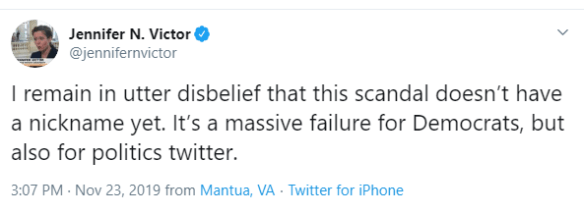
Kiev Pro Quo

Untitled

She makes an excellent point.

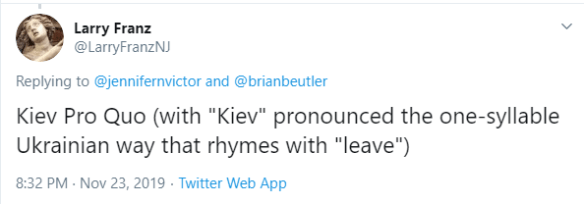
Without looking at the suggestions she got from “politics Twitter” (in order to make the challenge more interesting), I put my thinking cap on and came up with “Kiev Pro Quo” or #KievProQuo, with “Kiev” having one syllable, making it rhyme with “leave”. That’s how the American diplomats have been pronouncing it, since one syllable is closer to how the Ukrainians say it. The two-syllable “Kee-ev” is how the Russians pronounce it.

I raced back to Twitter. There was no time to lose!

Untitled2

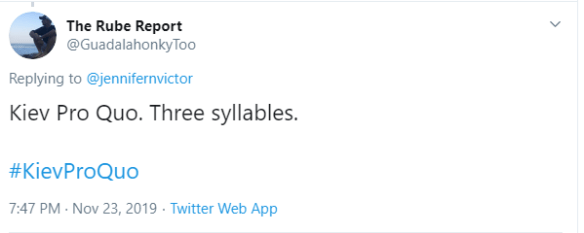
Checking out the competition, I was stunned to see that someone else got there first. He beat me by 45 damn minutes. (If only we’d gone to dinner sooner. If only the waitress and cook had been faster.)

Untitled

So there it is, America. Now all we have to do is spread the word (or phrase).

For more on “kiev” vs. “kee-ev” and whether it’s “Ukraine” or “The Ukraine”, see this helpful explanation.

A High Crime or Misdemeanor If Ever There Was One

Federal law says that a public official (such as the President) who, directly or indirectly, corruptly demands, seeks, receives, accepts, or agrees to receive or accept anything of value (such as the announcement of a criminal investigation into a prospective political opponent) in return for being influenced in the performance of any official act (such as inviting a foreign leader to the White House or delivering military aid to that foreign leader’s country) is guilty of bribery.

The Constitution says the President, Vice President and all civil officers of the United States shall be removed from office on impeachment for, and conviction of treason, bribery or other high crimes and misdemeanors.

Our president directly, indirectly and secretly demanded something of value to his political campaign in return for performing official actions. That’s one solid reason he should be impeached and removed from office.

It makes no difference that the foreign criminal investigation was never announced and never took place. It makes no difference that the military aid was ultimately delivered (after the president’s corruption was revealed). The president made it clear to his subordinates and his lawyer that he wanted to bribe the president of Ukraine. Attempted bribery, even if discovered in time to be interfered with, counts as bribery.

There are other reasons he should be removed from office, including the fact that a grand jury would have indicted him for obstruction of justice if the Department of Justice had chosen to prosecute, and the fact that he is knowingly receiving “emoluments” (i.e. cash) from foreign governments while in office, something the Constitution forbids. But bribery is the offense the Democrats are investigating and publicizing at the moment.

Representative Adam Schiff, chairman of the House Intelligence Committee, summarized today’s testimony by Ambassador Gordon Sondland in thirteen minutes. It’s worth watching.