Creeps or Idiots?

My immediate reaction to this election was succinct:

Almost half of American voters are creeps or idiots. It’s not polite to say so, but that’s how it looks from here.

I wondered at the time whether I should change it to “creeps and/or idiots”, since that would have been more accurate, but decided to leave it alone.

Alex Guerrero, a philosophy professor at Rutgers University (the state university of New Jersey), offers a similar analysis, but more detailed and nuanced. He ends up at an interesting, although implausible, place:

Four years ago, I wrote that whoever won, half the country would feel “some combination of anger, alienation, shame, sadness, despair, fear, impotence, rage, and hopelessness.” We—the millions of members of the two parties—were far apart then and have moved even further apart under Txxxx.

If you are one of the almost 77 million Americans who voted for Biden, what should you make of the almost 72 million Americans who voted for Txxxx? Let me distinguish two broad views.

The first is to see Txxxx supporters—or at least many of them—as bad like Txxxx: as people who are racist, or xenophobic, or sexist, or don’t mind that Txxxx is; people who spent four years saying “fuck your feelings”; people who don’t mind Txxxx’s willingness to make up electoral fraud and to disregard norms of law and democracy; people who ignore or embrace Txxxx’s cruelties, collusions, corruptions, and crimes. These people might be Txxxx die-hards who worship him, quasi-nihilistic fans who enjoy his talent for enraging the left, or pragmatists who see Txxxx as a cruel but effective means to their ends.

Whichever category they fall in, they are morally culpable for supporting Txxxx—particularly once it was clear exactly who Txxxx is and how he would govern—and likely to be what we might colloquially call bad people. Furthermore, this is not something that is easily changeable. These views and values are now deeply held and unlikely to be modified, at least not in the near future, at least not for the vast majority of them. Call this the moral deplorables view.

The second is to see Txxxx supporters as not nearly as bad as Txxxx himself. These 70 million Americans might be people who have been misled into viewing Txxxx in unrealistic ways: as a patriot, a leader, a staunch ally of Black and Latina/o communities, a religious person who cares about all people, a skilled businessman who can support employment and economic recovery, an ally of freedom and justice. These are people whose values—we are to imagine—are not that different from our own. They are not racists, bigots, or sexists, or not deeply so, and perhaps not much more than many of Biden’s 77 million supporters.

But they have a large set of false non-moral beliefs about Txxxx himself, and another large set of false non-moral beliefs about the views and character and positions of those on the left, including Biden. Let us imagine, further, that those false beliefs themselves are not culpably held—they result from the evidence they have encountered in the echo chambers that they find themselves in, and that they find themselves in these positions is not their fault [Note: in many cases, that’s hard to imagine]. There are more modest and more extreme versions of this view—maybe people are somewhat morally responsible for their false views, rather than being completely off the hook. But the basic view suggests that Txxxx supporters could be productively engaged, that they could change their views. Call this the epistemic reformables view.

(I will leave aside the view that asks us to think that Txxxx himself is not as bad as he seems to be, although of course that is what Txxxx supporters would urge us to think.)

The first view focuses on the deep moral character of Txxxx supporters. The second view focuses on the contingently bad epistemic situation of Txxxx supporters. The correct view probably involves some complex mixture of these.

Many who support Biden will see the moral deplorables view as correct and see the epistemic reformables view as misguided and naïve. The idea of trying to empathize with and constructively engage Txxxx supporters—something that they almost never do for us—is pointless and morally misguided. We are done with the countless thinkpieces that try to understand the disaffected white Txxxx voter. If you support Txxxx, we don’t support you, we aren’t going to try to understand you, we aren’t going to go out of our way to engage you, we are going to fight you tooth and nail, and we are going to defeat you. What that means is not entirely clear. More on that in a moment.

On the epistemic reformables view, we assume that many of Txxxx’s supporters are not as bad as supporting Txxxx would seem to require. Something else must have gone wrong. Many put blame at the doorstep of the misinformation ecosystem that exists on the right, led by Breitbart, Infowars, Truthfeed, OAN, Gateway Pundit and others at the extreme edge, and Washington Examiner, the Daily Caller, Fox News, and others at something somewhat less extreme—all of this swirled together and shared by the output from smaller operations and individuals through Facebook, YouTube, Twitter . . . This is how people end up believing QAnon, how they end up seeing Biden as a “child sniffing, demented liar,” and how they end up thinking everyone in the Democratic party is secretly a socialist (indistinguishable from a communist) hellbent on destroying America. 

There are other explanations, too. . . .  Their apparently racist and bigoted attitudes are not deep; they reflect lack of education, fear of what is unfamiliar, and being a bit behind rapidly changing social norms. . . .

On this view, the things to push for are reform of our institutions: educational, political, informational [Question: How does one go about reform Fox News?]. With those kinds of reforms, we will come to see that millions of Txxxx supporters are very much like us—people we cannot only tolerate and respect, but also love and embrace. . . . 

We will get more information about which view is correct in the coming years as we see how people change (or don’t) in response to Biden’s presidency and Txxxx receding (we can hope) into the background. But when I incline toward the second, one reason is because of the relatives of mine who I know both support Txxxx and, although not perfect people, are not like Txxxx—and I can see how they have come to believe what they believe, even when that seems like a mistake.

If one thinks the first view is correct, one must think about what other moral obligations come along with that view. Among other things, I think that view should come with a commitment to dissolving the United States political community.

If one is elected to represent a political community, one should be committed to taking seriously the preferences and values of the whole community, compromising with (and certainly not just ignoring) views held by large percentages of the population, and making law and policy that is responsive to the full electorate, not just 51% of it. But one should ignore morally deplorable views and citizens who hold such views. But one cannot do so if that means ignoring the views of millions of people in a systematic way. In that context, the options are either a kind of omnipresent moral paternalism or simple political domination—neither is compatible with basic democratic values, at least not if one expects that situation to be durable over time. . . . 

Txxxx got near 60% or more of the vote in the contiguous states of Idaho, Montana, Utah, Wyoming, Nebraska, South Dakota, North Dakota, Kansas, Oklahoma, Missouri, Arkansas, Louisiana, Mississippi, Alabama, Tennessee, Kentucky, and West Virginia. That deep red stripe can pick up other softer red states if they want to join. The Western and Eastern states could be two separate countries, or one. Maybe even raising the possibility results in some change.

Untitled23

Of course, it is true that views do not go away if one simply divides the political community. What one faces then is the situation we are in with respect to many foreign countries with what we perceive to be serious problems—we try to influence them to change and open our borders to those who would like to leave their community and join ours.

To the extent that this response seems excessive, it is perhaps because we still have hope that we are in the epistemic reformable situation. But—I conclude once again, four years later—perhaps we should be more open than we seem to be to talking about whether and why we all want to remain in a country together.

Unquote.

We should keep in mind that preferring right-wing propaganda to reality-based journalism is revealing in itself. For most people, it’s not a totally innocent choice. Also, “informational institutions” like Fox News are not exactly susceptible to reform. I’m less forgiving and less optimistic about these matters than Prof. Guerrero.

As the map shows, the Electoral College result did create three contiguous zones, but for poor isolated Georgia (assuming we consider the Great Lakes more like wide rivers — as far as Georgia is concerned, we could do the same with the Atlantic Ocean).

Aside from the accounting complexity, the main reason against splitting up the United States is that it would condemn millions of people who aren’t creeps or idiots to living in a country run by too many people who are.  

Untitled

Beyond Moral Judgment by Alice Crary

Sometimes you (I mean me) finish a book and decide you shouldn’t have bothered. I’m not sure about this one.

It began with an interview. Richard Marshall spoke with philosophy professor Alice Crary as part of his End Times series. This is part of what she said (or wrote, since the conversations are at least partly via email):

“Moral realism” is a label that I deliberately don’t use in describing my image of ethics. Not that . . . the term is obviously ill-suited to capture things I believe. It is, for instance, a conviction of mine that that there are morally salient aspects of the world that . . . lend themselves to empirical discovery. A case could easily be made for speaking of moral realism in this connection. But that would likely generate confusion. When I claim that, say, humans and animals have moral qualities that are as such observable, I work with an understanding of what the world is like, and of what is involved in knowing it, that is foreign to familiar discussions of moral realism. These discussions are often structured by the assumption that objectivity excludes anything [related to] human subjectivity. Moral realism is frequently envisioned as an improbable position on which moral values are objective in this subjectivity-extruding sense while still somehow having a direct bearing on action and choice. . . .

A great deal of my work has been devoted to investigating the grip on the contemporary philosophical imagination of conceptions of objectivity—of the sorts operative in these conversations about moral realism—that take the expulsion of everything subjective as their hallmarks. I have repeatedly argued that restrictions these conceptions impose on what kinds of things count as objective are not justified . . . I have tried to show not only that we should reject the restrictions but also that doing so is urgent because necessary for getting morally and politically salient aspects of our lives into view. . . .

 I favor a “wider” conception of objectivity. I mean a conception loose or wide enough to encompass, inter alia, ethical values. . . .

I attack the view—which I describe as narrowly rational—that it is in theory possible to grasp any real connection of thought from an abstract, ethically neutral vantage point. I do so to show that there are ethically decisive considerations that this view leaves us unequipped to recognize, and I take an interest in work in the different humanities, as well as in literature and the other arts, because such work affords resources for uncovering things inaccessible to an abstract gaze. . . .

The upshot is that [for many philosophers, or most] there appears to be no room within ethics for humanistic thinking or artistic expression as such, and this represents a massive and practically catastrophic contraction of ethics. Within my ethical writings, alongside showing that this contraction is philosophically unjustifiable, I bring out how it is morally disastrous—among other things, by identifying harms to human beings and animals that it leaves us incapable of registering.

So I bought and read her book.

575167._UY400_SS400_

To sum it up, if I can, Prof. Crary says that being ethical and understanding ethics both require us to pay more attention to our feelings or “sensitivity”, what might be called our human reactions to what we experience as we go about our lives, and less attention to strictly ethical propositions, concepts and rules. She discusses cases in which people’s pre-existing ethical views (for example, that ethical people must follow certain rules) make it impossible for them to properly appreciate and evaluate people’s behavior, including their own. 

I’m not sure if her views are controversial among philosophers. The idea that feelings underlie ethics has a very long philosophical history, going as far back as ancient Greece (or consider, for instance, the title of Adam Smith’s 1759 book The Theory of Moral Sentiments). That’s one reason I’m not sure I should have read her book.

Another reason is that the book isn’t well-written. It’s repetitious, with lots of descriptions of what she has already argued and what she’s going to argue next. Her sentences also tend to go on and on, requiring frequent backtracking to see how the various clauses relate. I kept reading party because I expected her to show how her approach to ethics yields different ethical views. But the chapters that primarily provide examples amount to saying that various characters in literature deserve more understanding than they get from other characters (works by Jane Austen, Tolstoy and Henry James portray people who are too “moralistic”) and that feminism requires awareness of the social, cultural and economic contexts of women’s lives.

But Prof. Crary may have the (edited) last word (almost):

The idea is that, if the person’s thinking . . . expresses her moral outlook, then, even where it deals with what we are inclined to think of as a “non-moral” topic, it is rightly brought under the heading of moral thinking. . . [Being indifferent] to subject matter . . . allows [moral thought] to range over . . . any topic (e.g. the ways in which humans live and work with animals, the role of luck in human life, the role of . . . games in the cognitive development of children, the manner in which sibling rivalries . . . affect major life choices, etc.) . . . I submit that once we remove ourselves from the artificial atmosphere of academic moral philosophy , where a preoccupation with moral judgments is generally granted the status of a disciplinary requirement, this broad understanding of moral though will strike us as entirely natural . . .

Within contemporary moral philosophy, it is generally assumed that moral differences take the form either of disagreements about whether to apply a moral concept or of disagreements about whether some moral concept . . . is one we ought to operate with in the first place. In contrast, . . . moral differences may exist between people who inherit and develop different ways of thinking and talking about the world even where there is no question of a disagreement of either of these types. . . . 

Once we acknowledge the possibility of these additional kinds of moral differences, we are obliged . . . to consider not only individuals’ moral judgments but also mode of thought and speech that do not employ moral concepts, and the sensibilities that inform these additional modes of thought and speech. What becomes apparent is that proper respect for . . . moral conversation involves concern with . . . individuals’ entire personalities, the whole complicated weave of their lives [44-45].

I don’t disagree.

Another Damn Book To Read

Just what I needed.

drunken-silenus.jpg!Large

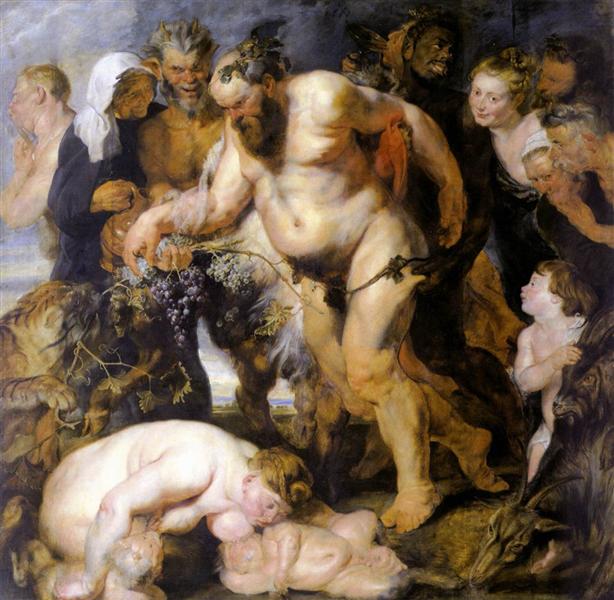
I’d seen advertisements for The Drunken Silenus: On Gods, Goats, and the Cracks in Reality, a new book by Morgan Meis. Then I saw a review by Leanne Ogasawara for Dublin Review of Books. Here’s half of it:

A man finds himself in Antwerp with nothing to do. Then he remembers, among other things, that this is the town where the painter Peter Paul Rubens made his home. At first, this annoys him, because he has no interest whatsoever in the painter. But then he thinks, why not write a book about Rubens.

Why not, indeed?

Essayist and critic Morgan Meis sets out to develop a new style of writing about art, one that is informed by a passionate looking. . . .

So, what is the painting in question? Well, it should be said that Rubens’s Drunken Silenus is not even in Antwerp anymore, since the city is now much too small for its golden boy. The painting is now in Munich. Meis travels there and stands in front of it. . . .

Meis is a philosopher. And so, standing in front of the drunken, out-of-control figure of Silenus, he immediately thinks of Nietzsche. . . .

According to Meis, Rubens was bowled over by Titian’s Bacchus and Ariadne   and who wouldn’t be?   in which the character Silenus can be found, playing a minor role in the back of the picture. You can see him slumped over asleep, presumably in a drunken stupor, being carried along on a mule. Rubens gravitates to this plump figure and brings him centre stage in his own painting, where naked Silenus seems ready to spring right off the canvas.

In case you don’t remember   and why would you?   Silenus was the tutor of Dionysius, and member of his wild and crazy entourage. He was also the goat-god who got tangled up with King Midas. Famously, the king asked Silenus to tell him what was the best thing in the world for men? “The best thing in the world for men is to never have been born,” declares Silenus. “And the second best thing is to die early.”

You get the idea: this is what my son would call a buzz kill. But this profoundly pessimistic message deeply affected Nietzsche. Nietzsche, who was so fascinated by opposing ancient Greek impulses – one toward order (the Apollonian) and one toward frenzy and the irrational (the Dionysian), could not help but be impressed. As Meis tells it:

All this talk (Nietzsche realised) of the measured and balanced Greek mind was sloppy. No, there is turmoil. Nietzsche saw it because he was willing to look. He didn’t listen to anyone else, the experts, the other scholars. He just took a look.

When I studied Nietzsche in university, we read Dodds’s 1925 work The Greeks and the Irrational. The book was revelatory, illuminating all that was irrational about ancient Greek society. We tend to idealise the Greeks for their devotion to reason   in law, in mathematics, rhetoric and philosophy, for example. But the Greeks, said Dodds, were also deeply driven by irrational forces expressed in religious and other social practices. . . .

According to Nietzsche, Silenus was the greatest hero because he embraced the violent irrational forces that are at our core. And indeed, this is the way he has long been viewed, even in Rubens’s sympathetic depiction.

But what is a goat-god anyway? Nietzsche responds to this question, in Meis’s words that:

God is a goat because God is truth and the real truth of the matter is that life is a matter of running and jumping in the forest and rushing after something to screw and something to eat and, according to Nietzsche in what he thought he learned from the Greeks, even the life of the mind, the intellectual life of the sad-thinking-creature known as man, this creature who must think and make art and make culture, insofar as man does those things, ought to be done with the pure life-expressing power of the goat.

Have you heard of the old joke that, Life is so terrible, it would have been better not to have been born. Who is so lucky? Not one in a hundred thousand!

More than anything, The Drunken Silenus is about the “tears of things” (lacrimae rerum). Underneath the beauty of Antwerp   underneath the beauty of all cities, he says, is the irrationality of violence, chaos, and war. A world of tears.

This is the deeper truth that Nietzsche uncovered in the figure of Silenus. And in Meis’s telling, as the Franco-Prussian War came to a head during The Birth of Tragedy’s original composition, this same impulse toward war and violence is what connects civilisations through history. This Dionysian horde that Nietzsche surely imagined battering the walls of the besieged city of Wörth in 1870 was the same Dionysian horde that devastated Europe in the Thirty Years War in Rubens’s time. . . .

In this telling, history is not a love story. But I do think there is something healthy about Nietzsche’s pessimism. To dwell on transience, in the tears of things, in decay and ruins, is ultimately an empowering practice. In Japan, it is referred to as “scattering flowers and fallen leaves” 飛花落葉 or . . . “dewdrop loves and our dewdrop selves”. The Lotus Sutra teaches that all that appears before us is as a dream, an illusion, a bubble, a shadow. All is like the dew or lightning. It should thus be contemplated that nothing has reality. That everything is in flux and that all must eventually perish is a sad but inevitable fact . . .

Unquote.

And then a purchase was made.

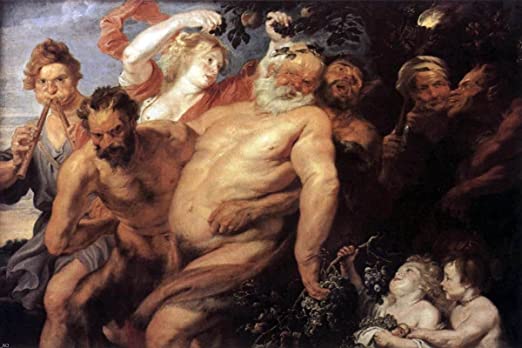
Peter Paul Rubens painted Silenus another time. Drunken Silenus Supported by Satyrs shows Dionysus’s companion and tutor getting a little help from his friends. We all need assistance sometimes, especially in what Ms. Ogasawara calls “our current time of worry and sickness”. Am I right or am I right?

Two days.

71x5QVmhEiL._AC_SX522_

Quantum Reality by Jim Baggott

The author is a former academic physicist with a leaning toward the experimental side of physics, as opposed to the theoretical side. From the preamble:

I know why you’re here.

You know that quantum mechanics is an extraordinarily successful scientific theory, on which much of out modern, tech-obsessed lifestyles depend. . . .You also know that it is completely mad. Its discovery forced open the window on all those comfortable notions we had gathered about physical reality . . . and shoved them out. Although quantum mechanics quite obviously works, it appears to leave us chasing ghosts and phantoms, particles that are waves and waves that are particles, cats that are at once both alive and dead, lots of seemingly spooky goings-on, and a desperate desire to lie down quietly in a darkened room.

But, hold on, if we’re prepared to be a little more specific about what we mean when we talk about “reality” and a little more circumspect about how we think a scientific theory might represent such a reality, then all the mystery goes away [Note: not really] . . . 

But . . . a book that says, “Honestly, there is no mystery” would . . . be completely untrue. For sure we can rid ourselves of all the mystery in quantum mechanics, but only by abandoning any hope of deepening our understanding of nature. We must become content to use the quantum representation simply as a way to perform calculations and make predictions, and we must resist the temptation to ask: But how does nature actually do that? And there lies the rub: for what is the purpose of a scientific theory if not to aid our understanding of the physical world.

. . . The choice we face is a philosophical one. There is absolutely nothing scientifically wrong with a depressingly sane interpretation of quantum mechanics in which there is no mystery. If we choose instead to pull on the loose thread, we are inevitably obliged to take the quantum representation at face value, and interpret its concepts rather more literally. Surprise, surprise, The fabric unravels to give us all those things about the quantum world that we find utterly baffling, and we’re right back where we started.

My purpose in this book is (hopefully) . . . to try to explain what it is about quantum mechanics that forces us to confront this kind of choice, and why this is entirely philosophical in nature. Making different choices leads to different interpretations or even modifications of the quantum representation and its concepts, in what I call . . . the game of theories.

Mr. Baggott follows the usual path that includes the work of Einstein and Niels Bohr and Erwin Schrödinger and ends with various theories of the multiverse. He lost me around page 160 in chapter 7. Up until then, I felt like I was understanding almost everything. Given the nature of quantum mechanics, that probably meant I was deeply confused. After that, my confusion was obvious.

He does make clear how anyone trying to understand the reality behind quantum mechanics, or to “interpret” it, ends up veering into philosophical speculation. His strong preference is for interpretations that can be tested empirically. That’s one reason he’s skeptical about multiverse theories, which don’t seem to be testable at all.

I’m glad I read the book, but I could have jumped from chapter 7 to the Epilogue, which is entitled “I’ve Got a Very Bad Feeling About This”:

I hope I’ve done enough in this book to explain the nature of our dilemma. We can adopt an anti-realist interpretation in which all our conceptual problems vanish, but which obliges us to accept that we’ve reached the limit or our ability to access deeper truths about a reality of things-in-themselves. The anti-realist interpretations tell us that there’s nothing to see here. Of necessity, they offer no hints as to where we might look to gain some new insights of understanding. They are passive; mute witnesses to the inscrutability of nature.

In contrast, the simpler and more palatable realist interpretations based on local or crypto-local hidden variables offered plenty of hints and continue to motivate ever more exquisitely subtle experiments. Alas, the evidence is now quite overwhelming and all but the most stubborn of physicists accept that nature denies us this easy way our. If we prefer a realist interpretation, taking the wavefunction and the conceptual problems this implies at face value, then we’re left with what I can only call a choice between unpalatable evils. We can choose de Broglie-Bohm theory and accept non-local spooky action at a distance. We can choose to add a rather ad hoc spontaneous collapse mechanism and hope for the best. We can choose to involve consciousness in the mix, conflating one seemingly intractable problem with another. Or we can choose Everett, many worlds and the multiverse. . . . 

There may be another way out. I’m pretty confident that quantum mechanics is not the end. Despite its unparalleled success, we know it doesn’t incorporate space and time in the right way [it seems to presume absolute space and absolute simultaneity, not Einstein’s relative spacetime]. . . . It may well be that any theory that transcends quantum mechanics will still be rife with conceptual problems and philosophical conundrums. But it would be nice to discover that, despite appearances to the contrary, there was indeed something more to see here.

That’s the end of the book. 

I got a copy of Quantum Reality after reading a very positive review by another physicist, Sabine Hossenfelder. She said it’s “engagingly written” and requires “no background knowledge in physics”. Maybe not, but a background would help, especially when you get to chapter 7.

I did acquire one idea, which fits with an idea I already had. It seems that the famous two-slit experiment, in which a single photon appears to take multiple paths, has a simple solution. When the photon is sent on its way, it’s a wave. It passes through both slits at the same time. Then, when it hits the screen on the other side of the two slits, it becomes a particle. Maybe this is the de Broglie-Bohm theory referred to above, which implies “spooky action at a distance”. But it sounds plausible to me.

The wave instantaneously becoming a particle seems (to me) to fit with the way entangled particles simultaneously adopt opposing characteristics. One is measured and found to be “up”, which means the other instantly becomes “down”, no matter how far away the two particles are. This suggests that spacetime isn’t fundamental. The distance we perceive as being far too great for two particles to immediately affect each other isn’t the fundamental reality. There’s something going on that’s deeper than spacetime. So the way in which a wave that’s spread out simultaneously disappears, resulting in a single particle hitting a screen, reveals the same thing.

So I feel like I’m making a bit of progress in understanding physics. This is most likely incorrect, but it makes me feel better. Now all I have to do is figure out why physicists claim we couldn’t find the location of the Big Bang. Sure, space is expanding in all directions from the Big Bang, they say, but they deny the universe has a center, where the Big Bang occurred (it would make a great location for a museum and a gift shop). I don’t understand their reasons for saying there is no center.

But one small, confused step at a time.

Philosophy Talk

A philosophy professor named Tim Sommers and I had an exchange at Three Quarks Daily about the Liar’s Paradox (the president wasn’t mentioned):

TS: There’s something wrong with the sentence, “This sentence is false.” Is it true or false? Well, if it’s true, then it’s false. But then if it’s false, it’s true. And so on. This is the simplest, most straightforward version of the “Liar’s Paradox”. It’s at least two thousand five hundred years old and well-known enough that you can buy the t-shirt on Amazon.com.

this-sentence-is-false

I’ve been thinking about the “Liar’s Paradox” lately, because I’m teaching an “Introduction to Philosophy” class on paradoxes (and writing a book) called “Life’s a Puzzle: Philosophy’s Greatest Paradoxes, Thought-Experiments, Counter-Intuitive Arguments, and Counter-Examples from AI to Zeno”. It starts with the “Liar’s Paradox” because it’s one of the oldest and most well-known, but also simplest and most daunting, of philosophical paradoxes. Some people think that while “puzzle” cases in philosophy are fun and showy, they are not where the real action is. I think every real philosophical puzzle is a window onto a mystery. And proposed solutions to that mystery are samples of the variety and possibilities of philosophy.

So, let’s start with this. Why is it called the “Liar’s Paradox”? Let’s go to the Christian Bible for that one, specifically, “St. Paul’s Letter to Titus” (Ch. 1, verses 12-14)

“They must be silenced, because they are disrupting whole households by teaching things they ought not to teach – and that for the sake of filthy lucre.12 One of Crete’s own prophets has said it: ‘Cretans are always liars, evil brutes, lazy gluttons.’13 This statement is true.14”

Verse 12 has philosophers dead to rights. We are disrupting whole households, teaching things we ought not to teach and – speaking for myself at least – it’s all about the filthy lucre (hence, the book). But verse 13 is what we want here. It has “Cretan’s own prophet” saying “Cretans are always liars.” Now, if that just means that all Cretans lie a lot, but not all the time, there’s no problem. But if it means that Cretans are always lying whenever they speak, given that this is asserted by a Cretan (read: liar), we have a paradox. This then is the primordial, liar’s version of the “Liar’s Paradox”. If that’s unclear you can simplify the liar’s version down to: “I am lying right now.”

By the way, “Crete’s own prophet” was “Epimenides of Crete”. Crete is the largest of the Greek islands, only 99 miles from the mainland, but (at that time) culturally distinct. It was the home of the Minoans. You might think you’ve never heard of the Minoans, but you have. They built a very famous labyrinth . . . 

What should we say about, “This sentence is false”? What if we said not every sentence has to be true or false and leave it at that? But “This sentence is not true” works just as well. Or rather works just as paradoxically. It’s true, if it’s not true. If it’s not true, it’s true. Even if we say not every sentence has to be true or false, we can’t have sentences that are both true and not true. That’s a straight-up contradiction. . . .

There’s . . . something called the Prior solution to the “Liar’s Paradox”, not because it’s prior to anything, but just because [it was formulated by] Arthur Prior. Prior says every sentence already implicitly implies its own truth. So, “This is fun”, really says “This sentence is true and this is fun.” Apply that to “This sentence is false” and you get “This sentence is true and this sentence is false”, which asserts a contradiction and so is just false now and not paradoxical. Voila! Problem solved.

Except, did you ever see the episode of “Rick and Morty” where Morty said, “What Rick just said is false”, and Rick said, “What Morty just said is true”? That’s the two-sentence version of the “Liar’s Paradox”. . . . Prior’s solution can’t help us here. (1) This sentence is true and the next sentence is false. (2) This sentence is true and the previous sentence is true. The paradox does not go away.

Maybe, what’s wrong with “This sentence is false” is that it’s self-referential. But, in general, it’s not a problem if a sentence is self-referential. Consider, “This sentence is six words long”. That’s just true. No problem. Or “This sentence is seven words long”. That’s just false. No problem. But “This sentence is false” is not just self-referential, it self-referentially assigns itself a truth value. So, let’s take a step back.

You have to admit, our ordinary, natural language is a mess. It’s imprecise and ambiguous and, most importantly, as any computer programmer will tell you, natural languages are over-flexible. They allow sentences to do things like self-referentially assign their own truth value. Computer languages can be thought of as artificial languages that replace natural languages in some contexts. Some universities now have departments of “logic and computation” that are no longer part of the philosophy department. This kind of thing happens all the time historically, by the way –  some part of philosophy morphs into a science. Four hundred years ago physics was “natural philosophy” and now they expect their own offices.

Anyway, in such an artificial language you might think there should be a kind of hierarchy of types of sentences. So, in computing, or in [the philosopher Alfred] Tarski’s logic, sentences can only assign truth values to sentences that are lower in the hierarchy. They are forbidden to assign truth-value to themselves or any of the sentences that outrank them.

“This sentence is false” is just nonsense, then, because it violates this rule. On this way of looking at it, the “Liar’s’ Paradox” is evidence that you need to enforce such a rule and/or develop an artificial language – or you get insoluble paradoxes.

So, how can we resolve the “Liar’s Paradox”. Beats me. I am hoping you will leave the solution in the comments section so I can go tell my class.

LF (me): I wonder what it would mean to “resolve” the Liar’s Paradox? Regarding the simple case, “this sentence is false”, would we have to show why it’s actually a regular true or false statement, or that it’s meaningless or vague or ungrammatical? There are lots of ways language can be used poorly. For example, some statements are rude. “This sentence is false” is paradoxical and not paradoxical in a good way if you’re having a normal conversation. If you’re teaching a course and want to discuss the issues the sentence raises about language, it’s paradoxical in an excellent way. But, in general, we don’t have to resolve a paradox like “this sentence is false”. We just have to avoid talking paradoxically (or rudely, falsely, ungrammatically, etc.), unless there’s a special reason to do otherwise.

TS: Thanks for the comment. I get what you are saying, I think. But still…what, if anything, is wrong with “This sentence is false”? It doesn’t appear to be, as you say, “meaningless or vague or ungrammatical” or even “rude”. Calling it “paradoxical” is just giving it a name. So, what would a resolution look like? Here are my thoughts on what might qualify. It’s true. Appearances aside, it’s just false. It’s ill-formed logically or as a speech-act. It’s meaningless, because… My hunch is that self-referentially assigning its own truth value violates some kind of “rule”, but I would like to see what that rule is better characterized – because I think it would be informative.  

[LF]: I will try to clarify. Presumably, to resolve a paradox means to show that it isn’t paradoxical. To resolve a problem is to make it go away, to no longer be problematic. Yet “This sentence is false” is clearly paradoxical, so it can’t be resolved or addressed in that way.

The next question is why is “this sentence is false” paradoxical? It’s paradoxical because it gives with one hand and takes away with the other. In ordinary, practical terms, declarative sentences are supposed to say something that’s true, yet “this sentence is false” simultaneously suggests that it’s not true. If the statement is meant to convey accurate information, it fails. It’s paradoxical. If it’s meant as entertainment, however, or as an example in a philosophy course, the fact that it’s paradoxical isn’t a problem; it’s a perfectly fine way to speak.

It’s the same situation with the two-sentence version of the paradox (“the next sentence is false”; “the previous sentence is true”). In practical terms, uttering these two declarative sentences suggests that each sentence is both true and not true (the principal difference being that each sentence refers to the other, and thereby indirectly to itself, not directly to itself, as in the one-sentence case). It’s another unresolvable paradox, a case in which language is being used poorly, if it’s meant in the usual way, to convey accurate information when uttering declarative sentences. The two-sentence case isn’t ungrammatical or meaningless in the usual sense, or rude or vague, other ways in which language can be spoken inappropriately unless there are overriding reasons to speak in those ways, for dramatic effect, for example.

I don’t think there’s a rule against “self-referentially assigning [a sentence’s] own truth value”. For example, everything I’m saying in this paragraph, including this sentence, is true. The relevant rule is “don’t make a declaration and indicate that it’s not true, unless you have a good reason for being paradoxical or ironic”. In similar fashion, “don’t tell somebody to do something and not do it, unless you have a good reason for contradicting yourself and don’t want it to be done” and “don’t ask somebody a question if you don’t want an answer, unless it’s a rhetorical question”. There are ordinary ways to speak that work well. Don’t mess with the formula unless you have a good reason to. I think that’s as deep as we need to go.

(Note: “Don’t mess with the formula” are the immortal words of Mike Love, addressed to Brian Wilson when things began to get strange around 1966.)

Unquote. (Prof. Sommers hadn’t responded to my response last time I looked.)

One other thought. I’m enjoying my news vacation during these troubled and troubling times, even though news leaks through. One of the results of avoiding the news is that you’re living in a different context. It occurred to me that, if I ran across the phrase “Fump Truck” during a really thorough news vacation (or if FBI Director James Comey had followed the rules and kept his mouth shut in 2016), I’d probably think it was a variation on “Dump Truck”. It wouldn’t suggest an entirely different phrase (similar to, but not “Dump Trump”).