Putin May Have Bitten Off Too Much in Ukraine

According to The Washington Post, Max Boot is a historian and foreign-policy analyst who the International Institute for Strategic Studies has called one of the “world’s leading authorities on armed conflict”. His response to Russia’s invasion of Ukraine (population 43 million) makes sense to me. He begins by quoting Churchill:

“There are no certainties in war.” – Winston Churchill

I am impatient with both those who insist that Vladimir Putin’s invasion of Ukraine is a stroke of “genius” and those who insist it is a historic blunder. The truth is we don’t know which it will be. That will depend on what the people of Ukraine — and the nations of the West — do to resist this war of aggression.

Putin does not shy away from the use of military force, and his experience of war over the past two decades undoubtedly makes him confident, even cocky, as Russian forces attack Ukraine.

Putin’s regime began with a successful attack on Chechnya [pop. 1.4 million] in 1999. Russian forces besieged the capital, Grozny, killing thousands, and soon took control of the entire breakaway republic. While a guerrilla war smoldered for years, Putin was finally able to establish control by installing a mini-dictator, first Akhmad Kadyrov, then his son . . .

Putin invaded a sovereign country, Georgia [pop. 4 million], in 2008. In just five days, the Russians drove to the outskirts of Tbilisi but did not take the capital. Instead, the invaders secured the Russian enclaves of South Ossetia and Abkhazia, which remain under Kremlin control. Georgia’s ambitions to join NATO lay shattered.

In 2014, after the overthrow of a pro-Russian ruler in Kyiv, Putin launched his first invasion of Ukraine. “Little green men” — i.e., Russian troops in uniforms without insignia — took control of Crimea [pop. 2.4 million]. Meanwhile, Russian-backed separatists launched a war in the Donbas region of eastern Ukraine that has continued to the present day . . . 

Then came the 2015 Russian intervention in Syria. With Russia’s ally Bashar al-Assad on the verge of being toppled, Putin sent in the Russian air force and a small number of Russian mercenaries and special forces to rescue him. With indiscriminate bombing of urban areas and even hospitals, the Russians killed thousands of civilians . . . . Putin defied predictions from then-President Barack Obama that Syria would turn out to be a Vietnam-style “quagmire” for Russia. Instead, it turned into a training ground for the kind of high-tech war that Putin is now unleashing on Ukraine.

It is easy to see how this long record of military success can lead Putin, who has ruled unchallenged for more than two decades, to imagine that he can now turn Ukraine into a satrapy. But the war he just unleashed on Ukraine is considerably more challenging than the ones he has previously waged.
_77728610_77727627

Ukraine’s military, while inferior to Russia’s, is superior to those of all the other foes Russia has fought over the past two decades. Ukrainians have more modern weapons than they did in 2014, and they have years of combat experience fighting Russian separatists. Russia’s continuing aggression has also made Ukrainians more nationalistic and pro-Western. One poll shows that support in Ukraine for joining NATO has risen from 34 percent in 2013 to 62 percent today. Ukrainians have been signaling they will resist, with even great-grandmothers training for guerrilla warfare [and, according to one report, thousands of automatic weapons distributed to the public].

. . . The revamped Russian military can certainly defeat the Ukrainian armed forces and take Kyiv. But then what? As Gen. David H. Petraeus said during the U.S. invasion of Iraq in 2003: “Tell me how this ends.”

The 190,000 troops that Putin has assembled to invade Ukraine are sufficient to effect regime change — but, as Petraeus recently noted, they are completely insufficient to control a country of more than 43 million people. That would likely require hundreds of thousands more Russian troops and could expose them to a costly, drawn-out guerrilla war that could sap Putin’s popularity.

Putin’s best bet would be to install a puppet regime in Kyiv — but how to keep it in power? The Ukrainian people have already used “people power” to topple two previous pro-Russian leaders, in 2005 and 2014. What is to stop them from doing it a third time? Putin would need to create a pro-Russian security force in Ukraine but, given the growing nationalism of the populace, that will be hard to do.

None of this is to suggest that his offensive is doomed to fail. It would be foolhardy to bet against a tyrant with Putin’s track record. But there is nothing foreordained about Russian success — and much that the West can do to stymie his aggression. It is imperative for the West to keep arming and supporting the Ukrainians . . .  and to keep piling up draconian sanctions on the Russian regime.

Napoleon marched into Spain in 1808 confident of success, only to bog down in a long and costly guerrilla war aided and abetted by his English enemies. Before long, he would complain that he was being bled dry by the “Spanish ulcer.” The West now has an opportunity to create a “Ukrainian ulcer” for Putin. We must ensure that the Russian dictator’s cruel and reckless gambit does not pay off.

Where They Are in Ukraine Right Now

We’ll be learning more about Ukraine now that Putin has recognized two parts of it as “independent nations” and moved in Russian “peacekeeping” forces. They’re the so-called People’s Republics of Donetsk and Luhansk. I wondered what this meant in terms of Ukrainian geography. 

Legally speaking, Ukraine is divided into 27 administrative regions. There are 24 “oblasts” (a term inherited from the Soviet Union”), plus the Autonomous Republic of Crimea (which Russia has occupied since 2014) and two cities, the Crimean city of Sevastopol and Ukraine’s capital, Kiev (or Kyiv). Donetsk and Luhansk are the two oblasts at the eastern edge of Ukraine next to Russia. Their principal cities are also called “Donetsk” and “Luhansk” (like New York, New York). In addition, the Donetsk and Luhansk oblasts are collectively known as the “Donbas” region. Unlike Crimea, Donbas is mostly Ukrainians, not ethnic Russians.

provinces-of-ukraine-map

There’s been fighting between the Ukrainian government and Russian-backed rebels in the Donbas region since 2014 (the same year Russia took Crimea). Thousands have died. More than a million Ukrainians have been displaced — most of them have left the country. Lately, there’s been a stalemate between the two sides and a partial ceasefire.

In the map below showing recent ceasefire violations (the yellow dots), the darker gray area represents Donbas as a whole (or most of it). The Ukrainian government controls the area north and west of the red line; the rebels control area south and east of the line.

FMIf9ieXMAEzgFd

The current division raises an obvious question: what will happen to the parts of Donetsk and Luhansk now controlled by Ukraine? Well, the Russian puppets who now “lead” those two “independent nations” have declared all of Donetsk and Luhansk (the entire Donbas) to belong to their new “nations”. So will the Russians try to take control of the areas north and west of the red line? If the Russians agree that those parts of Donbas really do belong to the two new People’s Republics, they will have to take them by force. Ukraine will resist and the fighting will be much worse than it’s been.

Ukrainian resistance may then lead to Russia deciding to take Ukraine as a whole, carrying out the massive invasion everybody has been talking about. An article in The Guardian sums up the current situation:

[The decision to recognize Donetsk and Luhansk as independent nations] answers some questions but others remain. There is a chance Putin may simply recognise the two republics “as they are”. This, after months of apocalyptic scenarios, would probably be privately accepted as a good outcome by Ukraine and the west.

But it seems likely that Putin has much more in mind than simply taking a nibble out of Ukraine’s east and taking formal responsibility for territories he already de facto controlled.

Putin’s final words, that if Kyiv did not stop the violence [violence that Russian propaganda claims Kiev is committing, but isn’t], they would bear responsibility for the “ensuing bloodshed”, were ominous in the extreme. It sounded, quite simply, like a declaration of war.

Why Putin and the Other Oligarchs May Prefer War to Peace

Everything that’s happening indicates that Russia will soon invade Ukraine (possibly after China’s Olympics ends tomorrow). The Russians will blame the Ukrainian government for provocations the Russians and their Ukrainian supporters have themselves caused and even claim it’s the Ukrainians who have attacked the Russians.

An invasion may not make much sense to the rest of the world, but Alexander Gabuev, a senior fellow at the Carnegie Moscow Centre, argues for The Economist that “elites have hijacked Russia and conflated the country’s interests with their own” and that’s “why Vladimir Putin and his entourage want war”. Further economic sanctions might even be in the Russian oligarchy’s interests:

. . . When it comes to Ukraine, people in Moscow and the West can be forgiven for assuming that the Kremlin’s policy is informed by a dispassionate strategy derived from endless hours of interagency debate and the weighing of pros and cons. What actually drives the Kremlin are the tough ideas and interests of a small group of longtime lieutenants to President Vladimir Putin, as well as those of the Russian leader himself. Emboldened by perceptions of the West’s terminal decline, no one in this group loses much sleep about the prospect of an open-ended confrontation with America and Europe. In fact, the core members of this group would all be among the main beneficiaries of a deeper schism.

Consider Mr Putin’s war cabinet, which is the locus of most decision-making. It consists of Nikolai Patrushev, the head of the Security Council; Alexander Bortnikov, the head of the FSB (the main successor agency of the KGB intelligence service); Sergei Naryshkin, the head of Russian Foreign Intelligence Service; and Defence Minister Sergei Shoigu. Their average age is 68 years old and they have a lot in common. The collapse of the Soviet Union, which Mr Putin famously described as the greatest geopolitical catastrophe of the 20th century, was the defining episode of their adult lives. Four out of five have a KGB background, with three, including the president himself, coming from the ranks of counterintelligence. It is these hardened men, not polished diplomats like Foreign Minister Sergey Lavrov, who run the country’s foreign policy.

In recent years members of this group have become very vocal. Messrs Patrushev and Naryshkin frequently give lengthy interviews articulating their views on global developments and Russia’s international role. According to them, the American-led order is in deep crisis thanks to the failure of Western democracy and internal conflicts spurred by the promotion of tolerance, multiculturalism and respect for the rights of minorities. A new multipolar order is taking shape that reflects an unstoppable shift in power to authoritarian regimes that support traditional values. A feisty, resurgent Russia is a pioneering force behind the arrival of this new order, along with a rising China. Given the state of affairs in western countries, the pair contend, it’s only natural that they seek to contain Russia and to install pro-Western regimes in former Soviet republics. The West’s ultimate goal of a Colour Revolution in Russia itself would lead to the country’s conclusive collapse.

Washington sees unfinished business in Russia’s persistence and success, according to Mr Putin’s entourage. As America’s power wanes, its methods are becoming more aggressive. This is why the West cannot be trusted. The best way to ensure the safety of Russia’s existing political regime and to advance its national interests is to keep America off balance.

Seen this way, Ukraine is the central battleground of the struggle. The stakes could not be higher. Should Moscow allow that country to be fully absorbed into a western sphere of influence, Russia’s endurance as a great power will itself be under threat. On a personal level, the world view of the hard men is an odd amalgam of Soviet nostalgia, great-power chauvinism and the trappings of the Russian Orthodox faith. The fact that the new elite in Kyiv glorifies the Ukrainian nationalists of the 20th century and thumb their noses at Moscow is a huge personal affront.

Why then are the people around Putin not scared about possible fallout from a new round of far-reaching economic sanctions? In their eyes, the sanctions that the West imposed to punish Russia for the annexation of Crimea and the war in Donbas were intended largely to check Russia’s rise. America and its allies would have found a way to introduce them one way or another, they were just looking for an excuse. Since 2014 such views have solidified. Messrs Patrushev, Bortnikov and Naryshkin all find themselves on the U.S. Treasury’s blacklist already, along with many other members of Mr Putin’s inner circle. There is no way back for them to the West’s creature comforts. They are destined to end their lives in Fortress Russia, with their assets and their relatives alongside them.

As for sanctions by sector, including those that President Joe Biden’s team plans to impose should Russia invade Ukraine, these may end up largely strengthening the hard men’s grip on the national economy. Import substitution efforts have generated large flows of budget funds that are controlled by the coterie and their proxies, including through Rostec. The massive state conglomerate is run by a friend of Mr Putin’s from his KGB days in East Germany, Sergey Chemezov. In a similar vein, a ban on food imports from countries that have sanctioned Russia has led to spectacular growth in Russian agribusiness. The sector is overseen by Mr Patrushev’s elder son Dmitry, who is Mr Putin’s agriculture minister.

Similarly much-touted financial sanctions have led to a bigger role for state-owned banks which, unsurprisingly enough, are also filled with KGB veterans. If anything, further sanctions wouldn’t just fail to hurt Mr Putin’s war cabinet, they would secure its members’ place as the top beneficiaries of Russia’s deepening economic autarky. The same logic is true of domestic politics: as the country descends into a near-permanent state of siege, the security services will be the most important pillar of the regime. That further cements the hard men’s grip on the country.

After two years of Covid-induced self-isolation for Kremlin bosses, there is a clear tendency toward tunnel vision and a dearth of checks and balances. Russia’s interests are increasingly becoming conflated with the personal interests of the people at the very top of the system.

Some Conservatives Want to Avoid a Coup in 2024

One such conservative is J. Michael Luttig. You know he’s a conservative, because he clerked for Antonin Scalia, worked for Ronald Reagan and was made a federal judge by the first President Bush. After 15 years as a judge, he was Boeing’s general counsel for 13 years (2008 income = $2.8 million). He’s apparently consulting with “a number of senior Republican senators” regarding changes to the Electoral Count Act. He warned America in a piece for the NY Times today: 

The clear and present danger to our democracy now is that former President D____ T____ and his political allies appear prepared to exploit the Electoral Count Act of 1887, the law governing the counting of votes for president and vice president, to seize the presidency in 2024 if Mr. T____ or his anointed candidate is not elected by the American people.

The convoluted language in the law gives Congress the power to determine the presidency if it concludes that Electoral College slates representing the winning candidate were not “lawfully certified” or “regularly given” — vague and undefined terms — regardless of whether there is proof of illegal vote tampering. After the 2020 election, Republican senators like Ted Cruz of Texas and Josh Hawley of Missouri tried to capitalize on those ambiguities in the law to do Mr. T____’s bidding, mounting a case for overturning the results in some Biden-won states on little more than a wish. Looking ahead to the next presidential election, Mr. T____ is once again counting on a sympathetic and malleable Congress and willing states to use the Electoral Count Act to his advantage.

He confirmed as much in a twisted admission of both his past and future intent earlier this month, claiming that congressional efforts to reform the Electoral Count Act actually prove that Mike Pence had the power to overturn the 2020 presidential election because of the alleged “irregularities.” The former vice president pushed back forcefully . . . 

The back-and-forth repudiations by Mr. T____ and Mr. P____ lay bare two very different visions for the Republican Party. Mr. T____ and his allies insist that the 2020 election was “stolen,” a product of fraudulent voting and certifications of electors who were not properly selected. Over a year after the election, they continue to cling to these disproved allegations, claiming that these “irregularities” were all the evidence Mr. Pence needed to overturn the results, and demanding that the rest of the G.O.P. embrace their lies. The balance of the Republican Party, mystifyingly stymied by Mr. T____, rejects these lies, but, as if they have fallen through the rabbit hole into Alice’s Wonderland, they are confused as to exactly how to move on from the 2020 election when their putative leader remains bewilderingly intent on driving the wedge between the believers in his lies and the disbelievers.

This political fissure in the Republican Party was bound to intensify sooner or later, and now it has, presenting an existential threat to the party in 2024. If these festering divisions cost the Republicans in the midterm elections and jeopardize their chances of reclaiming the presidency in 2024, which they well could, the believers and disbelievers alike will suffer.

While the Republicans are transfixed by their own political predicaments, and the Democrats by theirs, the right course is for both parties to set aside their partisan interests and reform the Electoral Count Act, which ought not be a partisan undertaking.

Democrats, for their part, should regard reform of the Electoral Count Act as a victory — essential to shore up our faltering democracy and to prevent another attack like the one at the Capitol on Jan. 6, 2021. These are actually the worthiest of objectives.

Republicans should want to reform the law for these same reasons, and more. Of course, some may never support reform of the Electoral Count Act simply because the former president has voiced his opposition to the efforts to revise it. But there are consequential reasons of constitutional and political principle for the large remainder of Republicans to favor reform in spite of the former president’s opposition.

Republicans are proponents of limited federal government. They oppose aggregation of power in Washington and want it dispersed to the states. It should be anathema to them that Congress has the power to overturn the will of the American people in an election that, by constitutional prescription, is administered by the states, not Washington . . . [although he doesn’t mention that the Constitution (Article I, Section 4, Clause 1) gives Congress the authority to change the rules for elections].

Constitutional conservatives, especially, should want Electoral Count Act reform, because they should be the first to understand that the law is plainly unconstitutional. Nothing in the Constitution empowers Congress to decide the validity of the electoral slates submitted by the states. In fact, the Constitution gives Congress no role whatsoever in choosing the president, save in the circumstance where no presidential candidate receives a majority of the electoral votes cast.

T____ acolytes like Mr. Cruz and Mr. Hawley should appreciate the need to reform this unconstitutional law. . . . No Republican should want to be an accessory to any successful attempt to overturn the next election — including an effort by Democrats to exploit the law.

If the Republicans want to prevent the Electoral Count Act from being exploited in 2024, several fundamental reforms are needed. First, Congress should formally give the federal courts, up to and including the Supreme Court, the power to resolve disputes over state electors and to ensure compliance with the established procedures for selecting presidential electors — and require the judiciary’s expeditious resolution of these disputes. Congress should then require itself to count the votes of electors that the federal courts have determined to be properly certified under state law.

Congress should also increase the number of members required both to voice an objection and to sustain one to as high a number as politically palatable. At the moment, only one member of each chamber is necessary to send an objection to the Senate and House for debate and resolution — an exceedingly low threshold that proved a deadly disservice to the country and the American people during the last election.

Currently, Congress has the power under Article II and the Necessary and Proper Clause to prevent states from changing the manner by which their electors are appointed after the election, but it has not clearly exercised that authority to prevent such postelection changes. It should do so.

Finally, the vice president’s important, but largely ministerial, role in the joint session where the electoral votes are counted should once and for all be clarified.

It is hardly overstatement to say that the future of our democracy depends on reform of the Electoral Count Act. Republicans and Democrats need to . . . fix this law before it enables the political equivalent of a civil war three years hence. The law is offensive to Republicans in constitutional and political principle, officiously aggrandizing unto Congress the constitutional prerogatives of the states. It is offensive to Democrats because it legislatively epitomizes a profound threat in waiting to America’s democracy. The needed changes, which would meet the political objections of both parties, should command broad bipartisan support in any responsible Congress. . . . 

Come to think of it, the only members in Congress who might not want to reform this menacing law are those planning its imminent exploitation to overturn the next presidential election.

Maybe the Biggest Secret in Politics

A Democratic strategist (they have one?) named Simon Rosenberg claims that “the most important, least understood story in US politics” is that the “economy does so well under Democrats and so poorly under Republicans”. He cites the following statistics:

16 years of Clinton and Obama yielded 34 million jobs

1 year of Biden yielded 6 million jobs

16 years of G. Bush, G. W. Bush and T____ yielded 1 million jobs.

40 million jobs added vs. 1 million? That sounded suspicious, so I found a chart based on data from the St. Louis Federal Reserve. It shows “job growth by U.S. President, measured as cumulative percentage change from month after inauguration to end of term” for presidents going back to Jimmy Carter. According to the chart, jobs increased by 33% during the Clinton, Obama and Biden years vs. 1% during the Bush, Bush and T____ years. 

Reagan had the best job growth for a Republican (although not as good as Clinton). But even if you go back 46 years and include Carter’s and Reagan’s numbers, there’s a stark difference:

21 years of Carter, Clinton, Obama and Biden: 45%

24 years of Reagan, Bush, Bush and T_____: 18%.

Job_Growth_by_U.S._President_-_v1

Yet if you were to ask voters which party does best with the economy, most would say the Republicans. They’re seen as the party of business and low taxes, despite the fact that they’re the party of Big Business and low taxes for corporations and the rich, which they always claim will improve the economy, but which doesn’t. For instance, they always say raising the minimum wage or raising taxes on the rich are “job killers”. The evidence shows otherwise: increasing the incomes of the working class and increasing taxes on the rich benefits the economy, since giving average consumers the ability to buy stuff increases the need for workers and taxing the rich allows the government to provide more services.

It may be hard to believe that voters are so wrong about the two parties. But here’s one reason why: Republicans have a powerful propaganda network and Democrats don’t. The Republicans have networks like Fox “News” and OAN, popular sites like Breitbart and the Daily Caller, and heavily-followed Facebook accounts, plus talk radio, all of which deliver a pro-Republican message, often in concert. The Democrats don’t have anything that organized or efficient. Most Democrats who pay attention to current events rely on corporate media, big organizations like the New York Times and CNN, that don’t want to seem too pro-Democratic.

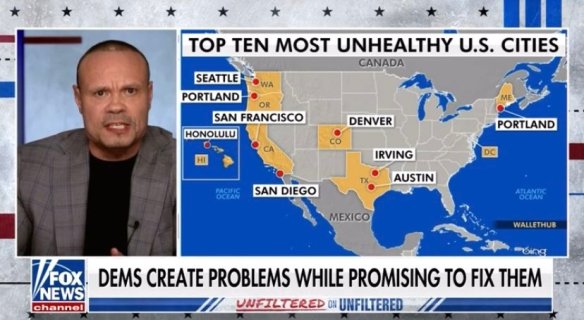
Here are two examples of what the Democrats are up against. Some clown on Fox claimed that Democrats don’t really care about people who live in cities, because the 10 unhealthiest cities in America are run by Democrats:

FK4VrP_UYBA1OH9

But the list of cities Fox used referred to the 10 healthiest cities!

FK4VrQBUcAA-iKV

Meanwhile, the NY Times put a story on the front page suggesting the January 6th committee isn’t acting normally:

The House committee investigating the assault on the Capitol and what led to it is employing techniques more common in criminal cases than in congressional inquiries.

The story is accurate. Since T___ and his allies aren’t cooperating, the committee has been forced to be aggressive. The article suggests this is a risky move and might backfire. It’s not normal for congressional committees! What’s especially weird, however, is that, as an example of normal practice, the article ignores Watergate and Iran-Contra and uses the Benghazi attack. The Republican House committee that “investigated” Benghazi went on for months in order to push a non-existent scandal. Their behavior apparently seemed normal to the Times:

By comparison, the House select committee that spent two and a half years investigating the 2012 Benghazi attack issued just a dozen or so subpoenas — a small fraction of the number issued by the Jan. 6 committee so far — and made no criminal referrals.

The author James Gleick sums up:

Did anyone at the Times think for a second before including this Benghazi comparison? Why so few subpoenas? Maybe because, even though it was a sham, everyone cooperated (remember Hillary?) [testifying for 11 hours] Why  no criminal referrals? Maybe because THERE WERE NO CRIMES.