What We’re Up Against Regarding Guns

The governor of Arizona has signed a law that requires guns acquired in gun buy-back programs to be sold. If a police department in Arizona buys your gun in order to reduce the likelihood that it will be used to commit a crime (such as shooting a police officer), they can’t destroy it. They have to sell it to a gun dealer, who can then resell it and return it to its rightful place in the community.

Police had argued that they were allowed to destroy guns acquired in such programs, even though an earlier Arizona law required that they sell any guns seized during crimes. The NRA and gun fanatics argued that destroying valuable weaponry is wasteful.

http://bigstory.ap.org/article/ariz-bill-requiring-resale-buyback-guns-signed

What the 1% Want from Washington

I don’t think I’ve ever heard of an opinion poll targeted at the rich. But two political science professors did a survey of people in the Chicago area with an average net worth of $14 million. Their research found that:

“The biggest concern of this top 1% of wealth-holders was curbing budget deficits and government spending. When surveyed, they ranked those things as priorities three times as often as they did unemployment — and far more often than any other issue…. They were also much less likely to favor raising taxes on high-income people, instead advocating that entitlement programs like Social Security and healthcare be cut to balance the budget.

“The wealthy opposed — while most Americans favor — instituting a system of national health insurance, raising the minimum wage to above poverty levels, increasing the Earned Income Tax Credit and providing a ‘decent standard of living’ for the unemployed. They were also against the federal government helping with or providing jobs for those who cannot find private employment.”

Which explains why so many politicians talk about reducing the budget deficit instead of stimulating the economy and helping the unemployed and underemployed. And why so many politicians want to cut Social Security and never even think about expanding it.

http://www.latimes.com/news/opinion/commentary/la-oe-page-wealth-and-politics-20130322,0,3575694.story

The Southern Strategy

In an article about the “Southern Way of Life”, Michael Lind argues that cheap labor is the basis for the South’s economic and political system, not racism. Slaves were surely low-paid workers, but so far the Southern system has survived whether cheap labor was provided by slaves, sharecroppers, indentured servants, the poorly educated or the supposed beneficiaries of “right to work (without unions)” laws:

“From the 19th century to the 21st, the oligarchs of the American South have sought to defend the Southern system, what used to be known as the Southern Way of Life.

Notwithstanding slavery, segregation and today’s covert racism, the Southern system has always been based on economics, not race.  Its rulers have always seen the comparative advantage of the South as arising from the South’s character as a low-wage, low-tax, low-regulation site in the U.S. and world economy.  The Southern strategy of attracting foreign investment from New York, London and other centers of capital depends on having a local Southern workforce that is forced to work at low wages by the absence of bargaining power.

Anything that increases the bargaining power of Southern workers vs. Southern employers must be opposed, in the interest of the South’s regional economic development model.  Unions, federal wage and workplace regulations, and a generous, national welfare state all increase the bargaining power of Southern workers, by reducing their economic desperation.  Anti-union right-to-work laws, state control of wages and workplace regulations, and an inadequate welfare state all make Southern workers more helpless, pliant and dependent on the mercy of their employers.”

It’s obvious that the Republican Party, which draws many of its leaders and much of its electoral strength from the South, is trying to convert our whole country to the Southern system. It’s class warfare, but in some quarters it’s considered impolite to say so.

http://www.salon.com/2012/10/10/slave_states_vs_free_states_2012/

Why Listening to TV Commentary Might Drive a Person Crazy

Today’s big story was that the nation’s official unemployment rate dropped to 7.8%. This is good news if you want the economy to improve.

Of course, it’s well-known that the unemployment rate calculated by the Bureau of Labor Statistics isn’t precise. It’s a statistical approximation based on various kinds of data. But the official rate does generally indicate whether unemployment is going up or down and roughly how many people are out of work.

Lately, when the number has been bad, Republicans have used this as evidence against the Democrats. Today, when the number was good, Republicans loudly suggested that the Obama administration somehow manipulated the number to its advantage. Right. When you like a number, it’s accurate. When you don’t, it’s phony. This behavior is so clearly hypocritical and self-serving that it’s hardly worth pointing out.

Unfortunately, I happened to switch to a cable news station today while the TV’s sound was on. What I immediately heard was this remark from one of the panelists: “I’m not smart enough to speculate on whether the number is accurate or not”.

Well, you’re apparently smart enough to be on TV. Shouldn’t you be smart enough to know that there is no reason to speculate at all? The unemployment rate is calculated by civil servants. There has never been any evidence that politicians have manipulated the official unemployment rate to their advantage. Isn’t it obvious that the Republicans are questioning the number this time because it’s bad news for them? Isn’t it obvious that people in the media were manipulated into speculating about the number’s accuracy in order to cast doubt in some voter’s minds about the economy and thereby affect the election? 

If you’re going to offer your opinions on television, you should at least be smart enough to know when to speculate and when not to.
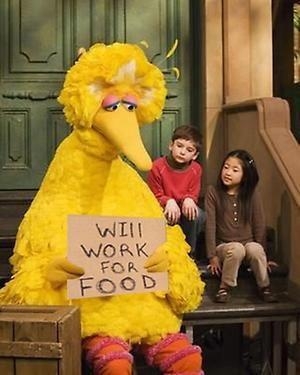
The Moment That Will Be Remembered

I couldn’t bring myself to watch the presidential debate last night — I’d get too angry when one guy was talking, and too frustrated when the other guy was, plus there’s the annoying moderator.

But the debate has already generated one memorable moment, possibly the one that will stick in people’s memories for a long time:

317502_10151037771736792_435611346_n

For more evidence, scroll through this:

http://www.dailykos.com/story/2012/10/04/1140178/-For-those-who-don-t-think-Romney-s-Big-Bird-moment-is-a-major-thing