The Song of the South

What is it that makes the American South so special? A journalist named Hamilton Nolan answers that and other questions at How Things Work, where he writes about labor, politics and power.

Since the Covid pandemic struck in 2020, more than two million people have migrated to the six fastest growing states in the South, bringing with them $100 billion in new income. This population shift is held up by Southern governors as proof of the success of their policies—and as a herald of an ongoing shift in the balance of economic power that is bound to continue due to the South’s inherent advantages. What spurred this grand relocation? Traditional wisdom will tell you that it was the more relaxed and open posture of Southern states like Florida during the Covid pandemic, along with the perpetual allures of warmer weather, lower taxes, and more affordable housing prices.

In reality, though, this current sloshing of America towards its drain is not the start of anything new at all. It is spurred not by any new economic paradigm, nor by any Texan or Floridian governor’s new ideas about unleashing the power of free enterprise under the nation’s sunniest skies. It is, instead, a normal reaction to a … rise in the appeal of something that the South has been offering for more than 200 years. Politicians will tell you that the South is attractive because it offers greater freedom. Actually, it offers cannibalism: it is willing to kill and eat its own to fuel a marginal improvement in your lifestyle. Don’t let this deal pass you by!

Ron Desantis is running (unsuccessfully) for president on the premise that he can do for America what he has done for Florida in the past three years. One way to look at his record during those crucial Covid years is: he kept stuff open and got rid of pandemic restrictions, which caused the Florida economy to flourish. Another, more accurate way to look at it is: he kept stuff open and got rid of pandemic restrictions because he fundamentally does not care whether his citizens live or die, as long as his state could get a temporary economic boost that he could use for self-promotional purposes. In this, Desantis was the perfect combination of the classic Southern socioeconomic strategy with a global pandemic.

Ever since being forced to give up formal slavery at gunpoint, the South has pursued a formula of attraction only one step removed from it. The region’s offer to businesses and wealthy people in the rest of America is, and has always been, this: “Come to the South. Do whatever you want. We won’t regulate you. We won’t tax you. We’ll crush any unions that dare to come here. We’ll provide a pool of dirt-cheap labor for you. Because we don’t tax you, our public services will be awful. Our public schools will be inadequate. But don’t worry, because we will build graceful private schools for the people with money, and we will build private country clubs and gated communities to shield you from the poverty, and racist cops to police the borders of the neighborhoods, and you can live here in a private island of bliss. The inadequacy of our public services and our outright racial oppression guarantee that that cheap labor force will continue forever. You can profit from that cheap labor force without ever having to interact with the people who compose it, except as various forms of servants. The oppression, sequestered away from you and walled off from impacting your life except to enhance it, is what makes the system work.”

That’s it. That’s the South’s sales pitch. It is the poorest and most backwards region of America by traditional socioeconomic measurements, but it’s great place to be when you exclude all of the poor people from your measurements. Which they do, because “not caring about all the poor people” is the key to the South’s ability to imagine itself as a place with a political system that works. This is the slavery mentality dragged cleanly into the present day, modified just enough to fit the letter of the law.

In the plantation era, the South was great, as long as you were a plantation owner. If you add all the slaves (and poor whites) into the calculation… ugh, you mess up the numbers. Despite the fact that the South’s failure to industrialize properly due to slavery was one of the things that lost it the Civil War, the region remains stubbornly addicted to cheap labor today. It is, at heart, an inferiority complex. The South’s leaders don’t really believe that they have anything to offer to lure people in other than a work force that will show up for rock bottom wages. If the South really believed in itself, it would be busily investing in public education and health care and a strong social safety net and all the other things that build a healthy and thriving society that ultimately attracts people and businesses. Instead, they do the opposite—because empowering the existing residents of the South would undermine its cheap labor pool.

When you see Southern governors doing seemingly irrational things like rejecting federal government Medicaid funding for their state’s residents, you must understand that the people who would be helped by that funding simply do not count in the minds of those states’ leaders. Their states are modern plantations, and they calculate the success of their governance based on the living standards of the plantation owners, not the workers. Even worse, doing things that help the workers live better could harm the project of maintaining a maximally desperate labor pool. The South doesn’t want their entire population to be healthy and well-educated. They want white people and business owners to be healthy, thanks to private doctors, and well-educated, due to private schools, and to have access to a limitless low-wage work force that, thanks to the failure of the state to invest in their welfare, has no choice but to acquiesce to being exploited. The more desperate they are, the better.

When you see Texas Republicans eliminate laws that grant workers water breaks, that is not some momentary outbreak of callousness; that is the point. …

Embracing the South’s toxic sales pitch pollutes the soul. “I am moving to Florida because the total lack of public health measures is nice and easy for me, as a rich person, even though I know it will cost a calculable number of Floridians their lives.” You are a bad person. “I am moving to Texas to save on my personal income taxes, even though I know that the cost of that is poor schools and oppression for vast swaths of this state’s neediest residents.” You are a bad person. “I am relocating my company’s factory to South Carolina because labor costs there are lower, even though I know that those low wages are a result of systematic oppression and union-busting designed to keep millions of poor people powerless over their own lives.” You are a bad person.

The bliss of ignorance is a critical part of this whole process. Move only between your air conditioned home on a golf course and your air conditioned office and your kids’ private school and the nice strip malls around your nice neighborhood and don’t ask any questions of the people who build the houses and serve the food and fill the factories and it is possible to cling to the illusion that this whole system works. But as soon as you begin to think about the aggregate welfare of everyone in the South—as soon as you place an equal value on the lives of the poor—it becomes devastatingly clear that all the nice enticements that tempted you down here require you to stand, at all times, on the necks of your fellow citizens. If you know that and continue to tolerate it, the South has poisoned you.

Unquote.

“The South has poisoned you”. It’s also how the South has poisoned American politics since the 18th century.
They Have Really Pretty Graphs

A big way our antiquated political system has let us down (way down) in recent years is the growth of inequality. It all goes back to the Reagan Revolution:

In August 1981, President Reagan signed the Economic Recovery Tax Act of 1981, which enacted a 27% across-the-board federal income tax cut over three years, as well as a separate bill that reduced federal spending, especially in anti-poverty programs [Wikipedia].

The Tax Reform Act of 1986 was the top domestic priority of President Reagan’s second term. The act lowered federal income tax rates, decreasing the number of tax brackets and reducing the top tax rate from 50 percent to 28 percent [Wikipedia].

Income tax rates have fluctuated since then under Republican and Democratic administrations without much change to Reagan’s policies. And when we consider the many deductions, exemptions and loopholes that tax lawyers and accountants are paid to take advantage of for their moneyed clients, effective tax rates have always been lower than the official rates.

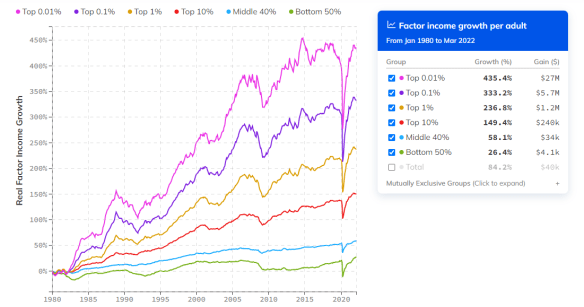
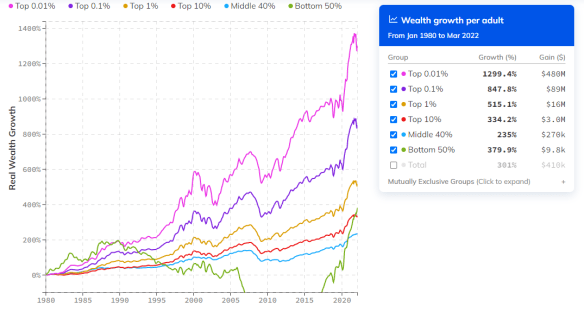
I was reminded of this history when somebody linked to a new site called Realtime Inequality. It was created by three UC Berkeley economists in order to show how different “income and wealth groups” benefit or fall behind when new growth numbers come out each quarter”:

Realtime Inequality provides timely and high-frequency estimates of the distribution of income and wealth in the United States. Our statistics distribute the totality of national income and household wealth across socio-economic groups and are updated each quarter when new macroeconomic numbers are published. (National income is similar to Gross Domestic Product and a better indicator of income earned by US residents.)

This makes it possible to estimate economic growth by socio-economic groups consistent with quarterly releases of macroeconomic growth, and to track the distributional impacts of government policies during and in the aftermath of recessions in real time. 

The site has graphs for both income and wealth that you can play around with for different groups and time periods. Thus, one measure of income growth between January 1980 and March 2022 shows that income (corrected for inflation) rose 333% for the top tenth of one percent and 26% for the bottom fifty percent.

x

While one measure of wealth for the same period grew by $89 million for the upper tenth of one percent and less than $10,000 for the bottom fifty percent.

y

It’s kind of fun to play with if you don’t think about it too hard.

Cutting Taxes for the Rich Simply Helps the Rich (Duh)

Some counterintuitive ideas are fine. Others counterintuitive ideas are stupid (and self-serving).

A counterintuitive idea popular among conservatives is that helping the rich makes them productive while helping the poor makes them lazy. Another is that cutting taxes on the rich increases what the government collects in taxes. Sure it does!

From CBS News:

Tax cuts for the wealthy have long drawn support from conservative lawmakers and economists who argue that such measures will “trickle down” and eventually boost jobs and incomes for everyone else. But a new study from the London School of Economics says 50 years of such tax cuts have only helped one group — the rich.

The new paper by [two British economists] examines 18 developed countries — from Australia to the United States — over a 50-year period from 1965 to 2015. The study compared countries that passed tax cuts in a specific year, such as the U.S. in 1982 when President Ronald Reagan slashed taxes on the wealthy, with those that didn’t, and then examined their economic outcomes. 

Per capita gross domestic product and unemployment rates were nearly identical after five years in countries that slashed taxes on the rich and in those that didn’t, the study found. 

But the analysis discovered one major change: The incomes of the rich grew much faster in countries where tax rates were lowered. Instead of trickling down to the middle class, tax cuts for the rich may not accomplish much more than help the rich keep more of their riches and exacerbate income inequality, the research indicates.

“Based on our research, we would argue that the economic rationale for keeping taxes on the rich low is weak” said a co-author of the study. “In fact, if we look back into history, the period with the highest taxes on the rich — the postwar period — was also a period with high economic growth and low unemployment.”

Unquote.

But not to worry, conservatives! Facts have a well-known liberal bias.

The Pandemic’s Economic Pain Hasn’t Been Shared

From The Associated Press:

In a stark sign of the economic inequality that has marked the pandemic recession and recovery, Americans as a whole are now earning the same amount in wages and salaries that they did before the virus struck — even with nearly 9 million fewer people working.

The turnaround in total wages underscores how disproportionately America’s job losses have afflicted workers in lower-income occupations rather than in higher-paying industries, where employees have actually gained jobs as well as income since early last year.

In February 2020, Americans earned $9.66 trillion in wages and salaries, at a seasonally adjusted annual rate, according to the Commerce Department data. By April, after the virus had flattened the U.S. economy, that figure had shrunk by 10%. It then gradually recovered before reaching $9.67 trillion in December, the latest period for which data is available.

Those dollar figures include only wages and salaries that people earned from jobs. They don’t include money that tens of millions of Americans have received from unemployment benefits or the Social Security and other aid that goes to many other households. The figures also don’t include investment income.

A separate measure tracked by the Labor Department shows the same result: Total labor income, excluding government workers, was 0.6% higher in January than it was a year earlier.

That is “pretty remarkable,” given the sharp drop in employment, said Michael Feroli, an economist at JPMorgan Chase.

The figures document that the vanished earnings from 8.9 million Americans who have lost jobs to the pandemic remain less than the combined salaries of new hires and the pay raises that the 150 million Americans who have kept their jobs have received.

The job cuts resulting from the pandemic recession have fallen heavily on lower-income workers across the service sector — from restaurants and hotels to retail stores and entertainment venues. By contrast, tens of millions of higher-income Americans, especially those able to work from home, have managed to keep or acquire jobs and continue to receive pay increases.

“We’ve never seen anything like that before,” said Richard Deitz, a senior economist at the Federal Reserve Bank of New York, referring to the concentration of job losses. “It’s a totally different kind of downturn than we’ve experienced in modern times.”

Of the nearly 10 million jobs that have been eliminated by the pandemic, 40% have been in restaurants, bars, hotels, arts, and entertainment. Retailers have lost nearly 400,000 jobs and many low-paying health care workers, such as nursing home attendants and home health care aides, have also been laid off.

On average, restaurant workers make just below $13 an hour, according to Labor Department data. Retail cashier pay is about the same. That’s less than half the economy-wide average of nearly $30 an hour.

“It tells the story of an economy that has really tanked for the most vulnerable,” said Elise Gould, an economist at the liberal Economic Policy Institute. “It’s shocking how small a dent that has made in the aggregate.”

The figures also underscore the unusually accelerated nature of this recession. . . . “This is one of the worst recessions we’ve ever had — compressed into one-tenth of the time that a normal recession would take,” said Ernie Tedeschi, policy economist at the investment bank Evercore ISI. . . .

The recovery in wages and salaries helps explain why some states haven’t suffered as sharp a drop in tax revenue as many had feared. That is especially true for states that rely on progressive taxes that fall more heavily on the rich. California, for example, said last month that it has a $15 billion budget surplus. Yet many cities are still struggling, and local transit agencies, such as New York City’s subway, have been hammered by the pandemic.

The wage and salary data also helps explain the steady gains in the stock market, which have been led by high-tech companies whose products are being heavily purchased and used by higher-income Americans . . .

This week, the New York Fed released research that underscored how focused the job losses have been. For people making less than $30,000 a year, employment has fallen 14% as of December. For those earning more than $85,000, it has actually risen slightly. For those in-between, employment has fallen 4%. . . .

Some companies have cut wages in this recession, but on the whole the many millions of Americans fortunate enough to keep their jobs have generally received pay raises at largely pre-recession rates. . . .

Unquote.

Another group that must have done relatively well is people who are retired. Social Security payments and pensions have stayed where they were and investment returns have generally been very good.

A Suggestion for Fixing America

Two professors writing for Foreign Policy see a way to simultaneously repair our country’s politics and economics (I’ve left out some of their analysis). Whether or not it succeeded, it wouldn’t hurt:

According to the Brookings Institution, Biden won 509 counties to [the other guy’s] 2,547—that’s over five times as many won by [the Republican]. But here’s the kicker. Biden’s counties constitute 71 percent of the country’s Gross Domestic Product, [the loser’s] less than 30 percent. Surely we must somehow factor this into how we think about why people vote the way they do? How does growth, or the lack thereof, determine elections?

What we see in U.S. politics today is the death and dissolution of a particular social coalition that dominated politics and economics and underwrote social peace for three generations; call it the carbon coalition.

The carbon coalition was an encompassing political coalition, built on a set of agreements negotiated between 1932 and 1950, that distributed the income generated by the industrial economy among groups within society. In the auto and steel industries, the most dynamic of that era, United Auto Workers and General Motors signed the 1950 Treaty of Detroit, which tied pay to productivity. This created a path to prosperity for two generations of workers in manufacturing.

Meanwhile, to bring rural areas into the coalition, the urban middle class paid higher prices for food and accepted permanent agricultural subsidies so that farmers could enjoy higher incomes. These agreements drew together labor, business, and farmers; the North and the South; the Great Plains and the Great Lakes into one settlement. This broadly inclusive distributive coalition in turn softened the sectional and partisan divisions that had roiled U.S. politics almost continuously since the 1890s.

. . . This political coalition was in fact entirely dependent on a particular growth model: an extremely fossil fuel-intensive agro-industrial economy.

It is only a slight exaggeration to suggest that the United States’ postwar economy was a massive machine that transformed oil, coal, and natural gas into income and food. Consider the following: In 1971, automobile production directly and indirectly provided 1 of every 6 jobs in the U.S. economy. Most of these jobs were unionized, or, if not, most workers enjoyed wages and benefits that spilled over from union agreements. Then add to these jobs others created by the interstate highway program, by the oil and gas industry, and by the retail sale of gasoline and the repair and maintenance of automobiles. And then throw in jobs in aviation, shipping, and agriculture, which became increasingly energy intensive due to the use of diesel-fueled equipment and through the use of natural gas to manufacture artificial fertilizer. Finally come jobs in plastics and petrochemicals.

The carbon coalition distributed the income generated by the carbon economy. Elections determined those distributions. That model is now dying and indeed, given climate change, must die. The politics it made possible are dying too.

The carbon economy has been in decline for decades, but the [political effects are only now becoming visible.

The center of economic dynamism and wealth generation in the United States now lies in knowledge-intensive (or at least high-value-added) industries, some of which, like pharmaceuticals, are research intensive and some of which, like various forms of media, are creative.

Although this knowledge economy is diverse, these activities share one overarching commonality: None require (much less depend on) fossil fuels. Indeed, their survival over the long haul depends on successfully switching out of carbon completely. Productivity in these activities doesn’t come from more energy and bigger machines applied to faster assembly lines but from improvements in our ability to manipulate, analyze, and monetize information.

The economy that drives U.S. GDP growth today is already post-carbon. And though many of its activities are energy intensive (server farms consume more than more than 2 percent of the world’s electricity use; financial services consume more electricity than any other industry in New York City), the energy they consume can come as readily from wind and solar as from coal and natural gas. This isn’t the case for the internal combustion engine, for the steel from which its constructed, and for the oil extraction, refining, and distribution systems that support it. Nor is it true for an ammonia plant or for cement or aviation. Farmers cannot substitute solar energy for artificial fertilizer.

The U.S. economy is thus now divided in two: a growing and potentially sustainable post-carbon economy that can adapt to the realities of climate change and a carbon economy in decline that is unsustainable. . . .

Americans no longer live in the same economy.  Rather, they live in two incompatible models of economic growth. Those who remain embedded in the carbon economy quite rationally want to defend and rejuvenate that model. In contrast, those who have found a spot in the post-carbon economy largely embrace the future. . . .

Today, the firms and sectors that make up each of the two growth models fund elections and determine the strategy of their parties.

The post-carbon coalition dominates the Democratic Party. This coalition brings together a West Coast variant composed of high-margin agriculture (think wine), Big Tech, entertainment, and digital and high-end services and an East Coast variant based largely on financial services. These post-carbonites embrace some variant of the Green New Deal, which identifies the climate crisis as the most critical issue the country faces and offers a coherent policy response.

The carbon economy coalition that dominates the Republican Party includes export agriculture, carbon extraction, refinement and production, steel and other declining traditional industrial sectors, as well as low-wage and low productivity services (think Walmart over Accenture). This fragment of the original carbon coalition remains committed to defending and rebooting the carbon economy; this is what “Make America Great Again” means. . . .

The United States’ two coalitions cannot be brought together. Indeed, they are existential threats to each other. And on a population scale, each electoral coalition has more or less the same number of potential voters. As a result, elections are decided by thin margins in a race to the death. . . .

For almost half of U.S. states, the Green New Deal, which is—sotto voce—at the center of Biden’s platform, spells the end of their existing strategies—think fracking, refining, plastics, mining, logging, and so on. And for the other half of the states that support the deal, scaling back its objectives to attract support from the carbon coalition threatens the post-carbon coastal communities. . . .

There is only one way to fix this mess. The post-carbon coalition has to bribe what’s left of [the carbon coalition] to make [a] transition. Non-coastal, largely Republican states must be the epicenter of the green transition and be the recipients of most of the investment. After all, they have the most assets to turn around and the most to lose if they are not compensated. If all they are offered is “you decarbonize/we keep the money,” then all they will give back is more [right-wing radicalism].

There are clear parallels in U.S. history, such as the massive bribe that the urban sector began paying to farmers in 1933 with the Agricultural Adjustment Act and two generations of generous farm bills . . . thereafter. Yet the bribe this time must involve more than a subsidy; it requires exiting the carbon economy. For it to work, green investment must extend well beyond energy capture (solar and wind farms) and downstream into industries that are powered by alternatives. Massive investments in electric vehicle production, for instance, to support a rapid turnover of the U.S. motor vehicle fleet with U.S.-built cars and trucks, are required. . . .

Elections in the United States are not being fought over rival principles and certainly not over median voters. They are contested over which parts of the country will grow and how and who will pay for it. Recognizing this is the first step to fixing the deeper problem of the carbon transition for the good of all Americans.