Providing for the General Welfare Works

I don’t think I’ve ever heard anybody say the goal of the Democratic Party is to “provide for the general welfare” (that phrase from the Constitution). We’ve all heard instead that Democrats are fiscally irresponsible big spenders, while Republicans keep government spending under control, helping the economy grow. Simon Rosenberg, who leads a progressive think tank, explains how wrong this is

Inconvenient truth, fiscal responsibility edition:

Biden is now the third consecutive Democratic president to have seen the annual deficit drop significantly on their watch. It rose significantly under the last three Republican presidents.

[Biden] said he’d soon become the only president “ever to cut the deficit by more than $1 trillion in a single year.” He’s on track to deliver. . . . 

When it comes to the deficit, Americans have endured a remarkably consistent pattern for four decades.

It starts with a Republican presidential candidate denouncing the deficit and vowing to balance the budget if elected. That Republican then takes office, abandons interest in the issue, and expresses indifference when the deficit becomes vastly larger. Then a Democrat takes office, at which point Republican lawmakers who didn’t care at all about the deficit suddenly decide it’s a critical issue that the new president must immediately prioritize.

During the Democratic administration, the deficit invariably shrinks — a development Republicans tend to ignore — at which point the entire cycle starts over.

As the cycle spins, polls continue to show that most Americans see Republicans as the party most trustworthy to reduce the deficit, despite reality, because some partisan branding is tough to change, even in the face of four decades’ worth of evidence. [Steve Benen, MSNBC]

There is perhaps no more important false narrative in American politics than the [Republican Party] is the party of growth and fiscal responsibility.

Team Biden appears to be eager to take that on. Praise f—ing be.

The White House is leaning into a new argument: That deficit reduction can and should be recast as a positive feature of successful *progressive* economic policy. [Greg Sargent]

As we’ve been saying for many months now, it is essential that every 2022 voter knows that when Democrats are in power things get better, and when Republicans are in power they don’t.

The data is clear, overwhelming. . . .

 [It’s] the most important, least understood story in American politics. . . 

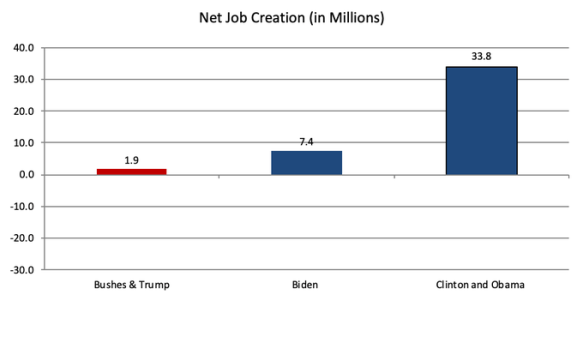
Since 1989, 43 million jobs have been created in the US, 41 million – 95% – have come under Democratic presidents. 

33.8 million jobs = 16 yrs of Clinton & Obama 

7.4 million jobs = 13 months of Biden

1.9 million jobs = 16 years of Bush, Bush & T____ [Rosenberg]
FNBxgDGX0AQdi1L

. . . Democrats need to have this conversation with voters this year. It is essential knowledge, critical to understanding where we are, and where we are going as a nation.

Unquote.

It’s amazing that voters regularly say they “trust” Republicans more on the economy despite their consistently worse results. Why? Republicans associate themselves with low taxes and getting the government “out of the way”. But reducing taxes on people and corporations who already have lots of money doesn’t help the economy; it simply concentrates more wealth at the top. Repealing the Affordable Care Act or abolishing the Department of Education wouldn’t create jobs. Democrats do a better job on the economy by spreading the wealth around. They do this by promoting the “general welfare”, as the Constitution requires. When the general population is better off, the economy is better off. It’s as simple as that.

Who’s On Your Side: A Simple Dichotomy?

The White House website has a new page devoted to last year’s very big infrastructure bill.

Untitled

It got Jennifer Rubin of The Washington Post thinking about the Democratic Party’s “message”, a phrase that ideally would fit on a bumper sticker:

While Russia’s brutal invasion of Ukraine and a highly impressive Supreme Court nominee afford Biden his first chance in months to break the bad news cycle and to project strength, he still lacks a big picture that ties it all together.

Biden faces several challenges: 1) He can’t do much about the biggest economic concern (inflation) which fairly or not voters blame on him; 2) Voters seem to have taken job growth and a return to post-covid normal for granted; 3) The GOP noise machine of constant conspiracies and baseless accusations effectively manipulates the mainstream media, which regurgitates GOP talking points; and 4) Voters forget how positively nutty the GOP has become and the degree to which its worst elements will predominate if it returns to the majority in one or both houses.

So what can Biden do? At its most basic, Democrats must convince voters they are on the side of regular Americans — making progress and solving real problems (e.g., jobs, covid). They need to remind voters that Democrats are on the right side of the middle class, democracy and law and order. Democrats must leave no doubt as to which party did a lot to clean up the mess left behind by the previous administration and which party understands the real problems left to work on (e.g., inflation, green energy, defending against international bullies).

Republicans? They are bullies and chaos creators (be it attacking the Capitol, letting the country default on the debt, setting up a litigation machine to sue teachers, undermining elections, threatening to take away kids whose parents give them medical care and inviting a truck blockade). Do voters really want to give power back to the crowd that defends violence (“legitimate political discourse”), lets their cult leader extort Ukraine, and goes to bat for big corporations (e.g., allowing them to escape paying taxes, protecting Big Pharma’s price gouging)?

Democrats need to get back to a fundamental message: When in power, they make government work for ordinary people and defend American values (democracy, opportunity, fairness, playing by the rules). They solve real problems. When Republicans are in power, they create division, conflict and chaos. They are not on your side. That’s it. A simple dichotomy.

Unquote.

The problem is that if there are voters out there who don’t already understand the difference between the two parties, they’re probably unreachable. If they bother to vote, they’ll make their choice one of two ways. If they see themselves as a Democrat or Republican, they’ll stick with the party that makes them feel comfortable. If they don’t have a particular political identity, they’ll vote for or against “change” (i.e. for or against the incumbent) depending on their mood that day. The irony is that if voters want meaningful change, they should elect more Democrats. In particular, more Democrats in the Senate would make roadblocks like Manchin and Sinema irrelevant. But since Democrats “control” both houses of Congress, many voters will mistakenly think electing more Republicans will bring about the kind of change they want.

Maybe the Biggest Secret in Politics

A Democratic strategist (they have one?) named Simon Rosenberg claims that “the most important, least understood story in US politics” is that the “economy does so well under Democrats and so poorly under Republicans”. He cites the following statistics:

16 years of Clinton and Obama yielded 34 million jobs

1 year of Biden yielded 6 million jobs

16 years of G. Bush, G. W. Bush and T____ yielded 1 million jobs.

40 million jobs added vs. 1 million? That sounded suspicious, so I found a chart based on data from the St. Louis Federal Reserve. It shows “job growth by U.S. President, measured as cumulative percentage change from month after inauguration to end of term” for presidents going back to Jimmy Carter. According to the chart, jobs increased by 33% during the Clinton, Obama and Biden years vs. 1% during the Bush, Bush and T____ years. 

Reagan had the best job growth for a Republican (although not as good as Clinton). But even if you go back 46 years and include Carter’s and Reagan’s numbers, there’s a stark difference:

21 years of Carter, Clinton, Obama and Biden: 45%

24 years of Reagan, Bush, Bush and T_____: 18%.

Job_Growth_by_U.S._President_-_v1

Yet if you were to ask voters which party does best with the economy, most would say the Republicans. They’re seen as the party of business and low taxes, despite the fact that they’re the party of Big Business and low taxes for corporations and the rich, which they always claim will improve the economy, but which doesn’t. For instance, they always say raising the minimum wage or raising taxes on the rich are “job killers”. The evidence shows otherwise: increasing the incomes of the working class and increasing taxes on the rich benefits the economy, since giving average consumers the ability to buy stuff increases the need for workers and taxing the rich allows the government to provide more services.

It may be hard to believe that voters are so wrong about the two parties. But here’s one reason why: Republicans have a powerful propaganda network and Democrats don’t. The Republicans have networks like Fox “News” and OAN, popular sites like Breitbart and the Daily Caller, and heavily-followed Facebook accounts, plus talk radio, all of which deliver a pro-Republican message, often in concert. The Democrats don’t have anything that organized or efficient. Most Democrats who pay attention to current events rely on corporate media, big organizations like the New York Times and CNN, that don’t want to seem too pro-Democratic.

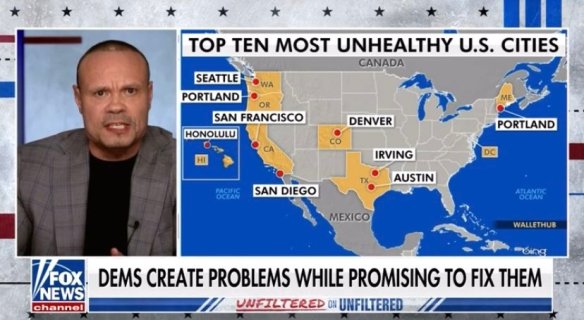
Here are two examples of what the Democrats are up against. Some clown on Fox claimed that Democrats don’t really care about people who live in cities, because the 10 unhealthiest cities in America are run by Democrats:

FK4VrP_UYBA1OH9

But the list of cities Fox used referred to the 10 healthiest cities!

FK4VrQBUcAA-iKV

Meanwhile, the NY Times put a story on the front page suggesting the January 6th committee isn’t acting normally:

The House committee investigating the assault on the Capitol and what led to it is employing techniques more common in criminal cases than in congressional inquiries.

The story is accurate. Since T___ and his allies aren’t cooperating, the committee has been forced to be aggressive. The article suggests this is a risky move and might backfire. It’s not normal for congressional committees! What’s especially weird, however, is that, as an example of normal practice, the article ignores Watergate and Iran-Contra and uses the Benghazi attack. The Republican House committee that “investigated” Benghazi went on for months in order to push a non-existent scandal. Their behavior apparently seemed normal to the Times:

By comparison, the House select committee that spent two and a half years investigating the 2012 Benghazi attack issued just a dozen or so subpoenas — a small fraction of the number issued by the Jan. 6 committee so far — and made no criminal referrals.

The author James Gleick sums up:

Did anyone at the Times think for a second before including this Benghazi comparison? Why so few subpoenas? Maybe because, even though it was a sham, everyone cooperated (remember Hillary?) [testifying for 11 hours] Why  no criminal referrals? Maybe because THERE WERE NO CRIMES.

A Silver Lining, Perhaps

The arguments Democratic senators made last night to reform the filibuster, e.g. by returning to the “talking” filibuster that can delay legislation as long as the minority keeps arguing against it, meaning that a bill can’t be stopped in its tracks by email, were so good that the refusal of two “Democratic” senators to vote for reform is either the result of stupidity or base motives.

If they truly believe the filibuster fosters bipartisan solutions, they are stupid. If they think the country will be better off with Republicans having total electoral control in various states, possibly resulting in the return of the worst president in history — whether he wins or not — they are horrible people. (We shouldn’t rule out the likelihood that they’re both stupid and horrible.)

Anyway, Paul Waldman of The Washington Posts looks on the bright side:

For years, Democrats have been waiting for Republicans to have their “epiphany,” to realize that scorched-earth politics and implacable opposition to anything a Democratic president might suggest are not good for the country. The epiphany has arrived — but it’s the Democrats who have finally come to understand reality, and are prepared to act accordingly.

This might seem like a moment of Democratic defeat [it sure as hell does]. But it could be a turning point, one that leads to more progress in the future.

At his Wednesday news conference, President Biden was asked whether he had over-promised and what he planned to change in the remainder of his term. In response, he said, “I did not anticipate that there’d be such a stalwart effort to make sure that the most important thing was that President Biden didn’t get anything done.”

Lots of people anticipated it — it has been a topic of debate for years, and Biden took a lot of criticism in the 2020 campaign from those who thought his claim that he could persuade Republicans to work with him was disingenuous or naive. Every reasonable observer knew that [Republicans] would approach his presidency with the same strategy it used with Barack Obama: Oppose almost everything the president proposes, and do everything in the party’s power to make him fail.

But what matters at the moment isn’t whether Biden ever believed [Republicans] would act differently. It’s that he seems ready to stop pretending that a dawn of bipartisan cooperation is about to break.

Now consider what happened that night, when Democratic Sens. Joe Manchin III (W.Va.) and Kyrsten Sinema (Ariz.) joined with every Republican to shoot down a rules change that would have allowed two voting rights bills — bills Manchin and Sinema claim to support — to receive an up-or-down vote.

It was absolutely a defeat, for Biden, for his party, and most of all for voters. But it also represented a significant shift within the Democratic Party. That’s because every single Democrat apart from Manchin and Sinema supported setting aside the filibuster.

A variety of factors led them there. The obstructionism and radicalism of today’s [Republican Party] certainly played a part. Perhaps just as important, we’ve had our first real, detailed debate about the filibuster, and all the arguments in its defense were revealed to be so preposterous that it has become almost impossible for any honest person to oppose reforming it.

As Sen. Amy Klobuchar (D-Minn.), a more moderate Democrat, explained in a passionate plea, the Senate has adjusted filibuster rules to allow majority votes more than 160 times, including for such pressing matters as “approving compensation plans for commercial space accidents.”

So with two exceptions, every member of the Democratic caucus, from progressives such as Bernie Sanders (I-Vt.) and Elizabeth Warren (Mass.) to moderates such as Jon Tester (Mont.) and Angus King (I-Maine), agreed that the filibuster has to change here as well.

There was nothing like that kind of unanimity even a year ago. That glass is now 48/50ths full.

And the defeat of these voting rights bills, which is extremely painful for both Democratic legislators and their party’s base, might actually hasten the filibuster’s demise.

As I’ve noted, in every state where Democrats have a chance to take a Republican Senate seat, all Democratic primary candidates favor scrapping the filibuster. That includes both moderates and progressives. Though there are many things that divide, for instance, Rep. Conor Lamb and Lt. Gov. John Fetterman in Pennsylvania, they agree the filibuster should go.

Democrats, including the president who has spent so much time insisting that he can achieve bipartisanship, are simply done waiting for Republicans to see the light. The next step is for them to get mad enough to do something about it.

Which might happen. Even though the most likely outcome in 2022 is a Republican sweep (following the usual midterm election pattern), Democratic voters can and should be angry enough about the death of these voting bills — among many other things, including the Supreme Court’s likely overturning of Roe v. Wade this year — to organize, register and overcome Republican voter suppression to get to the polls in November.

If you’re a Democrat and you’re mad at Manchin and Sinema — and you should be — the answer is to make them irrelevant by electing a few more Democrats to the Senate.

Besides, they’ll probably be around for only a few more years. Manchin might not run for reelection in 2024, and if he does, he’ll probably lose, as long as Republicans find a halfway decent candidate in deep-red West Virginia. And after this, Sinema couldn’t win a Democratic primary for dogcatcher; if she runs again the same year, she’ll face a strong primary challenge [the latest poll shows she has an 8% — eight percent — approval rate among Arizona Democrats].

So it’s not hard to imagine the Senate considering voting rights again in the near future — and this time, there will be 50 votes to pass it.

Thanks to Manchin and Sinema, and to Republicans who remain just what they’ve been all along, Democrats can no longer afford to delude themselves about how politics works today. And for a change, they all know it.

I Guess It’s a Little Thing, But This Other Thing Is Big

The U.S. has two major political parties. One is older than the other. Which one?

You might think it’s the Republican Party. It’s not. The Democratic Party was founded in 1828, when Andrew Jackson was running for president. It’s the oldest active political party in the world. Jackson was the first Democratic president, which is why the party is occasionally called the “Party of Jackson” (even though Jackson might not be a Democrat today).

The Republican Party wasn’t founded until 1854. The party’s main thrust was opposition to slavery. It’s sometimes called the “Party of Lincoln” because Abraham Lincoln was the first Republican president — even though Lincoln was a liberal or progressive for his day, not a conservative or reactionary (the Republicans began to move right around 1912 and never looked back).

It bugs me that news people frequently refer to the Republican Party as the GOP. Many Americans don’t know what “GOP” refers to or stands for. It’s “Grand Old Party”, even though the Democratic Party is older. In fact, the GOP acronym was first used to refer to the Democratic Party. After the Democrats dropped it, the Republicans picked it up.

So the Republican Party isn’t old compared to the Democratic Party; news people don’t have a friendly little acronym for the Democrats; and worst of all, when the GOP does something especially bad — like opposing voting rights in Congress and across the country — a significant number of people don’t even realize it’s the Republicans at work. That’s why I try to avoid using “GOP”.

That was the small thing. Here’s the big thing, as chronicled by Jennifer Rubin of The Washington Post. Her article appears on the paper’s digital front page as “Dear Media: Stop Giving the GOP the Benefit of the Doubt”: 

The Republican Party has a reliable — albeit inadvertent — ally in the mainstream media. The latter remain all too anxious to make the authoritarian and often blatantly racist party seem “normal.”

When Republican Glenn Youngkin won the governor’s race in Virginia, the media gobbled up the GOP talking point that he had cracked the code for the post-T___ era. See how clever he was to keep his distance from former president D____ T____? The coverage rarely scrutinized his positions, such as his potentially disastrous proposed tax cuts or his aversion to mask mandates, a critical part of Virginia’s school reopening.

The story line was set: Democrats blew it by closing schools; Youngkin was “smart” to pose as a normal Republican. As The New York Times cooed: “Many conservatives see his campaign as providing a template for how to delicately embrace T____ism in blue states.”

Delicately? Youngkin was always serious about the MAGA camp’s culture wars, as he made abundantly clear on day one of his governorship.

Shortly after his inauguration, Youngkin promptly banned critical race theory from Virginia curriculums, even though it isn’t taught in schools, thereby flaunting his willingness to cater to White grievance in a state infamous for its resistance to desegregation. He described what would be removed from school curriculum: “All of the principles of critical race theory, the fundamental building blocks of actually accusing one group of being oppressors and another of being oppressed, of actually burdening children today for sins of the past.”

Listening to Youngkin, one might never know that slavery and Jim Crow are woven into the Commonwealth’s history and are relevant to ongoing racial disparities in wealth, education, health and homeownership. His airbrushed version of history is the standard MAGA effort to cater to White supremacists and wreak havoc in the schools. If only the media had taken him seriously during the campaign.

And just as Democrats predicted, Youngkin swiftly imported Florida Gov. Ron DeSantis’s war on mask requirements, preventing schools from issuing such mandates. Several school boards promptly decried his edict and said they’d go on protecting teachers and students. It seems Youngkin duped voters and the media who wanted to believe there was a normal alternative to MAGA Republicanism.

The media’s predilection for portraying Republicans as tactically brilliant is indicative of their preference for treating politics as a game. They denude their coverage of any qualitative judgment that would inform voters that the party’s “cleverness” is lying, plain and simple.

This refusal by the media to render judgment on the GOP’s cult leaders has gone on for more than six years. Despite replete evidence of T____’s inability [note: refusal] to distinguish truth from fiction, his self-image of grandiosity and his fixation on conspiracy theories, the mainstream media failed to characterize T____’s conduct as abnormal.

Take his bizarre rally in Arizona on Saturday, where he rambled incoherently, insisting, for example, “The left is now rationing lifesaving therapeutics based on race, discriminating against and denigrating . . . White people to determine who lives and who dies. If you’re White, you don’t get the vaccine, or if you’re White, you don’t get therapeutics.” This is a loony lie. . . . 

No reasonable person could hear this and not conclude he is unhinged. And he has been sounding like this for years. Yet the media largely covered the rally as run-of-the-mill politics. One New York Times headline: “T____ Rally Underscores G.O.P. Tension Over How to Win in 2022.” Meanwhile, Politico intoned: “Spread out in a sea of red MAGA hats and T-shirts emblazoned with ‘T____ won,’ the former president’s fans roared in support as he aired complaints about the election and made swipes at the Biden administration.”

Is that what he was doing? “Airing complaints”? Or was he making positively ludicrous claims, like the guy on the street corner hollering about the end of the world? Anodyne descriptions that slot T____’s antics into “politics as usual” mislead news consumers. To make matters worse, interviewers avoid asking Republicans how they can pledge loyalty to someone so bonkers.

Certainly, the media should avoid rendering a psychiatric evaluation . . . but they routinely refuse to convey the abnormality on display before them. This is “the emperor has no clothes” on steroids.

Unflinching, brutally honest coverage would describe T____’s behavior accurately, including his syntax and preposterous lies. It would concede this conduct would be disqualifying for any business executive or even a small-town mayor. The media are compelled to level with voters: The two parties are not equivalent, in part because one treats its crackpot leader like a messiah. . . .