Evangelical Christians for Sanders, the Left-Winger?

Two articles about Christianity and American politics caught my eye this week.

The first was a New York Magazine interview with someone named Jim, an alumnus of Liberty University, who now works as a pastor and therapist. Liberty University is the Southern Baptist school in Virginia founded by Jerry Falwell, the well-known televangelist and right-wing troublemaker. Jim posted some anonymous remarks on Reddit in response to Presidential candidate Bernie Sanders’s recent speech at Liberty. Here’s the part New York Magazine quoted:

As I heard Bernie Sanders crying out to the religious leaders at Liberty University, in his hoarse voice, with his wild hair — this Jew — and he proclaimed justice over us, he called us to account, for being complicit with those who are wealthy and those who are powerful, and for abandoning the poor, the least of these, who Jesus said he had come to bring good news to.

Jim grew up supporting right-wing politicians, as so many evangelical Christians are taught to do. But he eventually realized that his politics conflicted with the Bible. He says that Bible study convinced him:

that the gospel of Christ is what he says it is in the Book of Luke. He says the messenger comes to bring good news to the poor, to heal the sick, and to set the captives free. If our gospel is not good news to the poor, to the captives, to the indebted and the broken, then it is not the gospel of Jesus Christ…

The Bible talks about God destroying those who destroy the Earth and standing for the weak and the penniless. That same God was being displayed on our flags and in our songs as this warrior king who doesn’t like the Muslims and who doesn’t like the poor and who wants us to have free-market capitalism and no regulations. I thought that was inconsistent. This is the same God who designed … his theocratic government in Israel so that the poor were cared for. This is the same God that designs into the concept of ministry a tithe of 10 percent to care for others…

Jim is remaining semi-anonymous for the time being. He says he doesn’t want his patients or congregants caught up in controversy. Nevertheless, he’s going to continue explaining why it makes sense for an evangelical Christian to support Senator Sanders:

I’m calling my fellow Evangelicals to raise their eyes and to pay attention, to read their Bibles carefully, as I was taught to do in an Evangelical school. So many get their faith points from [right-wing TV personalities] Bill O’Reilly or Sean Hannity, but if they would get their faith from Jesus, they would be surprised at how he does not fit into any box and flips the tables of the money-changers and stands with the adulterers and prevents the death penalty…

Bernie at Liberty, for me, struck such a nerve because he treated us like grown-ups. He presented the message thoughtfully, politely. He was warmhearted, he was jovial, he didn’t play any political games. He didn’t tell us what we wanted to hear. He was just plain, and it reminded me of John the Baptist.

But why does someone like Jim seem like such an outlier? Aren’t evangelical Christians the natural ally of right-wing politicians and Big Business?

No, not according to One Nation Under God: How Corporate America Invented Christian America, a book by Kevin Kruse, Professor of History at Princeton. As explained in a review at the website of Democracy: A Journal of Ideas, Kruse argues that there was an organized effort in the 1950s to link religion and corporate capitalism. For example, a group called:

Spiritual Mobilization sought to rally clergymen to fight liberalism, arguing that the only political position compatible with Christianity was laissez-faire. They aimed to counter the ideas—summed up as the Social Gospel—that good Christians might have obligations to help the poor, that there was something spiritually problematic about the love of money, and that working to create a better and more egalitarian social order might be necessary to live a righteous life. In his first inaugural address, Roosevelt had celebrated the expulsion of the money changers from the “temple of our civilization,” and called for replacing the “mad chase of evanescent profits” with a return to more noble social values. Spiritual Mobilization begged to differ, insisting instead that profit could be the cornerstone of a moral vision.

Spiritual Mobilization was funded by conservative businessmen and a number of corporations, including General Motors and Gulf Oil. Its leader “embraced his identity as a man who preached to the rich: “I have smiled when critics of mine have called me the Thirteenth Apostle of Big Business or the St. Paul of the Prosperous.”

Kruse says that:

 … long before the 1970s, religious leaders … and the businessmen who backed them sought to politicize the country’s churches, seeing them as a natural and sympathetic base. Their concern was not social or sexual politics, but rather economics—they wanted to advance a libertarian agenda to undermine the economic program that became ascendant during the New Deal. This top-down Christianity in turn provided an image of the United States as an explicitly religious nation, creating a rhetoric that inspired the populist Christian conservatives of a later generation. When the men who built the religious right in the 1970s—such as Jerry Falwell and his Moral Majority—issued their jeremiads about the United States as a fallen nation, they made the implicit case that the country had hewed more closely to faith before the 1960s. But in fact, Kruse suggests, the pumped-up image of America as a Christian nation had gained popularity only a decade before.

Before Jerry Falwell, there was the evangelist Billy Graham:  

… one of his major concerns [was] the encroachment of the liberal state… Graham opposed the Marshall Plan and the welfare state, and attacked the Truman Administration for spending too much on each…  [In 1951] Graham warned the audience at a North Carolina crusade that the country was no longer “devoted to the individualism that made America great,” and that it needed to return to the “rugged individualism that Christ brought” to humankind.

America has been a Christian nation for a long time in the sense that most Americans have thought of themselves as Christians and still do. The question is: what role should Christianity play in a our democracy? The Constitution requires separation of church and state, but people have the right to support politicians who share their religious ideals. This makes me wonder what America would be like if there were more Christians like Jim.
Cutting the Cord (Thanks to a Hard-Working Man)

The Verizon website said their technician would get to our house around 9:30 pm to do our installation. The anonymous dispatcher said it would really be around 8:15 (only three hours after the original 5 pm deadline).

So it was a pleasant surprise when the technician called at 6:30 to say he’d be at our house in fifteen minutes. He arrived as promised and quickly got to work.

Four hours later, he was done. Among other things, he’d had to string 350 feet of cable from our basement to a telephone pole two blocks away, working in the dark on a hot, humid night. It was an impressive performance.

When we thanked him and said good-night, we assumed he’d be dropping off his van at some Verizon garage and then get home by midnight or so. No, he’d actually be driving to Newark to do some work for another customer. He explained that Verizon is forcing their previously-unionized technicians to work 60 hours a week.

We didn’t ask what time he started work yesterday. But on a good day, if all goes well, he puts in 12 hours. That’s not 12 hours in an air-conditioned or heated office. That’s 12 hours of driving around, in good and bad weather, carrying equipment, going up and down stairs, climbing on roofs, drilling holes, stringing cable, attaching electronic gizmos to inside and outside walls, while also dealing with people like us. Sometimes in the dark. 

Do you think it would be a good idea for Verizon to hire and train more technicians, so their employees wouldn’t have to work 12 hours a day (or more), five days a week? We all know the corporate business model is to get as much work as possible out of workers while providing as little compensation as possible, but there are lots of Americans who could use a decent job. It would be good for the country and even good for the corporations if they’d spread some of the wealth around.

Cutting the Cord (the Saga Continues and Continues)

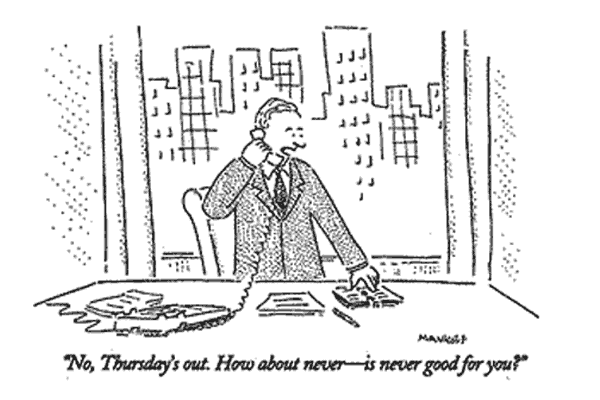
how-about-never

Verizon told us they’d be at our house between 11 am and 2 pm to install our new fiber optic connection (good-bye, Comcast!). The installation was supposed to take three hours and might require work on the outside of our house.

After a while, I checked our order status on the Verizon website. A note had been added. The technician will arrive between 1 pm and 5 pm. Ok, whatever.

The afternoon wore on. No technician. No word from Verizon. No email, no phone call.

But another visit to their website reveals an updated note: the technician will arrive between 7:45 pm and 8:45 pm. Really? To do a three-hour job that might involve working outside? In the dark?

Ok, let’s contact Verizon. First, a brief online chat. Second, a phone call to “customer service”. Third, another phone call to “customer service” after the first call disconnects.

The Verizon representative is surprised to hear that Verizon technicians do installations at night. So am I. I ask her to confirm that this is actually going to happen. Or will the technician actually show up tomorrow morning? Or never?

She contacts the dispatcher, who confirms that the technician will be arriving tonight. I’m not convinced.

Meanwhile, the website has a new note: the technician will arrive between 9 pm and 10 pm:

verizon 1

verizon 2

I find this new promise even less believable than “between 7:45 and 8:45”. Our technician will be working past midnight to finish this job? I express my skepticism and repeat my request for confirmation.

Yes, the dispatcher still says the technician will arrive between 7:45 and 8:45 pm, even though the website disagrees. I express an opinion or two to “customer service” and we say good-bye.

Comcast, I already miss you and you haven’t gone away!

Cutting the Cord (the Saga Continues)

A couple days ago, I went to the Comcast website to ask about eliminating our cable television service (the two online chats that resulted are recorded in an earlier post).

The two “analysts” with whom I chatted, Kaye and Marites, said the same thing: If I wanted to save money by canceling cable TV while keeping our phone and internet service (as part of a so-called “Double Play” package), I’d simply need to get in touch with some other Comcast employee:

com 111

Having gathered my strength for almost 48 hours, I called 888-739-1379 today.

As the pessimistic (i.e. realistic) part of my mind expected, it wasn’t quite as easy as Kaye or Marites promised. In fact, Matthew explained that it would not be possible to get a “Double Play” discount by speaking to him or anyone else on the phone.

According to Matthew, my only option would be to visit the Comcast website, because, in his words (and the words of Marites too!): “they have more options for promotions”. Unfortunately, the best Matthew could do was offer me the “standard” arrangement for phone and Internet service. That would reduce my basic bill by – to quote from that earlier chat with Kaye – hardly anything at all:

com 444

It never occurred to me before that one of the benefits of a huge monopolistic corporation providing support to its customers by phone and also by website is that (1) employees who answer the phone can tell customers to use the website and (2) employees who chat on the website can tell customers to use the phone.

It really is an elegant solution to the Customer Service Problem.

Next stop: Investigate getting phone service from one of the smaller companies that do that these days, as preparation for finally cutting the cable television cord. 

By the way, I know I should tell Comcast I want to cancel everything in order to get a better deal, but I’d prefer to end our relationship completely (even though Verizon isn’t a wonderful alternative). And I know that when the time comes for us to go our separate ways, I need to tell them I’m moving to Iceland. Or that I’m dead. According to this interesting article, Comcast doesn’t have answers for situations like that:

Save Attempt is Not Applicable in the Following Scenarios:
1) Customer is moving in with an existing Comcast customer (CAE [i.e. Comcast Retention Specialist] must verify Comcast services active at new address)
2) Customer is moving to a non-Comcast area (CAE must verify by looking up zip code)
3) Account holder is deceased / incapacitated
4) Temporary / seasonal disconnect and Seasonal Suspend Plan is not available in their area
5) Natural disaster
6) Customer doesn’t know what address they’re moving to.

Cutting the Cord (the Saga Begins)

I didn’t think it would be possible via an online chat to give Comcast less money, but decided to start there anyway.

com 1com 2

com 000

Twenty minutes and one reconnect later:

com 4

com 5com 6Well, I didn’t expect anything else. But sometimes it’s good to get confirmation.

In fact, I’m very familiar with everything you can do at this site: http://customer.comcast.com. For one thing, you can add services but you can’t cancel them….