Whereof One Can Speak 🇺🇦

Nothing special, one post at a time since 2012

Prognosis: Not Good At All

American democracy is dying, according to Brian Klaas of University College London, and “when they start dying … they usually don’t recover”:

For decades, the United States has proclaimed itself a “shining city upon a hill,” a beacon of democracy that can lead broken nations out of their despotic darkness. That overconfidence has been instilled into its citizens, leading me a decade ago to the mistaken, naïve belief that countries [with faltering democracies] have something to learn from the U.S. rather than also having wisdom to teach us.

During the D____ T____ presidency, the news covered a relentless barrage of “unprecedented” attacks on the norms and institutions of American democracy. But they weren’t unprecedented. Similar authoritarian attacks had happened plenty of times before. They were only unprecedented to us.

I’ve spent the past 12 years studying the breakdown of democracy and the rise of authoritarianism around the world, in places such as Thailand, Tunisia, Belarus, and Zambia…. My studies and experiences have taught me that democracies can die in many ways. In the past, most ended in a quick death….. But in the 21st century, most democracies die like a chronic but terminal patient. The system weakens as the disease spreads. The agony persists over years. Early intervention increases the rate of survival, but the longer the disease festers, the more that miracles become the only hope.

American democracy is dying. There are plenty of medicines that would cure it. Unfortunately, our political dysfunction means we’re choosing not to use them, and as time passes, fewer treatments become available to us, even though the disease is becoming terminal. No major pro-democracy reforms have passed Congress. No key political figures who tried to overturn an American election have faced real accountability. The president who orchestrated the greatest threat to our democracy in modern times is free to run for reelection, and may well return to office.

Our current situation started with a botched diagnosis….Most American pundits and journalists used an “outsider comes to Washington” framework to process T____’s campaign and his presidency, when they should have been fitting every fresh fact into an “authoritarian populist” framework or a “democratic death spiral” framework. While debates raged over tax cuts and offensive tweets, the biggest story was often obscured: The system itself was at risk…..

The basic problem is that one of the two major parties in the U.S. … has become authoritarian to its core. Consequently, there are two main ways to protect American democracy. The first is to reform the Republican Party, so that it’s again a conservative, but not authoritarian, party….

The second is to perpetually block authoritarian Republicans from wielding power. But to do that, Democrats need to win every election. When you’re facing off against an authoritarian political movement, each election is an existential threat to democracy. “Democracies can’t depend on one of two major parties never holding power,” argues Brendan Nyhan, a government professor at Dartmouth College….Eventually, the authoritarian party will win.

Erica Frantz, an Michigan State University expert on authoritarianism, told me she shares that concern: With Republicans out of the White House and in the congressional minority, “democratic deterioration in the U.S. has simply been put on pause”….

When democracies start to die, they usually don’t recover. Instead, they end up as authoritarian states with zombified democratic institutions: rigged elections in place of legitimate ones, corrupt courts rather than independent judges, and propagandists replacing the press.

There are exceptions. Frantz pointed to Ecuador, Slovenia, and South Korea as recent examples. In all three cases, a political shock acted as a wake-up call, in which the would-be autocrat was removed and their political movement either destroyed or reformed. In South Korea, President Park Geun-hye was ousted from office and sent to prison. But more important, Frantz explained, “there was a cleaning of the house after Park’s impeachment, with the new administration aggressively getting rid of those who had been complicit in the country’s slide to authoritarianism.”

Those examples once signaled a hopeful possibility for the United States. At some point, T____’s spell over the country and his party could break. He would go too far, or there would be a national calamity, and we’d all come to our democratic senses.

By early 2021, [he] had gone too far and there had been a national calamity. That’s why, on January 6, 2021, as zealots and extremists attacked the Capitol, I felt an unusual emotion mixed in with the horror and sadness: a dark sense that there was a silver lining.

Finally, the symptoms were undeniable. After T____ stoked a bona fide insurrection, the threat to democracy would be impossible to ignore. As Lindsey Graham and Mitch McConnell denounced Trump on the Senate floor, it looked like Republicans might follow the South Korean path and America could finally take its medicine.

In reality, the denunciations were few and temporary. According to a new poll from the University of Monmouth, six in 10 Republican voters now believe that the attack on the Capitol was a form of “legitimate protest”….And rather than cleaning house, the Republicans who dared to condemn T____ are now the party’s biggest pariahs….

That leaves American democracy with a bleak prognosis. Barring an electoral wipeout of Republicans in 2022 (which looks extremely unlikely), the idea that the party will suddenly abandon its anti-democracy positioning is a delusion.

Pro-democracy voters now have only one way forward: Block the authoritarian party from power, elect pro-democracy politicians in sufficient numbers, and then insist that they produce lasting democratic reforms.

The wish list from several democracy experts I spoke with is long, and includes passing the Electoral Count Act [which may soon happen], creating a constitutional right to vote, reforming districting so more elections are competitive, … electing the president via popular vote, reducing the gap in representation between states like California and Wyoming, introducing some level of proportional representation or multimember districts, aggressively regulating campaign spending and the role of money in politics, and enforcing an upper age limit for Supreme Court justices. But virtually all of those ideas are currently political fantasies.

The American system isn’t just dysfunctional. It’s dying. Nyhan believes there is now a “significant risk” that the 2024 election outcome will be illegitimate. Even Frantz, who has been more optimistic about America’s democratic resilience in the past, doesn’t have a particularly reassuring retort to the doom-mongers: “I don’t think U.S. democracy will collapse, but just hover in a flawed manner, as in Poland.”

We may not be doomed. But we should be honest: The optimistic assessment from experts who study authoritarianism globally is that the United States will most likely settle into a dysfunctional equilibrium that mirrors a deep democratic breakdown. It’s not yet too late to avoid that. But the longer we wait, the more the cancer of authoritarianism will spread. We don’t have long before it’s inoperable.

The Dumbest Timeline

When did we stumble into the dumbest timeline? Maybe we did it in 1914 when the European powers blundered into a devastating world war. Maybe it was in 1964 when Barry Goldwater accepted the Republican nomination for president while claiming that “extremism in defense of liberty is no vice”. Or maybe it wasn’t until 2016 when a demagogic con man eked out a victory in the Electoral College. Regardless of when we got here, there’s strong evidence that that’s where (or when) we are. Jonathan Chait of New York Magazine offers two pieces of evidence:

First, the demise of Biden’s social policy agenda:

The most depressing thing about the demise of the Biden administration’s social-policy agenda — other than the demise itself, of course — is the atmosphere of sheer economic illiteracy that surrounded it. Critics of the measure, ultimately including Joe Manchin, made arguments against it that were not so much misguided as lacking any elemental grasp of the basic principles involved (“not even wrong”).

The main argument used against Biden’s plan was that it would worsen inflation, with conservatives scolding Biden for ignoring the sage insights of Larry Summers. To take just one example, pundit Marc Thiessen wrote that Biden signed an economic stimulus in March 2021 “despite warnings from even liberal economists, such as former Treasury secretary Lawrence H. Summers…. But instead of trying to tamp down the flames, Biden keeps trying to pour gasoline on the inferno, with more spending and more free money from Washington.” The tone of this column, like many of the right-wing polemics, is one of incredulous condescension: Biden is such a blithering idiot that he is ignoring the obvious conclusion and instead digging holes and pouring gasoline or whatever.

Whatever the case against Build Back Better, this was not it. The American Rescue Plan did contribute to inflation; its purpose was to stimulate demand by injecting deficit-financed spending into the economy. Build Back Better had a different purpose: to address social needs over a long period of time and finance that spending through taxation.

Spending financed by new taxes is not inflationary. That is why Summers himself endorsed Build Back Better. Yet [reactionaries] spent the better part of a year citing Summers as the authority on why Biden’s long-term plans would cause inflation, oblivious to the fact that any economist, very much including Summers, would say otherwise.

In deference to public concerns about inflation, Manchin ultimately reshaped the last version of the bill as an anti-inflationary measure. The plan would have raised $1 trillion in new revenue (or reduced spending) and used half the proceeds for deficit reduction. This would not have had a large effect on inflation, but there is no question that … it would place downward pressure on prices.

[Republicans] simply refused to acknowledge this aspect of the plan at all. In the end, even Manchin himself abandoned his own plan, which was designed in part to reduce inflation, on account of inflation, which is like deciding not to cut greenhouse-gas emissions because it’s too hot.

… When the 9.1% inflation number was released, Manchin [supposedly] said to Schumer, “Why can’t we wait a month to see if the numbers come down? How do you pour $1 trillion on that tempo with inflation?

Remember, $1 trillion is not the size of the spending in the bill; $1 trillion is the size of the revenue. That’s the pay-for aspect of the bill Manchin insisted on maintaining in order to fight inflation. The $1 trillion would not be poured onto economic growth. It would be poured out of economic growth.

In the end, Biden’s attempt to enact permanent social change died in an atmosphere in which the most ignorant fallacies carried the day.

Next, incoherence and derangement on gay marriage:

In 2004, the Republican Party was united in anger at the idea that judges would seize the issue of gay marriage from its rightful place in the legislative arena…..“The only question is whether the constitutional status of marriage will be determined by unelected judges or the American people,” claimed the Alliance for Marriage.

[Republicans] may finally get their wish. The matter of gay marriage is finally coming for a vote before what they have always insisted is its rightful venue: Congress. And yet, far from expressing gratitude that Congress is finally exerting its sacred Article III powers, conservatives are angry that elected officials are now meddling in business properly settled by the courts…..The old danger of activist judges has passed, and now conservative principle requires the party to take a stand against activist … legislators.

Congress is voting to codify same-sex marriage because the Supreme Court’s decision overturning Roe v. Wade undercut the main legal theory that supported other unenumerated rights, including marriage equality….

It wasn’t long ago that opposition to gay marriage held pride of place atop the ideals of the right-wing firmament, second only to the strategic genius of the Bush administration’s “global war on terror” strategy. Conservatives thundered daily against the horrific terrors that would ensue if gay people were permitted to wed each other….

After their heroic stand at the gates of civilization failed, essentially none of the things conservatives warned would happen actually transpired. The cycle of failed prophecy is a familiar one for American conservatism. Every new social or economic reform, from the abolition of child labor to the establishment of Social Security to Obamacare, brings hysterical predictions of collapse that eventually give way to silent acceptance without any stage of reconsidering the failed mental model that produced the erroneous fears in the first place.

At the moment, the case against gay marriage has reached an awkward phase. Marriage equality has enough broad acceptance (around 70 percent support) that the party doesn’t wish to emphasize the issue. But the minority in opposition forms a large enough portion of their base that few Republicans wish to renounce their old stance completely.

Hence the incentive to declare the matter an improper subject for public debate. Unable to take a stand either in favor or against the marriage-equality bill, Republicans are instead directing their arguments … against the Democrats for bringing it up at all….

Finally, an exchange on Twitter between a right-wing blogger and a history professor:

Blogger: Remember when they spent years telling us to panic over the hole in the ozone layer and then suddenly just stopped talking about it and nobody ever mentioned the ozone layer again? This was also back during the time when they scared school children into believing “acid rain” was a real and urgent threat.

Professor: The ozone hole and acid rain. Two things that were LITERALLY fixed by science-led, globally-coordinated, long-term, concrete international action. It’s like being held hostage by the world’s stupidest serial-killer.

Hitting Voters in the Gut

Paul Waldman of The Washington Post says Democrats need messages that “hit voters in the gut“:

Faced with demands to do something about the right-wing revolution the Supreme Court is inflicting on the country, congressional Democrats will hold votes on bills guaranteeing marriage equality and the right to contraception. These are protected at the moment, but many fear the court and Republicans will move to attack them sometime in the near future.

Since these bills will fall to Republican filibusters in the Senate, they are demonstration votes, meant … in large part to force Republicans to vote against them and thereby reveal themselves to be out of step with public opinion. As many a Democrat has said, “Let’s get them on the record.”

But “getting them on the record” doesn’t accomplish much if you don’t have a strategy to turn that unpopular vote into a weapon that can be used to actually punish those Republicans. And there’s little evidence Democrats have such a strategy.

Sure, they’ll issue some news releases and talk about it on cable news. And here or there the vote might find its way into a campaign mailer (“Congressman Klunk voted against contraception! Can the women of the Fifth District really trust Congressman Klunk?”). But I fear that too many Democrats think getting them on the record is enough by itself.

The reason is that unlike their Republican counterparts, Democrats tend to have far too much faith in the American voter.

People in Washington, especially Democrats, suffer from an ailment that is not confined to the nation’s capital. It plays out in all kinds of places and in politics at all levels. It’s the inability to see politics from the perspective of ordinary people.

… It’s hard to put yourself in the mind of someone whose worldview is profoundly different from your own. If you care about politics, it’s almost impossible to understand how the average person — even the average voter — thinks about the work you do and the world you inhabit.

If you’re reading this, politics is probably a daily reality for you. You almost certainly have a deep well of both foundational knowledge and day-to-day awareness of the political world. You know who the major players are and what their jobs entail. You can explain what a “filibuster” is, or how a bill becomes a law. And because you follow the news, you know what the issues of the moment are and where the two parties stand on them.

Here’s the problem: Most Americans have only a fraction of the understanding you do about these things — not because they’re dumb or ignorant but mainly because they just don’t care. They worry about other things, especially their jobs and their families. When they have free time they’d rather watch a ballgame or chat with a friend than read about whether certain provisions of Build Back Better might survive in some process called “reconciliation.”

If you are the kind of weirdo who cares about politics, you may find it difficult to communicate effectively to those regular people about something they neither know nor care much about.

Like many people, I discovered this disconnect the first time I volunteered on a campaign and went door to door trying to convince people to vote for my candidate. Most didn’t know who he was, didn’t know who he was running against, and didn’t much care about the issues I raised.

In fact, the very idea of “issues” — where a thing happening in the world is translated into something the government might implement policies to address — was somewhat foreign to them. Because I was young and enthusiastic but not schooled in subtle communication strategies, I couldn’t get beyond my own perspective and persuade them of anything.

In the years since, I’ve spent plenty of time trying to understand how normal people think about politics, but that understanding is always incomplete. And most Democrats I know are still captive to the hope that politics can be rational and deliberative, ultimately producing reasonable outcomes.

Republicans have no such illusions. They usually start from the assumption that voters don’t pay attention and should be reached by the simplest, most emotionally laden appeals they can devise. So Republicans don’t bother with 10-point policy plans; they just hit voters with, “Democrats want illegals to take your job, kill your wife, and pervert your kids,” and watch the votes pour in.

Of course, sometimes those appeals fall flat, and Democrats win plenty of elections. And every once in a while, a vote in Congress gets so much attention and discussion that even regular people hear about it and might even form an opinion.

But like most such demonstration votes, the ones on contraception and marriage equality … won’t be one of those times. Turning them into something that moves the electorate will require a lot of planning and work to execute. It will mean concerted and coordinated effort. If Democrats think “getting them on the record” will get the job done all by itself, they’re going to be disappointed once again.

Unquote.

If I was a Democratic politician, I’d try to hit my constituents in the gut with stories like these and remind them which side Republicans are on:

Just 3 Weeks Post-Roe, the Stories Emerging Are Worse Than Anyone Imagined (Jezebel)

United Kingdom smashes its all-time, hottest-day record, 100 million Americans under alerts in global heat emergency (CNN)

The Screams of the Children Have Been Edited Out (Counterpunch)

They Have Really Pretty Graphs

A big way our antiquated political system has let us down (way down) in recent years is the growth of inequality. It all goes back to the Reagan Revolution:

In August 1981, President Reagan signed the Economic Recovery Tax Act of 1981, which enacted a 27% across-the-board federal income tax cut over three years, as well as a separate bill that reduced federal spending, especially in anti-poverty programs [Wikipedia].

The Tax Reform Act of 1986 was the top domestic priority of President Reagan’s second term. The act lowered federal income tax rates, decreasing the number of tax brackets and reducing the top tax rate from 50 percent to 28 percent [Wikipedia].

Income tax rates have fluctuated since then under Republican and Democratic administrations without much change to Reagan’s policies. And when we consider the many deductions, exemptions and loopholes that tax lawyers and accountants are paid to take advantage of for their moneyed clients, effective tax rates have always been lower than the official rates.

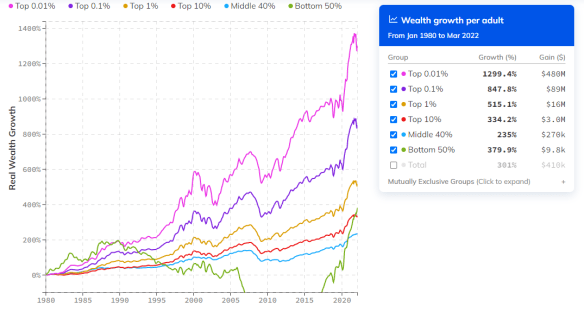
I was reminded of this history when somebody linked to a new site called Realtime Inequality. It was created by three UC Berkeley economists in order to show how different “income and wealth groups” benefit or fall behind when new growth numbers come out each quarter”:

Realtime Inequality provides timely and high-frequency estimates of the distribution of income and wealth in the United States. Our statistics distribute the totality of national income and household wealth across socio-economic groups and are updated each quarter when new macroeconomic numbers are published. (National income is similar to Gross Domestic Product and a better indicator of income earned by US residents.)

This makes it possible to estimate economic growth by socio-economic groups consistent with quarterly releases of macroeconomic growth, and to track the distributional impacts of government policies during and in the aftermath of recessions in real time. 

The site has graphs for both income and wealth that you can play around with for different groups and time periods. Thus, one measure of income growth between January 1980 and March 2022 shows that income (corrected for inflation) rose 333% for the top tenth of one percent and 26% for the bottom fifty percent.

x

While one measure of wealth for the same period grew by $89 million for the upper tenth of one percent and less than $10,000 for the bottom fifty percent.

y

It’s kind of fun to play with if you don’t think about it too hard.

More from Ezra Klein on Reforming the Supreme Court

Last week I shared most of Ezra Klein’s article about the Supreme Court and the way today’s politics is more about power than norms. He revisited the topic this week. Here’s most of what he wrote:

Late in the lead-up to the 2020 presidential election, as Mitch McConnell rushed to replace Ruth Bader Ginsburg with Amy Coney Barrett, the left began pushing Joe Biden to endorse adding seats to the Supreme Court. Biden, in response, did what politicians do when faced with an issue they don’t want to think about: He promised to create a commission to study the issue.

That commission submitted its report in December 2021, and as far as I can tell, Biden’s lack of interest has been confirmed. For all the fury at the Supreme Court in recent weeks, the Biden administration doesn’t seem to have mentioned the report or any of the options it raised. Perhaps that’s just an admission of political reality. Democrats don’t have the votes to change the court.

But the Biden administration needs to change political reality, not just accept it….. One such [response] might be a plan to repair the court — one that goes beyond restoring Roe v. Wade and demonstrates a deeper vision for reimagining America’s political system in an era of crisis….

The commission’s report doesn’t endorse any particular plan. Instead, over nearly 300 pages, it considers several plans and airs the arguments for and against them. At times it’s pathologically evenhanded, bordering on naĂŻve….But in total, the report is a thorough … tour through ways the court could be restructured….

In Federalist No. 78, Alexander Hamilton wrote that the judiciary has “… neither FORCE nor WILL, but merely judgment”. The debate over the Supreme Court tends to revolve around the word “legitimacy.” The fear is that the court will lose its legitimacy, whatever that means. But the word Hamilton uses is more interesting: judgment.

I take the problem with the current Supreme Court to be that there’s no reason to trust its judgment, and many reasons to mistrust it. The process for picking appointees is thoroughly politicized. The process by which seats come open and the court is refreshed is thoroughly politicized, save when death intervenes with a justice’s preferred moment of retirement. Critical cases are decided again and again on party-line votes, making a hash of the idea that the court speaks as an institution, on behalf of the Constitution, rather than as nine ideologically predictable political appointees.

As I argued last week, the court — like the rest of our political system — wasn’t designed for an era of polarized political parties. It is supposed to be a check on the other branches, not an amplifier of the power the parties wield across them. Its problem is a mismatch between the political system for which it was designed and the political system we actually have. And so the question is, what might the court look like if it were designed for this era? What reforms would make the court’s judgment more, rather than less, trustworthy?

In my view, court packing, the idea that arguably launched the commission, fails that test…. You can’t fix the court by adding justices. You’re shifting the balance of power by contributing to the underlying problem: turning the court into an untrustworthy institution and setting off a cycle of reprisals with unknown consequences…. [Note: I disagree. This is an emergency. If the Democrats in Washington wanted to, they could add four justices to match the number of federal circuit courts. There used to be nine circuits. Now there are thirteen. Then let the Democrats propose a way to make the court more balanced in the future. See below.]

Let’s start with the easy one: term limits. Lifetime appointment did not mean, for most of American history, what it means today. The commission notes that until the 1960s, the average length of service on the court was 15 years. Now it’s 26 years — and perhaps rising. As the partisan stakes of Supreme Court nominations have sharpened, life span has become one more variable to game: Parties are looking for the youngest justices they can credibly pick in order to ensure their nominees hold power far into the future.

Worse, because justices retire strategically, power in the court now builds power in the court later. As the commission notes, Trump “appointed three Justices in his single four-year term; his immediate Democratic predecessors, Presidents Barack Obama, Bill Clinton, and Jimmy Carter, made only four appointments total in a combined twenty years in office.” Lifetime appointments were intended to insulate the justices from politics. Instead, they have become a driver of the court’s politicization.

Limiting justices to 18-year terms has collected a fair amount of bipartisan support over the years…. When the National Constitution Center convened separate groups of liberal and conservative legal scholars to consider court reform, both ended up proposing 18-year terms. It also has the force of international practice behind it. This, from the report, is worth reflecting on:

The United States is the only major constitutional democracy in the world that has neither a retirement age nor a fixed term limit for its high court Justices….  In light of this contrast, one scholar who testified before the Commission opined that, “were we writing the United States Constitution anew, there is no way we would adopt the particular institutional structure that we have for judicial tenure. No other country has true lifetime tenure for its justices, and for good reason.”

… Eighteen-year terms would mean, over time, that presidents could expect two appointments per term. A two-term presidency would see four appointments — … enough to make sure the court doesn’t fall too far out of step with the American people. It would also lower the stakes on any one vacancy or any one decision, because vacancies would become predictable and commonplace.

But there’s also a need to depoliticize the court and protect it from politics. It now seems unlikely that vacant seats can ever be filled when the White House and the Senate are controlled by opposing parties … [No, the evidence is that would only happen if Republicans controlled the Senate, like they did in 2015. As Mr. Klein adds parenthetically…] (In case you thought Merrick Garland a one-off, McConnell has already said it’s “highly unlikely” he’d let Biden fill a Supreme Court seat if Republicans retake the Senate in 2022.)

But the commission has an interesting idea for that. If the Senate fails to act on, or otherwise confirm, two Supreme Court nominees in a set amount of time, the deadlock could trigger a new process in which the chief judges of the federal Courts of Appeals would vote on the next nominee….

More radical is the idea for a “balanced bench.” The commission does not discuss this idea at any length… The balanced bench is a proposal by Daniel Epps and Ganesh Sitaraman, both law professors, to divvy up Supreme Court seats in a new way: Both parties would get five justices, and then those 10 justices would be called upon to unanimously or near-unanimously agree on another five justices.

The merits of the balanced bench proposal are perfectly, if accidentally, encapsulated in the commission’s critique of the idea:

An explicit requirement that Justices be affiliated with particular parties would constrain the pool of potential nominees and reinforce the notion that Justices are partisan actors….This close identification of Justices with political party could undermine the perception of judicial independence, which is important to the acceptance of and compliance with the Court’s decisions.

Yes, it would be a shame to reinforce the accurate perception that Supreme Court nominees, chosen by political parties, extensively vetted for ideological reliability, might be, on some level, partisan actors. [This is] extraordinary: Even if it is true that the justices have “ideological motivations,” we must act like it isn’t true, because an accurate understanding of the judiciary might undermine “acceptance of and compliance with” its decisions.

This is an argument for denial, when what we require is a reckoning…. A central question in any political system is how to balance power so all sides have an interest in the system’s continued success. The problem in our system is that we are balancing the power of places rather than parties. The framers believed the politics of states would structure our politics. “Many considerations … seem to place it beyond doubt that the first and most natural attachment of the people will be to the governments of their respective States,” wrote James Madison in Federalist No. 46. And so the Senate balances the power of states equally, and the [Electoral College] gives rural areas a boost in political representation.

But the framers were wrong. Political parties are our primary political attachments, and that’s been true for decades. Perhaps the Supreme Court should be a place that balances their power rather than another venue through which they compete for dominance.

Taking parties seriously means recognizing who is left out by party competition, too. Many Americans … find themselves utterly unrepresented by the current nominations process. There should be a path to the Supreme Court that does not rely on proving yourself a loyal foot soldier, decade after decade, to the party likeliest to sponsor you, a path that relies on building the best reputation for judgment among peers of all political persuasions. The “balanced bench” idea would create that path, too…. The proposal is a provocative sketch rather than a fully worked-through plan. But provocations are what we need.

We treat the creaking, cracking structure of American government with a strange mix of awe and fatalism; either we think it somehow heretical to question, or we’re so pessimistic about the prospect of change that we don’t even bother. But to dive into the history of court reform, as the commission does, is to be reminded that the Supreme Court was imagined by human minds, and made and remade by human hands. We honor the idea of the American experiment, but we have lost the spirit of experimentation that made it work. We did not discover the ideal structure for the Supreme Court, once and for all, in 1869 [when the number of justices was set to nine]. Our forerunners did their best for the times in which they lived. It is time we did ours.