Recent posts (including this one) look as if I used the “Like” button on them. If you hover over the little brown image next to the “Liked” button, you’ll see “L Franz”. That’s me. It’s true I’m usually somewhat pleased with my posts, but I would never “Like” them. Some fine people at WordPress.com know about the problem. They’ve suggested several things but so far no luck.
Debt, Schmet
The Nobel Prize in economics that Prof. Paul Krugman won isn’t technically a Nobel Prize, since it’s not one of the prizes Alfred Nobel created back in 1905. Krugman’s “Nobel Prize” (not “Noble Prize”) was actually the Sveriges Riksbank Prize in Economic Sciences in Memory of Alfred Nobel, established in 1968 by a donation from Sweden’s central bank to the Nobel Foundation.
Nonetheless, Krugman is very smart and knows a lot about economics. From his New York Times newsletter:
I get a lot of hate mail; in fact, I worry if a column doesn’t generate a big backlash, because it suggests that I may have been off my game. But it’s interesting to see what generates the most hate. In general, writing “Donald Trump is a terrible person” gets a sort of collective shrug…The real vitriol tends to come over monetary and fiscal policy.
In particular, I don’t think anything I’ve written has angered as many people as my declaration five years ago that debt is money we owe to ourselves — a point I naïvely imagined would be self-evident once people thought about it. But it turns out that challenging the notion that government borrowing imposes a burden on our children and grandchildren deeply offends many people, even though that notion makes very little sense.
So I don’t really expect people to be persuaded when I say that the response to Covid-19 is a near-perfect demonstration of my point. But let’s give it a try, anyway.
Here’s where we are right now. To contain the coronavirus, we’ve effectively shut down a significant part of the economy. Around 10 percent of U.S. workers are or were employed in “leisure and hospitality,” which has basically been locked down; even more are employed in retail trade, much of which has also been locked down.
For those of us still drawing a paycheck, this is annoying but not much more than that; I dream of coffee shops and concerts, but those aren’t necessities. For those who made a living by providing banned services, however, the lockdown is a financial catastrophe.
So we’re providing disaster relief on a huge scale: unemployment insurance, aid to small businesses and more. It’s still inadequate, and a lot of the money still isn’t making it to the people who need it most. But put that on one side, and ask: How are we paying for it?
The immediate answer is that the federal government is borrowing the money. New projections from the Congressional Budget Office suggest that federal debt, as a share of G.D.P., will be around 30 points higher by the end of next year than it was at the end of 2019.
But who will that money be owed to? The answer is, me — and people like me. That is, those who are still receiving more or less their normal incomes are spending less and saving more — yes, we’re buying more groceries and booze, but that’s vastly outweighed by reduced spending on restaurants and vacations. And those savings are, one way or another, being recycled via the federal government into aid for those less fortunate.
Some of the recycling is direct: My wife and I have, in fact, bought some U.S. government bonds. Most of it is indirect: You put more money in your bank account, the bank accumulates extra reserves in its account at the Federal Reserve, and the Fed buys government bonds. But the details aren’t especially important. At a fundamental level, the government is helping one group of Americans by borrowing from another group of Americans.
You might ask how the money will be repaid; actually, the odds are that it never will be repaid, which is OK but that’s a story for another time. There are also potential problems created by a high level of federal debt, although to be honest it’s unlikely that U.S. debt will be a real problem any time soon.
The key point for now, however, is that this debt-financed disaster relief isn’t coming at the expense of America’s future growth; it’s not making the country poorer, and it’s not cheating future generations. The debt we’re incurring now is money we owe to ourselves.
Unquote.
Krugman knows, of course, that some of America’s debt is owed to foreign countries, but it’s less than most people think.
As of this month, U.S. federal debt is $24 trillion. One quarter of that or $6 trillion is called “intragovernmental” debt. It’s money that’s owed by U.S. government agencies to other U.S. agencies. For example, the Social Security administration owns half of the $6 trillion (because Social Security invests its excess cash in U.S. government bonds).
The other $18 billion of U.S. debt is called “public” debt. Two-thirds of it or $12 trillion is owned by Americans, either individuals, companies or other entities. Foreigners own the other third or $6 trillion.
Krugman would be more precise, therefore, if he said that 75% of the government’s debt is money we owe ourselves. Foreigners are owed 25%.
For more on debt from Prof. Krugman:
America came out of World War II with huge debts — and experienced an unprecedented economic boom.
Britain emerged from World War II with debt of 270 percent of G.D.P. It never paid that debt off — but the ratio of debt to G.D.P. fell 80 percent over the next generation anyway.
New Jersey’s Steps to Reopening
Governor Murphy just presented the steps he thinks the Garden State needs to take before life can become more normal. Other states are doing the same thing. Murphy added that everything would be coordinated with neighboring states: “This isn’t just about NJ. Rushing ahead of our partners would risk returning our entire region back into lockdown mode”.
He didn’t announce a timeline:
Until we give the public confidence that they should not be fearful, we cannot take further steps. A plan that is needlessly rushed is a plan that will needlessly fail.
If businesses like restaurants, barber shops and theaters reopen, but their customers stay home, there won’t be any point to reopening.
The PowerPoint version:




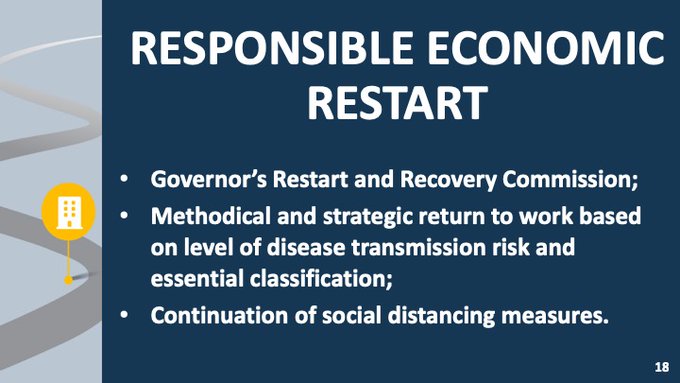
He skipped page 19 (is it a state secret?):

A Baseball Legend Few Fans Know About
It was a time before radar guns, but they say his fastball was the fastest in the history of baseball. In fact, much faster. I’d never heard of him until yesterday.
From The Washington Post:
Steve Dalkowski, who entered baseball lore as the hardest-throwing pitcher in history, with a fastball that was as uncontrollable as it was unhittable and who was considered perhaps the game’s greatest unharnessed talent, died April 19 at a hospital in New Britain, Conn. He was 80 and died from Covid-19.
Mr. Dalkowski pitched nine years in the minor leagues in the 1950s and ’60s, mostly in the Baltimore Orioles organization, without reaching the major leagues. Yet, in that time, he amazed — and terrified — countless hitters with a blazing fastball of astonishing speed.
He was not a big man, only about 5-foot-10 and 175 pounds, but he possessed lightning in his left arm. He had almost a slingshot motion, somewhere between a sidearm and overhand delivery.
Ted Williams, who played against Bob Feller and other fireballers during his Hall of Fame career, was said to havefaced Mr. Dalkowski in one spring training and called him the “fastest ever.” Another major leaguer, Eddie Robinson, swung and missed at 10 pitches before he could make weak contact with one of Mr. Dalkowski’s fastballs.
“As 40 years go by, a lot of stories get embellished,” Pat Gillick, Mr. Dalkowksi’s minor league teammate and a Hall of Fame general manager, told Sports Illustrated in 2003. “But this guy was legit. He had one of those arms that come once in a lifetime”….
The fastest documented fastball in baseball history was thrown by left-hander Aroldis Chapman, currently a relief pitcher for the New York Yankees. Chapman had the speed tattooed on the inside of his left wrist: 105.1 mph.
People who saw Mr. Dalkowski said he threw at least as hard. Radar guns were not in use when Mr. Dalkowski pitched, but his catcher in the Orioles system, Cal Ripken Sr., estimated his fastball was between 110 and 115 mph.
Ripken spent decades in baseball, eventually becoming manager of the Orioles. He saw Sandy Koufax, Goose Gossage and J.R. Richard pitch, and he watched from the third-base coaching box as Nolan Ryan threw fastballs clocked at more than 100 mph.
“Steve Dalkowski was the hardest thrower I ever saw,” Ripken said.
In one game Ripken was catching, he called for a breaking pitch. Mr. Dalkowski missed the sign and threw his fastball instead. It hit the umpire in the mask, breaking it in three places. The umpire was knocked unconscious.
In 1957, when Mr. Dalkowski was 18 and in his first professional season, he tore off part of a batter’s ear with an errant pitch. That batter was Bob Beavers, then in the Dodgers organization.
“The first pitch was over the backstop. The second pitch was called a strike, I didn’t think it was,” Beavers told the Courant last year. “The third pitch hit me and knocked me out, so I don’t remember much after that. . . . I never did play baseball again.”
That was Mr. Dalkowski’s problem throughout his baseball career: He had the best arm in the game, but he could not control his pitches.
In high school, he pitched a no-hitter in which he walked 18 batters and struckout 18. Another time, in an extra-inning minor-league game, he walked 18 hitters and struck out 27 while throwing 283 pitches — far more than a team would allow a pitcher to throw today.
In 1960, when he was with a minor league team in Stockton, Calif., Mr. Dalkowski struck out 262 batters in 170 innings — an astonishing rate of 14 strikeouts per 9 innings. But he also walked 262 batters.
His pitches sometimes flew over backstops and sent spectators ducking for cover. On a dare, he threw a ball over the center field fence — 440 feet away. Another time, he won a bet with teammate Andy Etchebarren and fired a ball through a wooden fence.
He once beaned a mascot with a fastball — a scene depicted in the 1988 baseball movie “Bull Durham.” The film’s screenwriter, Ron Shelton, played in the Orioles minor league system a few years after Mr. Dalkowski, but stories about him were still being told. He based the character of “Nuke” LaLoosh, played by Tim Robbins, on Mr. Dalkowski.
“Playing baseball in Stockton and Bakersfield several years behind Dalko, but increasingly aware of the legend,” Shelton wrote in the Los Angeles Times in 2009, “I would see a figure standing in the dark down the right-field line at old Sam Lynn Park in Oildale, a paper bag in hand. Sometimes he’d come to the clubhouse to beg for money.
“Our manager, Joe Altobelli, would talk to him, give him some change, then come back and report, ‘That was Steve Dalkowski.’ And a clubhouse full of cocky, young, testosterone-driven baseball players sat in awe — of the unimaginable gift, the legend, the fall”….
Coaches tried everything with Mr. Dalkowski: changing his stance on the mound, his grip on the ball; they asked him to aim high or aim low, to relax as he threw. Nothing worked.
In 1962, Mr. Dalkowski was assigned to the Orioles’ Class A affiliate in Elmira, N.Y. The manager was a young Earl Weaver, who later managed in Baltimore for 17 years and went into the Hall of Fame.
Weaver encouraged Mr. Dalkowski to throw his slider for strikes and not to throw his fastball at full strength every time. When he got to two strikes on an opposing hitter, Weaver would whistle, as a signal for Mr. Dalkowski to bring his best fastball.
“Earl had managed me in Venezuela in winter ball. We got along,” Mr. Dalkowski told the Sun in 2003. “He handled me with tough love. He told me to run a lot and don’t drink on the night you pitch. Then he gave me the ball and said, ‘Good luck.’ ”
Mr. Dalkowski would go on to have his best season, with an earned run average of 3.04. He had 37 consecutive scoreless innings at one point….
The next year, in spring training, Mr. Dalkowski was fitted for a big league uniform, finally about to realize his dream.
“He had the team made easily,” Orioles manager Billy Hitchcock told the Sun years later.
But on March 22, 1963, while pitching to the New York Yankees in a spring training game, Mr. Dalkowski felt something snap in his elbow. He was 23.
He tried to come back from the injury, pitching in the minors until 1965, but the lightning was gone. During his minor league career, he won 46 games and lost 80. In 956 innings, he struck out 1,324 batters and walked 1,236.
He never made it to the majors….
After his elbow injury in 1963, Mr. Dalkowski disappeared for years. He became a migrant farmworker in California — and a down-and-out alcoholic.
After failed rehab attempts, Mr. Dalkowski’s sister brought him back to [Connecticut] in 1994. He spent the rest of his life in an assisted-living facility, within blocks of the high school baseball field where he first found glory….
Unquote.
If it was a movie, they’d find an upbeat ending. They’d probably use this:
He rose from a wheelchair last year in Los Angeles to throw out a ceremonial first pitch at Dodger Stadium.
We’ve Been Hoping for a Tipping Point
Yet a tipping point, the last straw, will probably never arrive. A number of citizens of this formerly great country will spray disinfectant on their corn flakes before pouring the milk, but President Lysol will stumble and bumble on for nine more months. Nevertheless, it’s encouraging to see the word “resign” appear in a reputable publication, not the feverish musings of a humble blogger.
From Jack Holmes of Esquire:
Of course there are people who will defend him no matter what, but it’s hard not to think that the watching Elite Political Media’s refusal to say what is right in front of them has also aided and abetted the madness. Could he have made it this far without people who are so scared of being accused of Bias or not being Objective that they can’t bring themselves to call a loon a loon? The latest example comes via The New York Times…They did not feel they could just say this is dangerous, not to mention fucking crazy. … if a guy walked into the lobby of the New York Times building yelling at people to drink bleach, he would be removed from the premises in short order. But when the president does it, we’ve got to check in with the experts to know what an 11-year-old knows….
In fairness, [the] Times story was delivered with some trademark low-key Times humor. But we need to get a little more direct here. Something really has to give. At what point are you misleading your readers by not pointing out that what just happened was fucking crazy, and they’re not crazy to think so? There is a need among some, particularly in Washington, to believe the president is not completely batty. The prospect that he has no idea what he’s doing, and in fact may not be all there, is psychologically difficult for some to grapple with. It’s also scary for some folks to think about just saying what’s in front of them and feeling the backlash from his supporters. So evening-news programs and newspapers spend a lot of time cleaning up what the president says, pruning the overgrown hedges into something vaguely coherent in their reports.
…. When are we going to demand more than a circus from the people in whom we now have so much of our futures invested, willingly or not? We should be calling for this guy to resign on a daily basis. He should be impeached again for gross incompetence. Mike Pence looks like fucking FDR by comparison. Most of the president’s supporters will never hold him to any standard that he might not meet. In fact, they will continually lower the bar to accommodate him, because they have already invested too much of themselves in this to go back. The sunk cost is too high. It’s up to everyone else to plainly say that he should not have this job any longer. We hired him, on a temporary basis, to manage the Executive Branch of our government. He should be fired.
Unquote.
Note: A spokesman for the governor of Maryland says that after receiving more than 100 calls, the state issued a reminder that “under no circumstances should any disinfectant product be administered into the body through the injection, ingestion or any other route”.
And just think, the 100 people who made those calls are some of the smarter ones.
 Whereof One Can Speak 🇺🇦
You must be logged in to post a comment.