Some Conservatives Want to Avoid a Coup in 2024

One such conservative is J. Michael Luttig. You know he’s a conservative, because he clerked for Antonin Scalia, worked for Ronald Reagan and was made a federal judge by the first President Bush. After 15 years as a judge, he was Boeing’s general counsel for 13 years (2008 income = $2.8 million). He’s apparently consulting with “a number of senior Republican senators” regarding changes to the Electoral Count Act. He warned America in a piece for the NY Times today: 

The clear and present danger to our democracy now is that former President D____ T____ and his political allies appear prepared to exploit the Electoral Count Act of 1887, the law governing the counting of votes for president and vice president, to seize the presidency in 2024 if Mr. T____ or his anointed candidate is not elected by the American people.

The convoluted language in the law gives Congress the power to determine the presidency if it concludes that Electoral College slates representing the winning candidate were not “lawfully certified” or “regularly given” — vague and undefined terms — regardless of whether there is proof of illegal vote tampering. After the 2020 election, Republican senators like Ted Cruz of Texas and Josh Hawley of Missouri tried to capitalize on those ambiguities in the law to do Mr. T____’s bidding, mounting a case for overturning the results in some Biden-won states on little more than a wish. Looking ahead to the next presidential election, Mr. T____ is once again counting on a sympathetic and malleable Congress and willing states to use the Electoral Count Act to his advantage.

He confirmed as much in a twisted admission of both his past and future intent earlier this month, claiming that congressional efforts to reform the Electoral Count Act actually prove that Mike Pence had the power to overturn the 2020 presidential election because of the alleged “irregularities.” The former vice president pushed back forcefully . . . 

The back-and-forth repudiations by Mr. T____ and Mr. P____ lay bare two very different visions for the Republican Party. Mr. T____ and his allies insist that the 2020 election was “stolen,” a product of fraudulent voting and certifications of electors who were not properly selected. Over a year after the election, they continue to cling to these disproved allegations, claiming that these “irregularities” were all the evidence Mr. Pence needed to overturn the results, and demanding that the rest of the G.O.P. embrace their lies. The balance of the Republican Party, mystifyingly stymied by Mr. T____, rejects these lies, but, as if they have fallen through the rabbit hole into Alice’s Wonderland, they are confused as to exactly how to move on from the 2020 election when their putative leader remains bewilderingly intent on driving the wedge between the believers in his lies and the disbelievers.

This political fissure in the Republican Party was bound to intensify sooner or later, and now it has, presenting an existential threat to the party in 2024. If these festering divisions cost the Republicans in the midterm elections and jeopardize their chances of reclaiming the presidency in 2024, which they well could, the believers and disbelievers alike will suffer.

While the Republicans are transfixed by their own political predicaments, and the Democrats by theirs, the right course is for both parties to set aside their partisan interests and reform the Electoral Count Act, which ought not be a partisan undertaking.

Democrats, for their part, should regard reform of the Electoral Count Act as a victory — essential to shore up our faltering democracy and to prevent another attack like the one at the Capitol on Jan. 6, 2021. These are actually the worthiest of objectives.

Republicans should want to reform the law for these same reasons, and more. Of course, some may never support reform of the Electoral Count Act simply because the former president has voiced his opposition to the efforts to revise it. But there are consequential reasons of constitutional and political principle for the large remainder of Republicans to favor reform in spite of the former president’s opposition.

Republicans are proponents of limited federal government. They oppose aggregation of power in Washington and want it dispersed to the states. It should be anathema to them that Congress has the power to overturn the will of the American people in an election that, by constitutional prescription, is administered by the states, not Washington . . . [although he doesn’t mention that the Constitution (Article I, Section 4, Clause 1) gives Congress the authority to change the rules for elections].

Constitutional conservatives, especially, should want Electoral Count Act reform, because they should be the first to understand that the law is plainly unconstitutional. Nothing in the Constitution empowers Congress to decide the validity of the electoral slates submitted by the states. In fact, the Constitution gives Congress no role whatsoever in choosing the president, save in the circumstance where no presidential candidate receives a majority of the electoral votes cast.

T____ acolytes like Mr. Cruz and Mr. Hawley should appreciate the need to reform this unconstitutional law. . . . No Republican should want to be an accessory to any successful attempt to overturn the next election — including an effort by Democrats to exploit the law.

If the Republicans want to prevent the Electoral Count Act from being exploited in 2024, several fundamental reforms are needed. First, Congress should formally give the federal courts, up to and including the Supreme Court, the power to resolve disputes over state electors and to ensure compliance with the established procedures for selecting presidential electors — and require the judiciary’s expeditious resolution of these disputes. Congress should then require itself to count the votes of electors that the federal courts have determined to be properly certified under state law.

Congress should also increase the number of members required both to voice an objection and to sustain one to as high a number as politically palatable. At the moment, only one member of each chamber is necessary to send an objection to the Senate and House for debate and resolution — an exceedingly low threshold that proved a deadly disservice to the country and the American people during the last election.

Currently, Congress has the power under Article II and the Necessary and Proper Clause to prevent states from changing the manner by which their electors are appointed after the election, but it has not clearly exercised that authority to prevent such postelection changes. It should do so.

Finally, the vice president’s important, but largely ministerial, role in the joint session where the electoral votes are counted should once and for all be clarified.

It is hardly overstatement to say that the future of our democracy depends on reform of the Electoral Count Act. Republicans and Democrats need to . . . fix this law before it enables the political equivalent of a civil war three years hence. The law is offensive to Republicans in constitutional and political principle, officiously aggrandizing unto Congress the constitutional prerogatives of the states. It is offensive to Democrats because it legislatively epitomizes a profound threat in waiting to America’s democracy. The needed changes, which would meet the political objections of both parties, should command broad bipartisan support in any responsible Congress. . . . 

Come to think of it, the only members in Congress who might not want to reform this menacing law are those planning its imminent exploitation to overturn the next presidential election.
Maybe We’ll Reach a Tipping Point

The Republican majority on the Supreme Court (three of whom were appointed by the worst president of modern times) decided that the Occupational Health and Safety Administration didn’t have the authority to impose a vaccine/testing mandate on employees at large companies because people who don’t work at large companies also get Covid-19. (People also die from carbon monoxide poisoning when they’re not at work, so OSHA probably shouldn’t protect employees from that either).

Later, the Supreme Court majority let stand a law in Texas that gives anybody in the state the right to sue someone who receives or administers an abortion after the woman has been pregnant for six weeks, contrary to previous Supreme Court decisions. Other states with Republican legislatures immediately began enacting similar laws. There’s now a strong possibility that the Republican majority will overturn the Roe v. Wade decision this year, allowing states to make abortion illegal again.

A three-judge appeals court ruled that Georgia’s new congressional map was a clear violation of the Voting Rights Act. Two of the judges who said the map was illegal were Republicans appointed by the same worst president, yet the Supreme Court majority allowed the map to stay in effect through the upcoming elections.

Meanwhile, in Canada, a mob of truck drivers decided to block the streets of the nation’s capital, causing the city’s mayor to declare an emergency. Another group, for the most part not driving big trucks, decided to block bridges between Canada and the US, disrupting trade and travel in both countries, in particular, the delivery of goods by both Canadian and American truck drivers. Yet right-wing figures in the US are supporting the Canadian blockades and discussing similar actions in the US.

If the Supreme Court majority overturns Roe v. Wade, if trade and travel are further disrupted by right-wing agitators, maybe there will be a tipping point. A majority of voters will understand that Republican politicians do not have their interests in mind and will vote accordingly.

(I forgot to mention the movement among right-wingers across the country to ban certain books and to eliminate history lessons that make white kids “uncomfortable”. It’s another example of Republicans going too far.)

One of the Most Sickening Developments in Recent Times

And wouldn’t you know, it involves our corrupt Supreme Court.

From Paul Waldman of The Washington Post:

In 2019, the Supreme Court ruled that it has no power to do anything about partisan gerrymandering, allowing states to gerrymander to their hearts’ content. But at the time, it clarified that it could still strike down racial gerrymanders, since drawing district lines that have the effect of eroding the power of minority groups would violate the Voting Rights Act.

But now the court may have cleared a path to potentially harming African American voters in another way, by further diluting their prospects for electing preferred candidates . . . 

Combine the Alabama case on which the court just ordered a stay with its decision to allow Texas’s abortion vigilante law to go into effect — all but outlawing abortion in the second largest state, Roe v. Wade be damned — and you can see the emergence of a new kind of political/legal process. It’s one Republicans will increasingly deploy to remake the landscape of U.S. law.

Here’s how it works:
 
  1. A Republican state legislature passes an obviously and unquestionably unconstitutional law.
  2. The Supreme Court uses its “shadow docket” to allow the law to remain in place for an extended period, nullifying the existing constitutional order in one state.
  3. Eventually, the court issues a sweeping order taking the changes nationwide — but since everyone saw it coming, it may not seem as radical as it might have, and in any case the court doesn’t really care what anyone thinks.

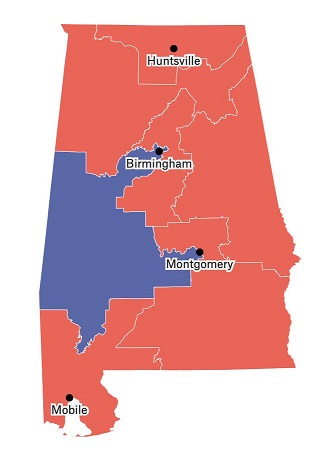
In the Alabama case, the GOP-run state legislature created a congressional map that packs many of the state’s Black voters into a single district. Though they make up 27 percent of the state’s population, African Americans have a remote chance of winning in only one of the state’s seven congressional districts. In Alabama, voters are highly divided by race; according to exit polls, 77 percent of Whites in Alabama voted for Donald Trump in 2020, compared with 55 percent in the country as a whole.

After a lengthy trial, a three-judge panel found that the map discriminated against the state’s Black voters in violation of Section 2 of the Voting Rights Act and ordered the state to produce a new map. That panel was made up of one judge appointed by Bill Clinton and two appointed by Trump, suggesting the legal judgment was clear.

[Here’s the map. The Republicans sent tentacles out to include Birmingham, Montgomery and one other area in order to cram as many Black people as possible into that single Democratic district.]
FLB43q2XwAgkxsY

Alabama appealed to the Supreme Court, where five justices [the most reactionary ones] issued a stay nullifying the lower court’s ruling, allowing a map that seems to clearly violate the Voting Rights Act to remain in place. They also accepted the case for a full hearing and judgment later on, but the stay came through what is now known as the “shadow docket,” where increasingly consequential rulings are issued on an emergency basis.

Justice Brett M. Kavanaugh, writing for the majority, said that it was too close to the election later this year, so the court simply had to intervene on Alabama’s behalf.

Even Chief Justice John G. Roberts Jr., the architect of the court’s long assault on voting rights and the author of its 2013 decision gutting other sections of the Voting Rights Act , was unable to justify what his [far right] colleagues did. In a brief dissent, he wrote that while he agreed with the decision to take the case for a full consideration — signaling that he looks forward to driving another stake into the heart of the Voting Rights Act — “the District Court properly applied existing law in an extensive opinion with no apparent errors for our correction.”

But the other five conservatives felt free to intervene. As Justice Elana Kagan wrote in dissent, “Today’s decision is one more in a disconcertingly long line of cases in which this Court uses its shadow docket to signal or make changes in the law, without anything approaching full briefing and argument.”

When it allows clearly unconstitutional or otherwise problematic state laws to remain in place, the court not only creates sweeping de facto change for temporary periods, it also sends a message to Republican state legislatures that nothing is off the table.

Is there a constitutional right you’d like to eliminate, a federal law you find displeasing, an outrageous fantasy you’d like to turn into reality? Pass a law making it happen, no matter how crazy, and there’s a good chance we’ll let it stand, at least for a while. And after that, who knows?

. . ., We’re embarking in a new era, in which a radicalized Republican Party meets an unusually aggressive Supreme Court majority eager to reimagine the whole scope of American law. And with six [Republicans, three appointed by the worst president in history] , they have a margin of error that allows them to indulge their wildest policy ambitions.

I’m Glad They Agree

If you express an opinion and somebody disagrees, they’ve given you an opportunity to change your mind. If the other person’s opinion is better than yours, you’ve learned something. That’s a positive outcome. There can also be a positive outcome if the other person agrees with you. It makes you feel good (although if you were wrong to begin with, agreement will just make the situation worse). 

I had two instances today where somebody agreed with me. This made me feel good (I’m going with the assumption that I wasn’t wrong to begin with).

First, the philosopher Justin E. H. Smith criticized the idea that we may be living in a computer simulation, in response to David Chalmers’s book Reality + (my contribution, not as elegant and with a lot fewer words, was “Reality, the Virtual Kind and the Unlikely Kind”):

According to Chalmers’s construal of the “it-from-bit” hypothesis, to be digital is in itself no grounds for being excluded from reality, and what we think of as physical objects may be both real and digital. One is in fact free to accept the first conjunct, and reject the latter, even though they are presented as practically equivalent. I myself am prepared to accept that a couch in VR [virtual reality] is a real couch — more precisely, a real digital couch, or at least that it may be real or reified in consequence of the way I relate to it. But this does not compel me to accept that the couch on which I am currently sitting is digital.

There is a persistent conflation of these two points throughout discussions of the so-called “simulation argument”, which Chalmers treats in several of his works but which is most strongly associated with the name of Nick Bostrom, who in 2003 published an influential article entitled “Are You Living in a Computer Simulation?” … Here I just want to point out one significant feature of it that occurs early in the introduction and that the author seems to hope the reader will pass over smoothly without getting hung up on the problems it potentially opens up. Consciousness, Bostrom maintains, might arise among simulated people if, first of all, “the simulations were sufficiently fine-grained”, and, second of all, “a certain quite widely accepted position in the philosophy of mind is correct.”

What is this widely accepted position, you ask? … It is, namely, the view, which Bostrom calls “substrate-independence”, that “mental states can supervene on any of a broad class of physical substrates. Provided a system implements the right sort of computational structures and processes, it can be associated with conscious experiences.” Arguments for functionalism or computationalism have been given in the literature, Bostrom notes, and “while it is not entirely uncontroversial, we shall here take it as a given.”

It is of course possible that conscious experiences may be realized in a silicon substrate or in a complex arrangement of string and toilet-paper rolls, just as they may be realized in brains. But do we have any evidence that the arrangements that we have come up with for the machine-processing of information are in principle the kind of arrangements that, as they become more and more complex or fine-grained, cross over into conscious experience? In fact, there is very good reason to think that the appearance of consciousness in some evolved biological systems is the result of a very different sort of developmental history than anything we have seen so far since the dawn of artificial intelligence in the mid-twentieth century….

Unquote.

Second, Michael Tomasky of The New Republic responded to the Republican National Committee’s characterization of what happened on January 6, 2021, as “legitimate political discourse”:

It’s now official: The Republican Party is no longer a political party in any known American sense. Honestly, it hasn’t been for a quite some time, but with last week’s resolution condemning Liz Cheney and Adam Kinzinger, the party made it official. We don’t always grasp the historic importance of events in real time, but rest assured that future historians, assuming the United States remains enough of a democracy to have honest ones, will point to Friday, February 4 as a pivotal day in the party’s war on democracy….

The money quote in this episode is the line in the resolution that condemns Cheney and Kinzinger for “participating in a Democrat-led persecution of ordinary citizens engaged in legitimate political discourse.” This is right out of 1984. When The New York Times reported that this meant that the RNC was referring to the January 6 insurrection as “legitimate political discourse,” RNC gauleiter Ronna McDaniel howled that of course she has condemned violence, and the legit discourse business referred to other stuff.

What other stuff, it’s hard to say. The text of the resolution didn’t leave room to interpretation. And the select committee on January 6 is not exactly investigating Republicans across the country who are, say, protesting mask mandates. In fact, it’s not investigating any kind of “discourse.” It’s looking specifically at actions by people on and around the date of the infamous riot….

The truth here is obvious: The party is talking out of both sides of its mouth. The obvious intent with that sentence is to minimize and legitimize what happened on January 6…. And now that T____ himself has said he may pardon everyone charged with January 6–related crimes, it was clear that McDaniel saw her job as aiding [him] in that project: If it’s the official party line that the insurrection was legitimate, then there’s nothing outrageous about pardons.

The Anti-Defamation League recently released a report finding that more than 100 Republican candidates on various ballots in 2022 have explicitly embraced extremism or violence … This is not some aberration that time will correct. It is a storm that will continue to gather strength, because it’s where the action and the money are, and no one in the GOP is opposing it—except the two people who were just essentially read out of the party….

The Republican Party … has become an appendage of T____ dedicated to doing his will and smiting his enemies. I had to laugh at the part of the resolution that denounced Joe Biden for his alleged pursuit of “socialism”…..

The Republican Party is further down the road to fascism than the Democrats are to socialism. And when, by the way, might Democrats start saying that? What are you waiting for, people? How much deeper does this crisis have to get before you start telling the American people the truth about what the GOP has become? It’s time to say it and to put Republicans on the defensive….We are at a moment of historical reckoning…. But Americans won’t know it, Democrats, unless you tell them.

Unquote. 

In other words: “When Do We All Get To Say They’re Fascists?”

Maybe the Biggest Secret in Politics

A Democratic strategist (they have one?) named Simon Rosenberg claims that “the most important, least understood story in US politics” is that the “economy does so well under Democrats and so poorly under Republicans”. He cites the following statistics:

16 years of Clinton and Obama yielded 34 million jobs

1 year of Biden yielded 6 million jobs

16 years of G. Bush, G. W. Bush and T____ yielded 1 million jobs.

40 million jobs added vs. 1 million? That sounded suspicious, so I found a chart based on data from the St. Louis Federal Reserve. It shows “job growth by U.S. President, measured as cumulative percentage change from month after inauguration to end of term” for presidents going back to Jimmy Carter. According to the chart, jobs increased by 33% during the Clinton, Obama and Biden years vs. 1% during the Bush, Bush and T____ years. 

Reagan had the best job growth for a Republican (although not as good as Clinton). But even if you go back 46 years and include Carter’s and Reagan’s numbers, there’s a stark difference:

21 years of Carter, Clinton, Obama and Biden: 45%

24 years of Reagan, Bush, Bush and T_____: 18%.

Job_Growth_by_U.S._President_-_v1

Yet if you were to ask voters which party does best with the economy, most would say the Republicans. They’re seen as the party of business and low taxes, despite the fact that they’re the party of Big Business and low taxes for corporations and the rich, which they always claim will improve the economy, but which doesn’t. For instance, they always say raising the minimum wage or raising taxes on the rich are “job killers”. The evidence shows otherwise: increasing the incomes of the working class and increasing taxes on the rich benefits the economy, since giving average consumers the ability to buy stuff increases the need for workers and taxing the rich allows the government to provide more services.

It may be hard to believe that voters are so wrong about the two parties. But here’s one reason why: Republicans have a powerful propaganda network and Democrats don’t. The Republicans have networks like Fox “News” and OAN, popular sites like Breitbart and the Daily Caller, and heavily-followed Facebook accounts, plus talk radio, all of which deliver a pro-Republican message, often in concert. The Democrats don’t have anything that organized or efficient. Most Democrats who pay attention to current events rely on corporate media, big organizations like the New York Times and CNN, that don’t want to seem too pro-Democratic.

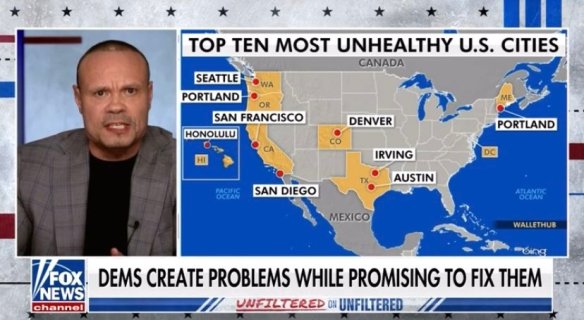
Here are two examples of what the Democrats are up against. Some clown on Fox claimed that Democrats don’t really care about people who live in cities, because the 10 unhealthiest cities in America are run by Democrats:

FK4VrP_UYBA1OH9

But the list of cities Fox used referred to the 10 healthiest cities!

FK4VrQBUcAA-iKV

Meanwhile, the NY Times put a story on the front page suggesting the January 6th committee isn’t acting normally:

The House committee investigating the assault on the Capitol and what led to it is employing techniques more common in criminal cases than in congressional inquiries.

The story is accurate. Since T___ and his allies aren’t cooperating, the committee has been forced to be aggressive. The article suggests this is a risky move and might backfire. It’s not normal for congressional committees! What’s especially weird, however, is that, as an example of normal practice, the article ignores Watergate and Iran-Contra and uses the Benghazi attack. The Republican House committee that “investigated” Benghazi went on for months in order to push a non-existent scandal. Their behavior apparently seemed normal to the Times:

By comparison, the House select committee that spent two and a half years investigating the 2012 Benghazi attack issued just a dozen or so subpoenas — a small fraction of the number issued by the Jan. 6 committee so far — and made no criminal referrals.

The author James Gleick sums up:

Did anyone at the Times think for a second before including this Benghazi comparison? Why so few subpoenas? Maybe because, even though it was a sham, everyone cooperated (remember Hillary?) [testifying for 11 hours] Why  no criminal referrals? Maybe because THERE WERE NO CRIMES.