Russia vs. Ukraine: Sometimes the Truth Leaks Out

The Russian government inadvertently told us the purpose of the invasion. The historian Timothy Snyder, an expert on Eastern Europe, explains:

Russia has a history of aiming for quick and decisive strikes against Ukraine, failing, then revealing the aims of the operation in media prepared on the assumption of success.

Such a sequences of events unfolded in 2014 during a Ukrainian presidential election. Russia tried to hack Ukraine’s central election commission so that it would present a far-right candidate, who in fact got less than 1% of the vote, as the winner.

The hack failed, but Russian media had been prepared for its success; and Russian television went on air with falsified results and even digital images that matched what the hack was supposed to produce. 

Something similar seems to have happened with the invasion of 2022. Like the hack in 2014, the invasion did not lead to the expected result. This left Russian media with prepared material which, since it assumed success, reveals (or confirms) the goals of the Russian invasion.

No doubt most such material was never published or quickly removed. This article seems to have slipped through. It was written for approved Russian media on the assumption of a quick Russian victory, and so reveals the goals of the invasion. 

The goals of the invasion described here are destruction of the Ukrainian government, control of all Ukrainian territory, the end of Ukrainian sovereignty, and a solution to the “Ukrainian question.”

Further anticipated is the creation of a unified Russian-Ukrainian-Belarusian entity, and the rebalancing of the world order in a “new epoch” of Russian domination over a humiliated and divided West. 

Unquote.

Of course, a divided West and a subjugated Ukraine is exactly what the former president tried to give his “savvy” Russian mentor when T____ criticized our allies, threatened to leave NATO and pressured Zelensky to provide dirt on Biden by freezing military aid (which led to his second impeachment).

Putin May Have Bitten Off Too Much in Ukraine

According to The Washington Post, Max Boot is a historian and foreign-policy analyst who the International Institute for Strategic Studies has called one of the “world’s leading authorities on armed conflict”. His response to Russia’s invasion of Ukraine (population 43 million) makes sense to me. He begins by quoting Churchill:

“There are no certainties in war.” – Winston Churchill

I am impatient with both those who insist that Vladimir Putin’s invasion of Ukraine is a stroke of “genius” and those who insist it is a historic blunder. The truth is we don’t know which it will be. That will depend on what the people of Ukraine — and the nations of the West — do to resist this war of aggression.

Putin does not shy away from the use of military force, and his experience of war over the past two decades undoubtedly makes him confident, even cocky, as Russian forces attack Ukraine.

Putin’s regime began with a successful attack on Chechnya [pop. 1.4 million] in 1999. Russian forces besieged the capital, Grozny, killing thousands, and soon took control of the entire breakaway republic. While a guerrilla war smoldered for years, Putin was finally able to establish control by installing a mini-dictator, first Akhmad Kadyrov, then his son . . .

Putin invaded a sovereign country, Georgia [pop. 4 million], in 2008. In just five days, the Russians drove to the outskirts of Tbilisi but did not take the capital. Instead, the invaders secured the Russian enclaves of South Ossetia and Abkhazia, which remain under Kremlin control. Georgia’s ambitions to join NATO lay shattered.

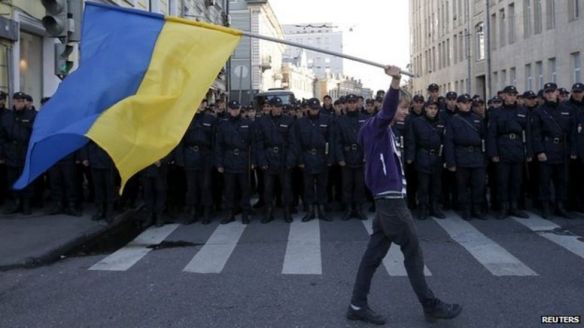
In 2014, after the overthrow of a pro-Russian ruler in Kyiv, Putin launched his first invasion of Ukraine. “Little green men” — i.e., Russian troops in uniforms without insignia — took control of Crimea [pop. 2.4 million]. Meanwhile, Russian-backed separatists launched a war in the Donbas region of eastern Ukraine that has continued to the present day . . . 

Then came the 2015 Russian intervention in Syria. With Russia’s ally Bashar al-Assad on the verge of being toppled, Putin sent in the Russian air force and a small number of Russian mercenaries and special forces to rescue him. With indiscriminate bombing of urban areas and even hospitals, the Russians killed thousands of civilians . . . . Putin defied predictions from then-President Barack Obama that Syria would turn out to be a Vietnam-style “quagmire” for Russia. Instead, it turned into a training ground for the kind of high-tech war that Putin is now unleashing on Ukraine.

It is easy to see how this long record of military success can lead Putin, who has ruled unchallenged for more than two decades, to imagine that he can now turn Ukraine into a satrapy. But the war he just unleashed on Ukraine is considerably more challenging than the ones he has previously waged.

_77728610_77727627

Ukraine’s military, while inferior to Russia’s, is superior to those of all the other foes Russia has fought over the past two decades. Ukrainians have more modern weapons than they did in 2014, and they have years of combat experience fighting Russian separatists. Russia’s continuing aggression has also made Ukrainians more nationalistic and pro-Western. One poll shows that support in Ukraine for joining NATO has risen from 34 percent in 2013 to 62 percent today. Ukrainians have been signaling they will resist, with even great-grandmothers training for guerrilla warfare [and, according to one report, thousands of automatic weapons distributed to the public].

. . . The revamped Russian military can certainly defeat the Ukrainian armed forces and take Kyiv. But then what? As Gen. David H. Petraeus said during the U.S. invasion of Iraq in 2003: “Tell me how this ends.”

The 190,000 troops that Putin has assembled to invade Ukraine are sufficient to effect regime change — but, as Petraeus recently noted, they are completely insufficient to control a country of more than 43 million people. That would likely require hundreds of thousands more Russian troops and could expose them to a costly, drawn-out guerrilla war that could sap Putin’s popularity.

Putin’s best bet would be to install a puppet regime in Kyiv — but how to keep it in power? The Ukrainian people have already used “people power” to topple two previous pro-Russian leaders, in 2005 and 2014. What is to stop them from doing it a third time? Putin would need to create a pro-Russian security force in Ukraine but, given the growing nationalism of the populace, that will be hard to do.

None of this is to suggest that his offensive is doomed to fail. It would be foolhardy to bet against a tyrant with Putin’s track record. But there is nothing foreordained about Russian success — and much that the West can do to stymie his aggression. It is imperative for the West to keep arming and supporting the Ukrainians . . .  and to keep piling up draconian sanctions on the Russian regime.

Napoleon marched into Spain in 1808 confident of success, only to bog down in a long and costly guerrilla war aided and abetted by his English enemies. Before long, he would complain that he was being bled dry by the “Spanish ulcer.” The West now has an opportunity to create a “Ukrainian ulcer” for Putin. We must ensure that the Russian dictator’s cruel and reckless gambit does not pay off.

Where They Are in Ukraine Right Now

We’ll be learning more about Ukraine now that Putin has recognized two parts of it as “independent nations” and moved in Russian “peacekeeping” forces. They’re the so-called People’s Republics of Donetsk and Luhansk. I wondered what this meant in terms of Ukrainian geography. 

Legally speaking, Ukraine is divided into 27 administrative regions. There are 24 “oblasts” (a term inherited from the Soviet Union”), plus the Autonomous Republic of Crimea (which Russia has occupied since 2014) and two cities, the Crimean city of Sevastopol and Ukraine’s capital, Kiev (or Kyiv). Donetsk and Luhansk are the two oblasts at the eastern edge of Ukraine next to Russia. Their principal cities are also called “Donetsk” and “Luhansk” (like New York, New York). In addition, the Donetsk and Luhansk oblasts are collectively known as the “Donbas” region. Unlike Crimea, Donbas is mostly Ukrainians, not ethnic Russians.

provinces-of-ukraine-map

There’s been fighting between the Ukrainian government and Russian-backed rebels in the Donbas region since 2014 (the same year Russia took Crimea). Thousands have died. More than a million Ukrainians have been displaced — most of them have left the country. Lately, there’s been a stalemate between the two sides and a partial ceasefire.

In the map below showing recent ceasefire violations (the yellow dots), the darker gray area represents Donbas as a whole (or most of it). The Ukrainian government controls the area north and west of the red line; the rebels control area south and east of the line.

FMIf9ieXMAEzgFd

The current division raises an obvious question: what will happen to the parts of Donetsk and Luhansk now controlled by Ukraine? Well, the Russian puppets who now “lead” those two “independent nations” have declared all of Donetsk and Luhansk (the entire Donbas) to belong to their new “nations”. So will the Russians try to take control of the areas north and west of the red line? If the Russians agree that those parts of Donbas really do belong to the two new People’s Republics, they will have to take them by force. Ukraine will resist and the fighting will be much worse than it’s been.

Ukrainian resistance may then lead to Russia deciding to take Ukraine as a whole, carrying out the massive invasion everybody has been talking about. An article in The Guardian sums up the current situation:

[The decision to recognize Donetsk and Luhansk as independent nations] answers some questions but others remain. There is a chance Putin may simply recognise the two republics “as they are”. This, after months of apocalyptic scenarios, would probably be privately accepted as a good outcome by Ukraine and the west.

But it seems likely that Putin has much more in mind than simply taking a nibble out of Ukraine’s east and taking formal responsibility for territories he already de facto controlled.

Putin’s final words, that if Kyiv did not stop the violence [violence that Russian propaganda claims Kiev is committing, but isn’t], they would bear responsibility for the “ensuing bloodshed”, were ominous in the extreme. It sounded, quite simply, like a declaration of war.

Why Putin and the Other Oligarchs May Prefer War to Peace

Everything that’s happening indicates that Russia will soon invade Ukraine (possibly after China’s Olympics ends tomorrow). The Russians will blame the Ukrainian government for provocations the Russians and their Ukrainian supporters have themselves caused and even claim it’s the Ukrainians who have attacked the Russians.

An invasion may not make much sense to the rest of the world, but Alexander Gabuev, a senior fellow at the Carnegie Moscow Centre, argues for The Economist that “elites have hijacked Russia and conflated the country’s interests with their own” and that’s “why Vladimir Putin and his entourage want war”. Further economic sanctions might even be in the Russian oligarchy’s interests:

. . . When it comes to Ukraine, people in Moscow and the West can be forgiven for assuming that the Kremlin’s policy is informed by a dispassionate strategy derived from endless hours of interagency debate and the weighing of pros and cons. What actually drives the Kremlin are the tough ideas and interests of a small group of longtime lieutenants to President Vladimir Putin, as well as those of the Russian leader himself. Emboldened by perceptions of the West’s terminal decline, no one in this group loses much sleep about the prospect of an open-ended confrontation with America and Europe. In fact, the core members of this group would all be among the main beneficiaries of a deeper schism.

Consider Mr Putin’s war cabinet, which is the locus of most decision-making. It consists of Nikolai Patrushev, the head of the Security Council; Alexander Bortnikov, the head of the FSB (the main successor agency of the KGB intelligence service); Sergei Naryshkin, the head of Russian Foreign Intelligence Service; and Defence Minister Sergei Shoigu. Their average age is 68 years old and they have a lot in common. The collapse of the Soviet Union, which Mr Putin famously described as the greatest geopolitical catastrophe of the 20th century, was the defining episode of their adult lives. Four out of five have a KGB background, with three, including the president himself, coming from the ranks of counterintelligence. It is these hardened men, not polished diplomats like Foreign Minister Sergey Lavrov, who run the country’s foreign policy.

In recent years members of this group have become very vocal. Messrs Patrushev and Naryshkin frequently give lengthy interviews articulating their views on global developments and Russia’s international role. According to them, the American-led order is in deep crisis thanks to the failure of Western democracy and internal conflicts spurred by the promotion of tolerance, multiculturalism and respect for the rights of minorities. A new multipolar order is taking shape that reflects an unstoppable shift in power to authoritarian regimes that support traditional values. A feisty, resurgent Russia is a pioneering force behind the arrival of this new order, along with a rising China. Given the state of affairs in western countries, the pair contend, it’s only natural that they seek to contain Russia and to install pro-Western regimes in former Soviet republics. The West’s ultimate goal of a Colour Revolution in Russia itself would lead to the country’s conclusive collapse.

Washington sees unfinished business in Russia’s persistence and success, according to Mr Putin’s entourage. As America’s power wanes, its methods are becoming more aggressive. This is why the West cannot be trusted. The best way to ensure the safety of Russia’s existing political regime and to advance its national interests is to keep America off balance.

Seen this way, Ukraine is the central battleground of the struggle. The stakes could not be higher. Should Moscow allow that country to be fully absorbed into a western sphere of influence, Russia’s endurance as a great power will itself be under threat. On a personal level, the world view of the hard men is an odd amalgam of Soviet nostalgia, great-power chauvinism and the trappings of the Russian Orthodox faith. The fact that the new elite in Kyiv glorifies the Ukrainian nationalists of the 20th century and thumb their noses at Moscow is a huge personal affront.

Why then are the people around Putin not scared about possible fallout from a new round of far-reaching economic sanctions? In their eyes, the sanctions that the West imposed to punish Russia for the annexation of Crimea and the war in Donbas were intended largely to check Russia’s rise. America and its allies would have found a way to introduce them one way or another, they were just looking for an excuse. Since 2014 such views have solidified. Messrs Patrushev, Bortnikov and Naryshkin all find themselves on the U.S. Treasury’s blacklist already, along with many other members of Mr Putin’s inner circle. There is no way back for them to the West’s creature comforts. They are destined to end their lives in Fortress Russia, with their assets and their relatives alongside them.

As for sanctions by sector, including those that President Joe Biden’s team plans to impose should Russia invade Ukraine, these may end up largely strengthening the hard men’s grip on the national economy. Import substitution efforts have generated large flows of budget funds that are controlled by the coterie and their proxies, including through Rostec. The massive state conglomerate is run by a friend of Mr Putin’s from his KGB days in East Germany, Sergey Chemezov. In a similar vein, a ban on food imports from countries that have sanctioned Russia has led to spectacular growth in Russian agribusiness. The sector is overseen by Mr Patrushev’s elder son Dmitry, who is Mr Putin’s agriculture minister.

Similarly much-touted financial sanctions have led to a bigger role for state-owned banks which, unsurprisingly enough, are also filled with KGB veterans. If anything, further sanctions wouldn’t just fail to hurt Mr Putin’s war cabinet, they would secure its members’ place as the top beneficiaries of Russia’s deepening economic autarky. The same logic is true of domestic politics: as the country descends into a near-permanent state of siege, the security services will be the most important pillar of the regime. That further cements the hard men’s grip on the country.

After two years of Covid-induced self-isolation for Kremlin bosses, there is a clear tendency toward tunnel vision and a dearth of checks and balances. Russia’s interests are increasingly becoming conflated with the personal interests of the people at the very top of the system.
The Scandal Is that They’re So Good at Creating “Scandals”

Mehdi Hassan of MSNBC is impressed:

You do have to admire the rightwing media echo chamber’s ability to weaponize even the most hyped-up of stories (John Durham filing!), misrepresent AND distort it, and then push it out with a relentless message discipline on cable and online that liberals could only ever dream of. . . . 

If your coverage and analysis of U.S. politics doesn’t center on or even include the fact that the right has a massive, well-funded, coordinated propaganda machine and its opponents don’t, then you’re really not doing it right.

Paul Waldman of The Washington Post is too:

On an average day, Fox News tells dozens or even hundreds of outright lies. Meanwhile there’s an entire trial happening in New York about A SINGLE WORD in a New York Times editorial about Sarah Palin, which was quickly corrected. Different worlds. 

Mr. Waldman wrote more about this latest instance of propaganda vs. reality:

When some appalling new story emerges of political actors lying to the public, should [the news media] confront it? Or will the attempt to debunk the story only draw more attention to it, spreading the lies further?

There’s no perfect answer that fits every situation. But at the very least, it’s important to understand how systems of propaganda operate, so we can try to minimize the damage they do. And never in our history has there been a propaganda system that operates with the skill, enthusiasm and outright shamelessness of the one conservatives have working for them right now.

That’s depressingly evident in the latest “blockbuster” story gripping the right, a story built on a grab bag of misleading assertions, misinterpretations and outright lies. It forces us to ask yet again: Is it possible to have a healthy democracy when so much of it is soaking in misinformation?

The current story concerns John Durham, the special counsel who has spent almost three years investigating the investigation into Russia’s attempts to subvert the 2016 election. You can read a comprehensive rundown of the facts here or here.

Durham has indicted Democratic lawyer Michael Sussmann for allegedly lying to the FBI, which Sussmann denies [that indictment itself is incredibly weak — it involves whether Sussman said he was representing a client in a private conversation he had with an FBI agent he knew]. In 2016, Sussmann, whose firm was doing legal work for Hillary Clinton’s campaign, gave the FBI a tip involving supposedly suspicious internet traffic between servers in Trump buildings and a Russian bank; it turned out to be nothing nefarious.

Sussman got the information through another client of his, Rodney Joffe, a technology executive with government cybersecurity contracts, including one that involved protecting the White House from cyber attacks.

In a court filing last week, Durham alleged that Joffe “exploited” his arrangement with the White House to obtain the data in question “for the purpose of gathering derogatory information about Donald Trump.”

Joffe vigorously denies this. His spokesperson says examining such data was par for the course, as he was doing cybersecurity work for the government, and in late 2016, everyone was appropriately concerned about Russian hacking. Durham has not indicted Joffe for anything.

But this is where the propaganda machine goes nuclear.

Fox News is treating this like a stunning revelation (“Worse than Watergate” trumpeted Sean Hannity), dramatically amping up the story with each retelling. After all, it isn’t good enough to say a lawyer with a second-order connection to the Clinton campaign got information from another client with legitimate access to White House internet traffic data; that’s not nearly scandalous enough.

So Fox published a headline reading “Clinton campaign paid to ‘infiltrate’ Trump Tower, White House servers to link Trump to Russia, Durham finds.” The Washington Examiner claimed Sussmann “spied on Trump’s White House office” — even though the internet data came from 2016, when Barack Obama was president.

“Hillary broke into a presidential candidate’s computer server and a sitting president’s computer server,” ludicrously claimed Fox host Jesse Watters. “There, her hackers planted evidence, fabricated evidence connecting Trump to Russia.”

Tucker Carlson added that Clinton’s campaign stole “presumably text messages,” which not even Durham alleges.

These are all lies. This is not about “hacking,” no evidence was planted and the data on White House traffic came from when Obama was president. You can argue that Durham’s filing was itself misleading and tendentious [which it was], but even if every word of it was true, what they were saying on Fox was outrageously false.

But the propaganda machine doesn’t stop there. Republican politicians — even those who know better — see their constituents being fed this line, so they rush to get in on the act:

The coverage has gone meta; Fox is now angrily asking why other news outlets are not matching their breathless coverage of this nothing burger, feeding their viewers’ paranoid fantasies about cover-ups and conspiracies.

So in no time, we move from questionable claims to obviously false allegations to demands for legal retaliation against political opponents to whining about their own victimhood, with the enthusiastic participation of GOP officeholders, none of whom has the courage to say, “Hey guys, I hate Hillary as much as anyone, but it seems like we’re running out ahead of the facts here.”

That’s because every Republican relies on the propaganda machine. It helps their own campaigns. It keeps the base in a state of perpetual anger. And if you question it, you will become its enemy.

This is happening while there’s an entire trial going on in New York about a single inaccurate word in a New York Times editorial about Sarah Palin — an editorial that was quickly corrected. The Times is falling all over itself to explain how it got something wrong, and no one on the left is defending the paper. Meanwhile, Fox programming contains extraordinary amounts of factual errors, misleading assertions and outright lies, almost none of which ever get corrected.

So where does that leave us? The unfortunate answer is that when a propaganda apparatus such as this one is so deeply embedded within one of our parties, it becomes almost impossible to puncture. Fantasies are accepted as fact, lies become immune to refutation and anyone who displays even a modicum of honesty is denounced as a traitor.

There may be a solution out there, a strategy to pull our politics back to reality. But if there is, we haven’t found it yet.

Unquote.

The former president issued a statement regarding this “scandal” claiming members of the Clinton campaign would have been executed (for crimes they didn’t actually commit), back when America was stronger. His bullshit was dutifully repeated here, there and everywhere as if it made any sense at all.

As we sink further into the abyss.