The Biden Boom

The economy sucks. It’s hard to escape that message, even if it’s not true. Eric Boehlert of Press Run criticized the reality-based press (not Fox) for “burying great news”:

Like clockwork, the first Friday of the month brought another blockbuster jobs report. The U.S. economy under President Joe Biden added another 400,000-plus new jobs in March, it was announced last week.

Biden is currently on pace, during his first two full years in office, to oversee the creation of 10 million new jobs and an unemployment rate tumbling all the way down to 3 percent. That would be an unprecedented accomplishment in U.S. history. Context: In four years in office, T____ lost three million jobs, the worst record since Herbert Hoover.

Yet the press shrugs off the good news, determined to keep Biden pinned down. ā€œThe reality is that one strong jobs report does not snap the administration out of its current circumstances,ā€ PoliticoĀ stressedĀ Friday afternoon. How about 11 straight strong job reports, would that do the trick? Because the U.S. economy under Biden has been adding more than 400,000 jobs per month for 11 straight months.

The glaring disconnect between reality and how the press depicts White House accomplishments means a key question lingers: Why is the press rooting against Biden? Is the press either hoping for a T____ return to the White House, or at least committed to keeping Biden down so the 2024 rematch will be close and ā€˜entertaining’ for the press to cover? Is that why the Ginni Thomas insurrection story was politely marched off the stageĀ after just a few days of coverage last week by the same news outlets that are now inĀ year threeĀ of their dogged Hunter Biden reporting? (ā€œABC This Weekā€ includedĀ 19 referencesĀ to Hunter Biden yesterday.)

Just look at the relentlessly dour economic coverage. For the press, inflation remains the dominant, bad-news-for-Dems economic story. Even on Friday, the day the stellar jobs report was released, ā€œinflationā€ was mentioned on cable news nearly as often as ā€œjobs,ā€ according to TVeyes.com.

AxiosĀ contorted itselfĀ by claiming Biden’s promise to add ā€œmillionsā€ of new jobs (which he’s already accomplished), was being threatened because there aren’t enough workers, because so few people are out of work— or something.

The home-run report itself was often depicted as a mixed bag. These were some of the glass-half-empty headlines that appeared in the wake of the latest runaway numbers:

• ā€œAmerica’s Job Market Is On Fire. Here’s Why It Doesn’t Feel Like Itā€ (CNN)

• ā€œBooming Job Growth Is a Double-Edged Sword For Joe Bidenā€ (CNN)

• ā€œWhy a Great Jobs Report Can’t Save Joe Bidenā€ (CNN)

• ā€œUnemployment Hits Pandemic Low in March, But Uncertainty Looms Aheadā€ (Washington Post)

• ā€œBiden Gets a Strong Jobs Report, But a Sour Mood Still Prevailsā€ (Washington Post)

Totally normal journalism, right? The president announces another blockbuster jobs report and the press presents it as borderline bad news.

Note that the above headlines about the sour mood prevailing despite the great jobs, and how uncertainty looms, came from theĀ Post, the same outlet that slotted the March jobs report into 87th placed on its website on Friday.

That afternoon readers on the daily’sĀ homepage had to scroll down 87 headlines before they saw the first reference to the great economic news. Among the headlines that ran higher on theĀ Post site that afternoon [was] “What’s The Best Way to Share My Old Home Videos?”

On-air, CNN also downplayed the jobs report,Ā accordingĀ to Dean Baker, senior economist for Center for Economic and Policy Research. ā€œCNN’s coverage of the report quickly turned to inflation,ā€ he wrote. ā€œIn its more general coverage of the economy,Ā the jobs report — which tells us about the employment and earnings situation for more than 160 million people — was barely a blip.ā€

Sunday’s ā€œMeet the Pressā€ round table featured two segments with assembled pundits. One focused on how immigration might be a problem for Democrats in the midterms, the other on how T____ might be a problem for Democrats in the midterms. As usual, Biden’s historic economic record was ignored.

That’s why, according to aĀ recent poll, 37 percent of Americans think the economyĀ lostĀ jobs over the last year, when it’s gained 7 million. (Just 28 percent of people know jobs were up.)

Virtually all the Beltway coverage today agrees on this central point: When it comes to the economy, Biden’s approval rating is taking a hit because Americans are freaked out by inflation. But maybe it’s taking a hit because AmericansĀ are under the false impression that jobs are disappearing. Voters don’t know what they don’t know because the press isn’t interested in telling them about record job success and an economy that’s years ahead of where experts thought it would be coming out of a global pandemic.

Biden is facing not just one organized opposition in the form of the [Republican Party], but another in the form of the Beltway press corps.

Last week, theyĀ hit Biden with 14 separate questions at a press briefing over the supposed ā€œgaffeā€ he made, expressing his moral outrage over the mass killings Russian President Vladimir Putn has unleashed in Ukraine. . . . The press didn’t ask a single question about the state of the Ukraine war.

And remember all winter how the press treated Covid as the most important ā€œcrisisā€ Biden faced and hung the pandemic around his neck? Today, the topic has vanished, the press has given the White House no credit for steering the country back to normalcy, and instead has latched onto gas prices as being a defining issue under Biden. The buried Covid coverage represents a telling example of how an issue that the press itself claimed would define the Biden administration gets translated into no news when it turns towards positive territory.

The Beltway press needs to take its thumb off the Biden scale.

Unquote.

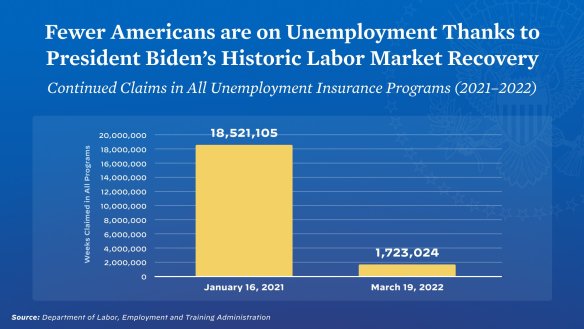
The Labor Department reported today that there were 166,000 new jobless claims last week, the lowest number since November 1968, when the population was much smaller.

The change since Biden took office. They didn’t all start driving for Uber:Ā Ā 

FPxYUTgXMAcecZy

Sadly, the writer quoted above has died in a bicycle accident:

Eric Boehlert, a veteran journalist who was a fierce critic of right-wing misinformation and hypocrisy in the news media, died on Monday in New Jersey. He was 57.
Providing for the General Welfare Works

I don’t think I’ve ever heard anybody say the goal of the Democratic Party is to “provide for the general welfare” (that phrase from the Constitution). We’ve all heard instead that Democrats are fiscally irresponsible big spenders, while Republicans keep government spending under control, helping the economy grow. Simon Rosenberg, who leads a progressive think tank, explains how wrong this is:Ā 

Inconvenient truth, fiscal responsibility edition:

Biden is now the third consecutive Democratic president to have seen the annual deficit drop significantly on their watch. It rose significantly under the last three Republican presidents.

[Biden] said he’d soon become the only president ā€œever to cut the deficit by more than $1 trillion in a single year.ā€ He’s on track to deliver. . . .Ā 

When it comes to the deficit, Americans have endured a remarkably consistent pattern for four decades.

It starts with a Republican presidential candidate denouncing the deficit and vowing to balance the budget if elected. That Republican then takes office, abandons interest in the issue, and expresses indifference when the deficit becomes vastly larger. Then a Democrat takes office, at which point Republican lawmakers who didn’t care at all about the deficit suddenly decide it’s a critical issue that the new president must immediately prioritize.

During the Democratic administration, the deficit invariably shrinks — a development Republicans tend to ignore — at which point the entire cycle starts over.

As the cycle spins, polls continue to show that most Americans see Republicans as the party most trustworthy to reduce the deficit, despite reality, because some partisan branding is tough to change, even in the face of four decades’ worth of evidence. [Steve Benen, MSNBC]

There is perhaps no more important false narrative in American politics than the [Republican Party] is the party of growth and fiscal responsibility.

Team Biden appears to be eager to take that on. Praise f—ing be.

The White House is leaning into a new argument: That deficit reduction can and should be recast as a positive feature of successful *progressive* economic policy. [Greg Sargent]

As we’ve been saying for many months now, it is essential that every 2022 voter knows that when Democrats are in power things get better, and when Republicans are in power they don’t.

The data is clear, overwhelming. . . .

Ā [It’s] the most important, least understood story in American politics. . .Ā 

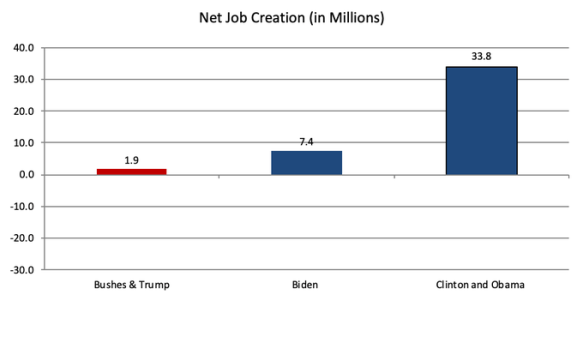
Since 1989, 43 million jobs have been created in the US, 41 million – 95% – have come under Democratic presidents.Ā 

33.8 million jobs = 16 yrs of Clinton & ObamaĀ 

7.4 million jobs = 13 months of Biden

1.9 million jobs = 16 years of Bush, Bush & T____ [Rosenberg]

FNBxgDGX0AQdi1L

. . . Democrats need to have this conversation with voters this year. It is essential knowledge, critical to understanding where we are, and where we are going as a nation.

Unquote.

It’s amazing that voters regularly say they “trust” Republicans more on the economy despite their consistently worse results. Why? Republicans associate themselves with low taxes and getting the government “out of the way”. But reducing taxes on people and corporations who already have lots of money doesn’t help the economy; it simply concentrates more wealth at the top. Repealing the Affordable Care Act or abolishing the Department of Education wouldn’t create jobs. Democrats do a better job on the economy by spreading the wealth around. They do this by promoting the “general welfare”, as the Constitution requires. When the general population is better off, the economy is better off. It’s as simple as that.

What Was Putin Thinking?

Why did he miscalculate so badly? Greg Sargent of The Washington Post asked that question of historian Timothy Snyder, the author of Bloodlands: Europe Between Hitler and Stalin and On Tyranny: Twenty Lessons from the Twentieth Century:

Sargent: What is it about Putin’s way of seeing the world, and his understanding of his own mythologies, that made it inevitable that he’d underestimate the Western response?

Snyder: For me the most revealing text here is the victory declaration, which the Russian press agency accidentally published on Feb. 26. What they say is that the West just basically needed one more push to fall into total disarray.

If you watch Jan. 6 clips over and over again, you can get that impression. The Russians really have been fixated on Jan. 6.

They thought a successful military operation in Ukraine would be that nudge: We’d feel helpless, we’d fall into conflict, it would help D____ T____ in the U.S., it would help populists around the world.

Sargent:Ā When you say Russia has been making a lot of Jan. 6 — what do they read into it?

Snyder: . . . T____’s attempt to overthrow the election on Jan. 6 made the American system look fragile. They think, ā€œOne more T____ and the Americans are done.ā€ In invading Ukraine, they think they’re putting huge pressure on the Biden administration. They’re going to make Biden look weak.

That probably was their deep fantasy about the West: Successful military occupation in Ukraine; the Biden administration is totally impotent; we humiliate them; T____ comes back; this is a big strategic victory for us.

Sargent:Ā There’s an essential through line from Jan. 6 to what we’re seeing now: Accountability for Jan. 6 becomes more important in this geopolitical context, where we’re reentering a conflict with Russia over whether liberal democracy is durable.

Snyder: . . . Putin’s idea about Ukraine is something like, ā€œUkrainian democracy is just a joke, I can overturn it easily. Everybody knows democracy and the rule of law are just a joke. What really matters are the capricious ideas of a tyrant. My capricious ideas happen to be that there are no Ukrainians. I’m going to send my army to make that trueā€.

That is much closer to the way T____ talks about politics than the way the average American talks about politics. I’m not saying T____ and Putin are exactly the same. But T____’s way of looking at the world — ā€œthere are no rules, nothing binds meā€ — that’s much closer to Putin. So there’s a very clear through line.

Sargent: . . . on some fundamental level, [Republicans aren’t] willing to forthrightly disavow Trump’s alignment with Putin and against Ukraine and the West.

Snyder:Ā I have this faint hope that Ukraine allows some folks to look at domestic politics from a new angle.

When we were in the Cold War, one reason the civil rights movement had the success it did, and one reason we kept up a welfare state, was that we were concerned about the Soviet rival.

Russia is a radically anti-democratic country now. Not only has it done frightful things to its own society; it has invaded another country that happens to be an imperfect democracy. We’re also an imperfect democracy.

When you have to look straight at the reality that a big powerful country is aimed at taking imperfect democracies and wiping them out, that gives you pause. I’m hopeful the realization that democracy rises and falls internationally might change the conversation at some deeper level about how we carry out our own voting.

Sargent:Ā Rising populism made Putin think Western liberal democracy was on the losing end of a grand struggle. But Biden and the Western allies may have seen that populism as a reason to get more galvanized and unified in response to the invasion.

Snyder:Ā In Putin’s mind, there’s a kind of confusion of pluralism with weakness. He’s misjudged both Zelensky and Biden, who are both pluralists: They’re both willing to look at things from various points of view. That can look like a form of weakness.

But history also shows that you can be a resolute pluralist. . . . Zelensky and Biden both embody that: At the end of the day, this whole idea that we listen to each other is something that we’re going to defend.

People in Ukraine are used to being able to exchange views and listen or not listen to their own government. That’s the thing which makes them different from Russia right now. That’s not something Putin can see from a distance.

Sargent:Ā You put your finger on something that’s been anĀ anti-liberal trope for at least a century: That pluralism is in some sense crippling to the possibilities of resolute national action. Putin is steeped in that type of anti-liberal philosophy, isn’t he?

Snyder:Ā Authoritarian regimes look efficient and attractive because they can make rapid decisions. But they often make rapidĀ badĀ decisions — like the rapid bad decision to invade Ukraine. Putin made it with just a handful of people, so he could make that decision rapidly.

That’s the reason you want institutions, the rule of law and pluralism and public discussion: To avoid idiotic decisions like that.

He’s been working from a certain far-right Russian tradition — that the state and the leader are the same person, and there should be no institutional barriers to what the leader wants to do.

It’s important for us to see that this is the realization of a different model, which has its own logic.

Sargent:Ā Paradoxically, we’re seeing that model’s decadence display itself.

Snyder:Ā Of course the situation is dangerous right now. But a lot of the sparks that are flying out of Russian media are a result precisely of their own fear and their own sense of crisis.

Your word ā€œdecadenceā€ is helpful here: When you’re decadent, what you say starts to depart more and more from the way the world actually is. Some Russian politicians are talking about how Poland needs to be taught a lesson. That’s alarming but it’s also unrealistic.

Sargent: I want to explore something you said to Ezra Klein: That in many ways, the response from the Western allies has been realistic and grounded, in that they aren’t trying to do too much. . . .Ā 

Snyder:Ā The thing that I’ve liked about the Biden administration is that they don’t have this metaphysical language that previous administrations have had about American power. They’ve stuck much closer to the ground.

They say, ā€œWe can’t do everything. But we can be creative and doĀ a lotĀ of things.ā€

By the way, that includes some stuff that we and others could go further on. We have to keep pouring arms into Ukraine, and the Europeans — now is the time to move forward on not buying oil and gas from Russia.

Sargent:Ā What’s your sense of where this is all going?

Snyder:Ā This war is happening because of the worldview and decisions of essentially one person. And I think it comes to an end when something shakes the worldview of that one person.

If the Ukrainians can get the upper hand and keep it for a few weeks, I think the worldview we have been talking about may start to shudder.

The right side has to be winning. That’s when we might have a settlement that ends this horrible war.

They Wanted To Assassinate a Troublesome Reporter

President Richard Nixon avoided impeachment or a jail cell by resigning. This strange story from 50 years ago made me wonder what plots were discussed in the White House more recently and whether that president will ever be punished. From The Washington Post:

Nixon’s hatred for the news media long predated his election as president. Where other politicians shrugged off public criticism, Nixon believed he was uniquely the target of journalistic vilification. When he entered the White House in 1969, he vowed revenge.

As president, Nixon orderedĀ illegal wiretaps on newsmenĀ who criticized his administration and instructed FBI director J. Edgar Hoover to compile a dossier on ā€œhomosexuals known and suspected in the Washington press corps.ā€ Nixon’s Justice Department filedĀ antitrust charges against television networks that criticized himĀ and went to court in an unprecedented attempt to legalize government censorship. Nixon’s aides even put together a list of ā€œenemies,ā€ including journalists, to be secretly targeted for government retaliation.

The journalist Nixon despised most was crusading columnist Jack Anderson, then theĀ most famous and feared investigative reporter in the country.Ā Anderson had a hand in exposing virtually every Nixon scandal since he first entered politics, and he escalated his attacks once Nixon was president, uncovering Nixon’s deceit in foreign policy, and his political and personal corruption.

Nixon railed that ā€œwe’ve got to do something with this son of a bitch,ā€ but nothing seemed to stop Anderson. The president’s reelection campaign planted a mole in the newsman’s office, but Anderson’s secretary discovered the snooping and ejected the infiltrator. A top White House adviser tried to discredit Anderson by leaking him forged documents, but he figured out they were bogus and didn’t fall for the ruse. TheĀ CIA illegally wiretapped and surveilled Anderson, but his nine children chased the spies away and Anderson mocked their incompetence in his column. The president evenĀ ordered his staff to smear Anderson as gay, but the allegation was as false as it was ridiculous and went nowhere.

Finally, in March 1972, the Nixon White House turned to the one method guaranteed to silence Anderson permanently: assassination. After meeting with the president in his hideaway office in the Old Executive Office Building, White House special counsel Charles Colson contacted his top White House operative, E. Howard Hunt. The ā€œson of a bitchā€ Anderson ā€œhad become a great thorn in the side of the president,ā€ Colson told Hunt, according to Hunt’s later Senate testimony, and the White House had to ā€œstop Anderson at all costs.ā€ (Hunt also corroborated this story in a 2003 interview.)

According to Hunt, Colson proposed assassinating Anderson by using an untraceable poison, perhaps a high dose of a hallucinogen like LSD. Colson instructed Hunt to ā€œexplore the matter with the CIA,ā€ where Hunt had previously worked as a spy. Although he never explicitly stated that Nixon gave the order,Ā Colson told Hunt that he was ā€œauthorized to do whatever was necessaryā€ to eliminate the reporter.

Hunt brought in his White House sidekick, G. Gordon Liddy, who was ā€œforever volunteering to rub people out,ā€ as Hunt put it. Liddy was enthusiastic: It would be a ā€œjustifiable homicide,ā€ he later said in media interviews, becauseĀ Anderson was a ā€œmutantā€ journalist who had ā€œgone too farā€ and ā€œhad to be stopped.ā€

On March 24, 1972, Hunt and Liddy met with a veteran CIA poison expert, Edward T. Gunn, in the basement of the Hay-Adams Hotel, a block from the White House. Gunn and Liddy, who didn’t know each other, used aliases.

Gunn later told Watergate prosecutors that Hunt said someone ā€œwas giving them troubleā€ and wanted an untraceable poison ā€œthat would get him out of the way.ā€ Gunn replied that no poison was completely undetectable. But he said the CIA had success painting LSD on a car’s steering wheel; the drug was then absorbed while driving and could cause a fatal car crash. However, there was also the risk that others — such as Anderson’s wife or children — would be poisoned if they drove the car instead.

ā€œOf course, there’s always the old simple method of simply dropping a pill in a guy’s cocktail,ā€ Gunn suggested. But Hunt pointed out that as a Mormon, Anderson was a teetotaler.

ā€œAspirin rouletteā€ was another option, Liddy said: slipping aĀ ā€œpoisoned replicaā€ of his headache tablet into his medicine bottle. Liddy and Hunt had already cased Anderson’s house for a possible break-in. But it would be ā€œhighly impractical,ā€ Hunt argued, to ā€œgo clandestinely into a medicine cabinet with a household full of people and pore over all of the drugs … until you found the one that Jack Anderson normally administered to himself.ā€

Besides, Liddy realized, it would take too long: ā€œMonths could go by before [Anderson] swallowed it.ā€ Not to mention the ā€œdanger than an innocent member of his family might take the pillā€ instead.

It might be simpler, Gunn suggested, to make Anderson’s car crash by ramming into it. Hunt and Liddy had already tailed Anderson as he drove between his home and office, and Gunn suggested a specific location along the route that was ā€œidealā€ because it was already ā€œnotorious as the scene of fatal auto accidentsā€Ā in Washington.

But Liddy thought this method was ā€œtoo chancyā€ and argued for simplicity: Anderson ā€œshould just become a fatal victim of the notorious Washington street-crime rate.ā€ Liddy offered to stab Anderson to death and make it look like a routine robbery by stealing Anderson’s watch and wallet. ā€œI know it violates the sensibilities of the innocent and tender-minded,ā€ Liddy later told Playboy, ā€œbut in the real world, you sometimes have to employ extreme and extralegal methods to preserve the very system whose laws you’re violating.ā€

Hunt briefed Colson about these various assassination options. But a few days later, the hit was canceled. The White House had a more urgent assignment: bugging the Democratic Party’s headquarters in the Watergate office building.

A few weeks later, Hunt and Liddy were arrested for their role in the Watergate burglary. The scandal that toppled Nixon’s presidency began unraveling.

In the aftermath, aĀ Senate committee investigated and confirmed the plot to poison Anderson. Liddy and HuntĀ eventually acknowledged their participation in the conspiracy.Ā Colson never did. All three went to prison for Watergate-related crimes.

But not Nixon, whose role in the Anderson plot has never been definitively established. Hunt believed that Colson didn’t have the ā€œballsā€ to order the assassination on his own and had acted at Nixon’s behest. Colson denied that. But it is hard to imagine Nixon’s closest advisers plotting to execute America’s leading investigative reporter without the tacit — if not explicit — authorization of the president.

“I’m Not Letting Anybody in the Senate Steal My Joy”

Today, Senator Cory Booker, Democrat of New Jersey, spoke in support of Judge Ketanji Brown Jackson’s nomination to the Supreme Court. He spoke for 20 minutes instead of asking her questions. Booker offered a powerfully emotional corrective to what’s been described as a “disgraceful” process, one in which a few Republican senators tried to outdo each other’s disrespectful, demagogic performances. Judge Jackson will be the first black woman to sit on the Supreme Court. Senator Booker made America seem better than it often is.

The senator devotes the first 10 minutes or so debunking ludicrous Republican attacks. If you don’t have 20 minutes to spare, jump 10 minutes in to watch the portion of his remarks that impressed so many today and should be remembered for years to come.

In another Washington building, the right-wing majority on the Supreme Court continued to side with Republicans whenever there’s a voting rights case, not only siding with them, but interjecting themselves when they don’t need to. When Judge Jackson is Justice Jackson, maybe she can convince one or two of her Republican colleagues to occasionally act like judges instead of right-wing hacks.

In other news, one of the Court’s worst members, Justice Clarence Thomas, has been in the hospital with an unnamed infection. It’s too much to ask, but may he soon rest in peace. The Court would then have four Republican crazies instead of five. That would allow the somewhat less corrupt Republican who’s Chief Justice to sometimes stop his radical colleagues from doing their worst.