The Passing Parade

The year is almost over and so is the decade that’s strangely ending with a “19” instead of a nice, round “20”. There is lots of news and commentary out there. An extremely truncated summary:

It didn’t make a splash, because this is 2019, not 1971, but The Washington Post reported:

A confidential trove of government documents obtained by The Washington Post reveals that senior U.S. officials failed to tell the truth about the war in Afghanistan throughout the 18-year campaign, making rosy pronouncements they knew to be false and hiding unmistakable evidence the war had become unwinnable…

“We were devoid of a fundamental understanding of Afghanistan — we didn’t know what we were doing,” Douglas Lute, a three-star Army general who served as the White House’s Afghan war czar during the Bush and Obama administrations, told government interviewers in 2015. He added: “What are we trying to do here? We didn’t have the foggiest notion of what we were undertaking … Who will say this was in vain?”

The Afghanistan Papers won’t get as much publicity as the Pentagon Papers. They should have called them the “Afghan Papers”, more concise language now being the custom.

The Post also explained the history of the “It was Ukraine, not Russia” myth that has taken up permanent residence in what’s left of the Toddler’s brain and is so popular among right-wing politicians and propagandists everywhere. In a few words, the Russian government created the myth in order to cast blame on somebody else:

The president’s intense resistance to the assessment of U.S. intelligence agencies that Russia systematically interfered in the 2016 campaign — and the blame he cast instead on a rival country — led many of his advisers to think that Putin himself helped spur the idea of Ukraine’s culpability, said the officials, who spoke on the condition of anonymity [of course]. . .One former senior White House official said [the president] even stated so explicitly at one point, saying he knew Ukraine was the real culprit because “Putin told me.”

The Popular Information political newsletter summarized new analysis of the president’s high crimes and misdemeanors:

An extraordinary analysis by top legal experts, published by Just Security, clearly explains how the impeachment inquiry [implied] that [the pres] committed at least three (and probably more) federal crimes. All of these crimes involved him abusing his presidential powers, making them particularly relevant to impeachment….

  • Federal campaign finance law
  • Bribery
  • Honest services fraud

[This last one] occurs “when a public official breaches his duty to act in the best interests of his constituents by performing an official act in exchange for personal gain”, such as “withholding funding that had been allocated by Congress —  money intended to advance U.S. national security by helping Ukraine combat Russian aggression — to advance his personal political interests”.

Cool.

By the way, Congressional Democrats and Rep. Justin Amash (an independent who was kicked out of the Republican Party when he exercised his conscience) finally got around to impeaching the monster. Paul Krugman reacted:

What we saw Wednesday was a parade of sycophants comparing their leader to Jesus Christ while spouting discredited conspiracy theories straight from the Kremlin. And as they were doing so, the object of their adoration was giving an endless, rambling, third-world-dictator-style speech, full of lies, that veered between grandiosity and self-pity…

Republicans, in other words, are beyond redemption; they’ve become just another authoritarian party devoted to the leader principle. And like similar parties in other countries, the G.O.P. is trying to rig future elections through gerrymandering and voter suppression, creating a permanent lock on power

But if Trump’s supporters look just like their counterparts in failed democracies abroad, his opponents don’t.

One of the depressing aspects of the rise of authoritarian parties like Hungary’s Fidesz and Poland’s Law and Justice has been the fecklessness of their opposition — disunited, disorganized, unable to make an effective challenge even to unpopular autocrats as they consolidated their power.

Trumpism, however, faced determined, united, effective opposition from the beginning, which has been reflected both in mass marches and in Democratic electoral victories. In 2017 there were only 15 Democratic governors, compared with 35 Republicans; today the score is 24 to 26. And last year, of course, Democrats won a landslide victory in House elections, which is what made the impeachment hearing and vote possible.

Many of the new Democratic members of Congress are in Republican-leaning districts, and some observers expected a significant number to defect on Wednesday. Instead, the party held together almost completely. True, so did its opponents; but while Republicans sounded, well, deranged in their defense of Trump, Democrats came across as sober and serious, determined to do their constitutional duty even if it involved political risks.

Now, none of this necessarily means that democracy will survive….

What we learned Wednesday, however, was that those who define America by its ideals, not the dominance of a particular ethnic group, won’t give up easily. The bad news is that our bad people are as bad as everyone else’s. The good news is that our good people seem unusually determined to do the right thing.

Finally, speaking of good people, the widely-read evangelical magazine Christianity Today called for the Toddler’s removal from office. The editorial got so much attention, their website crashed:

His Twitter feed alone—with its habitual string of mischaracterizations, lies, and slanders—is a near perfect example of a human being who is morally lost and confused…. .Whether [he] should be removed from office by the Senate or by popular vote next election — that is a matter of prudential judgment. That he should be removed, we believe, is not a matter of partisan loyalties but loyalty to the Creator of the Ten Commandments….

To the many evangelicals who continue to support [him] in spite of his blackened moral record, we might say this: Remember who you are and whom you serve. Consider how your justification of [the president] influences your witness to your Lord and Savior. Consider what an unbelieving world will say if you continue to brush off [his] immoral words and behavior in the cause of political expediency. If we don’t reverse course now, will anyone take anything we say about justice and righteousness with any seriousness for decades to come?

You have to wonder how many of the president’s supporters understand that, if the Senate did its duty in the new year, our convicted president would be replaced by super-Christian Mike Pence, not the dreaded mainline Protestant who failed to carry Wisconsin.

In conclusion, it seems to me that we face two major issues:  climate change and bringing majority rule to America.

Majority rule would mean dealing with the courts, the Electoral College, a skewed Senate, gerrymandering, election security, campaign finance reform and voter suppression. It’s quite an agenda. But, as Senator Warren [subject of the latest Rolling Stone interview] keeps saying, we need big, structural change in our political system if we’re going to make progress on issues like climate change, inequality and much more.

Oh, and you might check out “The Historical Case for Abolishing Billionaires” in The Guardian. It begins by quoting another well-known proponent of regulated capitalism, Adam Smith.
The House Judiciary Committee Summarizes Its Findings

The House Judiciary Committee released a 180-page report yesterday explaining why the president should be removed from office (the document is 658 pages long because of other contents). Below, in 1,500 words, the Democratic majority summarizes the case against the president:

The House Committee on the Judiciary has completed the consideration of two articles of impeachment against President Donald J. Trump. The first article charges that the President used the powers of his office to solicit and pressure a foreign government, Ukraine, to investigate his domestic political rival and interfere in the upcoming United States Presidential elections. The second article charges that the President categorically obstructed the Congressional impeachment inquiry into his conduct. Taken together, the articles charge that President Trump has placed his personal, political interests above our national security, our free and fair elections, and our system of checks and balances. He has engaged in a pattern of misconduct that will continue if left unchecked. Accordingly, President Trump should be impeached and removed from office.

This report proceeds in four parts.

FIRST, it describes the process by which the Committee came to recommend that the House impeach the President of the United States. From start to finish, the House conducted its inquiry with a commitment to transparency, efficiency, and fairness. The Minority was present and able to participate at every stage. From September to November of this year, the House Permanent Select Committee on Intelligence, in coordination with the Committee on Oversight and Reform and the Committee on Foreign Affairs, collected evidence related to the charges against President Trump. The House Permanent Select Committee on Intelligence held public hearings to develop the evidence and share it with the American people. The committees then transmitted their evidence to the Judiciary Committee, together with a nearly 300-page public report and 123 pages of Minority views.

Consistent with House precedent, after the evidence arrived at the Judiciary Committee, the Committee invited President Trump and his counsel to participate in the process. Notably, and unlike past Presidents, President Trump declined to attend any hearings, question any witnesses, or recommend that the Committee call additional witnesses in his defense.

SECOND, the report discusses the standard for impeachment under the Constitution. The Framers were careful students of history and knew that threats to democracy could take many forms. Therefore, they adopted a standard for impeachment that captured a range of misconduct: “Treason, Bribery, or other high Crimes and Misdemeanors.” A clear theme unified these constitutional wrongs: officials who abused, abandoned, or sought personal benefit from their public trust—and who threatened the rule of law if left in power—faced impeachment and removal. The Framers principally intended “other high Crimes and Misdemeanors” to include three forms of Presidential wrongdoing: (1) abuse of power, (2) betrayal of the national interest through foreign entanglements, and (3) corruption of office and elections. Any one of these violations of the public trust justifies impeachment. When combined in a single course of conduct, as is the case here, they state a powerful case for impeachment and removal from office.

THIRD, the report examines the facts underlying the first charge against President Trump: abuse of power. On July 25, 2019, when he spoke by telephone to President Zelensky of Ukraine, President Trump had the upper hand. President Zelensky had been recently elected. Ukraine was locked in an 3 existential battle with Russia, which had invaded and illegally occupied eastern Ukraine more than five years earlier. The conflict was continuing and Ukraine needed our help—both in the form of vital military aid, which had already been appropriated by Congress because of our security interests in the region, and also in the form of an Oval Office meeting, to show the world that the United States continues to stand with our ally in resisting the aggression of our adversary.

On that July 25 call, President Zelensky expressed gratitude for past American defense support and indicated that he was ready to buy more anti-tank weapons from the United States. In response, President Trump immediately asked President Zelensky to “do us a favor, though.” He asked Ukraine to announce two bogus investigations: one into former Vice President Joseph R. Biden, Jr., then his leading opponent in the 2020 election, and another to advance a conspiracy theory that Ukraine, not Russia, attacked our elections in 2016. One investigation was designed to help him gain an advantage in the 2020 election. The other was intended to help President Trump conceal the truth about the 2016 election. Neither investigation was supported by the evidence or premised on any legitimate national security or foreign policy interest.

After the call with President Zelensky, President Trump ratcheted up the pressure. He continued to dangle the offer of the Oval Office meeting and to withhold the $391 million in military aid. The evidence shows that, on the same day that the call took place, Ukrainian officials became aware that funding had been withheld. The President also deployed his private attorney and other agents, some acting outside the official and regular channels of diplomacy, to make his desires known.

These facts establish impeachable abuse of power. To the founding generation, abuse of power was a specific, well-defined offense. It occurs when a President exercises the powers of his office to obtain an improper personal benefit while injuring and ignoring the national interest. The evidence shows that President Trump leveraged his office to solicit and pressure Ukraine for a personal favor.

This unquestionably constitutes an impeachable offense, but the first article of impeachment also identifies two aggravating factors. When President Trump asked President Zelensky for a favor, he did so at the expense of both our national security and the integrity of our elections. As to the first, America has a vital national security interest in countering Russian aggression, and our strategic partner Ukraine is quite literally at the front line of resisting that aggression. When the President weakens a partner who advances American security interests, the President weakens America. As to election integrity, American democracy above all rests upon elections that are free and fair. When the President demands that a foreign government announce investigations targeting his domestic political rival, he corrupts our elections. To the Founders, this kind of corruption was especially pernicious, and plainly merited impeachment. American elections should be for Americans only.

FOURTH and finally, the report describes the second charge against President Trump: obstruction of Congress. President Trump did everything in his power to obstruct the House’s impeachment inquiry. Following his direction not to cooperate with the inquiry, the White House and other agencies refused to produce a single document in response to Congressional subpoenas. President Trump also attempted to muzzle witnesses, threatening to damage their careers if they agreed to testify, and even attacked one witness during her live testimony before Congress. To their great credit, many witnesses 4 from across government–including from the National Security Council, the Department of State, and the Department of Defense–ignored the President’s unlawful orders and cooperated with the inquiry. In the end, however, nine senior officials followed President Trump’s direction and continue to defy duly authorized Congressional subpoenas. Other Presidents have recognized their obligation to provide information to Congress under these circumstances. President Trump’s stonewall, by contrast, was categorical, indiscriminate, and without precedent in American history.

The Constitution grants the “sole Power of Impeachment” to the House of Representatives. Within our system of checks and balances, the President may not decide what constitutes a valid impeachment inquiry. Nor may he ignore lawful subpoenas for evidence and testimony or direct others to do so. If a President had such authority, he could block Congress from learning facts bearing upon impeachment in the House or trial in the Senate and could thus control a power that exists to restrain his own abuses. The evidence shows clearly that President Trump has assumed this power for himself and, left unchecked, the President will continue to obstruct Congress through unlawful means.

Although the 2020 election is less than a year away, Congress cannot wait for the next election to address the President’s misconduct. President Trump has fallen into a pattern of behavior: this is not the first time he has solicited foreign interference in an election, been exposed, and attempted to obstruct the resulting investigation. He will almost certainly continue on this course. Indeed, in the same week that the Committee considered these articles of impeachment, the President’s private attorney was back in Ukraine to promote the same sham investigations into the President’s political rivals and, upon returning to the United States, rapidly made his way to the White House. We cannot rely on the next election as a remedy for presidential misconduct when the President is seeking to threaten the very integrity of that election. We must act immediately.

The Committee now transmits these articles of impeachment to the full House. By his actions, President Trump betrayed his office. His high crimes and misdemeanors undermine the Constitution. His conduct continues to jeopardize our national security and the integrity of our elections, presenting great urgency for the House to act. His actions warrant his impeachment and trial, his removal from office, and his disqualification to hold and enjoy any office of honor, trust, or profit under the United States.

Unquote.

The actual text of the two Articles of Impeachment are near the beginning of the document in very small print. They’re in larger print here.

The full House of Representatives will vote to impeach the president this week. Whether the matter proceeds to a trial in the Senate probably depends on whether the Republicans agree to conduct a fair trial with specific procedures laid out in advance. Since Senate Republicans are coordinating their approach to a trial with the White House, it’s hard to believe they’ll agree to reasonable procedures. That would allow the House to continue its investigations and add more charges before sending anything to the Senate. There is no question more charges could and should be brought. David Leonhardt of the New York Times recommends eight:

  1. Obstruction of Justice
  2. Contempt of Congress
  3. Abuse of Power
  4. Impairing the Administration of Justice
  5. Acceptance of Emoluments
  6. Corruption of Elections
  7. Abuse of Pardons
  8. Conduct Grossly Incompatible with the Presidency

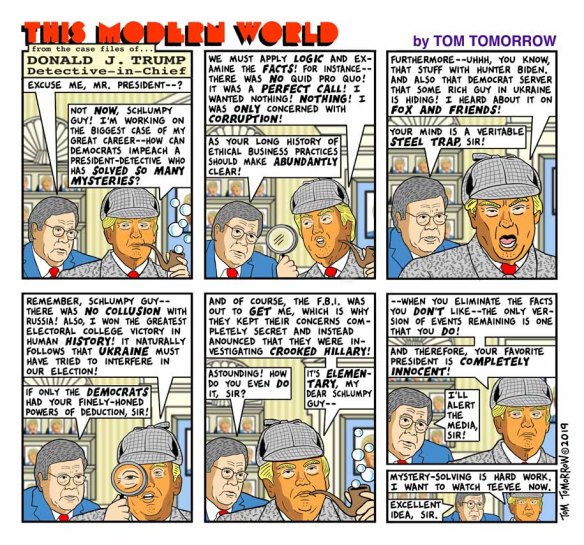
The Detective-In-Chief

TMW2019-12-18colorLARGE

I know, it’s not a laughing matter. Neither is the scandalous response of Republican politicians to his impeachment.

But you’ll feel good and maybe get future laughs by supporting Tom Tomorrow’s extraordinary work here, there or everywhere.

If You Want To Feel Even Worse About the 2016 Election

Or imagine how good it will be to get rid of this president, you can watch Howard Stern’s long interview with Hillary Clinton. He’s a very big fan of hers, so he gushes a lot, but as human beings or leaders go, she beats the Toddler hands down.

For the most important part of the interview, go to the brief Russian Meddling & 2020 Election section in part 4 further down the page.

This is part 1.

Part 2

0:00 – Therapy & Religion

4:24 – Family & Upbringing

15:39 – College Years & Obama

20:35 – Meeting Bill Clinton

Part 3

0:00 – Favorite President

5:08 – Falling in Love 

12:55 – Investigating Nixon & Meeting MLK

18:32 – Becoming First Lady & Public Scrutiny

Part 4

0:00 – Life in the Public Eye

9:33 – Economy & Bin Laden Raid

18:31Russian Meddling & 2020 Election

Part 5

0:00 – “The Book of Gutsy Women”

12:17 – Nelson Mandela

21:01 – The Beatles & the Rolling Stones

Their Big Concern in the 1780s

Bob Bauer, a law professor and former counsel to President Obama, explains what the authors of the Constitution thought about having a president like this one:

The founders feared the demagogue, who figures prominently in the Federalist Papers as the politician who, possessing “perverted ambition,” pursues relentless self-aggrandizement “by the confusions of their country.” The last of the papers, Federalist No. 85, linked demagogy to its threat to the constitutional order — to the “despotism” that may be expected from the “victorious demagogue.” This “despotism” is achieved through systematic lying to the public, vilification of the opposition and, as James Fenimore Cooper wrote in an essay on demagogues, a claimed right to disregard “the Constitution and the laws” in pursuing what the demagogue judges to be the “interests of the people.”

Should the demagogue succeed in winning the presidency, impeachment in theory provides the fail-safe protection. And yet the demagogue’s political tool kit, it turns out, may be his most effective defense. It is a constitutional paradox: The very behaviors that necessitate impeachment supply the means for the demagogue to escape it.

As the self-proclaimed embodiment of the American popular will, the demagogue portrays impeachment deliberations as necessarily a threat to democracy, a facade for powerful interests arrayed against the people that only he represents. Critics and congressional opponents are traitors. Norms and standing institutional interests are fraudulent.

[The president] has made full use of the demagogic playbook. He has refused all cooperation with the House. He lies repeatedly about the facts, holds public rallies to spread these falsehoods and attacks the credibility, motives and even patriotism of witnesses. His mode of “argument” is purely assaultive. This is the crux of [his] defense, and not an argument built on facts in support of a constitutional theory of the case.

Of course, all the presidents who have faced impeachment mounted a political defense, to go with their legal and constitutional case. And it is not unusual that they — and, even more vociferously, their allies — will attack the process as a means of undoing an election.

The difference in [the president’s] case is not merely one of degree. Richard Nixon despised his opposition, convinced of their bad faith and implacable hatred for him. But it is hard to imagine [the current president] choosing (and actually meaning) these words to conclude, as Nixon did, a letter to the chair of Judiciary Committee: “[If] the committee desires further information from me … I stand ready to answer, under oath, pertinent written interrogatories, and to be interviewed under oath by you and the ranking minority member at the White House.”

[Our president] has instead described Adam Schiff, the chairman of the Intelligence Committee, as a “corrupt” politician who shares with other “human scum” the objective of running the “most unfair hearings in American history.”

These remarks are not merely one more instance of [his] failure to curb his impulses. This is his constitutional defense strategy. [His] White House counsel, informing the House of the president’s refusal to cooperate, declared that the impeachment process is unconstitutional and invalid — a “naked political strategy” — and advised that the president would not participate. It matters that the president’s lawyer, in a formal communication with the House, used rhetoric that might have been expected from the hardest-core political supporters. Once again, contrasts with past impeachments are illuminating. Bill Clinton’s White House counsel Charles Ruff testified before the House Judiciary Committee, pledging to “assist you in performing your constitutional duties.”

The demagogue may be boundlessly confident in his own skills and force of political personality, but he cannot succeed on those alone. He can thrive only in political conditions conducive to the effective practice of these dark arts, such as widespread distrust of institutions, a polarized polity and a fractured media environment in which it is possible to construct alternative pictures of social realities. Weak political parties now fall quickly into line with a demagogue who can bring intense pressure to bear on party officials and officeholders through his hold on “the base.” As we have seen…, the demagogue can bully his party into being an instrument of his will, silencing or driving out dissenters. Republican officeholders know that [he] can take to Twitter or to Fox News or to the podium at rallies — or all of the above — to excoriate them for a weak will or disloyalty.

This is how the Republican Party has become [his] party. It is also why that party will not conceive of its role in impeachment as entailing a constitutional responsibility independent of the president’s political and personal interests. It has come to see those interests as indistinguishable from its own. In this way the constitutional defense of the case against [the president] and the defense of his own interests become one and the same. As another fabled demagogue, Huey Long of Louisiana, famously announced: “I’m the Constitution around here now.”

The implications for the constitutional impeachment process are dire. Until [now], modern impeachment has ended with some generally positive assessment of its legacy. Nixon’s resignation appeared to indicate that serious charges could bring the parties together in defense of the rule of law. “The system worked” was a popular refrain, even if this was a somewhat idealized and oversimplified version of events. The Clinton impeachment suggested that the standards for an impeachable offense required a distinction between public misconduct and private morality, and Congress [allowed] an independent counsel statute [Note: which had been abused by Kenneth Starr] … to lapse.

[This] impeachment is headed toward a very different summation. A demagogue can claim that Congress has forfeited the right to recognition of its impeachment power, then proceed to unleash a barrage of falsehoods and personal attacks to confuse the public, cow legislators and intimidate witnesses. So long as the demagogue’s party controls one of the two chambers of Congress, this strategy seems a sure bet.

Unquote.