Thoreau’s Journal and Modern Equivalents (with Apologies to the French)

Henry Thoreau wrote a lot more than Walden and Civil Disobedience. Among other things, he wrote two million or so words in his journal. Here’s the first entry, dated October 20, 1837, when Thoreau was 20 (the “he” is probably Thoreau’s friend and mentor Ralph Waldo Emerson):

“What are you doing now?” he asked, “Do you keep a journal?” — So I make my first entry to-day. 

A week later, Thoreau described two interlopers at Goose Pond:

Two ducks, of the summer or wood species, which were merrily dabbling in their favorite basin, struck up a retreat on my approach, and seemed disposed to take French leave, paddling off with swan-like majesty . They are first-rate swimmers, beating me at a round pace, and – what was to me a new trait in the duck character – dove every minute or two and swam several feet under water, in order to escape our attention. Just before immersion they seemed to give each other a significant nod, and then, as if by a common understanding, ‘t was heels up and head down in the shaking of a duck’s wing. When they reappeared, it was amusing to observe with what a self-satisfied, darn-it-how-benicks-’em air they paddled off to repeat the experiment.

According to the usual sources, a “French leave” is an old expression that means leaving or taking your leave without permission or without an announcement. You just go, like two ducks quietly paddling away from a naturalist or a birthday part; or  like a soldier going A.W.O.L. or even deserting. In some contexts, a “French leave” is a pretty bad thing, which is why the French call it “filer Ă  l’anglaise or “to leave English style”. (By the way, I couldn’t discover what “darn-it-how-benicks-’em” means, or I’d have shared that too.) 

When I picked up my unread copy of The Journal 1837-1861 this afternoon and read those two entries above, I was impressed. Thoreau was a damn good writer, even at the age of 20. Then I asked myself a standard question. Would Thoreau have written a blog instead of a journal if he’d had the opportunity? People do write journals today. Some even write millions of words, despite the modern world’s distractions. But why write a journal instead of a blog? (And why in the world write a blog?)

It seems like the basic difference between journals and blogs is that journals are private and blogs aren’t. In theory, you can write whatever you want in your journal and nobody will be the wiser, at least until you make it public or your grieving family resurrects it. But on a blog, there are restrictions. Usually, anyone with the necessary technology can read your latest post, so you watch what you say. You want to be interesting, but not too interesting.

On the other hand, you can give yourself much more freedom on a blog by writing anonymously or using pseudonyms. But if journals can be made public and blogs can be made private, perhaps ease of access isn’t the fundamental difference between journals and blogs. Maybe the key difference is the intended audience. In writing a journal, you are writing to and for yourself. Someone else might eventually read your journal, but journals are self-directed. Blogs, on the other hand, are other-directed. It’s assumed there is an audience of actual human beings out there. Hence, you write a blog with an audience (you guys) in mind, even though by doing so, you are writing for yourself as well.

On this blog’s “About” page, I used to say that writing is a way to find out what you think. In the case of a blog, however, it’s a way to find out what you think and then share it. Your words could even save the world one day. (Hey, it’s not completely impossible!) As for Thoreau, I think he would have been a blogger, because, despite his time alone in the woods, he wanted us all to live better lives.

But let’s get back to those ducks. You’ve probably noticed that many blogs display a certain statistic. Here on this blog, as of this moment, you the reader are invited to join 313 other followers. The idea behind that statistic, of course, is that a large number of followers demonstrates that a blog is worth following (50 million Frenchmen can’t be wrong). What you probably haven’t noticed, however, is that the number of followers (on WordPress blogs anyway) never goes down! At least, this blog’s number has never gone down (jeez, I must be almost as good as Thoreau).

Now, assuming it’s just possible that somebody who decided to follow this blog once upon a time may have lost interest, or that someone who followed this blog only did so in order to tell me about their blog, I should see my number of followers fluctuate. Somebody stops following – the number goes down. Somebody starts following – the number goes up. I’m forced to conclude, therefore, that “join 313 other followers” should really say “join 313 other people who followed this blog for whatever reason and may or may not be following it now, with the emphasis on ‘not'”.

I know that at least five people, well, maybe four people, read this blog regularly, because they tell me so (I prefer to believe them). And there are statistics indicating that other followers visit now and then. But when you think about it, a blog that is only read by its author is basically a journal. A blog with no readers is about as self-directed as one of those fancy notebooks that come with a lock and key.

Despite the impressive statistic, therefore, many “followers” have, yes, taken French leave! They’ve quietly departed, even more quietly than (here they are) those ducks on Goose Pond.
The County Clerk Who Cried Religion

That Kentucky county clerk is back on the streets, as long as she promises not to interfere with the clerk’s office issuing marriage licenses to gay people. My reaction to her situation is that anybody who strongly objects to their job requirements for personal reasons should look for another job. Same-sex couples now have the legal right to get married. Nobody has the legal right to stop them. It’s as simple as that, regardless of any objections the county clerk might have, including objections based on her particular interpretation of a book she considers sacred.

In a lighter vein, someone named Jim expressed himself on Facebook (the link is no longer universally available). You might lift your voice in song if you know the tune: 

I am the very model of a modern fundamentalist
I’m not merely judgmental, I’m the absolute judgmentalest!
I always follow scripture and I act on God’s authority
But marital longevity was never my priority.

I married first one husband, then two others, then another one
Because I think one man is pretty much like any other one.
I’ve never been too troubled by the dubious legalities
Of sex outside of marriage or of other trivialities.

But when it comes to icky stuff like homosexuality
I’m always very strident with my Puritan morality.
In short in matters biblical and spiritual and Calvinist,
I am the very model of a modern fundamentalist!

In questions of behavior I fall back on my Old Testament
(Though saying no to shrimp is way too much of an impediment).
I pick and choose the verses that support my little weltanschauung
And pledge never to change my mind from now til götterdämmerung.

I’ll ride this hobby horse until I’m richer than a sybarite,
There’ll always be good money in denouncing godless sodomites.
I’ll put my name as author on some books that I can barely read
And get a show on cable to inform the world what God decreed.

My husbands all agree that I know more about what marriage is
Than five Supreme Court justices whose law my faith disparages.
In short in matters biblical and spiritual and Calvinist,
I am the very model of a modern fundamentalist!

In fact, when I see what is meant by constitutionality
When I can do my job with requisite impartiality,
When I can join in marriage two young men who might be thespians,
Or issue nuptial licenses to enterprising lesbians,

When I can see that love is love no matter what the sexes are
And understand that gays are just like me and my three exes are,
In short, when I have finally got a dose of moral clarity
I’ll find out what is meant by the idea of Christian charity.

Til then I’ll flout the law and draw my wages from the county tax
Which is what God would do if only He was up on all the facts
Til then in matters biblical and spiritual and Calvinist,
I am the very model of a modern fundamentalist!

Cutting the Cord (Thanks to a Hard-Working Man)

The Verizon website said their technician would get to our house around 9:30 pm to do our installation. The anonymous dispatcher said it would really be around 8:15 (only three hours after the original 5 pm deadline).

So it was a pleasant surprise when the technician called at 6:30 to say he’d be at our house in fifteen minutes. He arrived as promised and quickly got to work.

Four hours later, he was done. Among other things, he’d had to string 350 feet of cable from our basement to a telephone pole two blocks away, working in the dark on a hot, humid night. It was an impressive performance.

When we thanked him and said good-night, we assumed he’d be dropping off his van at some Verizon garage and then get home by midnight or so. No, he’d actually be driving to Newark to do some work for another customer. He explained that Verizon is forcing their previously-unionized technicians to work 60 hours a week.

We didn’t ask what time he started work yesterday. But on a good day, if all goes well, he puts in 12 hours. That’s not 12 hours in an air-conditioned or heated office. That’s 12 hours of driving around, in good and bad weather, carrying equipment, going up and down stairs, climbing on roofs, drilling holes, stringing cable, attaching electronic gizmos to inside and outside walls, while also dealing with people like us. Sometimes in the dark. 

Do you think it would be a good idea for Verizon to hire and train more technicians, so their employees wouldn’t have to work 12 hours a day (or more), five days a week? We all know the corporate business model is to get as much work as possible out of workers while providing as little compensation as possible, but there are lots of Americans who could use a decent job. It would be good for the country and even good for the corporations if they’d spread some of the wealth around.

Cutting the Cord (the Saga Continues and Continues)

how-about-never

Verizon told us they’d be at our house between 11 am and 2 pm to install our new fiber optic connection (good-bye, Comcast!). The installation was supposed to take three hours and might require work on the outside of our house.

After a while, I checked our order status on the Verizon website. A note had been added. The technician will arrive between 1 pm and 5 pm. Ok, whatever.

The afternoon wore on. No technician. No word from Verizon. No email, no phone call.

But another visit to their website reveals an updated note: the technician will arrive between 7:45 pm and 8:45 pm. Really? To do a three-hour job that might involve working outside? In the dark?

Ok, let’s contact Verizon. First, a brief online chat. Second, a phone call to “customer service”. Third, another phone call to “customer service” after the first call disconnects.

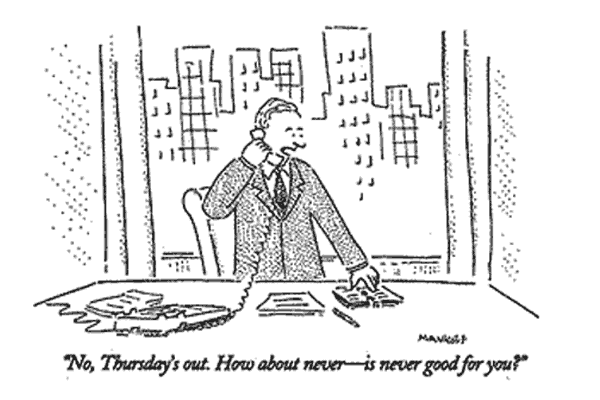
The Verizon representative is surprised to hear that Verizon technicians do installations at night. So am I. I ask her to confirm that this is actually going to happen. Or will the technician actually show up tomorrow morning? Or never?

She contacts the dispatcher, who confirms that the technician will be arriving tonight. I’m not convinced.

Meanwhile, the website has a new note: the technician will arrive between 9 pm and 10 pm:

verizon 1

verizon 2

I find this new promise even less believable than “between 7:45 and 8:45”. Our technician will be working past midnight to finish this job? I express my skepticism and repeat my request for confirmation.

Yes, the dispatcher still says the technician will arrive between 7:45 and 8:45 pm, even though the website disagrees. I express an opinion or two to “customer service” and we say good-bye.

Comcast, I already miss you and you haven’t gone away!

In the Meantime

Our official cord cutting is only two days away. Good-bye, Comcast (the “triple play” people)! Hello, Verizon (the fiber optic people) and Ooma (the telephone people)! 

Assuming we can still communicate with the outside world at that point, I might finally be ready to post what I’ve been intermittently working on for the past two weeks: a more detailed account of what it means to have a perspective.

Or maybe I’ll treat our rupture with Comcast as a deadline. Deadlines provide motivation and there are so few of them when you’re retired (of course, there’s always the Final Deadline all flesh is heir to). I don’t want my most recent thoughts on perspective to be lost to the world just because Verizon isn’t able to safely transmit my packets of data hither, thither and yon! Comcast has been able to do that most of the time (I give them that).

In the meantime, here’s some musical entertainment from Neil Young. His voice rubs some people the wrong way, but he’s made some wonderful music, especially when he plays loud, like he usually does with the three guys in Crazy Horse. “Like a Hurricane” is one of his best songs. This is the studio version from 1977 and an energetic live version from 1986. They’re both eight minutes long, so this should hold you until Wednesday.

Â