Whereof One Can Speak 🇺🇦

Nothing special, one post at a time since 2012

One Way to Dilute the Senate’s Filibuster Rule

Jennifer Rubin of The Washington Post suggests a way to get around the Senate filibuster that I’ve never heard before. It’s probably too rational for “Democratic” filibuster fans like Sen. Joe Manchin and Sen. Krysten Sinema to accept, but it’s interesting just the same:

… Democrats are close to pulling off something that has eluded them for the past year and a half: passing legislation to address climate change and the costs of health care [note: while reducing the deficit and moderating inflation], and doing it without any Republican votes,” The Post reports. “This has been one of President Biden’s top goals since he took office, so much so that he and Democratic leadership have reserved their one legislative tool to get it done: reconciliation.” Pretty impressive, huh?

Now, imagine telling [Sen. Joe Manchin, the West Virginia Democrat] he would need 60 votes to pass the package. Even he would likely agree that would be an outrageous hurdle to overcome.

As Manchin explained on CNN’s “State of the Union” on Sunday, Republicans have refused to engage in any reasonable discussion on the deal. “I think it’s a great piece of legislation and on normal times, my Republican colleagues would be for something such as this,” he said. He pointed out that their opposition is irrational and driven by rank partisanship. “We’ve basically paid down debt, [which] is what they want. We’ve accelerated [issuing drilling permits], which is what they want,” he said. “And we’ve increased production of energy, which is what they want. We’ve done things that we should be doing together.”

But since Republicans won’t cooperate, Democrats must move ahead with the reconciliation process — a gigantic loophole in the allegedly sacrosanct filibuster rules. Huge policy goals can be achieved even though the other side willfully obstructs progress.

Why, then, do Manchin and others cling so tightly to the filibuster rules when equally important — if not more important — policy goals are up for discussion, such as on abortion rights, voting rights and reforming the Supreme Court? It’s tautology to say that the reconciliation process applies only to tax and spending rules under limited circumstances. Why should items not directly tied to spending have to be stripped out of legislation?

Democrats can leave the filibuster in place if they must but can simply alter the Senate’s “Byrd rules” governing reconciliation bills so that measures pertaining to the restoration or protection of fundamental rights can be included. An infrastructure bill could also include “democracy infrastructure” that protects voting rights. The same limit on reconciliation legislation (once or twice per fiscal year) could still apply.

Manchin’s current legislative effort highlights just how hypocritical he is for opposing filibuster fixes. Indeed, he has relied on demonstrably false premises to defend his position.

For example, he often argues that Democrats and Republicans can always negotiate things together. Not so in the era of petulant obstruction from MAGA Republicans. In the case of his own mammoth bill, Manchin has realized that Democrats should not allow Republican opposition to deter them.

Manchin also frequently insists that if Democrats take steps to weaken the filibuster, Republicans will do the same when they are in power. Well, Republicans have already weakened Senate rules by lowering the votes needed to confirm Supreme Court justices to a simple majority. Republicans have also already used the reconciliation process in an attempt to pass bills such as the repeal of the Affordable Care Act. That failed because their extreme measures were so unpopular that they could not get even a majority for that.

I don’t expect Manchin to acknowledge his intellectual dishonesty and blatant inconsistency. But that doesn’t mean the rest of his party has to go along. If voters send two more Democrats to the Senate and somehow hold the House (if not in 2022, then win it back in 2024), they should consider using [no, absolutely use] their power to secure fundamental constitutional rights that the Supreme Court has stripped away.
But Could He Be Elected from a Jail Cell?

On a very hot summer afternoon, what better to consider than what to do about “a pathetic, degenerate huckster capable of great violence and evil” who is going to run for president again? Followed by some encouraging words from Merrick Garland. First, from Charles Blow of The New York Times:

His entire foray into politics has been one of testing the fences for weaknesses. Every time a fence has failed, he has been encouraged. He has become a better political predator.

With the conclusion of this series of hearings about the Jan. 6 insurrection, it has become ever clearer to me that T____ should be charged with multiple crimes. But I’m not a prosecutor. I’m not part of the Department of Justice. That agency will make the final decision on federal charges.

The questions before the Justice Department are not only whether there is convincing evidence that T____ committed the crimes he is accused of but also whether the country could sustain the stain of a criminal prosecution of a former president.

I would turn the latter question around completely: Can the country afford not to prosecute Trump? I believe the answer is no.

He has learned from his failures and is now more dangerous than ever.

He has learned that the political system is incapable of holding him accountable. He can try to extort a foreign nation for political gain and not be removed from office. He can attempt a coup and not be removed from office.

He has learned that many of his supporters have almost complete contempt for women. It doesn’t matter how many women accuse you of sexual misconduct; your base, including some of your female supporters, will brush it away. You can even be caught on tape boasting about sexually assaulting women, and your followers will discount it.

He has learned that the presidency is the greatest grift of his life. For decades, he has sold gilded glamour to suckers — hawking hotels and golf courses, steaks and vodka — but with the presidency, he needed to sell them only lies that affirmed their white nationalism and justified their white fragility, and they would happily give him millions of dollars. Why erect a building when you could simply erect a myth? T____ will never willingly walk away from this.

Now with the investigation into his involvement in the insurrection and his attempts to steal the election, he is learning once again from his failures. He is learning that his loyalty tests have to be even more severe. He is learning that his attempts to grab power must come at the beginning of his presidency, not the end. He is learning that it is possible to break the political system.

Not only does T____ apparently want to run again for president; The New York Times reported that he might announce as soon as this month, partly to shield himself “from a stream of damaging revelations emerging from investigations into his attempts to cling to power after losing the 2020 election.”

T____ isn’t articulating any fully fleshed-out policy objectives he hopes to accomplish for the country, but that should come as no surprise. His desire to regain power has nothing to do with the well-being of the country. His quest is brazenly self-interested. He wants to retake the presidency because its power is a shield against accountability and a mechanism through which to funnel money.

Should his re-election bid prove successful, T____’s second term will likely be far worse than the first.

He would tighten his grip on all those near him. Mike Pence was a loyalist but in the end wouldn’t fully kowtow to him. The same can be said of Bill Barr. T____ will not again make the mistake of surrounding himself with people who would question his authority.

Some of the people who demonstrated more loyalty to the country than they did to T____ during these investigations were lower-level staff members. For the former president, they, too, present an obstacle. But he might have a fix for that as well.

Axios reported on Friday that “T____’s top allies are preparing to radically reshape the federal government if he is re-elected, purging potentially thousands of civil servants and filling career posts with loyalists to him and his ‘America First’ ideology”.

According to Axios, this strategy appears to revolve around his reimposing an executive order that would reassign tens of thousands of federal employees with “some influence over policy” to Schedule F, which would strip them of their employee protections so that T____ could fire them without recourse to appeal. [Note: T____ created Schedule F by executive order a few weeks before the 2020 election. It gave him unprecedented power to ignore civil service rules. President Biden repealed the executive order on his second day in office.]

Perhaps most dangerous, though, is that T____ will have learned that while presidents aren’t too big to fail, they are too big to jail. If a president can operate with impunity, the presidency invites corruption, and it defies the ideals of this democracy.

A T____ free of prosecution is a T____ free to rampage.

Some could argue that prosecuting a former president would forever alter presidential politics. But I would counter that not prosecuting him threatens the collapse of the entire political ecosystem and therefore the country.

Unquote.

We don’t know what it will mean, but Attorney General Merrick Garland repeated his intention to hold everybody responsible for January 6th (and possibly the entire attempted coup):

Prognosis: Not Good At All

American democracy is dying, according to Brian Klaas of University College London, and “when they start dying … they usually don’t recover”:

For decades, the United States has proclaimed itself a “shining city upon a hill,” a beacon of democracy that can lead broken nations out of their despotic darkness. That overconfidence has been instilled into its citizens, leading me a decade ago to the mistaken, naïve belief that countries [with faltering democracies] have something to learn from the U.S. rather than also having wisdom to teach us.

During the D____ T____ presidency, the news covered a relentless barrage of “unprecedented” attacks on the norms and institutions of American democracy. But they weren’t unprecedented. Similar authoritarian attacks had happened plenty of times before. They were only unprecedented to us.

I’ve spent the past 12 years studying the breakdown of democracy and the rise of authoritarianism around the world, in places such as Thailand, Tunisia, Belarus, and Zambia…. My studies and experiences have taught me that democracies can die in many ways. In the past, most ended in a quick death….. But in the 21st century, most democracies die like a chronic but terminal patient. The system weakens as the disease spreads. The agony persists over years. Early intervention increases the rate of survival, but the longer the disease festers, the more that miracles become the only hope.

American democracy is dying. There are plenty of medicines that would cure it. Unfortunately, our political dysfunction means we’re choosing not to use them, and as time passes, fewer treatments become available to us, even though the disease is becoming terminal. No major pro-democracy reforms have passed Congress. No key political figures who tried to overturn an American election have faced real accountability. The president who orchestrated the greatest threat to our democracy in modern times is free to run for reelection, and may well return to office.

Our current situation started with a botched diagnosis….Most American pundits and journalists used an “outsider comes to Washington” framework to process T____’s campaign and his presidency, when they should have been fitting every fresh fact into an “authoritarian populist” framework or a “democratic death spiral” framework. While debates raged over tax cuts and offensive tweets, the biggest story was often obscured: The system itself was at risk…..

The basic problem is that one of the two major parties in the U.S. … has become authoritarian to its core. Consequently, there are two main ways to protect American democracy. The first is to reform the Republican Party, so that it’s again a conservative, but not authoritarian, party….

The second is to perpetually block authoritarian Republicans from wielding power. But to do that, Democrats need to win every election. When you’re facing off against an authoritarian political movement, each election is an existential threat to democracy. “Democracies can’t depend on one of two major parties never holding power,” argues Brendan Nyhan, a government professor at Dartmouth College….Eventually, the authoritarian party will win.

Erica Frantz, an Michigan State University expert on authoritarianism, told me she shares that concern: With Republicans out of the White House and in the congressional minority, “democratic deterioration in the U.S. has simply been put on pause”….

When democracies start to die, they usually don’t recover. Instead, they end up as authoritarian states with zombified democratic institutions: rigged elections in place of legitimate ones, corrupt courts rather than independent judges, and propagandists replacing the press.

There are exceptions. Frantz pointed to Ecuador, Slovenia, and South Korea as recent examples. In all three cases, a political shock acted as a wake-up call, in which the would-be autocrat was removed and their political movement either destroyed or reformed. In South Korea, President Park Geun-hye was ousted from office and sent to prison. But more important, Frantz explained, “there was a cleaning of the house after Park’s impeachment, with the new administration aggressively getting rid of those who had been complicit in the country’s slide to authoritarianism.”

Those examples once signaled a hopeful possibility for the United States. At some point, T____’s spell over the country and his party could break. He would go too far, or there would be a national calamity, and we’d all come to our democratic senses.

By early 2021, [he] had gone too far and there had been a national calamity. That’s why, on January 6, 2021, as zealots and extremists attacked the Capitol, I felt an unusual emotion mixed in with the horror and sadness: a dark sense that there was a silver lining.

Finally, the symptoms were undeniable. After T____ stoked a bona fide insurrection, the threat to democracy would be impossible to ignore. As Lindsey Graham and Mitch McConnell denounced Trump on the Senate floor, it looked like Republicans might follow the South Korean path and America could finally take its medicine.

In reality, the denunciations were few and temporary. According to a new poll from the University of Monmouth, six in 10 Republican voters now believe that the attack on the Capitol was a form of “legitimate protest”….And rather than cleaning house, the Republicans who dared to condemn T____ are now the party’s biggest pariahs….

That leaves American democracy with a bleak prognosis. Barring an electoral wipeout of Republicans in 2022 (which looks extremely unlikely), the idea that the party will suddenly abandon its anti-democracy positioning is a delusion.

Pro-democracy voters now have only one way forward: Block the authoritarian party from power, elect pro-democracy politicians in sufficient numbers, and then insist that they produce lasting democratic reforms.

The wish list from several democracy experts I spoke with is long, and includes passing the Electoral Count Act [which may soon happen], creating a constitutional right to vote, reforming districting so more elections are competitive, … electing the president via popular vote, reducing the gap in representation between states like California and Wyoming, introducing some level of proportional representation or multimember districts, aggressively regulating campaign spending and the role of money in politics, and enforcing an upper age limit for Supreme Court justices. But virtually all of those ideas are currently political fantasies.

The American system isn’t just dysfunctional. It’s dying. Nyhan believes there is now a “significant risk” that the 2024 election outcome will be illegitimate. Even Frantz, who has been more optimistic about America’s democratic resilience in the past, doesn’t have a particularly reassuring retort to the doom-mongers: “I don’t think U.S. democracy will collapse, but just hover in a flawed manner, as in Poland.”

We may not be doomed. But we should be honest: The optimistic assessment from experts who study authoritarianism globally is that the United States will most likely settle into a dysfunctional equilibrium that mirrors a deep democratic breakdown. It’s not yet too late to avoid that. But the longer we wait, the more the cancer of authoritarianism will spread. We don’t have long before it’s inoperable.

The Dumbest Timeline

When did we stumble into the dumbest timeline? Maybe we did it in 1914 when the European powers blundered into a devastating world war. Maybe it was in 1964 when Barry Goldwater accepted the Republican nomination for president while claiming that “extremism in defense of liberty is no vice”. Or maybe it wasn’t until 2016 when a demagogic con man eked out a victory in the Electoral College. Regardless of when we got here, there’s strong evidence that that’s where (or when) we are. Jonathan Chait of New York Magazine offers two pieces of evidence:

First, the demise of Biden’s social policy agenda:

The most depressing thing about the demise of the Biden administration’s social-policy agenda — other than the demise itself, of course — is the atmosphere of sheer economic illiteracy that surrounded it. Critics of the measure, ultimately including Joe Manchin, made arguments against it that were not so much misguided as lacking any elemental grasp of the basic principles involved (“not even wrong”).

The main argument used against Biden’s plan was that it would worsen inflation, with conservatives scolding Biden for ignoring the sage insights of Larry Summers. To take just one example, pundit Marc Thiessen wrote that Biden signed an economic stimulus in March 2021 “despite warnings from even liberal economists, such as former Treasury secretary Lawrence H. Summers…. But instead of trying to tamp down the flames, Biden keeps trying to pour gasoline on the inferno, with more spending and more free money from Washington.” The tone of this column, like many of the right-wing polemics, is one of incredulous condescension: Biden is such a blithering idiot that he is ignoring the obvious conclusion and instead digging holes and pouring gasoline or whatever.

Whatever the case against Build Back Better, this was not it. The American Rescue Plan did contribute to inflation; its purpose was to stimulate demand by injecting deficit-financed spending into the economy. Build Back Better had a different purpose: to address social needs over a long period of time and finance that spending through taxation.

Spending financed by new taxes is not inflationary. That is why Summers himself endorsed Build Back Better. Yet [reactionaries] spent the better part of a year citing Summers as the authority on why Biden’s long-term plans would cause inflation, oblivious to the fact that any economist, very much including Summers, would say otherwise.

In deference to public concerns about inflation, Manchin ultimately reshaped the last version of the bill as an anti-inflationary measure. The plan would have raised $1 trillion in new revenue (or reduced spending) and used half the proceeds for deficit reduction. This would not have had a large effect on inflation, but there is no question that … it would place downward pressure on prices.

[Republicans] simply refused to acknowledge this aspect of the plan at all. In the end, even Manchin himself abandoned his own plan, which was designed in part to reduce inflation, on account of inflation, which is like deciding not to cut greenhouse-gas emissions because it’s too hot.

… When the 9.1% inflation number was released, Manchin [supposedly] said to Schumer, “Why can’t we wait a month to see if the numbers come down? How do you pour $1 trillion on that tempo with inflation?

Remember, $1 trillion is not the size of the spending in the bill; $1 trillion is the size of the revenue. That’s the pay-for aspect of the bill Manchin insisted on maintaining in order to fight inflation. The $1 trillion would not be poured onto economic growth. It would be poured out of economic growth.

In the end, Biden’s attempt to enact permanent social change died in an atmosphere in which the most ignorant fallacies carried the day.

Next, incoherence and derangement on gay marriage:

In 2004, the Republican Party was united in anger at the idea that judges would seize the issue of gay marriage from its rightful place in the legislative arena…..“The only question is whether the constitutional status of marriage will be determined by unelected judges or the American people,” claimed the Alliance for Marriage.

[Republicans] may finally get their wish. The matter of gay marriage is finally coming for a vote before what they have always insisted is its rightful venue: Congress. And yet, far from expressing gratitude that Congress is finally exerting its sacred Article III powers, conservatives are angry that elected officials are now meddling in business properly settled by the courts…..The old danger of activist judges has passed, and now conservative principle requires the party to take a stand against activist … legislators.

Congress is voting to codify same-sex marriage because the Supreme Court’s decision overturning Roe v. Wade undercut the main legal theory that supported other unenumerated rights, including marriage equality….

It wasn’t long ago that opposition to gay marriage held pride of place atop the ideals of the right-wing firmament, second only to the strategic genius of the Bush administration’s “global war on terror” strategy. Conservatives thundered daily against the horrific terrors that would ensue if gay people were permitted to wed each other….

After their heroic stand at the gates of civilization failed, essentially none of the things conservatives warned would happen actually transpired. The cycle of failed prophecy is a familiar one for American conservatism. Every new social or economic reform, from the abolition of child labor to the establishment of Social Security to Obamacare, brings hysterical predictions of collapse that eventually give way to silent acceptance without any stage of reconsidering the failed mental model that produced the erroneous fears in the first place.

At the moment, the case against gay marriage has reached an awkward phase. Marriage equality has enough broad acceptance (around 70 percent support) that the party doesn’t wish to emphasize the issue. But the minority in opposition forms a large enough portion of their base that few Republicans wish to renounce their old stance completely.

Hence the incentive to declare the matter an improper subject for public debate. Unable to take a stand either in favor or against the marriage-equality bill, Republicans are instead directing their arguments … against the Democrats for bringing it up at all….

Finally, an exchange on Twitter between a right-wing blogger and a history professor:

Blogger: Remember when they spent years telling us to panic over the hole in the ozone layer and then suddenly just stopped talking about it and nobody ever mentioned the ozone layer again? This was also back during the time when they scared school children into believing “acid rain” was a real and urgent threat.

Professor: The ozone hole and acid rain. Two things that were LITERALLY fixed by science-led, globally-coordinated, long-term, concrete international action. It’s like being held hostage by the world’s stupidest serial-killer.

They Have Really Pretty Graphs

A big way our antiquated political system has let us down (way down) in recent years is the growth of inequality. It all goes back to the Reagan Revolution:

In August 1981, President Reagan signed the Economic Recovery Tax Act of 1981, which enacted a 27% across-the-board federal income tax cut over three years, as well as a separate bill that reduced federal spending, especially in anti-poverty programs [Wikipedia].

The Tax Reform Act of 1986 was the top domestic priority of President Reagan’s second term. The act lowered federal income tax rates, decreasing the number of tax brackets and reducing the top tax rate from 50 percent to 28 percent [Wikipedia].

Income tax rates have fluctuated since then under Republican and Democratic administrations without much change to Reagan’s policies. And when we consider the many deductions, exemptions and loopholes that tax lawyers and accountants are paid to take advantage of for their moneyed clients, effective tax rates have always been lower than the official rates.

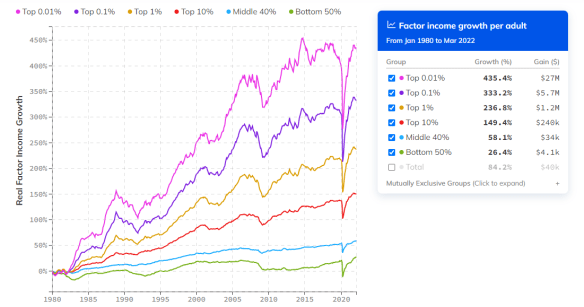
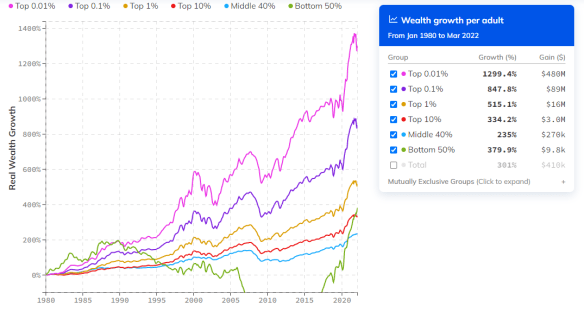
I was reminded of this history when somebody linked to a new site called Realtime Inequality. It was created by three UC Berkeley economists in order to show how different “income and wealth groups” benefit or fall behind when new growth numbers come out each quarter”:

Realtime Inequality provides timely and high-frequency estimates of the distribution of income and wealth in the United States. Our statistics distribute the totality of national income and household wealth across socio-economic groups and are updated each quarter when new macroeconomic numbers are published. (National income is similar to Gross Domestic Product and a better indicator of income earned by US residents.)

This makes it possible to estimate economic growth by socio-economic groups consistent with quarterly releases of macroeconomic growth, and to track the distributional impacts of government policies during and in the aftermath of recessions in real time. 

The site has graphs for both income and wealth that you can play around with for different groups and time periods. Thus, one measure of income growth between January 1980 and March 2022 shows that income (corrected for inflation) rose 333% for the top tenth of one percent and 26% for the bottom fifty percent.

x

While one measure of wealth for the same period grew by $89 million for the upper tenth of one percent and less than $10,000 for the bottom fifty percent.

y

It’s kind of fun to play with if you don’t think about it too hard.