Mary, My Wife, My Disciple?

The Smithsonian has a long article with a lot more information about the scrap of papyrus that suggests Jesus had a wife.

Personally, I don’t care whether he was married or not (or what kind of sex life he had, if any). What’s interesting is that Professor Karen King, who is presenting this new information to the world, doesn’t claim that the papyrus provides reliable biographical information about Jesus. She admits that it calls into question the official view that Jesus wasn’t married, but she thinks that its real significance is that it shows yet again that important alternative versions of Christianity were suppressed by church authorities:

“Her scholarship has been a kind of sustained critique of what she calls the ‘master story’ of Christianity: a narrative that casts the canonical texts of the New Testament as divine revelation that passed through Jesus in ‘an unbroken chain’ to the apostles and their successors—church fathers, ministers, priests and bishops who carried these truths into the present day.

According to this ‘myth of origins,’ as she has called it, followers of Jesus who accepted the New Testament—chiefly the Gospels of Matthew, Mark, Luke and John, written roughly between A.D. 65 and A.D. 95 —were true Christians. Followers of Jesus inspired by noncanonical gospels were heretics hornswoggled by the devil.”

In this case, the alternative version is one in which a woman (possibly Mary Magdalene) has a larger role in the history of Christianity, either as the wife of Jesus or as an “apostle to the apostles”.
 http://www.smithsonianmag.com/history-archaeology/The-Inside-Story-of-the-Controversial-New-Text-About-Jesus-170177076.html#ixzz27288Pbf5

Stravinsky and Nijinsky

Igor Stravinky’s ballet The Rite of Spring was first performed in Paris in 1913. It’s well-known that the performance was not a success. There was a tremendous uproar in the audience. Objects were thrown at the performers. Fights broke out. The house lights were eventually turned on to quiet the crowd. The performance continued, while some 40 members of the audience were ejected. 

I’ve always thought that it was Stravinsky’s violent modern music that was the source of the trouble. Apparently that isn’t true. From today’s New York Times:

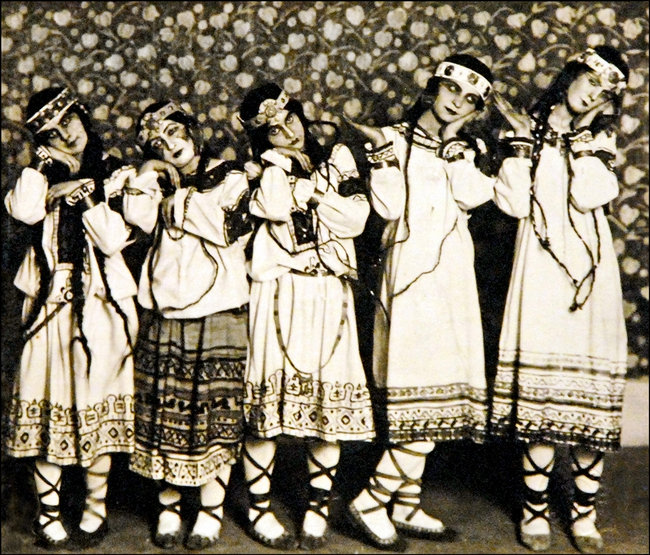
“It was not Stravinsky’s music that did the shocking. It was the ugly earthbound lurching and stomping devised by Vaslav Nijinsky, the greatest dancer in the troupe but a novice choreographer, that offended the Paris public, for whom ballet was all about swans and tutus and elevation. Once the whistlers and hooters got going, nobody even heard the music. Most of the reviews paid no attention to Stravinsky beyond naming him as the composer before turning with gusto to the weird antics onstage and the weirder ones in the hall”.

The Rite of Spring was performed with less turmoil a few more times in Paris and then in London. But it wasn’t until the work was performed the following year in a concert hall in Russia, without the dancers, that it became a success.

Costumes worn by some of the dancers who raised a ruckus in Paris:

16JPRITE1-popup

http://www.nytimes.com/2012/09/16/arts/music/rite-of-spring-cools-into-a-rite-of-passage.html?_r=1&ref=arts 

The Truth Shall Set You Free

Albion’s Seed is a very long book by the historian David Hackett Fischer. It explains how four regional cultures from England were transferred to different parts of colonial America.

For example, the fact that English aristocrats controlled the settlement of Virginia but had little role in the settlement of Massachusetts explains important differences between the history of the South and New England, even up to the present day.

“As early as 1642, the Massachusetts Bay Colony required that all children should be trained to read by their parents or masters”. Partly out of fear that Satan (the Old Deluder) was always trying to cloud people’s minds, “the Old Deluder Law compelled every town of fifty families to hire a schoolmaster and every town of one hundred families to keep a grammar school which offered instruction in Latin and Greek”.

Contrast this attitude toward literacy and education with that expressed by Governor William Berkeley of Virginia in 1671: 

“I thank God there are no free schools nor printing (in Virginia), and I hope we shall not have these for one hundred years; for learning has brought disobedience, and heresy, and sects into the world, and printing has divulged them, and libels against the best government. God keep us from both!”

In fact, the aristocrats who ran Virginia believed in education for their offspring. It was the lower classes, including slaves, who were supposed to remain ignorant: “the penalty for a slave who tried to learn how to write was to have a finger amputated”. 

The Prediction of Henry Adams

The historian Henry Adams, grandson of John Adams, wrote this around 1905, looking back over his life:

“Science now lay in a plane where scarcely one hundred or two hundred minds in the world could follow its mathematical processes; but bombs educate vigorously, and even wireless telegraphy and air-ships might require the reconstruction of society…. At the rate of progress since 1800, every American who lived into the year 2000 would know how to control unlimited power. He would think in complexities unimaginable to an earlier mind. He would deal with problems altogether beyond the range of earlier society. To him the 19th century would stand on the same plane as the 4th — equally childlike” (Chapter 34, The Education of Henry Adams).

It’s remarkable how the future always turns out to be stranger than we could imagine in some ways and not so different in other ways.

But He Seemed Like Such a Nice Man

Michael Lind offers an explanation for the intense right-wing, anti-government, apocalyptic rhetoric that we hear so much of these days: “(Ronald Reagan’s) moderation in office had less effect on American society than the decades of vilification of the public sector that he pumped like toxic waste into public discourse.”

Lind points out that “every crackpot element of today’s radical Right can find inspiration in quotes from Reagan”, such as:

“In the present crisis, government is not the solution to our problem; government is the problem.”

“Government’s view of the economy could be summed up in a few short phrases: If it moves, tax it. If it keeps moving, regulate it. And if it stops moving, subsidize it.”

“The nine most terrifying words in the English language are: ‘I’m from the government and I’m here to help.’”

“The best minds are not in government. If any were, business would hire them away.”

And on other topics:

“Within the covers of the Bible are all the answers for all the problems men face.”

“You and I have a rendezvous with destiny. We will preserve for our children this, the last best hope of man on earth, or we will sentence them to take the first step into a thousand years of darkness” (from Reagan’s nomination speech for Barry Goldwater in 1964).

They say the world has become too complex for simple answers. They are wrong.”

“It’s silly talking about how many years we will have to spend in the jungles of Vietnam when we could pave the whole country and put parking stripes on it and still be home by Christmas.”

Lind concludes: “Reagan won his popularity by encouraging Americans to think and feel like aggrieved victims, while absolving them from any responsibility for the modern government that they themselves voted for.”

http://www.salon.com/2012/08/28/reagans_radical_rhetoric/