Whereof One Can Speak 🇺🇦

Nothing special, one post at a time since 2012

Finally

With Vice President Kamala Harris casting the tie-breaking vote, Senate Democrats accomplished something important today, over the solid opposition of their Republican colleagues. It’s a big deal. The Democratic majority in the House of Representatives now needs to approve the bill. It’s hard to imagine that won’t happen.

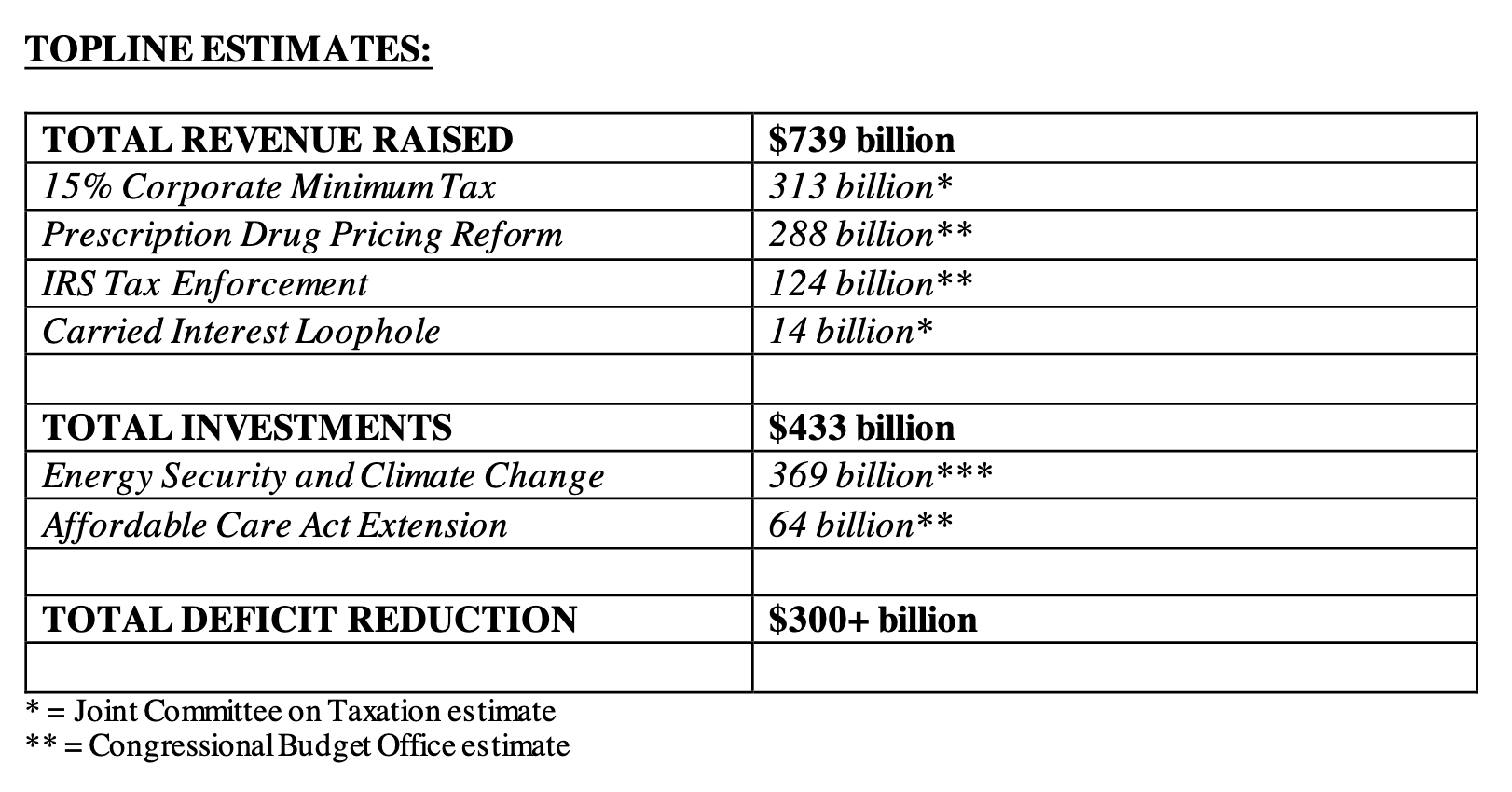
First, however, it should be noted that news people can’t resist attaching a dollar amount to a bill like this. The Guardian, for example, has this headline:

Senate passes $739bn healthcare and climate bill after months of wrangling.

You have to read the article to figure out what the $739 billion refers to. Is it what the government will spend? Over what period of time? Or is it what the government will collect in new taxes? When will that happen? It’s a really dumb way to point out that it’s a big piece of legislation.

Much more helpfully, here’s how The Washington Post began its analysis of the bill:

Major changes to the Affordable Care Act. The nation’s biggest-ever climate bill. The largest tax hike on corporations in decades. And dozens of lesser-known provisions that will affect millions of Americans.

The legislation Democrats muscled through the Senate on Sunday would represent one of the most consequential pieces of economic policy in recent U.S. history.

The article includes the Congressional Budget Office’s most recent analysis of what the bill will do in coming years.

There will be new spending and tax breaks amounting to $385 billion on green energy and the climate crisis (including rebates for electric vehicles and other technology) and $100 billion for improved healthcare.

There will be increased taxes and other revenue totaling $470 billion from a new 15% minimum tax on corporations, a tax on companies buying their own stock, and a strengthened IRS, plus $320 billion in mostly drug-related healthcare savings (including allowing Medicare to negotiate drug prices).

$485 billion in spending and tax breaks and $790 billion in revenue and savings (roughly the Guardian’s number) equates to a reduction of $305 billion in the federal deficit. Lowering the federal deficit and lower prices on things like prescription drugs and green technology justified calling it the Inflation Reduction Act, although “Deficit and Inflation Reduction” would have been more accurate.

For now, a few comments. From Paul Krugman:

This was a victory for urgently needed policy. Democrats came into power with a three-part agenda: climate, infrastructure, and social programs [they delivered on infrastructure with a bit of Republican help last year].

They just delivered on the first, which was the most crucial — and no, it wasn’t far less than they sought. It accomplished most of the original objective [it’s estimated that this bill delivers about 80% of the cumulative emissions reductions over 10 years that that Biden’s original  Build Back Better plan would have].

What got lost were the extensive social programs. That’s a tragedy; we could have virtually eliminated child poverty, among other things [except Sen. Joe Manchin was opposed to doing that]. Even there, this bill expanded the enhanced subsidies that have helped bring the percentage of the uninsured to a record low.

But overall, it’s a remarkable record for a party with 50 senators and a relentlessly obstructionist opposition [and two obstructive Democrats, Manchin and Sinema].

From a Washington Post reporter:

Sen. Brian Schatz of Hawaii is visibly emotional and wiping away tears after final passage of the Inflation Reduction Act. “This is a planetary emergency, and this is the first time the federal government has taken action that is worthy of the moment,” he tells reporters. “Now I can look my kids in the eye.”

And just to keep in mind who Republican politicians represent, this is from Rolling Stone:

“Republicans have just gone on the record in favor of expensive insulin,” Sen. Ron Wyden said after Republicans voted to remove an insulin price cap from the Inflation Reduction Act. “After years of tough talk about taking on insulin makers, Republicans have once against wilted in the face of heat from Big Pharma.”

Democrats needed 60 votes, according to Senate math, in order to keep the private insurance cap in the Inflation Reduction Act. While seven Republicans voted to retain the cap, that was still three senators short of the 60 needed.

Around 37.3 million Americans, 11.3 percent of the population, have diabetes. … Insulin is a “catastrophic” expense for 14 percent of the seven million Americans who need it daily, according to a Yale University study. That means those 14 percent are spending at least 40 percent of their monthly income (after paying for food and housing) on insulin.

The goods news is that the bill — at least for the moment — maintained a $35 per month cap on insulin costs for people on Medicare.

Need I mention there’s an election in three months? Make sure you’re registered and vote for Democrats up and down the ballot!
A Tax Break That Will Never Die

Democrats are on the verge of passing a major bill that will attack the climate crisis, expand healthcare, slow down inflation, reduce the deficit, and even deal with tax evasion. In order to get all fifty Democratic senators to support the bill, a piece of the bill that would have raised taxes on a small number of very wealthy people was dropped. It’s a classic example of the way money corrupts American politics. From The New York Times:

Once again, carried interest carried the day.

The last-minute removal by Senate Democrats of a provision in the climate and tax legislation that would narrow what is often referred to as the “carried interest loophole” represents the latest win for the private equity and hedge fund industries. For years, those businesses have successfully lobbied to kill bills that aimed to end or limit a quirk in the tax code that allows executives to pay lower tax rates than many of their salaried employees.

In recent weeks, it appeared that the benefit could be scaled back, but a last-minute intervention by Senator Kyrsten Sinema, the Arizona Democrat, eliminated what would have been a $14 billion tax increase targeting private equity.

Lawmakers’ inability to address a tax break that Democrats and some Republicans have called unfair underscores the influence of lobbyists for the finance industry and how difficult it can be to change the tax code….

On Friday, the private equity and hedge fund industries applauded the development, describing it as a win for small business [of course they did].

“The private equity industry directly employs over 11 million Americans, fuels thousands of small businesses and delivers the strongest returns for pensions,” said Drew Maloney, the chief executive of the American Investment Council, a lobbying group. “We encourage Congress to continue to support private capital investment in every state across our country”….

Carried interest is the percentage of an investment’s gains that a private equity partner or hedge fund manager takes as compensation. At most private equity firms and hedge funds, the share of profits paid to managers is about 20 percent [so the people who manage these small investment firms take around 20% of the firm’s investment profits as their salaries, not because they invested their own money but because they expect to be paid for their labor].

Under existing law, that money is taxed at a capital-gains rate of 20 percent for top earners. That’s about half the rate of the top individual income tax bracket, which is 37 percent….

An agreement reached last week by Senator Joe Manchin III, Democrat of West Virginia, and Senator Chuck Schumer of New York, the majority leader, would have [made it more harder for the managers of these firms] to take advantage of the lower 20 percent tax rate.

But Ms. Sinema, who has received political donations from wealthy financiers who usually donate to Republicans and who was cool to the idea of targeting carried interest last year, objected.

In the past five years, the senator has received $2.2 million in campaign contributions from investment industry executives and political action committees, according to OpenSecrets, a nonprofit group that tracks money in politics. The industry was second only to retired individuals in giving to Ms. Sinema and just ahead of the legal profession, which gave her $1.8 million. Executives of some of those firms have made campaign contributions to Ms. Sinema, including George Roberts, Henry Kravis and Joseph Bae at KKR and Sean Klimczak and Eli Nagler at Blackstone.

For years, carried interest has been a tax policy piñata that never cracks open.

During the 2016 presidential campaign, D____  J. T____ said, “We will eliminate the carried interest deduction, well-known deduction, and other special-interest loopholes that have been so good for Wall Street investors and for people like me but unfair to American workers.”

When President Biden ran for president in 2020, his campaign said he would “eliminate special tax breaks that reward special interests and get rid of the capital gains loophole for multimillionaires.” To do that, he said, he would tax long-term capital gains at the ordinary top income tax rate, essentially wiping away the special treatment of carried interest.

A similar proposal appeared in Mr. Biden’s budget last spring, but, as Democrats tried unsuccessfully to pass their Build Back Better legislation in the summer and fall, carried interest disappeared.

Jared Bernstein, a member of the White House’s Council of Economic Advisers, lamented that outcome. “This is a loophole that absolutely should be closed,” Mr. Bernstein told CNBC last September. “When you go up to Capitol Hill and you start negotiating on taxes, there are more lobbyists in this town on taxes than there are members of Congress”….

Opinions on the carried interest tax treatment vary even within the financial industry. In posts on Twitter in late July, Bill Ackman, the founder of Pershing Square Capital Management, a New York hedge fund, said that while “favorable tax treatment” for the founders of new businesses was essential, people who manage funds that own many companies should not be entitled to the same benefit.

“The carried interest loophole is a stain on the tax code,” he wrote in one post. “It does not help small businesses, pension funds, other investors in hedge funds or private equity and everyone in the industry knows it. It is an embarrassment and it should end now.”

Some analysts were skeptical all along that lawmakers would actually change the carried interest tax treatment in the final bill. While it has become a high-profile target, the change Democrats were seeking would have raised little tax revenue compared with other provisions in the legislation, known as the Inflation Reduction Act….

“The proposal that was in the bill until last night made a technical adjustment [regarding] assets that qualified for carried interest treatment,” said Jean Ross, a senior fellow at the Center for American Progress, a liberal research group in Washington. “A better approach would tackle the issue head-on and say that compensation for services managing an investment fund should be taxed like work and subject to ordinary tax rates”….

Ms. Sinema herself has said little about why she considered it so important to preserve the carried interest tax treatment [could that possibly mean she has no good reason for doing that?]. She has said that she plans to work on legislation with Senator Mark Warner, Democrat of Virginia, to address the loophole. But if the legislation is not included in the current package, which is being fast-tracked under an arcane budget process, any reform will require support from at least 10 Republicans [which everyone, including Sinema, knows will mean nothing is done, since Republican politicians don’t like rich people to be taxed].

“I think we reached agreement that there are areas where there’s been abuse,” Mr. Warner said in an interview, adding, “I’m disappointed it didn’t get in this bill, but I’m looking forward to working with Senator Sinema — and others — to see if we can address this [news flash: you can’t and you won’t address it].

Unquote.

To summarize, if you’re an accountant that works at one of these firms, you get a salary and pay income tax at the rate for regular income. If you’re a customer at one of these firms and your investment did well, the profits you get are taxed at the lower rate for capital gains. If you run the firm, you take some of the profits from your customers’ investments as your compensation, but the government taxes your compensation as if you made the investment with your own money, so you get to pay significantly less income tax. If Democrats try to fix this absurdity, Republicans and even some Democrats will stand in the way, while you claim that your compensation should be taxed at the lower rate because, well, because your customers get the lower rate and the investments you make help other businesses (while sometimes destroying others).

Which shows once again that too many politicians work for their donors, not the people they represent.

We Should Believe It When We See It

Minutes after passing a bipartisan bill to increase US production of semiconductors, Senate Democrats announced that, believe it or not, conservative “Democratic” Senator Joe Manchin has agreed to pass a Democrats-only budget reconciliation bill that addresses some of President Biden’s Build Back Better agenda.

One cool thing about this is that evil Republican Senator Mitch McConnell said he wouldn’t support the semiconductor bill if Democrats tried to do any good Build Back Better stuff. So it appears the Democrats waited until right after the semiconductor bill passed to announce they were doing something Build Back Better-ish (i.e. good) after all. Maybe this will work out, assuming erratic “Democratic” Senator Krysten Sinema goes along, giving Senate Democrats the 50 votes they need (with Vice President Harris breaking the tie in the 50-50 Senate):

From Crooked Media’s free, informative, daily newsletter:

Dear readers, have we ever told you how wise and handsome we’ve always found Sen. Joe Manchin (D-WV) to be? No? Well it’s totally true, and senator, if you’re reading this, you would look especially good allowing the passage of climate legislation that will prevent our country from simultaneously burning and drowning. 

In a surprise turn of events, Manchin and Sen. Majority Leader Chuck Schumer announced today that they struck a deal on a domestic-spending package that includes climate and energy programs and tax increases on the wealthy. This is a breakthrough after more than a year of negotiations that looked all but dead two weeks ago when Manchin abruptly announced he would not support any new climate spending, because he was just too concerned about inflation, you guys!!! 

Manchin has been a thorn in the side of his Democratic colleagues, the main holdout on most of the progressive social policies the Biden administration had hoped to enact. In his somewhat-opaque statement, Manchin signaled support for climate and energy programs, as well as “adopting a tax policy that protects small businesses and working-class Americans while ensuring that large corporations and the ultra-wealthy pay their fair share in taxes.” Is this the same Joe Manchin we have come to know and mostly-disdain? Could it be?  

Well yes, it still mostly is the same old Joe. The bill agreed upon was titled the Inflation Reduction Act of 2022 [eyes roll out of my head] and Manchin in his statement made sure to include a jab at the much more comprehensive Build Back Better, which he can now brag to his pals across the aisle about helping to kill. His statement also focuses mostly on inflation, and not the climate emergency or the many ills that Build Back Better was trying to treat. But for once I will resist dragging Joe’s ass too hard, because this bill is much better than the extremely-narrow drug-pricing package Dems were prepared to accept when it looked like Manchin was ready to walk away entirely last month.

And now that Fossil Fuel Joe is on board, the bill is much more likely to actually become law, and the bill is actually good [although we don’t know all the details yet].  

The climate provisions in the proposed bill are the largest fiscal piece of it, to the tune of $369 billion, which is good. All aspects of the bill—the reduction in energy and health care costs, and the deficit reduction—are anti-inflationary, which is also good. The bill allows Medicare to negotiate drug prices and lowers ACA premiums, and closes a whole host of tax loopholes with increased funding to the IRS, all without any regressive, shit-eating spending cuts you’d normally expect Congress to include in a big budget bill. We’re not sure where his change of heart came from (was he visited by three ghosts when he had covid this week?) but we’re not questioning it.  

Assuming Dems can pass the bill in the House and the Senate parliamentarian allows it to be approved with 51 votes (or 50 and a tie break from VP Harris) through the budget reconciliation process, this has a serious chance of becoming law as early as August. This would be a huge win for Democrats going into midterms, who will need every single win they can get. It will give them a concrete answer to voters rightly asking, “What have you done for me lately?” 

The bill faces a number of hurdles before it can become law, but White House Joe has signed off on it in a statement, so we thank you, Senate Joe, for your begrudging cooperation at last. Kyrsten Sinema don’t even FUCKING think about it.

An initial summary of the compromise bill.

The Dumbest Timeline

When did we stumble into the dumbest timeline? Maybe we did it in 1914 when the European powers blundered into a devastating world war. Maybe it was in 1964 when Barry Goldwater accepted the Republican nomination for president while claiming that “extremism in defense of liberty is no vice”. Or maybe it wasn’t until 2016 when a demagogic con man eked out a victory in the Electoral College. Regardless of when we got here, there’s strong evidence that that’s where (or when) we are. Jonathan Chait of New York Magazine offers two pieces of evidence:

First, the demise of Biden’s social policy agenda:

The most depressing thing about the demise of the Biden administration’s social-policy agenda — other than the demise itself, of course — is the atmosphere of sheer economic illiteracy that surrounded it. Critics of the measure, ultimately including Joe Manchin, made arguments against it that were not so much misguided as lacking any elemental grasp of the basic principles involved (“not even wrong”).

The main argument used against Biden’s plan was that it would worsen inflation, with conservatives scolding Biden for ignoring the sage insights of Larry Summers. To take just one example, pundit Marc Thiessen wrote that Biden signed an economic stimulus in March 2021 “despite warnings from even liberal economists, such as former Treasury secretary Lawrence H. Summers…. But instead of trying to tamp down the flames, Biden keeps trying to pour gasoline on the inferno, with more spending and more free money from Washington.” The tone of this column, like many of the right-wing polemics, is one of incredulous condescension: Biden is such a blithering idiot that he is ignoring the obvious conclusion and instead digging holes and pouring gasoline or whatever.

Whatever the case against Build Back Better, this was not it. The American Rescue Plan did contribute to inflation; its purpose was to stimulate demand by injecting deficit-financed spending into the economy. Build Back Better had a different purpose: to address social needs over a long period of time and finance that spending through taxation.

Spending financed by new taxes is not inflationary. That is why Summers himself endorsed Build Back Better. Yet [reactionaries] spent the better part of a year citing Summers as the authority on why Biden’s long-term plans would cause inflation, oblivious to the fact that any economist, very much including Summers, would say otherwise.

In deference to public concerns about inflation, Manchin ultimately reshaped the last version of the bill as an anti-inflationary measure. The plan would have raised $1 trillion in new revenue (or reduced spending) and used half the proceeds for deficit reduction. This would not have had a large effect on inflation, but there is no question that … it would place downward pressure on prices.

[Republicans] simply refused to acknowledge this aspect of the plan at all. In the end, even Manchin himself abandoned his own plan, which was designed in part to reduce inflation, on account of inflation, which is like deciding not to cut greenhouse-gas emissions because it’s too hot.

… When the 9.1% inflation number was released, Manchin [supposedly] said to Schumer, “Why can’t we wait a month to see if the numbers come down? How do you pour $1 trillion on that tempo with inflation?

Remember, $1 trillion is not the size of the spending in the bill; $1 trillion is the size of the revenue. That’s the pay-for aspect of the bill Manchin insisted on maintaining in order to fight inflation. The $1 trillion would not be poured onto economic growth. It would be poured out of economic growth.

In the end, Biden’s attempt to enact permanent social change died in an atmosphere in which the most ignorant fallacies carried the day.

Next, incoherence and derangement on gay marriage:

In 2004, the Republican Party was united in anger at the idea that judges would seize the issue of gay marriage from its rightful place in the legislative arena…..“The only question is whether the constitutional status of marriage will be determined by unelected judges or the American people,” claimed the Alliance for Marriage.

[Republicans] may finally get their wish. The matter of gay marriage is finally coming for a vote before what they have always insisted is its rightful venue: Congress. And yet, far from expressing gratitude that Congress is finally exerting its sacred Article III powers, conservatives are angry that elected officials are now meddling in business properly settled by the courts…..The old danger of activist judges has passed, and now conservative principle requires the party to take a stand against activist … legislators.

Congress is voting to codify same-sex marriage because the Supreme Court’s decision overturning Roe v. Wade undercut the main legal theory that supported other unenumerated rights, including marriage equality….

It wasn’t long ago that opposition to gay marriage held pride of place atop the ideals of the right-wing firmament, second only to the strategic genius of the Bush administration’s “global war on terror” strategy. Conservatives thundered daily against the horrific terrors that would ensue if gay people were permitted to wed each other….

After their heroic stand at the gates of civilization failed, essentially none of the things conservatives warned would happen actually transpired. The cycle of failed prophecy is a familiar one for American conservatism. Every new social or economic reform, from the abolition of child labor to the establishment of Social Security to Obamacare, brings hysterical predictions of collapse that eventually give way to silent acceptance without any stage of reconsidering the failed mental model that produced the erroneous fears in the first place.

At the moment, the case against gay marriage has reached an awkward phase. Marriage equality has enough broad acceptance (around 70 percent support) that the party doesn’t wish to emphasize the issue. But the minority in opposition forms a large enough portion of their base that few Republicans wish to renounce their old stance completely.

Hence the incentive to declare the matter an improper subject for public debate. Unable to take a stand either in favor or against the marriage-equality bill, Republicans are instead directing their arguments … against the Democrats for bringing it up at all….

Finally, an exchange on Twitter between a right-wing blogger and a history professor:

Blogger: Remember when they spent years telling us to panic over the hole in the ozone layer and then suddenly just stopped talking about it and nobody ever mentioned the ozone layer again? This was also back during the time when they scared school children into believing “acid rain” was a real and urgent threat.

Professor: The ozone hole and acid rain. Two things that were LITERALLY fixed by science-led, globally-coordinated, long-term, concrete international action. It’s like being held hostage by the world’s stupidest serial-killer.

They Have Really Pretty Graphs

A big way our antiquated political system has let us down (way down) in recent years is the growth of inequality. It all goes back to the Reagan Revolution:

In August 1981, President Reagan signed the Economic Recovery Tax Act of 1981, which enacted a 27% across-the-board federal income tax cut over three years, as well as a separate bill that reduced federal spending, especially in anti-poverty programs [Wikipedia].

The Tax Reform Act of 1986 was the top domestic priority of President Reagan’s second term. The act lowered federal income tax rates, decreasing the number of tax brackets and reducing the top tax rate from 50 percent to 28 percent [Wikipedia].

Income tax rates have fluctuated since then under Republican and Democratic administrations without much change to Reagan’s policies. And when we consider the many deductions, exemptions and loopholes that tax lawyers and accountants are paid to take advantage of for their moneyed clients, effective tax rates have always been lower than the official rates.

I was reminded of this history when somebody linked to a new site called Realtime Inequality. It was created by three UC Berkeley economists in order to show how different “income and wealth groups” benefit or fall behind when new growth numbers come out each quarter”:

Realtime Inequality provides timely and high-frequency estimates of the distribution of income and wealth in the United States. Our statistics distribute the totality of national income and household wealth across socio-economic groups and are updated each quarter when new macroeconomic numbers are published. (National income is similar to Gross Domestic Product and a better indicator of income earned by US residents.)

This makes it possible to estimate economic growth by socio-economic groups consistent with quarterly releases of macroeconomic growth, and to track the distributional impacts of government policies during and in the aftermath of recessions in real time. 

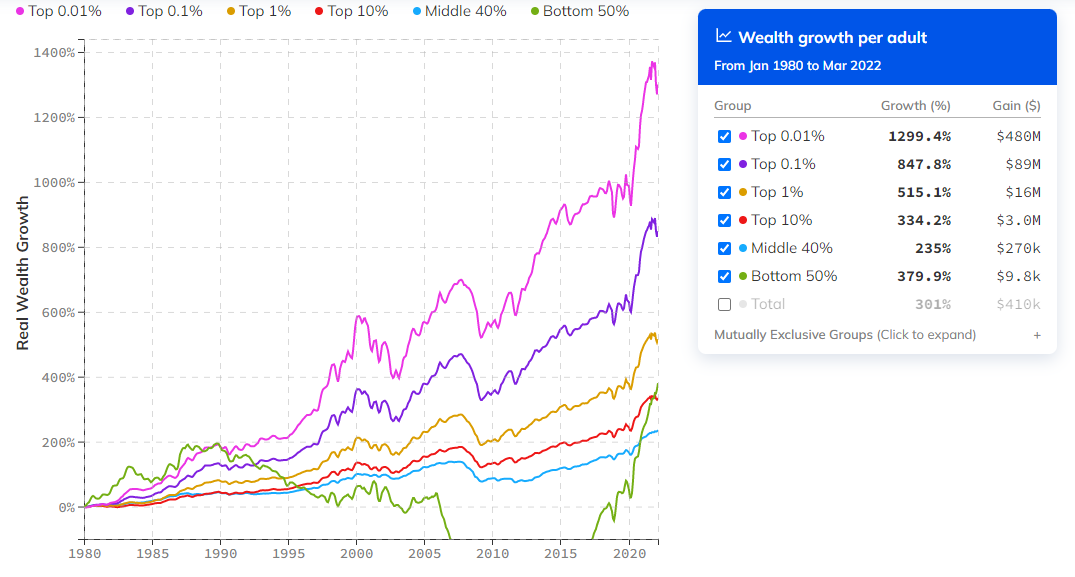
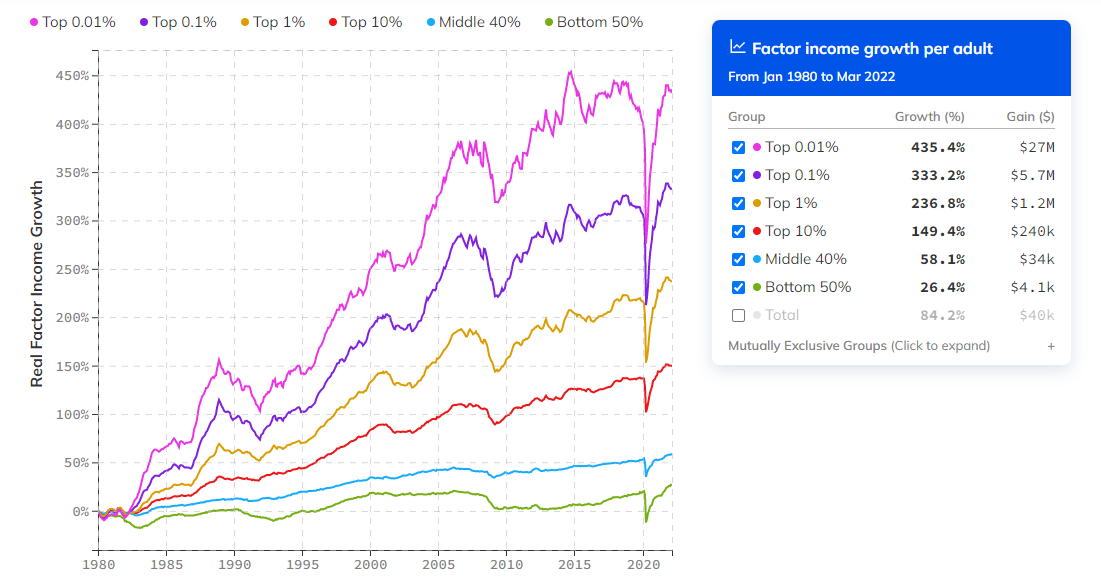
The site has graphs for both income and wealth that you can play around with for different groups and time periods. Thus, one measure of income growth between January 1980 and March 2022 shows that income (corrected for inflation) rose 333% for the top tenth of one percent and 26% for the bottom fifty percent.

x

While one measure of wealth for the same period grew by $89 million for the upper tenth of one percent and less than $10,000 for the bottom fifty percent.

y

It’s kind of fun to play with if you don’t think about it too hard.