Same As It Ever Was

Romney’s plan to fix the economy is the same plan offered by his predecessors (and his goal of 12 million new jobs is the number forecast by economists as normal job growth).

Mike Konczal of the Roosevelt Institute:

The same exact playbook is there in 2006, as it was in 2004 and 2008, and as it is in 2012. Domestic oil production, school choice, trade agreements, cut spending and reduce taxes and regulations — it’s been the conservative answer to times of deep economic stress, times of economic recovery, times of economic worries, and times of economic panic. Which is another way of saying that the Republicans have no plan for how to actually deal with this specific crisis we face.

http://www.nextnewdeal.net/rortybomb/romney-will-solve-crisis-exact-same-gop-plan-2008-2006-2004

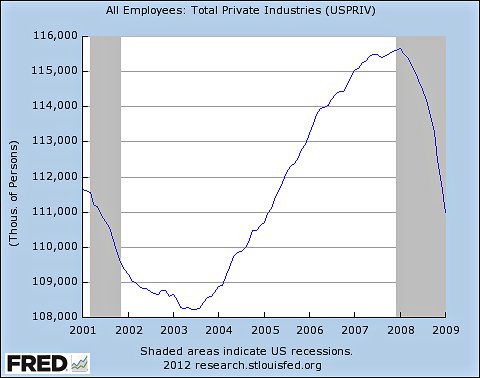
Paul Krugman (today’s best political columnist by far) concurs and offers a chart showing the pathetic history of job growth during the two terms of our last Republican president:

We should ask how the identical policies worked out in Bush’s two terms. And the answer is: zero job growth in term one (and a fall in private sector employment), one million in term two. Oh, and private sector employment lower when Bush left office than when he arrived.

083112krugman1-blog480

http://krugman.blogs.nytimes.com/2012/08/31/the-definition-of-insanity/

Why We Owe What We Owe

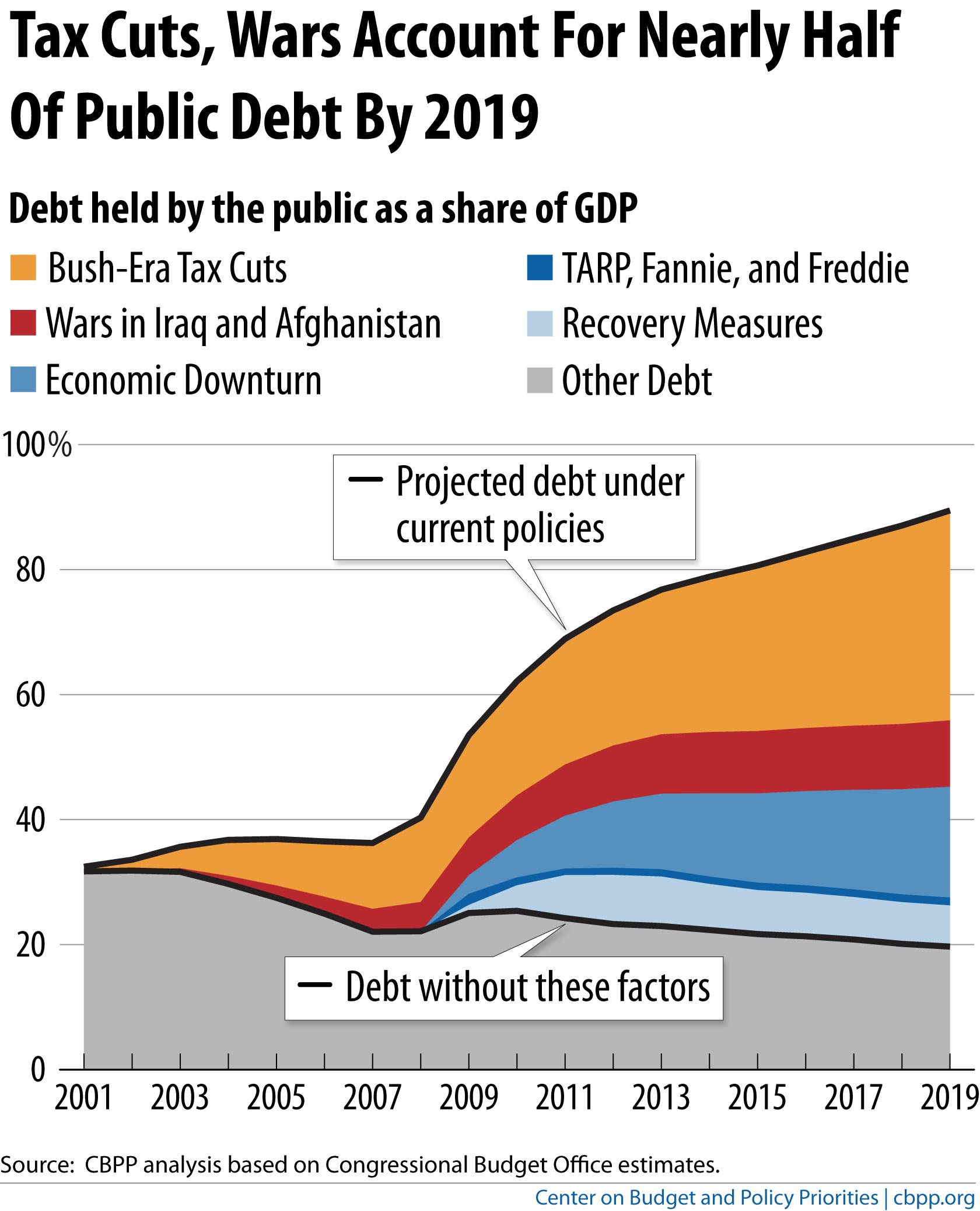
Ezra Klein of the Washington Post discusses the national debt and why it’s wrong to blame Obama:

“If there’d been no Bush tax cuts, no wars, no financial crisis and everything else had been the same? Debt would be between 20 and 30 percent of GDP today, rather than almost 100 percent.”

Debt-graph-CBPP

http://www.washingtonpost.com/blogs/ezra-klein/wp/2012/08/28/republican-national-convention-the-one-graph-you-need-to-see-before-watching/

But He Seemed Like Such a Nice Man

Michael Lind offers an explanation for the intense right-wing, anti-government, apocalyptic rhetoric that we hear so much of these days: “(Ronald Reagan’s) moderation in office had less effect on American society than the decades of vilification of the public sector that he pumped like toxic waste into public discourse.”

Lind points out that “every crackpot element of today’s radical Right can find inspiration in quotes from Reagan”, such as:

“In the present crisis, government is not the solution to our problem; government is the problem.”

“Government’s view of the economy could be summed up in a few short phrases: If it moves, tax it. If it keeps moving, regulate it. And if it stops moving, subsidize it.”

“The nine most terrifying words in the English language are: ‘I’m from the government and I’m here to help.’”

“The best minds are not in government. If any were, business would hire them away.”

And on other topics:

“Within the covers of the Bible are all the answers for all the problems men face.”

“You and I have a rendezvous with destiny. We will preserve for our children this, the last best hope of man on earth, or we will sentence them to take the first step into a thousand years of darkness” (from Reagan’s nomination speech for Barry Goldwater in 1964).

They say the world has become too complex for simple answers. They are wrong.”

“It’s silly talking about how many years we will have to spend in the jungles of Vietnam when we could pave the whole country and put parking stripes on it and still be home by Christmas.”

Lind concludes: “Reagan won his popularity by encouraging Americans to think and feel like aggrieved victims, while absolving them from any responsibility for the modern government that they themselves voted for.”

http://www.salon.com/2012/08/28/reagans_radical_rhetoric/

Sweden Isn’t So Bad

Despite what some politicians and pundits say, most Americans, including Republicans, think that it would be better if we had a more equal distribution of wealth in this country.

In fact, most of  us think that Sweden’s distribution of wealth is much better than ours. A retired librarian in Wisconsin has more to say on the subject:

http://www.jsonline.com/news/opinion/wealth-equity-we-all-want-it-j36iut3-167388085.html

Here is the relevant graph:

Ariely & Norton - Inequality

Choosing to Fall Behind

We’ve gotten used to thinking that America is the greatest country in the world. Obviously, we’re a rich and powerful nation that has historically been a land of opportunity for most of our citizens. We have accomplished so much. Yet we are falling behind other advanced nations. Not because of external circumstances, but by choice.

Eduardo Porter, writing in the NY Times, points out that: “Every developed country aspires to provide a better life for its people. The United States, among the richest of all, fails in important ways. It has the highest poverty and the highest infant mortality among developed nations. We provide among the least generous unemployment benefits in the industrial world. Not long ago one of the most educated countries in the world, the United States is slipping behind. The reason is not difficult to figure out: rich though we are, we can’t afford the policies needed to improve our record.”

Why are we falling behind? Mr. Porter explains:

“Citizens of most industrial countries have demanded more public services as they have become richer. And they have been by and large willing to pay more taxes to finance them. Since 1965, tax revenue raised by governments in the developed world have risen to 34 percent of their gross domestic product from 25 percent, on average.

The big exception has been the United States. In 1965, taxes collected by federal, state and municipal governments amounted to 24.7 percent of the nation’s output. In 2010, they amounted to 24.8 percent. Excluding Chile and Mexico, the United States raises less tax revenue, as a share of the economy, than every other industrial country.

No wonder we can’t afford to keep more children alive.”

http://www.nytimes.com/2012/08/15/business/economy/slipping-behind-because-of-an-aversion-to-taxes.html?ref=eduardoporter

Here are two principal reasons why we can’t afford to do what needs to be done.

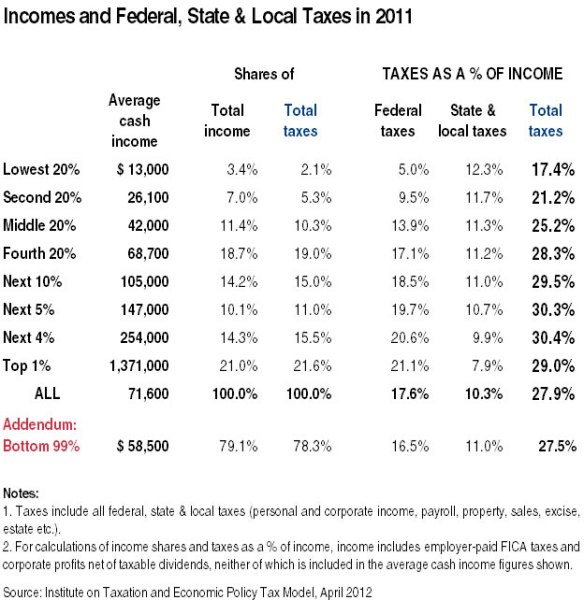
Reason 1: We no longer have a progressive tax system. When you factor in the various kinds of taxes we pay, it turns out that the people who could afford to pay more are taxed at roughly the same rate as everyone else.
taxday2012table

http://ctj.org/ctjreports/2012/04/who_pays_taxes_in_america.php

Reason 2: It’s hard to believe, but the US is responsible for at least 40% of the world’s total military spending. We spend 5 times as much as China and 10 times as much as Russia. Unless we’re going to fight the rest of the world, or maybe counter an invasion from outer space, we are wasting a whole lot of money that could be spent toward making this the greatest country in the world.

http://en.wikipedia.org/wiki/List_of_countries_by_military_expenditures

We are choosing to fall behind.