Nostalgia Once Removed, or Stardust Memories

Chinatown is a wonderful movie. One of the great things about it is how it portrays Los Angeles in 1937. The city looks so shiny and new. Watching Chinatown always makes me nostalgic for Los Angeles, even though I lived there decades after the 1930s. 

What’s odd is that I don’t have especially happy memories of Los Angeles. Living there, it often seemed as if the really good stuff was happening on the other side of town.

My nostalgia, my “bittersweet longing for things, persons, or situations of the past”, my “wistful or excessively sentimental yearning for return to some past period”, is mostly for the past that didn’t happen. It’s for the past that might have been, a longing for missed opportunities in a setting that promised something wonderful.

The Germans could have a word for it: “Sehnsuchtnacheinervergangenensie hattennie”.

Sehnsucht nach einer vergangenen sie hatten nieNostalgia for a past you never had.

We might also call the phenomenon “stardust memories”.

Bet on Achilles to Beat the Tortoise

Many are the times I’ve thought about Achilles and the tortoise:

Zeno concluded from this and other paradoxes that motion is an illusion, so it’s important to show why Achilles will beat the tortoise. Otherwise, we’ll all have to sit very still.

Zeno’s argument goes something like this:

1) When Achilles starts running at point A, the tortoise is already at B.
2) By the time Achilles reaches point B, the tortoise is at point C.
3) By the time Achilles reaches point C, the tortoise is at point D.
4) This series can be extended forever.
5) In order to catch up, Achilles will have to perform an infinite series of tasks in a finite amount of time.
6) It’s impossible to perform an infinite series of tasks in a finite amount of time.
7) Therefore, Achilles can never catch up to the tortoise.

But we know that mighty Achilles is going to catch up to the tortoise and win the race. Fast runners beat slow walkers. Hence, the paradox.

In his book A Brief History of the Philosophy of Time, Adrian Bardon suggests that Aristotle had a good response to Zeno. Aristotle apparently argued that Zeno’s paradox rests on confusing “an abstract value (i.e. time), which is mathematically divisible into instants, with actual change, which is not literally composed of infinitesimal units of change”. In other words, Aristotle distinguished between “the rules for time (as a mere abstraction) and those for change (as a real phenomenon)”. Maybe Aristotle was right, but I’m not sure Zeno would have been convinced.

Bardon also discusses the mathematical concept of a “limit”, which “allows for an infinite number of finite quantities to add up to a finite sum”. That’s the idea mentioned at the end of the video. Many have concluded that Zeno can be answered using this concept, although Bardon asks: “Can a limit be a real endpoint to a real process, or is it just a new mathematical convention that disregards the metaphysical question about time and change with which Aristotle and Zeno are struggling? Does it really help matters to say that [motion or change] represents convergence on a limit? That wouldn’t have sounded like real motion to either Zeno or Aristotle”.

Maybe Zeno’s argument does require a subtle and sophisticated response. But what struck me as weak about his argument was one of the premises listed above:

6) It’s impossible to perform an infinite series of tasks in a finite amount of time.

Really? Who says? Isn’t that what we do every time we move from point A to point B? Having arrived at point B, haven’t we also traveled 1/2 of the distance, 1/3 of the distance, 1/4 of the distance, 1/5 of the distance and so on? Isn’t this a clear example of performing an infinite series of tasks in a finite amount of time? Granted that the tasks overlap, but it seems fair (albeit boring) to describe what we’ve done this way, without having to explain what the mathematical concept of a “limit” is or draw a distinction between the rules for speaking about time and the rules for speaking about change.

Perhaps this is mere sophistry and Zeno would have considered it such, since he and the Sophists were contemporaries. I think it’s a simple truth that moving around involves doing many little things by doing one big thing. Take that, Zeno!

On a similar note, the English philosopher G. E. Moore wrote a famous article called “Proof of an External World”. In that article, he said he could prove the existence of the world outside our minds by drawing our attention to his two hands: “by doing this, ipso facto, I have proved the existence of external things”. Whether that’s a great argument or not is an open question. Moore defended his argument, however, by pointing out that skeptical philosophical arguments (such as proving motion to be an illusion) often rely on philosophical intuitions or generalities (such as premise 6 above) that we have much less reason to accept than the common sense beliefs they supposedly refute.

All right, it’s safe to start moving again.

A Guide to Reality, Part 5

Alex Rosenberg, the author of The Atheist’s Guide to Reality, argues that “we should embrace physics as the whole truth about reality”. On the face of it, that’s a remarkable statement open to obvious challenges. 

Rosenberg, however, acknowledges that parts of physics are relatively speculative, unsettled or even inconsistent. It’s the solidly-confirmed part of physics that he’s talking about, the part of physics that is “finished” and “explains almost everything in the universe – including us”. What he’s really claiming, therefore, is that settled physics is the whole truth about reality. 

But is settled physics actually true? Philosophers disagree about what science is, what truth is and, not surprisingly, how close science gets to the truth, but I agree with Rosenberg that settled physics seems to be true. The predictions of special relativity, for example, appear to be 100% correct. (This isn’t to deny that some settled physics might become unsettled one day.) As evidence of the reliability of physics, Rosenberg points out how precise some predictions are: “quantum electrodynamics predicts the mass and charge of subatomic particles to 12 decimal places”. Those predictions are “true” in any reasonable sense of the word, even if physicists eventually refine their predictions to even more decimal places.

Some philosophers and scientists don’t accept Rosenberg’s “scientific realist” view, however. They think science is merely a tool that allows us to get things done. Questions like whether electrons or other theoretical entities really exist as physics describes them are put aside, since they’re viewed as unanswerable and irrelevant. Personally, I think physics allows us to get things done because it’s true, and furthermore it’s true in the sense that the objects and events physics describes are real, whether they’re observable or not. I believe that’s Rosenberg’s opinion too.

The second, more interesting challenge to Rosenberg’s view of physics concerns his claim that settled physics is the “whole” truth about reality. Clearly, there are mathematical and logical truths, which aren’t part of physics, but I take Rosenberg to be referring to truths about the universe and its contents, i.e. “real” stuff.

Nevertheless, if physics isn’t finished, it can’t be the “whole” truth. There must be some physical truths yet to be discovered (for example, what’s the story on dark matter and dark energy, two big things we know little about?). So Rosenberg’s claim that we should embrace settled physics as the whole truth about reality should really be understood as “settled physics is the only truth about reality we currently have”.  

Two obvious questions remain, however. Do we discover the truth from sciences other than physics? And do we learn anything true about the world even when we aren’t doing science?

Well, most people would agree that chemistry, for example, is a science that gets at the truth if any science does. Rosenberg clearly knows about chemistry, so why would he deny that chemistry is as valid as physics? The answer is that he thinks physics has shown there is nothing in the universe except fermions (e.g. quarks) and bosons (e.g. photons). From the idea that fermions and bosons are the only things that really exist, he concludes that all of reality can be explained in terms of those sub-atomic particles. After all, everything in the universe involves elementary particles being somewhere or doing something. Since physics is the science that tells us all about elementary particles and what they do, it’s the fundamental science. Using physics, therefore, we can explain chemistry, which we can then use to explain biology. Another way of saying this is that biology is reducible to chemistry and chemistry is reducible to physics. Knowledge of physics is the only knowledge that counts, because “the physical facts fix all the facts”, including chemical and biological facts.

The big problem with this point of view, aside from the difficulty in actually carrying out such reductions (replacing chemistry with physics, for example) is that fermions and bosons do such interesting things when they interact or are arranged in certain ways. Put some together and you have atoms; put some atoms together and you have molecules; put some of them together and you have cells. Once low-level particles are arranged as, for example, clouds or baseballs or trees, patterns or regularities in the behavior of these higher-level entities emerge. There are new facts to be learned.

If the universe were merely a collection of sub-atomic particles randomly scattered about, there wouldn’t be any chemical or biological facts for chemists and biologists to discover. But the particles in our universe aren’t randomly scattered. They’ve clumped together in various ways. Acquiring knowledge about these clumps (of which you and I are examples) is what chemists, biologists and other scientists (geologists, astronomers, psychologists, etc.) do. Rosenberg knows this, of course, but for some reason downplays it, choosing to focus on physics as the sine qua non of science. In virtue of its power and generality, physics should be embraced as the most fundamental science, but it clearly isn’t the only science worth embracing. 

The other question raised by Rosenberg’s scientism (or physics-ism) is whether we can add to our knowledge when we aren’t doing science at all. Rosenberg doesn’t seem to think so. Although science is built on observation, he is extremely skeptical about what can be learned by simply looking and listening. He also seriously mistrusts introspection. More on this later. 

Next: The 2nd Law of Thermodynamics and us.

Wartime: Understanding and Behavior in the Second World War by Paul Fussell

Paul Fussell’s best-known book is The Great War and Modern Memory. In that book, he wrote about the effect of World War I, especially trench warfare, on British writers. Wartime is Fussell’s similar book about World War II. This one isn’t mainly concerned with the war’s effect on writers, however. It has a much broader scope. There are discussions, for example, of the myth of “precision” bombing; the frequency of military foul-ups; rumors; rationing; stereotypes; accentuating the positive; casualty rates; popular songs; swearing; hunger; and sexual frustration. There is even a whole chapter devoted to “chickenshit” – the petty crap that superiors inflict on subordinates.

Fussell wrote from experience. He was awarded the Bronze Star and the Purple Heart as an infantry officer in France. His goal in Wartime was to capture the reality of World War II as it was endured by American and British soldiers, sailors and airmen, especially those who actually saw combat (a small minority of those who served). He often does this by contrasting military reality with the sanitized version presented to the people back home. If you were in the service but not in combat, your main emotions were boredom and anger. If you were in combat, it was fear and horror.

According to Fussell, the authorities eventually realized that engaging in more than 240 days of combat (not consecutive days, but total days) would drive anyone insane. That sums up World War II for the men who did the actual fighting.

The Enduring Mystery of “Chevy Shut Down”

WFMU is a listener-sponsored, free-form radio station broadcasting out of Jersey City, New Jersey. Now, of course, their programs, old and new, are available worldwide at http://www.wfmu.org.

A couple days ago, the insightful person who does the “Fool’s Paradise” show on Saturday afternoon played “Chevy Shut Down” by the Jaguars. It went by quickly and I’d never heard it before, but there was something extremely familiar about it.

Now, of course, there’s YouTube, so an obscure single from 1964 can be listened to over and over again, all over the world, maybe forever! It’s also easy to investigate just about anything. Some have investigated “Chevy Shut Down”, but with little success. The YouTube description says “Millions of hours searching the Google has netted NO information”. I searched “the Google” too and think the Jaguars may have started out in Oklahoma, but it isn’t clear where they came from or who they were (there have been lots of groups called the “Jaguars”). One thing I did find out is that two years ago a copy of the 45 sold on eBay for $100.

What’s especially interesting about this song, aside from its general rambunctiousness and semi-incomprehensible lyrics, is that it’s a “mashup” (the modern term). The Jaguars started with the Beach Boys’ 1963 classic “Shut Down”, rewrote the lyrics and apparently borrowed the intro from “Fun, Fun, Fun”. Then they threw in some of the Rip Chords’ “Hey, Little Cobra” (“go little Chevy, cause I know you’re gonna shut ’em down”) and Chuck Berry’s “Little Queenie” (“go go, go little Chevy”). The result: Cherry Records C-0369, “Chevy Shut Down”.

250960539743

The song starts after the brief introduction. (Some of the mystery is lifted after the video.)(Update: the YouTube video I originally posted is now gone. This one is from 2018.)

Six months ago, someone calling himself Steven Williamson left a comment on YouTube:

This is my Dad singing this song. The Jaguars only recorded 2 songs back in the 60’s. Chevy Shut Down and Just Out Of Luck. I know he was proud to see this. There are still some copies of these songs left but very hard to find.

That is pretty cool.

Whoever they were, the Jaguars did a mashup with incomprehensible lyrics in 1964 that still rocks. They were clearly ahead of their time.

For comparison purposes, the original “Shut Down” from 1963:

The Beach Boys loved how Chuck Berry played guitar:

The Rip Chords’ big hit reached #4 in the U.S. at the dawn of the British Invasion (and led to “go little Chevy, cause I know you’re gonna shut ’em down”):

The incomparable Chuck Berry as he appeared in the 1959 movie “Go, Johnny Go!” (hence, “go, go, go little Chevy”):

August 2020 update: There’s been recent discussion in the comments. The enduring mystery isn’t what it used to be. Thus, ladies and gentlemen: The Jaguars! (Most of them anyway. See below.)

From Bryan Sharp:

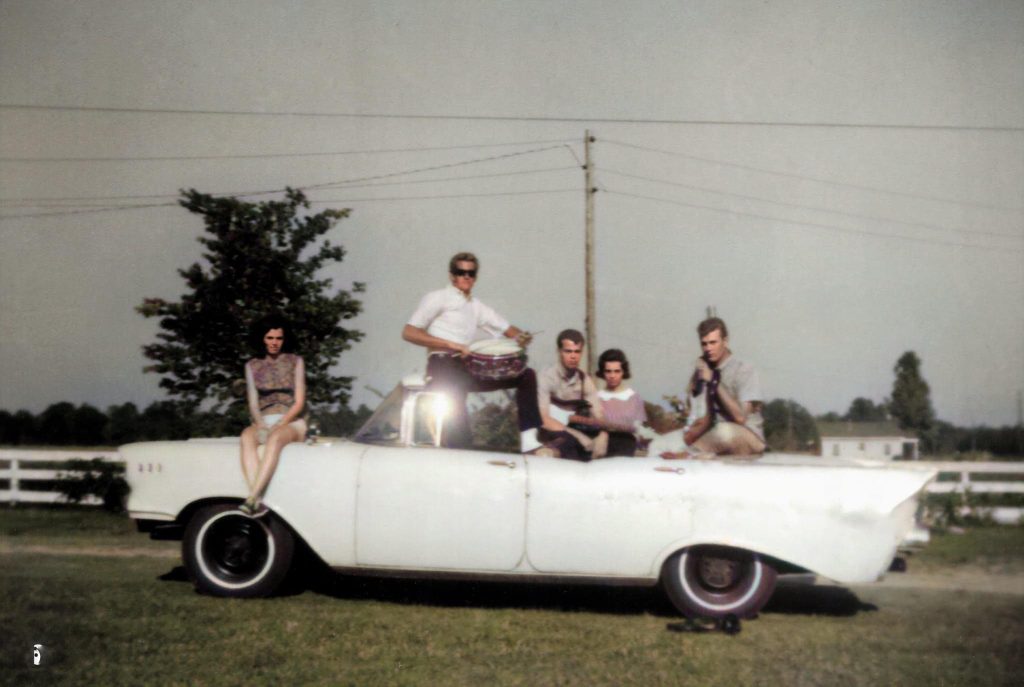
Original members of the “Jaguar Band” Left to right: Willie “Bruto” Perdue , Gerald Black “Jerry” & Dale Sellers on the trunk. Not in the picture was James “Rabbit” Williamson.  Rabbit said that car belonged to Willie Perdue. It was a 57 Chevrolet and he cut the top out to turn it into a convertible.  Rabbit said he was probably riding his motorcycle around somewhere. Juanita Purdue is on the hood and that’s Judy (Mclaughlin) Black. Dale’s father Mr. Calvin took the picture in their front yard on a Sunday afternoon May 1965.

Rabbit was telling how “The Jaguars” played @ The Civic Center in Panama City.  He said Earl Lowery was playing the drums @ that time, when Willie was in Vietnam.Rabbit said The Jaguars won a talent show in Evergreen, AL that sent the band to Panama City. Not too long after playing in  Panama City Dale went to Nashville.  Rabbit said, “we did what we wanted to do, record that record” (Rabbit, Jerry, Dale, & Willie).