Corporate Life As Depicted On My Old Bulletin Board

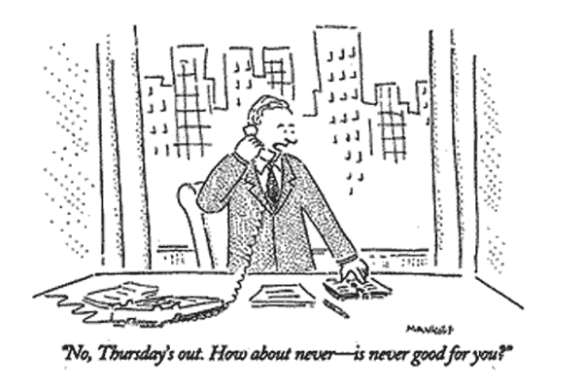
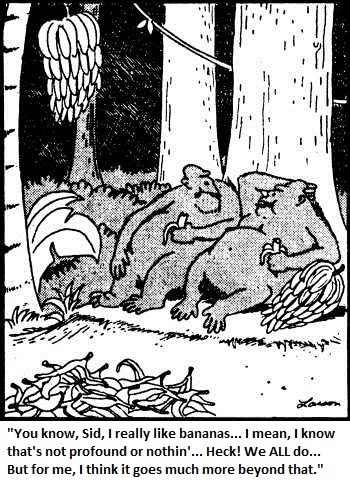
There were four cartoons on the bulletin board in my office for many years, back when I was paid to help the wheels of finance capitalism turn. Maybe there was a theme that united them. Of course, not everyone liked them as much as I did.

The first one was by Bob Mankoff, the cartoon editor of The New Yorker, who recently announced he’s leaving that job. It’s the most famous one he drew.

how-about-never

The other three were by Gary Larson, who drew The Far Side for 15 brilliant years.

7b0668a619c04b1168db8db673846a13

lGPdM1E

4DqHp

So is there a theme here? We have a businessman subverting standard practice; a gorilla who sees himself as more complex than his peers; someone in a horrible situation who thinks it’s worth stating the obvious but is afraid he might make things even worse; and two spiders with very high hopes doomed to failure.

It was a “successful” career, but no wonder I still have bad dreams about the place.

The Real Building Blocks of the Universe (So Far)

Thales of Miletus is generally credited with being “the first philosopher in the Greek tradition [and] as the first individual in Western civilization known to have entertained and engaged in scientific philosophy” (Wikipedia). Less formally, he’s known as the ancient Greek who thought everything is made of water.

But that wasn’t a crazy idea at the time:

Thales [c. 624 – c. 546 BC] is recognized for breaking from the use of mythology to explain the world and the universe, and instead explaining natural objects and phenomena by theories and hypothesis, i.e. science. Almost all the other Pre-Socratic philosophers followed him in explaining nature as deriving from a unity of everything based on the existence of a single ultimate substance, instead of using mythological explanations. Aristotle reported Thales’ hypothesis that the originating principle of nature and the nature of matter was a single material: water (Wikipedia).

Jumping forward around 2,500 years, we’re still trying to figure out what everything is made of. If you’d asked me a few days ago, and given me a few seconds to think about it, I’d probably have said everything is made of very tiny particles like quarks and photons:

Standard_Model_of_Elementary_Particles.svg.0

Fortunately, however, the scales have been lifted from my eyes. All it took was watching a lecture by a physicist named David Tong. It’s called “Quantum Fields: The Real Building Blocks of the Universe”. Here’s how he explains the situation on his University of Cambridge webpage:

Fields

We learn in school that the basic building blocks of matter are particles. In fact, we often continue to teach this in universities where we explain that quarks and electrons form the lego-bricks from which all matter is made.

But this statement hides a deeper truth. According to our best laws of physics, the fundamental building blocks of Nature are not discrete particles at all. Instead they are continuous fluid-like substances, spread throughout all of space. We call these objects fields.

The most familiar examples of fields are the electric and magnetic field. The ripples in these fields give rise to what we call light or, more generally, electromagnetic waves. The field [relating to a magnet is shown here].

mfield

From Fields to Particles

If you look closely enough at electromagnetic waves, you’ll find that they are made out of particles called photons. The ripples of the electric and magnetic fields get turned into particles when we include the effects of quantum mechanics.

But this same process is at play for all other particles that we know of. There exists, spread thinly throughout space, something called an electron field. Ripples of the electron field get tied up into a bundle of energy by quantum mechanics. And this bundle of energy is what we call an electron. Similarly, there is a quark field, and a gluon field, and Higgs boson field. Every particle your body — indeed, every particle in the Universe — is a tiny ripple of the underlying field, moulded into a particle by the machinery of quantum mechanics.

qfields

These fields fill the universe, even what seems to be empty space. All of the particles the physicists have identified are manifestations of these fields. In some sense, apparently, so are we. 

Prof. Tong gave his lecture at the Royal Institution in London in November. It’s an hour-long introduction to Quantum Field Theory for the general public. He’s an entertaining speaker and, as an added bonus, he looks and sounds a lot like the comedian John Oliver.

If you want to jump ahead a little, it’s about nine minutes in when he announces that:

The best theories we have tell us that the fundamental building blocks of nature are not particles but something much more nebulous and abstract. The fundamental building blocks of nature are fluid-like substances which are spread throughout the entire universe and ripple in strange and interesting ways. That’s the fundamental reality in which we live. These fluid-like substances, we have a name for, we call them “fields”.

Have fun. After this, you may never see the world in the same way.


(Hmm, notice how I didn’t mention You Know Who once? This should not suggest that anything is back to normal yet. Far from it.)

Against Autocracy and Apathy

David Frum, who wrote speeches for George W. Bush, is one of the few right-wingers who haven’t swallowed Drump’s Kool-Aid. He now writes for The Atlantic, where he published an excellent article in January called “How To Build An Autocracy”. Its subtitle was “The preconditions are present in the U.S. today. Here’s the playbook Donald [Drump] could use to set the country down a path toward illiberalism”.

It’s a full-length magazine article that takes a while to load because of all the advertisements (unless your ad blocker is working), but it was very well-received and is still worth reading. Frum begins by imagining Drump being sworn in for his second term. America hasn’t gone completely over the edge but it’s not healthy either. The article concludes:

Those citizens who fantasize about defying tyranny from within fortified compounds have never understood how liberty is actually threatened in a modern bureaucratic state: not by diktat and violence, but by the slow, demoralizing process of corruption and deceit. And the way that liberty must be defended is not with amateur firearms, but with an unwearying insistence upon the honesty, integrity, and professionalism of American institutions and those who lead them. We are living through the most dangerous challenge to the free government of the United States that anyone alive has encountered. What happens next is up to you and me. Don’t be afraid. This moment of danger can also be your finest hour as a citizen and an American.

I was reminded of the article because Mr. Frum generated what’s called a “tweetstorm” on Twitter today. Up until a few months ago, I thought Twitter was basically a joke. I didn’t realize how interesting it is as a source of political news and commentary. So I created an account and now follow a small number of journalists, politicians and people with common interests (and a few comedians). Some of the journalists, including David Frum, offer what’s almost a running commentary on the day’s events. Here’s what he wrote today in 21 segments:

  1. [The Attorney General] Sessions story today is a sinister confirmation of central thesis of my autocracy article:
  2. Donald Trump is a uniquely dangerous president because he harbors so many guilty secrets (or maybe 1 big guilty secret).
  3. In order to protect himself, Trump must attack American norms and institutions – otherwise he faces fathomless legal risk
  4. In turn, in order to protect their legally vulnerable leader, Republicans in Congress must join the attack on norms & institutions
  5. Otherwise, they put at risk party hopes for a once-in-a-lifetime chance to remake US government in ways not very popular with voters
  6. American institutions are built to withstand an attack from the president alone. But …
  7. … they are not so well-built as to withstand an attack from a conscienceless president enabled by a hyper-partisan Congress
  8. The peculiar grim irony in this case is that somewhere near the center of Trump’s story is the murky secret of Trump’s Russia connection
  9. Meaning that Trump is rendering his party also complicit in what could well prove …
  10. … the biggest espionage scandal since the Rosenberg group stole the secret of the atomic bomb.
  11. And possibly even bigger. We won’t know if we don’t look
  12. Despite patriotic statements from individual GOPers, as of now it seems that Speaker Ryan & Leader McConnell agree: no looking.
  13. So many in DC serenely promise that “checks and balances” will save us. But right now: there is no check and no balance.
  14. Only brave individuals in national security roles sharing truth with news organizations.
  15. But those individuals can be found & silenced. What then? We take it too much for granted that the president must lose this struggle
  16. The “oh he’s normal now” relief of so many to Trump’s Feb 28 speech revealed how ready DC is to succumb to deal making as usual.
  17. As DC goes numb, citizen apathy accumulates …
  18. GOP members of Congress decide they have more to fear from enforcing law against the president than from ignoring law with the president
  19. And those of us who care disappear down rabbit holes debating whether Sessions’ false testimony amounts to perjury or not
  20. Meanwhile job market strong, stock market is up, immigration enforcement is popular.
  21. I’m not counseling despair here. I don’t feel despair. Only: nobody else will save the country if you don’t act yourself.

Of course, it will be the height of irony if Drump, after claiming that he inherited a disaster from Obama, ends up getting credit for the economy improving and ISIS being defeated, but that’s the way American politics works. At the present moment, however, what especially struck me about Frum’s comments was the idea that citizen apathy, including my own, might be growing. 

I was able to attend a town hall by our Congressman, Rep. Leonard Lance (NJ-7), two weeks ago. He the typical relatively sensible Republican who went to Washington and now almost always follows the party line. At the town hall, he avoided straight answers, repeated some ridiculous Republican talking points and made promises he won’t keep, but at least he got an extended earful from hundreds of angry constituents.

But now that the excitement of the town hall has faded, and no big demonstrations like the Women’s March on Washington in the news, I’m beginning to feel a little numb myself. That’s natural, I suppose. Intensity will come and go, even as the outrages continue. In the meantime, however, if you’d like to do something positive, there’s a special election being held in a suburban district outside Atlanta to replace the lying creep who’s now running the Dept. of Health and Human Services.

Jon Ossoff is a Democratic candidate who could pull off an upset in Georgia’s Sixth Congressional District if he gets enough support and there’s enough of an anti-Drump backlash. Even if he doesn’t win, a close election will show Republicans like our Leonard Lance that their re-election isn’t assured. I made a donation today. You can too if you visit Mr. Ossoff’s campaign site.

Even if you’re not at peak emotional intensity right now, you can always spend a few dollars for an important cause. 

The Simulation Situation

There are smart people who think we’re probably living in a simulation. They question whether we’re flesh and blood creatures inhabiting a physical universe. Instead, we’re mental constructs “living” inside an incredibly sophisticated computer program. Our reality is someone else’s virtual reality.

Adam Gopnik of The New Yorker summarizes the logic:

The argument, actually debated at length at the American Museum of Natural History just last year, is that the odds are overwhelming that ours is a simulated universe. The argument is elegant. Since the advance of intelligence seems like the one constant among living things—and since living things are far likelier than not to be spread around the universe—then one of the things that smart living things will do is make simulations of other universes in which to run experiments….

Since there will be only one “real” universe, and countless simulated ones, the odds that we are living in one of the simulations instead of the one actual reality are overwhelming. If intelligent life exists, then we are surely likely to be living in one of its Matrices. As Clara Moskowitz, writing in Scientific American, no less, explains succinctly, “A popular argument for the simulation hypothesis came from University of Oxford philosopher Nick Bostrum in 2003, when he suggested that members of an advanced civilization with enormous computing power might decide to run simulations of their ancestors. They would probably have the ability to run many, many such simulations, to the point where the vast majority of minds would actually be artificial ones within such simulations, rather than the original ancestral minds. So simple statistics suggest it is much more likely that we are among the simulated minds.”

Mr. Gopnik somewhat jokingly suggests that recent events, in particular, an evil buffoon becoming President, a startling turnaround in the Super Bowl, a dumb mistake at the Oscars, are evidence that someone “up there” is messing with us (“Let’s do this crazy thing and see what happens!”). 

In response, Jesse Singal of New York Magazine argues that recent events seem so bizarre because recent history has been relatively calm:

…part of what’s going on here is that over the last few decades, the world has gotten so much less weird — in mostly good ways — that it’s now easier to highlight and harp upon what are, in the grand scheme of things, relatively minor weirdness flare-ups….

We pay more attention to the Patriots coming back from 28–3 in an impossibly short span of time because we’re less distracted by the U.S. trying to napalm its way out of an inconceivably stupid jungle quagmire. We gawk at the Oscar craziness and dwell on it because it stands out in a saner world than many of our parents and grandparents inhabited. Hell, it’s too early to say, but in the long run, barring an unforeseen catastrophe, maybe even [Donald Drump] — God or superintelligent alien simulators willing — will end up getting a mere footnote, rather than a chapter, in the Book of Weirdness humanity continues writing every moment of every day.

I think Mr. Singal is correct, of course. As some have noted, the Oscar thing was bound to happen (it had already happened once before, in 1964 to Sammy Davis Jr.); sports teams occasionally overcome big deficits, especially when the other team helps; and the Electoral College could have done what the Founders intended and elected a normal person (although I have to admit that, as naturally-occurring events in any possible world go, Drump in the White House is hard to accept).

The idea that we are constructs in some kind of vast computer program isn’t the same as what was depicted in the Matrix movies. In the Matrix, we were good, old-fashioned human beings being manipulated into thinking we were somewhere else. In the simulation hypothesis, we’re software that thinks it’s human. But once you start to imagine possibilities like these, it’s hard to conclude we’re one vs. the other. Would it be easier to create virtual beings who think they’re organisms like us or to trick organisms like us into thinking we’re somewhere else? 

That’s one of the problems I have with the idea of the big simulation. It’s the same problem I have with the idea that our minds could be uploaded onto a computer. In theory, a program could execute the same thoughts that you or I have. For example, it could reach the same conclusions we would if presented with the same evidence. But could a program have the same feelings, the same conscious experience, we have when we touch, hear or see? Maybe so, but it’s hard for me to understand how a program could possibly do that. Would the software include components that made the software believe it was conscious when it really wasn’t? Could the evil demon have tricked Descartes into think he was conscious when he really wasn’t?

Of course, there are other problems with the simulation hypothesis besides my personal lack of imagination. Nobody knows how common life is. How often, for example, do chemical components form single-cell organisms? How often does single-cell life make the transition to multi-cellular life? Assuming complex organisms develop, how often do they form stable societies? And how much technological progress do stable societies make before they destroy themselves or hit some other bump in the cosmic road? We know there are lots of stars in the universe, and now it looks like there are lots of planets too, but beyond that it’s all speculation.

It’s also questionable whether advanced civilizations would decide to run such simulations even if they could. Why assume that beings that advanced would care about creating a world like ours? Wouldn’t they have better things to do?

More than a few philosophers and physicists think there are other universes in addition to ours, maybe even an infinite number of them. In one or more of those many universes, every possibility is real. So maybe the universe we experience is a vast simulation. On the other hand, maybe it’s a simulation being run for an audience of one. How do I know that the simulation I’m witnessing is simulating something for anyone else? It would certainly be simpler to simulate a universe for a single “person” (me) as opposed to billions of them (all of you). At any rate, I’m sure I’m here. Are you?
Fuck Him. He’s Still a Con Man.

Donald Drump gave a long speech last night that made some people think he’s not as bad as they thought. This has happened before. If you think otherwise, that he’s suddenly become “presidential” rather than “unpresidented”, read these: 

Michael Grunwald, “Salesman-in-Chief”, Politico

Brian Beutler, “The Worst Performance of [Drump’s] Presidency Now Belongs to the Press Corps”, The New Republic

Greg Sargent, “The Pundits Are Wrong. [Drump’s] Handling of the Ryan Owens Affair Was Contemptibly Cynical”, The Washington Post

Alex Pareene, “You Cretins Are Going To Get Thousands of People Killed”, The Concourse

Meanwhile, Reuters reports that there was a record high of 63.5 degrees in Antarctica last year.Â