Trusting Hillary

Last week, Republican Senator Lindsey Graham, while admitting that his own political party has gone “batshit crazy”, referred to Hillary Clinton as “the most dishonest woman in America”. He was joking – kind of (video here). 

This week, former Republican Presidential candidate Mitt Romney, while attacking one of this year’s candidates, said “a person as dishonest and untrustworthy as Hillary Clinton must not become President” (transcript here).

Obviously, characterizing Clinton as dishonest and untrustworthy is standard song and dance for Republican politicians. What’s been surprising lately is how many Democrats are making similar statements. The Democrats in question are generally the ones who support Clinton’s opponent for the Democratic Presidential nomination, Senator Bernie Sanders. 

I bring this up because “73angelD” posted this comment on New York Magazine‘s site yesterday:

73angelD: “There are many middle-aged female Sanders supporters like myself who do not trust Clinton.”

That type of thing from a liberal or progressive voter who should and almost certainly will vote for Clinton in November raises an interesting question. So I asked it:

PersonaObscura [that’s me!]: “I’m honestly confused. What is it that you don’t trust Clinton to do? Do you think she’ll be remarkably less liberal in office than she says she’ll be? Or her voting record in the Senate indicates? She’s always seemed to be more liberal than her husband, but less slippery.”

Which someone else tried to answer: 

Madapalooza: “We don’t trust her irresponsiblity due to the email scandal, her being a Goldwater Girl, her taking hundreds of thousands from the institutions she “claims” she’s going to regulate, withholding the wall street transcripts, the fact that she not once but twice dismissed black protesters who simply asked her to explain her racial remarks on television, her husband sabotaging the voting polls in Massachusetts on super Tuesday, ect, ect…”

Resisting the urge to comment on those particular “offenses” (and the more powerful urge to correct the “ect, ect”), I replied:

PersonaObscura: “You listed things you don’t like about her or her husband, but trust has to do with what you expect her to do as President. Based on everything she’s said and done in her life, and what we’ve gone through as a nation in recent years, it’s reasonable to expect her policies will be to the left of Bill Clinton’s and to the right of what Bernie’s would have been. This will be our choice in November: a relatively liberal Democrat vs. some right-wing goon.”

The discussion probably went on from there (my policy in these matters is to say one or two things and then exit, often pursued by an angry elephant or donkey).

As we traverse the next eight months, we should all keep in mind that casting a ballot in a Presidential election amounts to making a prediction. Who do we predict will have the most success carrying out policies we endorse? We can’t be certain, so we need to make an educated guess.

In Hillary Clinton’s case, it should be obvious to everyone that she will tend to do her job like President Obama has done his. She won’t govern like a democratic socialist or a reactionary Republican. There is no reason to think she has been hiding her real intentions for the past 50 years. Therefore, we can trust her to govern like Jimmy Carter, Bill Clinton and Barack Obama, not like Ronald Reagan, George H. W. Bush or his feckless son.

She will try to reduce income inequality, create middle class jobs, move us closer to universal healthcare, reform our immigration policies and protect the environment. She will pay attention to science. She will take a particular interest in issues facing women and children. She will be pro-market but not necessarily pro-big business. She will nominate reasonable people to be judges.

Likewise, she will allow the CIA and NSA to stay in business, authorize drone strikes and allow Israel to get away with very bad behavior toward the Palestinians. We can trust her to do these kinds of things, the good and the bad. That’s the kind of trust that’s relevant.

Saying you don’t trust Hillary Clinton is an easy way to criticize her without bothering to explain what you don’t trust her to do. As President, she will often disappoint us, but who knows? She could turn out to be almost as progressive as the Republicans fear. It’s about time they got something right.

The article referred to above is here. The author’s thesis is that some conservatives are voting for Sanders because they don’t like uppity women. I don’t recommend the comments!

PS:  A few words about Hillary Rodham back when she would have been Feeling the Bern:

In her junior year, Rodham became a supporter of the antiwar presidential nomination campaign of Democrat Eugene McCarthy. In early 1968, she was elected president of the Wellesley College Government Association and served through early 1969. Following the assassination of MartinLuther King, Jr., Rodham organized a two-day student strike and worked with Wellesley’s black students to recruit more black students and faculty. In her student government role, she played a role in keeping Wellesley from being embroiled in the student disruptions common to other colleges. A number of her fellow students thought she might some day become the first female President of the United States….

That summer, [after graduation] she worked her way across Alaska, washing dishes in Mount McKinley National Park and sliming salmon in a fish processing cannery in Valdez (which fired her and shut down overnight when she complained about unhealthful conditions). [Wikipedia]
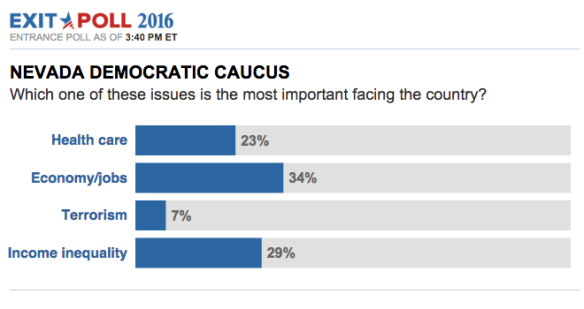
Brief Political Commentary

Voters who attended the Democratic caucuses in Nevada yesterday were asked to identify the most important issue facing America. 34% said the economy and jobs; 7% said terrorism.

NVDem_Issues_02202016

Voters in the Republican primary in South Carolina were asked the same question. 28% said the economy and jobs, but 32% said terrorism.

SGOP_IssuesV2_02202016I haven’t been able to determine whether the Democrats and Republicans were given the same list of issues to choose from, but it’s still remarkable that one-third of Republican voters chose terrorism as the most important issue we face. In fact, it’s remarkable that 7% of the Democrats said the same thing.

Unless these people think there is a strong chance that terrorists (of whatever political persuasion, not just Islamic fundamentalists) will attack America with nuclear or biological weapons, it’s silly to put terrorism at the top of the list. (In fact, given how silly it is, I have to wonder – mostly facetiously – whether some of those Democrats were devious Republicans attending the Democratic caucuses in order to make trouble, something the rules in Nevada allowed).

Here in New Jersey, we don’t get to participate in the nomination process until June, when it won’t matter what we think or how we vote. But if anyone asked me, I’d put global warming first, because of its possibly catastrophic consequences. After that, it would be hard to choose between the economy and jobs; money in politics; and the number of Americans who have lost their minds and vote for Republicans.

Automatic Weapons Again

A statistic from Vox:  More Americans have been killed with guns since 1968 than have died in all of our wars going back to 1776. 

Now, we all know that the purpose of “automatic” weapons is to disable or kill many people very quickly. Rational Americans understand that no private citizen should legally possess powerful weapons of this kind or the ammunition that goes with them. The Constitution doesn’t give us the right to bear any kind of “arms” no matter how dangerous. Making these weapons illegal does not require going down the slippery slope to banning all firearms. The United States isn’t going to invade Texas and even Texas isn’t the Wild West. More guns and more powerful guns means more innocent people being maimed and killed.  

But if law-abiding citizens don’t own such weapons, only criminals will! That’s exactly right. Police and the armed forces will have access to these weapons in case they’re needed. Anybody else who has an automatic weapon will be and should be a criminal.

From New York Times op-ed writer Timothy Egan’s article about our latest massacre:

A day after the California carnage, the Senate decided to do nothing, again, voting down a measure that would have made it more difficult for people on the terror watch list, felons and the mentally ill to buy guns.

Well, it wasn’t as if the whole Senate made that decision:

YEAs (Do Something) — 45
Baldwin (D-WI)
Bennet (D-CO)
Blumenthal (D-CT)
Booker (D-NJ)
Boxer (D-CA)
Brown (D-OH)
Cantwell (D-WA)
Cardin (D-MD)
Carper (D-DE)
Casey (D-PA)
Coons (D-DE)
Donnelly (D-IN)
Durbin (D-IL)
Feinstein (D-CA)
Franken (D-MN)
Gillibrand (D-NY)
Heinrich (D-NM)
Hirono (D-HI)
Kaine (D-VA)
King (I-ME)
Kirk (R-IL)
Klobuchar (D-MN)
Leahy (D-VT)
Manchin (D-WV)
Markey (D-MA)
McCaskill (D-MO)
Menendez (D-NJ)
Merkley (D-OR)
Mikulski (D-MD)
Murphy (D-CT)
Murray (D-WA)
Nelson (D-FL)
Peters (D-MI)
Reed (D-RI)
Reid (D-NV)
Sanders (I-VT)
Schatz (D-HI)
Schumer (D-NY)
Shaheen (D-NH)
Stabenow (D-MI)
Tester (D-MT)
Udall (D-NM)
Warren (D-MA)
Whitehouse (D-RI)
Wyden (D-OR)
NAYs (Do Nothing) — 54
Alexander (R-TN)
Ayotte (R-NH)
Barrasso (R-WY)
Blunt (R-MO)
Boozman (R-AR)
Burr (R-NC)
Capito (R-WV)
Cassidy (R-LA)
Coats (R-IN)
Cochran (R-MS)
Collins (R-ME)
Corker (R-TN)
Cornyn (R-TX)
Cotton (R-AR)
Crapo (R-ID)
Cruz (R-TX)
Daines (R-MT)
Enzi (R-WY)
Ernst (R-IA)
Fischer (R-NE)
Flake (R-AZ)
Gardner (R-CO)
Graham (R-SC)
Grassley (R-IA)
Hatch (R-UT)
Heitkamp (D-ND)
Heller (R-NV)
Hoeven (R-ND)
Inhofe (R-OK)
Isakson (R-GA)
Johnson (R-WI)
Lankford (R-OK)
Lee (R-UT)
McCain (R-AZ)
McConnell (R-KY)
Moran (R-KS)
Murkowski (R-AK)
Paul (R-KY)
Perdue (R-GA)
Portman (R-OH)
Risch (R-ID)
Roberts (R-KS)
Rounds (R-SD)
Rubio (R-FL)
Sasse (R-NE)
Scott (R-SC)
Sessions (R-AL)
Shelby (R-AL)
Sullivan (R-AK)
Thune (R-SD)
Tillis (R-NC)
Toomey (R-PA)
Vitter (R-LA)
Wicker (R-MS)

So, I have two recommendations. The first is for Democrats (D) and Independents (I): 

Support rational gun control, do what you can to make your position known and always vote, but never, ever vote for a Republican. 

The second is for Republicans (R):

Seek treatment from a qualified mental health professional. 

~~~~~

Times columnist Gail Collins describes some of the rationalizations offered by Republican politicians in support of doing nothing.

Bernie, Hillary, Emails, Decisions, Decisions

New Jersey will hold its Presidential primary election nine months and fifteen days from now. By that time, we will almost certainly know who the Democratic nominee and the next President of the United States will be (she used to be Secretary of State). June of 2016 might sound like a long way off, but we in New Jersey, along with our friends in California and a few other states, always wait for everyone else to hold their primary elections first.

Aside from the fact that we’re naturally considerate (“Please, I insist.” “No, no, after you.”), this means we don’t have to spend much time deciding which Democrat or Republican should be President. Unlike Iowa, Vermont and South Carolina, we have more important things to do.

Anyway, if I had the opportunity to vote sooner than next June, like maybe tomorrow, I’m not sure who I’d choose. From a policy perspective, I’d go with Bernie Sanders, the democratic socialist Senator from Vermont. Voting for Sanders would make me feel good. I even think he could beat a Republican in the general election, because most Americans, whether they realize it or not, agree with his positions. (See “How Mainstream Is Bernie Sanders?” and “Why Surprising Numbers of Republicans Have Been Voting for Sanders in Vermont”).

Despite the popular appeal of Sanders’s positions, however, Clinton might do better in a general election. It would be harder for the Republicans to falsely portray her as a wild-eyed radical. And despite some of her hawkish views on foreign policy and military spending, Hillary Clinton might end up being a very progressive President. She seems more aware of our country’s increasing inequality and more likely to do something about it than she used to be. Further, she might be able to get more done than Sanders, since the politicians, bureaucrats and plutocrats she’d have to work with would be more likely to consider her “one of them”. 

(Every time I imagine President Sanders taking office, I’m reminded of A Very British Coup, in which the election of a proud Labor Party socialist as Prime Minister leads to army helicopters descending on Downing Street and Parliament. See also Seven Days in May. All fiction, of course.) 

But since I’m a proud resident of New Jersey, I don’t have to make a decision about this any time soon. Meanwhile, our national nightmare (i.e. our Presidential campaign) will continue.

That brings me to a perceptive article by Heather Digby Parton called “Anatomy of a Hillary Clinton Pseudo-Scandal”. She writes:

… the press can pass judgement about anything once it’s “out there” regardless of whether or not what’s “out there” is true. This allows them to skip doing boring rebuttals of the facts at hand and instead hold forth at length about how it bears on the subject’s “judgement” and the “appearance” of wrongdoing without ever proving that what they did was wrong.

You see, if the person being discussed were “competent,” it wouldn’t be “out there” in the first place, so even if it is based upon entirely specious speculation, it’s his or her own fault for inspiring people to speculate so speciously. It all goes back to their “character”… 

And even if the charges are patently false, they are always far too complicated to rebut in detail; and, anyway, the other side says something different, so who’s really to say what’s true and what isn’t?  [Note: that’s what Paul Krugman calls “Shape of Earth: Views Differ” journalism.]

It’s still the responsibility of the target of those charges because he or she shouldn’t have allowed him or herself to be in a position where someone could make false charges in the first place.

From this perspective, it’s irrelevant whether any of those famous emails were classified at the time (apparently they weren’t, besides which lots of stuff the government classifies shouldn’t be). It’s also irrelevant whether it was forbidden to use a private computer then (apparently it wasn’t). 

I agree about the irrelevance in one sense. It’s irrelevant as to whether Clinton or Sanders or some other Democrat should be our next President.

Money and Politicians, Plus Judges

ThinkProgress reports that the Supreme Court sensibly ruled, in a 5-4 decision, that a state can restrict lawyers’ campaign contributions to judges. Chief Justice Roberts explained why:

States may regulate judicial elections differently than they regulate political elections, because the role of judges differs from the role of politicians. Politicians are expected to be appropriately responsive to the preferences of their supporters. Indeed, such “responsiveness is key to the very concept of self-governance through elected officials.” The same is not true of judges. In deciding cases, a judge is not to follow the preferences of his supporters, or provide any special consideration to his campaign donors. A judge instead must “observe the utmost fairness,” striving to be “perfectly and completely independent, with nothing to influence or control him but God and his conscience.” As in White, therefore, our precedents applying the First Amendment to political elections have little bearing on the issues here.

So a majority of the Court agreed that it’s important for judges not to be influenced by campaign contributions, because judges are expected to serve the public good. Does that mean it’s acceptable for politicians to be influenced by campaign contributions, since they’re expected to serve the interests of whoever gives them money?

The obvious problem with Roberts’s explanation is that politicians should serve the public good as much as judges. A President is supposed to serve the national interest. Senators are supposed to serve the national interest and the interests of their particular states. Politicians are only supposed to do little favors for people who give them money. Otherwise, we’d say the politicians were for sale!

After all, we vote anonymously so that nobody, not even the candidates, know who we voted for. That makes sense, because how a particular person voted shouldn’t matter to a politician who represents “the people”.

But doesn’t that suggest that campaign contributions (assuming they’re legal at all) should be anonymous too? Politicians shouldn’t know who gave them money or spent money on their behalf, because they’re not supposed to be influenced by such things. They’re supposed to make their decisions on the merits, not reward the rich people or groups who paid for their campaigns. Nor should politicians be able to extort contributions by threatening anyone.

Anonymous campaign funding was the subject of a 2004 book called “Voting With Dollars” written by two law professors. They argued that all voters should be given government-financed “gift cards” that could only be used to finance presidential campaigns. Last year, two political scientists called for making all campaign contributions anonymous, even those made by major donors:

Indeed, if we think about all the ways transparency helps contributors and candidates put pressure upon each other, it is clear that reporting contributions can make matters worse. Suppose, then, that we turned out the lights? What if we let Adelson and Shaun McCutcheon spend their money on politics but not take credit for their “generosity”? What if we made all campaign contributions and independent expenditures anonymous — and made sure they stayed anonymous?

I don’t know if it’s possible to design a system that would guarantee anonymity. If people contributed to a general fund from which payments were made to their candidates of choice, it would be difficult for the contributors to see that they’d made a specific contribution to a particular candidate without their having the ability to share that information with the candidate in question. Maybe it would be enough to make it illegal to communicate the source of donations or “independent” spending, as the political science professors suggest.  

In addition to reducing the number of favors politicians did for their major contributors, anonymity would theoretically reduce the amount of money in politics too. Presumably, some of the wealthy would limit their spending if they couldn’t expect something in return. Of course, even anonymous contributions won’t solve the Big Money problem. Fixing that will require a majority on the Supreme Court that doesn’t equate unlimited political spending with free speech.