He Doesn’t Have a Clue. Neither Do They.

This piece by Jonathan Chait of New York Magazine very nicely explains some of the Orange Menace’s appeal. He is the apotheosis of the Low Information Voter, the citizens who are conscientious enough to register and cast a ballot, but who have trouble deciding who to vote for, not so much because they’re “centrists” with “moderate” views, but because they don’t have a fucking clue:

It is widely known that [DT] — whose political profile over the decades has vacillated from liberal to conservative to moderate to populist, and supported and opposed abortion rights, higher taxes on the rich, and universal health care — does not care very much about political ideas. This explanation is true, but incomplete. The president also does not know very much about political ideas. And it is not merely the details of policy that he lacks. Trump has no context for processing ideas. He does not understand which kinds of ideas imply support for which kinds of policies, nor why political figures tend to believe what they do, nor why they agree or disagree with one another. He is capable of forming strongly held beliefs about people in politics, but he does so in entirely personal terms. Trump’s flamboyant, weird ignorance reveals a distinct pattern. He is not so much non-ideological as sub-ideological.

It is common to attribute Trump’s protean identity as simple self-interest: He has aligned himself with whichever party seemed to benefit him at any given moment. And surely calculation plays a role. But it cannot explain all his puzzling statements about politics. Sometimes he expresses openness about unpopular policies his administration and party would never go for (like a higher tax on gasoline). Trump constantly relates questions about politics back to himself and his alleged deal-making genius not only because he’s a narcissist, but because the contest of political debate remains largely mysterious to him.

Many Americans share Trump’s lack of ideological sophistication. High-information voters tend to clump at the ends of the political spectrum. They may not have sophisticated beliefs, but their identification with one of the party coalitions is a tool they use to make sense of individual issues. Low-information voters tend to have a weak understanding of what the political parties stand for and how those positions relate to each other. These voters can be roughly categorized as “centrist” because they don’t line up neatly with one party platform or the other. But, rather than a consistently moderate outlook, they share a mishmash of extreme and frequently uninformed beliefs. Because they don’t understand the philosophical basis for disagreements, they assume the two parties ought to naturally cooperate, and tend to see partisan bickering as a failure and an indication of personal fault by politicians.

Trump thinks about politics like a low-information voter, which enabled him to speak their language naturally. His stated belief during the campaign that he could expertly craft a series of popular deals — “it’s going to be so easy” — appealed to low-information voters because it earnestly described the political world as they see it. Trump’s experience as a developer and professional celebrity have put a narcissistic gloss on Trump’s low-information worldview. He sees politics as a variation of real estate or reality television — a field where the players are sorted not so much as combatants on opposing teams (though they may compete at times) but on a hierarchy of success, with the big stars at the top sharing interests in common. His vague boasts that his presidency would create terrific things that everybody loves and is winning again is a version of how he truly sees the world….

Politics is a strange institution that forces committed professionals who have coherent philosophical beliefs to persuade voters who mostly do not. Barack Obama accomplished this in highbrow fashion. His characteristic political style was to incorporate the values of both left and right and try to … synthesize the perspectives together. (“There’s not a liberal America and a conservative America; there’s the United States of America.”) Trump accomplishes it in lowbrow style, by literally not understanding the source of the disagreement.

On that note, perhaps a bit of humor will help. Here’s Tom Tomorrow of This Modern World from back in 2004. That was the election that pitted the dim-witted, semi-competent incumbent, President George W. Bush, who had already screwed up one way and another for four years, against John Kerry, the respected but boring Senator and future Secretary of State who had married an heiress and wasn’t a “regular guy”:

themodernworld-theundecidedvoter

Do You Think Americans Are Getting What They Deserve?

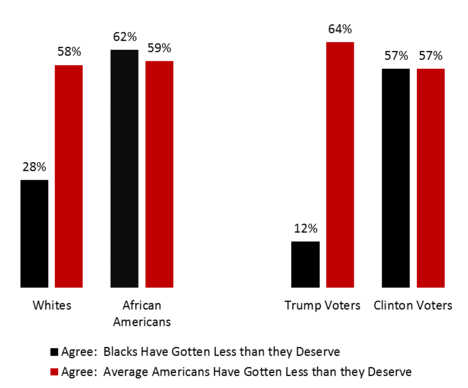
The chart below is the result of a poll of 1,000 Americans who mirror the population of the country as a whole. The question they were asked was:

Do you agree or disagree with the following statements?

  1. Over the past few years, blacks have gotten less than they deserve.
  2. Over the past few years, average Americans have gotten less than they deserve.

The results:

Most blacks and Clinton voters are in very close agreement: neither group has gotten what they deserve.

By the same percentage, whites think that average (i.e. mostly white) Americans haven’t gotten what they deserve. Blacks, however, have done well. 

Trump voters also agree that average Americans haven’t gotten what they deserve. They’re very sure, however, that blacks have been living on easy street.

2016-12-19-1482185503-3679361-trump_deserve-thumb

The political scientist who reported the results concludes:

It appears, then, that Trump voters weren’t simply motivated by their widespread belief that average Americans are being left behind. Rather, their strong suspicion that African Americans are getting too much—a belief held by the overwhelming majority of Trump voters—was a much stronger predictor of their vote choices in last month’s election.

Racially resentful beliefs that African Americans are getting more than they deserve were so strongly linked to support for Trump, in fact, that their impact on both the 2016 Republican Primary and the general election were larger than they had ever been before.

Another conclusion we should draw is that America’s race problem and America’s politics won’t improve much until there are fewer of us white people around.

For All the Special Snowflakes Out There

Who couldn’t bring themselves to vote for a “flawed” candidate.

czlrgidxeaepghr

(Thanks to whoever made this. Assuming it isn’t real. Yet.)

In Case You Missed It, Let’s Review the Crime That’s Still in Progress

Republican Senator Mitch McConnell and Republican FBI Director James Comey, with help from Vladimir Putin and Julian Assange, are in the process of stealing our election. They’ll do it unless the Electoral College does its constitutional, patriotic duty nine days from now and elects Hillary Clinton or some other qualified person.

The indictment:

According to the CIA, and probably the NSA too, neither of which are generally considered left-wing organizations, Russia hacked both Democrats and Republicans this year, but the Russians only gave the Democrats’ stolen information to Wikileaks. Wikileaks then gave the information, some of which was embarrassing to the Democrats and the Clinton campaign, to the world.

In September, President Obama informed Congressional leaders that the Russians had done this in order to elect the Orange Menace. Obama also requested a bipartisan declaration opposing the Russian interference in our election. But Senator McConnell, the Republican Majority Leader, wouldn’t make a joint statement, arguing that it would interfere with the election.

Instead, on October 7th, the Department Of Homeland Security and the Office of the Director of National Intelligence issued their own watered-down joint statement on Russia’s hacking activity, not pointing out that only information damaging to the Democrats was being revealed:

The U.S. Intelligence Community [which includes the CIA, FBI, NSA and thirteen other agencies] is confident that the Russian Government directed the recent compromises of e-mails from US persons and institutions, including from US political organizations…. These thefts and disclosures are intended to interfere with the US election process….We believe, based on the scope and sensitivity of these efforts, that only Russia’s senior-most officials could have authorized these activities.

Furthermore, on October 31st, the Financial Times reported that the Republican Director of the FBI was against making even that announcement:

FBI chief opposed US statement blaming Russia for hacks

Government official says James Comey had election timing concerns

Of course, only three days before, and only eleven days before the election, Director Comey ignored the Department of Justice policy against making such announcements near an election and sent a letter to Congressional leaders announcing a new investigation into emails possibly involving Hillary Clinton.

That letter was immediately leaked to the press and led to a blizzard of news coverage. The Orange Menace immediately declared that “this changes everything”. Although nothing at all came of the investigation, the Clinton and T—p campaigns agree that the FBI’s new suggestion of scandal was the crucial last-minute event that swayed enough voters to change the election. From Politico:

Top officials for both campaigns said the revelation—which turned out to be an inconsequential cache of previously parsed emails kept on the laptop of Clinton aide Huma Abedin’s estranged husband, Anthony Weiner—was a game-changer in a race in which Clinton had little margin for error. Elan Kreigel’s team saw her numbers collapse in the most volatile swing demographic: educated whites who had been repulsed by Trump’s sexual misdeeds.

To sum up: Vladimir Putin releases hacked emails in order to defeat Clinton. Julian Assange makes the emails public. Mitch McConnell and James Comey interfere with voters being told about Russia’s plan on the grounds that it will affect the election, i.e. hurt the Republican candidate. Meanwhile, Comey ignores Department of Justice policy and tells the world that there is more to the supposed Clinton email scandal, not caring that his last-minute “revelation” will affect the election, i.e. hurt the Democratic candidate.

Despite everything, Clinton gets almost 3 million more votes than T—p nationwide. But in three “swing” states that Clinton expected to win, T—p gets 77,000 more votes than Clinton, giving him the Electoral College majority necessary to become President.

As the saying goes, can you spell “coup d’Ă©tat”? How about “treason”? If you think that’s too harsh, how about “putting party ahead of country”?

The solution:

At this late date, the only ones who can prevent this crime from succeeding are the Republican members of the Electoral College. Thirty-seven of them can deny an unqualified, dangerous person the presidency and let the House of Representatives choose someone else. Forty-eight of them can switch to Hillary Clinton and elect the qualified person who got more votes. It’s that simple. 

And yet it’s that unlikely. What are the odds that there are more than a handful of Republicans among the 306 who will vote on December 19th who are sufficiently patriotic and sufficiently respectful of the Constitution to do what Alexander Hamilton said was necessary? Regarding the Electoral College, from The Federalist Papers, number 68:

Nothing was more to be desired than that every practicable obstacle should be opposed to cabal, intrigue, and corruption. These most deadly adversaries of republican government might naturally have been expected to make their approaches from more than one quarter, but chiefly from the desire in foreign powers to gain an improper ascendant in our councils. How could they better gratify this, than by raising a creature of their own to the chief magistracy of the Union?…

But the convention have guarded against all danger of this sort, with the most provident and judicious attention. They have not made the appointment of the President to depend on any preexisting bodies of men, who might be tampered with beforehand to prostitute their votes; but they have referred it in the first instance to an immediate act of the people of America, to be exerted in the choice of persons for the temporary and sole purpose of making the appointment….

All these advantages will happily combine in the plan devised by the convention; which is, that the people of each State shall choose a number of persons as electors, equal to the number of senators and representatives of such State in the national government, who shall assemble within the State, and vote for some fit person as President. Their votes, thus given, are to be transmitted to the seat of the national government, and the person who may happen to have a majority of the whole number of votes will be the President….

The process of election affords a moral certainty, that the office of President will never fall to the lot of any man who is not in an eminent degree endowed with the requisite qualifications. Talents for low intrigue, and the little arts of popularity, may alone suffice to elevate a man to the first honors in a single State; but it will require other talents, and a different kind of merit, to establish him in the esteem and confidence of the whole Union, or of so considerable a portion of it as would be necessary to make him a successful candidate for the distinguished office of President of the United States.

I mean, how amazing would it be, if a band of brave citizens, now being referred to as “Hamilton Electors”, rose to the occasion, saved the world and got complimentary tickets to the Broadway smash “Hamilton” too?

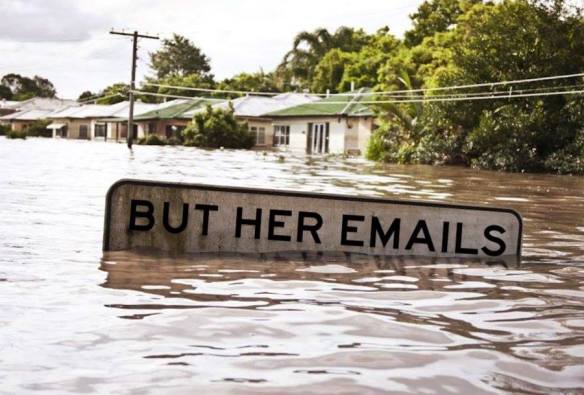
PS – Forgot to mention that T—p is going to appoint Senator McConnell’s wife to a cabinet position. Others in T—p’s cabinet, like the head of Exxon who will be Secretary of State, are very pro-Russian. But emails!

PPS – Nate Silver, respected political analyst and statistician, on Twitter: “Clinton lost 4 states (FL, MI, WI, PA) by ~1 point. If not for Comey/Russia, she probably wins them all by ~2 points & strategy looks great.”

America Isn’t a Democracy? Not Really, But It’s Suffering

Having finally finished the previous post, I was deleting bookmarks when I came upon an article I’d forgotten to read: “America’s Not a Democracy, and That’s Bad News for Democrats”. It’s by Ed Kilgore of New York Magazine. He’s a professional writer who makes some of the points I made, but in a more professional manner.

The least significant part of his article is captured by that eye-catching phrase “America’s Not a Democracy”. The distinction he’s drawing is that between a democracy and a republic. But what’s a republic? Here’s a standard definition from The American Heritage New Dictionary of Cultural Literacy (3rd edition). A “republic” is: 

A form of government in which power is explicitly vested in the people, who in turn exercise their power through elected representatives.

But the dictionary goes on to explain that:

Today, the terms “republic” and “democracy” are virtually interchangeable, but historically the two differed. Democracy implied direct rule by the people, all of whom were equal, whereas republic implied a system of government in which the will of the people was mediated by representatives, who might be wiser and better educated than the average person. In the early American republic, for example, the requirement that voters own property and the establishment of institutions such as the Electoral College were intended to cushion the government from the direct expression of the popular will.

Well, we can certainly agree that the Electoral College is on its way to cushioning the government from the popular will this year, since it appears that Hillary Clinton (now leading the monster by almost 2.5 million votes) will be spending January 20th at home in Chappaqua – or maybe somewhere nice and warm where English is a foreign language.

Anyway, we now use the phrase “representative democracy” to say what America is. It means that we average citizens have a big role in choosing other citizens to run big parts of the government. 

The more significant part of the article is a recitation of the various ways in which “the … imbalance between the party that keeps winning the presidential popular vote and the party that keeps winning everything else is entirely the product of a system that systematically violates the supposedly sacrosanct principle of voter equality”. In other words, One Person, One Vote is a nice sentiment but that’s about it. Mr. Kilgore concludes, therefore:

For all of these interlocking reasons, the half-or-so of the American citizenry that is prone to support the Democratic Party and its more-or-less progressive agenda and ideology is and may continue to be underrepresented at the federal level to the point of powerlessness, and confined at the state and even local levels to enclaves that contain an awful lot of people but exert limited clout. And all this is totally aside from the extrinsic factors that place a thumb on the scale for Republicans, such as their support from business and financial interests and our currently uncontrolled system of campaign financing.

He then lists some ways Democrats might improve the situation. My favorite is “to win majorities in more states”. Unfortunately for our representative democracy, he doesn’t explain how that can be done.Â