Whereof One Can Speak 🇺🇦

Nothing special, one post at a time since 2012

Some Truth About the Constitution and Well-Regulated Militias

Rolling Stone has a good article about the twisted reading of the 2nd Amendment we’re living under. From legal affairs journalist Jay Michaelson:

The lie at the heart of all of this insanity is the Right’s ludicrous perversion of the Second Amendment. . . . Until 2008, no federal court had held that the Second Amendment conveyed a right to own a gun. On the contrary, the Supreme Court clearly said that it didn’t.

Why? Because of the obvious language of the amendment, which reads, in full, “A well regulated Militia, being necessary to the security of a free State, the right of the people to keep and bear Arms, shall not be infringed.”

For nearly two hundred years, there was widespread agreement that the Second Amendment meant what it said: that the right “of the people” meant the right to bear arms in well-regulated militias, which was how the nation protected itself prior to standing armed forces and police, and which slave-owners maintained to protect against possible uprisings.

Unquote. I interrupt the Rolling Stone article to insert more about militias from lawyer M. S. Bellows, Jr.:

What many don’t know is the Constitution’s *other* militia clauses that give the 2nd Amendment context:

Yes, “militia” is discussed OUTSIDE the 2nd Amendment. Article 1, Section 8 gives Congress power over national defense, including the army, navy – and militia. If we want to understand what the 2nd Amendment means by “well-regulated militia,” that’s where we have to start.

First, the Framers knew Caesar had led his troops across the Rubicon to crush the Republic and foresaw that a too-strong standing army could topple their nascent democracy in a military coup (as we’ve seen countless times elsewhere).

Accordingly, the Framers allowed for a permanent navy but a TEMPORARY army: “Congress shall have the power… To provide and maintain a Navy” (full stop), and “To raise and support Armies, but no Appropriation of Money to that Use shall be for a longer Term than two Years.”

But how could the new nation defend itself on land without a standing (i.e., permanent) army? The militia.

The idea being that in 1787, armies weren’t hard to create quickly: just pull cannons out of a warehouse, requisition a bunch of mules/horses, and call for volunteers . . .

But there’s more to it:

By “militia,” the Framers didn’t mean the Proud Boys and similar beer-swilling yahoos acting on their own initiative. They meant volunteer professionals, soldiers who would be equipped, trained, regulated, and deployed BY CONGRESS just like other military units. Here, read it for yourself. Article I, section 8, clauses 15 and 16:

“[Congress shall have Power] To provide for calling forth the Militia to execute the Laws of the Union, suppress Insurrections and repel Invasions” and “to provide for organizing, arming, and disciplining, the Militia, and for governing such Part of them as may be employed in the Service of the United States, … reserving to the States respectively, the Appointment of the Officers, and the Authority of training the Militia according to the discipline prescribed by Congress.”

So: CONGRESS is responsible for deploying, overseeing, *arming*, and *disciplining* (i.e training and regulating) the militia (with the states choosing local officers and arranging for training as Congress directs). Basically, the National Guard. . . .

Which is the point of this thread: that the 2nd Amendment doesn’t stand in isolation. It’s part of a larger scheme. After the original Constitution was adopted, the Framers immediately wrote the Bill of Rights: ten amendments designed to clearly identify and protect certain rights. One of them was the right to keep and bear arms.

Why? Some Framers feared the Constitution endangered states’ rights. Southern Framers, in particular, feared Congress might disarm the state militias that existed mainly to suppress rebellion by enslaved people. So the 2nd Amendment provides that members of the militia can’t be disarmed by the federal government.

Which basically is the same as saying that federal troops aren’t allowed to seize the Oregon National Guard armory in Salem. Which is fine. I can live with that.

Unquote. So how did we get to the point where a well-regulated militia is now interpreted as almost anybody with a credit card? Back to Rolling Stone:

What changed?

. . .  While the 1972 Republican party platform had actually supported gun control, the Reagan Revolution transformed the party.  (Ronald Reagan wrote an article praising individual gun ownership in Guns & Ammo magazine in 1975.)  Now, being pro-gun, like being anti-abortion, became a pillar of the New Right ideology.

After all, it ticked all the boxes, tapping into white fears of “crime” and “the inner cities,” populist resentment of “big government,” and male fears of losing power in the age of women’s liberation. The Right’s newfound infatuation with guns was white, male fragility projected onto firearm ownership.

And what had once been a fringe view rejected by the Supreme Court — that the Second Amendment gave individuals a right to own guns — gradually became Republican Party gospel when the fringe took over the party.  Former Chief Justice Warren Burger (a conservative appointed by Richard Nixon) described it as “a fraud on the Amer­ican public.”

Eventually, this view won out, not by persuasion but by simple politics. By 2008, there were five conservative justices on the Supreme Court, and Justice Scalia wrote an opinion in D.C. v. Heller saying that the Second Amendment conferred an individual right to own guns.

There are numerous problems with Scalia’s opinion:

First, he claims that the clause about militias is just a preface, with no relevance to the meaning of the right. “The former does not limit the latter grammatically, but rather announces a purpose,” he wrote. . . .  But wait a minute – if maintaining militias is the purpose of the amendment, then why does “the people” mean not militias but individuals?  Why is a purpose not a purpose? Justice Scalia simply dismisses the first half of the amendment as merely decorative, with no function whatsoever.

Second, Scalia simply dispatches as “dubious” the drafting history of the amendment, in which James Madison deliberately did not use language of individual rights that was present in contemporaneous documents. Thomas Jefferson, for example, had once proposed “No freeman shall ever be debarred the use of arms.” That proposal was rejected.

Third, Scalia inverts the meaning of the Second Amendment itself, by saying that Congress actually can ban military-grade weapons (i.e. the kinds a militia would use) but not handguns, which are used for self-defense (which the amendment never mentions).

Of course, what’s really happening here is a social, cultural phenomenon, using the constitution as an excuse. . . .

The tragic irony . . . is that we know how to stop this from happening. . . . The advocacy group Everytown for Gun Safety lists 37 solutions on its website, from background checks to waiting periods, prohibiting ‘open carry’ to repealing ‘stand your ground’ laws, banning high-capacity magazines and assault weapons to holding the gun industry accountable.

. . .  But God help any Republican who has the courage to stand up to the NRA, gun manufacturers, and the rage of the populist Right. . . . Our [inability] to do anything about these horrifying mass shootings is not the Second Amendment’s fault. . . .It’s Republicans’ fault. It is that simple.

Unquote. Today it’s also the fault of a few rogue Democrats in the Senate who love the filibuster and fear doing anything about guns. But the point remains: almost all Republican politicians oppose gun control and almost all Democratic politicians support it. 
It’s Been Coming. It’s Why Elections Truly Matter

Two Washington Post columnists react. First, Monica Hesse:

This is for the girl right now hiding in the bathroom stall with two pink lines on a pregnancy test and the rest of her life in front of her.

On Monday evening, Politico published a leaked document that seemed to signal that the Supreme Court may soon overturn Roe v. Wade. “Roe was egregiously wrong from the start,” Justice Samuel A. Alito Jr. wrote in a draft opinion that would end federal protection of abortion access. The official decision won’t be announced until later this summer, and meanwhile, it’s time to think of the girl in the bathroom stall and everyone else who has been or ever will be in her position, and of everyone who put her there.

. . . Conservative voters elected conservative politicians who appointed conservative judges. A machine decades in the making, . . . a decision that cleanly establishes a divide in America: men, who will have control over the most intimate parts of their bodies, and women, who will have control over their bodies only in some states, at the whim of some legislators.

“A right to abortion is not deeply rooted in the Nation’s history and traditions,” Alito wrote in the draft opinion. He makes no mention of the things that are rooted in the nation’s history and traditions: slavery, disenfranchisement, discrimination. . . .Bodily autonomy should not be granted to women because of history and traditions; it should be recognized because of their innate dignity as human beings. . . .

There were always abortions, after all. They happened with Mason jars, and they happened with knitting needles, and they happened in bedrooms, and they happened without painkillers, and they happened with women squeezing one another’s hands so tightly their knuckles were white, and they happened, and they happened, and they happened. The overturning of Roe would not mean the end of abortions. It would just mean the end, in certain states, of safe, legal abortions.

Alito’s opinion is barbarous and cruel. It is broad where it could have been narrow. It is scathing where it could have been compassionate. It is, as discussions about abortion often are, so preoccupied with scrambling for the moral high ground that it pays no attention to the women being trampled underfoot.

This is for the girl right now hiding in the bathroom stall with two pink lines on a pregnancy test. The girl who is going to find a way to not be pregnant anyway, no matter what the Supreme Court ends up saying in June. . . . 

Next, Paul Waldman:

. . .  Many have noted that this decision [assuming it holds] will be extremely unpopular; polls show that between 60 and 65 percent of Americans say Roe should remain. The draconian laws Republicans are already proposing at the state level could be even more unpopular.

But if those facts allowed [anybody to think] this day would not come, they were clearly misguided. The coming nightmare for reproductive rights is in large part a product of minority rule. It’s what Republicans have painstakingly constructed over the course of decades, and it might take just as long to dismantle it — if Democrats can do that at all.

Opinions on abortion have been remarkably resistant to change for the past 50 years. The antiabortion movement’s attempt to convince the public that abortion is murder was a failure, and that likely won’t change in the post-Roe world.

Conservatives know that perfectly well. But the whole point of building the apparatus of minority rule was for moments like this. To do popular things, you don’t have to twist the system in knots and eliminate democratic accountability. You do it to stop popular things you don’t like, enable yourself to do things the public doesn’t want, and hold on to power no matter what.

The details should be familiar by now. The Senate gives two votes to every state, so 40 million Americans in California, most of them Democrats, get the same representation as 580,000 Americans in Wyoming, most of them Republicans. That is then levered into the electoral college, which is why the past two Republican presidents took office despite having lost the popular vote.

That (plus unprecedented ruthlessness in refusing to allow a Democratic president to fill an open seat) gets you a conservative Supreme Court supermajority — appointed by presidents who lost the popular vote, confirmed by GOP senators who represent a national minority — enacting a conservative legal revolution the public never asked for.

That court then validates nearly every effort by state Republicans to insulate their own power through voter suppression and partisan gerrymandering. That will enable them to outlaw abortion over the objections of their own state populations, knowing that district lines have been drawn in a way that predetermines the outcome of elections.

It’s a closed loop, an interlocking system that insulates Republicans from accountability.

There are times when Democrats can overcome it, for example by electing governors in swing states such as Wisconsin and North Carolina. But because it’s almost impossible for Republicans to lose their hold on state legislatures, they can hamstring and undermine the governor much as congressional Republicans . . . will to President Biden if they take control of Congress in this fall’s elections.

Now consider where they’re going now that Roe is apparently dead. Forget about 15-week bans and six-week bans; a couple dozen Republican-run states will probably outlaw abortion entirely, perhaps with a grudging exception to save the life of the pregnant woman . . . 

But even that will not be enough. GOP state legislators are working to ban abortion in other states; in Missouri, one Republican state legislator has introduced a bill to allow anyone to sue over an abortion that occurred anywhere if “sexual intercourse occurred within this state and the child may have been conceived by that act of intercourse”. . . .

And it isn’t just abortions. In the antiabortion movement, most forms of birth control — including birth control pills, Plan B and even IUDs — are widely and wrongly considered “abortifacients,” the moral equivalent of abortion. Once laws outlawing abortion are passed, this is where the movement will likely turn its attention — and Republican legislators who worry only about primary challenges from the right will face pressure to go after birth control.

Meanwhile, the next time Republicans have complete control in D.C., they’ll push for a nationwide ban on abortion. The planning is already underway.

If your response is to say, “That would never happen — it would be too unpopular,” remember, that’s exactly what some said about overturning Roe. The whole point of minority rule is that you don’t have to worry about what’s unpopular.

Part of the sinister genius of minority rule is that if it is constructed with enough care and comprehensiveness, it can be demoralizing to the majority, which sees no way around it, at least in the short term. . . .

Overcoming that demoralization will require a psychological fortitude on the part of Democrats, and a commitment to do what Republicans did: to work not just for the next election but for a project that will unfold over decades. Even if you don’t get what you want from one president or one Congress, you have to take small steps until you reach your ultimate goal, knowing victory is never assured and will be a long time in coming.

That’s what the people who wanted to outlaw abortion committed themselves to, and now their victory is here. It can be reversed, but it will not be easy. . . .

Unquote.

Americans, mainly women, fought for years to make abortion legal so women would have more control over their bodies and thus their lives. The court decisions talk a lot about whether there’s a right to privacy, but it’s always been a contest between individual freedom and religious dogma. Here in America, unlike most places, freedom is losing:

The story of abortion rights in the 21st century can be seen in two world-shaking developments this past week [this is from the New York Times in September].

In the first, the U.S. Supreme Court effectively upheld drastic new abortion restrictions in Texas. A few days later, Mexico’s high court paved the way for nationwide legalization.

It may be tempting to see Mexico’s ruling as the more surprising, catapulting the world’s second most populous Catholic country on a deeply contentious social matter.

But experts say it is the United States that stands out. Since 2000, 31 countries, many just as pious as Mexico, have expanded access to abortion. Only three have rolled it back: Nicaragua, Poland and the United States.

Elections matter.

Radical Judges Running Wild

It’s only getting worse at the Supreme Court now that six of the nine justices are Republicans. A University of Texas law professor explains:

Last week the Supreme Court, by a 5-to-4 vote, put back into effect a T___ administration regulation that [makes it harder for] states to [protect rivers and streams from being polluted]. The unsigned, unexplained order in Louisiana v. American Rivers came as part of a highly technical dispute over the scope of the Clean Water Act — and leaves for another day whether the regulation is a valid interpretation of that Nixon-era statute.

But the temporary decision cannot be ignored, especially because of the brief but blistering dissenting opinion written by Justice Elena Kagan. It’s not the first time that liberal justices have called out most of the court’s conservative [no, radical] justices for their increasingly frequent use of the so-called shadow docket — unsigned, unexplained orders like the one last week. But it was significant for being the first time that [Republican] Chief Justice John Roberts joined her (and Justices Stephen Breyer and Sonia Sotomayor) in doing so.

With the striking public stance, the chief justice illustrated how concerns about the procedural shortcuts the other [right-wing] justices are taking . . . . He also made clear what many have long suspected: The Roberts court is over.

The term “shadow docket” was introduced by the University of Chicago law professor Will Baude in 2015 to describe the more obscure part of the Supreme Court’s work — the thousands of unsigned and usually unexplained orders that the justices issue each year to manage their docket. Those orders are in contrast to the merits docket, the 60 to 70 cases each year that go through rounds of briefing and oral argument before being resolved in long, signed opinions for the court.

Owing to its inscrutability, the shadow docket has historically received much less public attention or scrutiny. Most shadow docket orders are anodyne — matters as routine as refusing to take up an appeal or giving a party more time to file a brief.

But far more than ever before, the court is using procedural orders on applications for emergency relief while appeals work their way through the courts to resolve disputes affecting the lives of millions of Americans — whether in blocking a rule from the Occupational Safety and Health Administration on a vaccination mandate for large employers, refusing to block Texas’ ban on most abortions after six weeks or putting back into effect congressional district maps that two Alabama lower courts struck down as violating the Voting Rights Act.

Time and again, the [Republican] justices are ordering lower courts to treat these decisions as precedents — even when, as in last week’s ruling, the order includes no analysis to apply to other cases, which often makes the precedent difficult for lower courts to apply.

Unsurprisingly, these rulings have provoked increasingly strident dissents from the court’s liberal justices. Last September, when the justices refused, by a 5-to-4 vote, to halt the patently unconstitutional Texas abortion law, Justice Kagan criticized the majority not just for the substance of its ruling but also for what that ruling said about the shadow docket. She wrote, “The majority’s decision is emblematic of too much of this court’s shadow-docket decision making — which every day becomes more unreasoned, inconsistent and impossible to defend.”

Last week, by freezing a district court injunction despite a lack of evidence that it was harming the complaining states, the majority once again defied the requirements for the very emergency relief they granted. Justice Kagan wrote that that renders the court’s “emergency docket not for emergencies at all” but rather “only another place for merits determinations — except made without full briefing and argument.” In other words, the principal justification for shadow docket orders — the need to intervene early in litigation to prevent a party from suffering irreversible harm while the appeal unfolded — was nowhere to be found.

Chief Justice Roberts voted with Justices Breyer, Sotomayor and Kagan in dissenting from six previous shadow docket rulings. But the Clean Water Act dispute was the first time he joined in the procedural criticism that the other conservatives were not just using the shadow docket but abusing it. . . .  By publicly endorsing the charge that the conservative justices are short-circuiting ordinary procedures to reach their desired results without sufficient explanation, Chief Justice Roberts provided a powerful counter to defenders of the court’s behavior, [such as hard-right] Justice Samuel Alito. . . . 

What is especially telling about Chief Justice Roberts’s dissents in these shadow docket cases is that, unlike Justices Breyer, Sotomayor and Kagan, he’s often been sympathetic to the results. In February’s Alabama redistricting ruling, for instance, Chief Justice Roberts agreed that the court should reconsider the interpretation of the Voting Rights Act under which Alabama’s maps had been struck down; he just believed that any change in that interpretation had to come through the merits docket, not the shadow docket.

At least on the shadow docket, though, that’s no longer up to him. Instead, the court’s destiny increasingly appears to be controlled by Justices Brett Kavanaugh and Amy Coney Barrett. She implored an audience at the Ronald Reagan Presidential Library just last week to “read the opinion” before jumping to any conclusions about whether the justices are acting more like politicians than judges. Two days later, she joined the majority’s unsigned, unexplained order in the Clean Water Act case, in which there was no opinion to read. Justice Kavanaugh, too, [is] troubled by criticism of the court’s behavior, [not] the behavior itself . . . . 

The court’s credibility [is wearing out]. The justices have long insisted — as Justices Sandra Day O’Connor, Anthony Kennedy and David Souter [all nominated by Republican presidents] put it in 1992 — that “the court’s legitimacy depends on making legally principled decisions under circumstances in which their principled character is sufficiently plausible to be accepted by the nation.” The proliferation of principle-free decisions affecting more and more Americans — and with a clear, troubling tendency of favoring Republicans over Democrats — calls that legitimacy into increasingly serious question.

It’s understandable, then, why Chief Justice Roberts would finally speak out. . . .  If even his objections can’t persuade the other [Republicans] to stop abusing the shadow docket, then that may signal the willingness of the court’s [radical right] majority to go even further in the future and to use the shadow docket to resolve even more significant and contentious constitutional questions.

“I’m Not Letting Anybody in the Senate Steal My Joy”

Today, Senator Cory Booker, Democrat of New Jersey, spoke in support of Judge Ketanji Brown Jackson’s nomination to the Supreme Court. He spoke for 20 minutes instead of asking her questions. Booker offered a powerfully emotional corrective to what’s been described as a “disgraceful” process, one in which a few Republican senators tried to outdo each other’s disrespectful, demagogic performances. Judge Jackson will be the first black woman to sit on the Supreme Court. Senator Booker made America seem better than it often is.

The senator devotes the first 10 minutes or so debunking ludicrous Republican attacks. If you don’t have 20 minutes to spare, jump 10 minutes in to watch the portion of his remarks that impressed so many today and should be remembered for years to come.

In another Washington building, the right-wing majority on the Supreme Court continued to side with Republicans whenever there’s a voting rights case, not only siding with them, but interjecting themselves when they don’t need to. When Judge Jackson is Justice Jackson, maybe she can convince one or two of her Republican colleagues to occasionally act like judges instead of right-wing hacks.

In other news, one of the Court’s worst members, Justice Clarence Thomas, has been in the hospital with an unnamed infection. It’s too much to ask, but may he soon rest in peace. The Court would then have four Republican crazies instead of five. That would allow the somewhat less corrupt Republican who’s Chief Justice to sometimes stop his radical colleagues from doing their worst.

One of the Most Sickening Developments in Recent Times

And wouldn’t you know, it involves our corrupt Supreme Court.

From Paul Waldman of The Washington Post:

In 2019, the Supreme Court ruled that it has no power to do anything about partisan gerrymandering, allowing states to gerrymander to their hearts’ content. But at the time, it clarified that it could still strike down racial gerrymanders, since drawing district lines that have the effect of eroding the power of minority groups would violate the Voting Rights Act.

But now the court may have cleared a path to potentially harming African American voters in another way, by further diluting their prospects for electing preferred candidates . . . 

Combine the Alabama case on which the court just ordered a stay with its decision to allow Texas’s abortion vigilante law to go into effect — all but outlawing abortion in the second largest state, Roe v. Wade be damned — and you can see the emergence of a new kind of political/legal process. It’s one Republicans will increasingly deploy to remake the landscape of U.S. law.

Here’s how it works:
 
  1. A Republican state legislature passes an obviously and unquestionably unconstitutional law.
  2. The Supreme Court uses its “shadow docket” to allow the law to remain in place for an extended period, nullifying the existing constitutional order in one state.
  3. Eventually, the court issues a sweeping order taking the changes nationwide — but since everyone saw it coming, it may not seem as radical as it might have, and in any case the court doesn’t really care what anyone thinks.

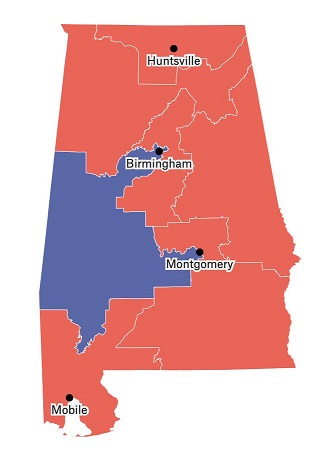
In the Alabama case, the GOP-run state legislature created a congressional map that packs many of the state’s Black voters into a single district. Though they make up 27 percent of the state’s population, African Americans have a remote chance of winning in only one of the state’s seven congressional districts. In Alabama, voters are highly divided by race; according to exit polls, 77 percent of Whites in Alabama voted for Donald Trump in 2020, compared with 55 percent in the country as a whole.

After a lengthy trial, a three-judge panel found that the map discriminated against the state’s Black voters in violation of Section 2 of the Voting Rights Act and ordered the state to produce a new map. That panel was made up of one judge appointed by Bill Clinton and two appointed by Trump, suggesting the legal judgment was clear.

[Here’s the map. The Republicans sent tentacles out to include Birmingham, Montgomery and one other area in order to cram as many Black people as possible into that single Democratic district.]
FLB43q2XwAgkxsY

Alabama appealed to the Supreme Court, where five justices [the most reactionary ones] issued a stay nullifying the lower court’s ruling, allowing a map that seems to clearly violate the Voting Rights Act to remain in place. They also accepted the case for a full hearing and judgment later on, but the stay came through what is now known as the “shadow docket,” where increasingly consequential rulings are issued on an emergency basis.

Justice Brett M. Kavanaugh, writing for the majority, said that it was too close to the election later this year, so the court simply had to intervene on Alabama’s behalf.

Even Chief Justice John G. Roberts Jr., the architect of the court’s long assault on voting rights and the author of its 2013 decision gutting other sections of the Voting Rights Act , was unable to justify what his [far right] colleagues did. In a brief dissent, he wrote that while he agreed with the decision to take the case for a full consideration — signaling that he looks forward to driving another stake into the heart of the Voting Rights Act — “the District Court properly applied existing law in an extensive opinion with no apparent errors for our correction.”

But the other five conservatives felt free to intervene. As Justice Elana Kagan wrote in dissent, “Today’s decision is one more in a disconcertingly long line of cases in which this Court uses its shadow docket to signal or make changes in the law, without anything approaching full briefing and argument.”

When it allows clearly unconstitutional or otherwise problematic state laws to remain in place, the court not only creates sweeping de facto change for temporary periods, it also sends a message to Republican state legislatures that nothing is off the table.

Is there a constitutional right you’d like to eliminate, a federal law you find displeasing, an outrageous fantasy you’d like to turn into reality? Pass a law making it happen, no matter how crazy, and there’s a good chance we’ll let it stand, at least for a while. And after that, who knows?

. . ., We’re embarking in a new era, in which a radicalized Republican Party meets an unusually aggressive Supreme Court majority eager to reimagine the whole scope of American law. And with six [Republicans, three appointed by the worst president in history] , they have a margin of error that allows them to indulge their wildest policy ambitions.