Fuck Him. He’s Still a Con Man.

Donald Drump gave a long speech last night that made some people think he’s not as bad as they thought. This has happened before. If you think otherwise, that he’s suddenly become “presidential” rather than “unpresidented”, read these: 

Michael Grunwald, “Salesman-in-Chief”, Politico

Brian Beutler, “The Worst Performance of [Drump’s] Presidency Now Belongs to the Press Corps”, The New Republic

Greg Sargent, “The Pundits Are Wrong. [Drump’s] Handling of the Ryan Owens Affair Was Contemptibly Cynical”, The Washington Post

Alex Pareene, “You Cretins Are Going To Get Thousands of People Killed”, The Concourse

Meanwhile, Reuters reports that there was a record high of 63.5 degrees in Antarctica last year. 

What’s Their Deal With Health Insurance Anyway?

It feels odd to write about anything else now that a senseless, malevolent being has taken control of the White House, but here goes anyway:

Four years ago, Dr. Ben Carson, who is expected to be the U.S. Secretary of Housing and Urban Development in the new administration, compared the Affordable Care Act to slavery:

“You know, Obamacare is really I think the worst thing that has happened in this nation since slavery,” Carson … said … in remarks at the Values Voter Summit in Washington. “And it is in a way, it is slavery in a way, because it is making all of us subservient to the government, and it was never about health care. It was about control…”

“And why did [the Obama administration] want to pass it so badly? Well, as I said the other night on television, Vladimir Lenin … said that socialized medicine is the keystone to the establishment of a socialist state.”

As we might expect, there is no evidence that Lenin said any such thing. The “socialized medicine” quote attributed to him by Carson and others was fabricated for a 1949 brochure issued by the American Medical Association. That’s back when the AMA was fighting President Truman’s proposal for national health insurance (and years before they opposed Medicare). But Carson telling that tall tale helps explain why the Republican Party is so opposed to the Affordable Care Act.

The ACA requires individuals to have health insurance (or pay more income tax) and employers of a certain size to offer health insurance to their employees (or pay more income tax). It also requires that health insurance plans meet specific requirements in order to qualify as health insurance for purposes of the law. So that’s one reason Republicans want to repeal the ACA. The law requires that we do something for our own benefit or for the benefit of others. It limits our freedom to do whatever the hell we want. That makes it a prime example of government overreach, or what the right-wing calls the “Nanny State”.

But since Republicans are forced to buy insurance for their houses and cars without making a fuss (let alone bringing up slavery or Nazi Germany), being forced to buy insurance for their bodies (or their employees’ bodies) can’t be the only reason they’re against the ACA.

A second reason is simply political. After decades of trying, a Democratic President finally got a bill passed that takes us closer to universal health insurance. But whatever Obama was for, the Republicans were against. They immediately labeled the ACA as “Obamacare” to help convince right-wingers to oppose the law, even if they didn’t know what the law did (and even if the law would improve their own lives). 

That’s despite the fact that the ACA adopted the conservative approach to universal healthcare that Republicans had been advocating since the 1970s. It’s pretty amazing. A letter to the editor in The Chicago Tribune tells the disheartening story:

Obamacare is virtually the same privatized mandate plan [the Republican Party] pushed since President Richard Nixon first proposed the National Health Strategy in 1971, then again in 1974. Then the GOP revived its privatized mandate plan again in 1993 with … the [HEART] act … an alternative to the [Clinton] single-payer plan… 

Obama — as a compromise to have basic health reform passed — used this same GOP blueprint with one significant change: adding a public option alongside the GOP’s privatized mandate plan … 

Eventually the public option was stripped out of the 2010 ACA bill as a further compromise to attract bipartisan support for the bill, leaving in its place the very plan that the GOP wanted and pushed for decades. Unfortunately, the ACA did not receive a single vote from the Republican Party that created the plan’s primary concepts as an alternative to a single-payer — “Medicare for all” — type of system.

No wonder the Republicans have had so much trouble coming up with a replacement for “Obamacare”. The law they’re so against is the law they used to be for.

A third reason the Republicans oppose the ACA is that it’s the kind of Robin Hood economic redistribution Republicans hate. It takes from the rich and gives to the poor. Paul Krugman explains in a blog post called “Health Care Fundamentals”:

Providing health care to those previously denied it is, necessarily, a matter of redistributing from the lucky to the unlucky. And, of course, reversing a policy that expanded health care is redistribution in reverse. You can’t make this reality go away.

Left to its own devices, a market economy won’t care for the sick unless they can pay for it; insurance can help up to a point, but insurance companies have no interest in covering people they suspect will get sick. So unfettered markets mean that health care goes only to those who are wealthy and/or healthy enough that they won’t need it often, and hence can get insurance….

The thing is, however, that guaranteeing health care comes with a cost. You can tell insurance companies that they can’t discriminate based on medical history, but that means higher premiums for the healthy — and you also create an incentive to stay uninsured until … you get sick, which pushes premiums even higher. So you have to regulate individuals as well as insurers, requiring that everyone sign up — the mandate. And since some people won’t be able to obey such a mandate, you need subsidies, which must be paid for out of taxes…

What [the Republicans] are left with is … voodoo: they’ll invoke the magic of the market to somehow provide insurance so cheap that everyone will be able to afford it whatever their income and medical status. This is obvious nonsense [but] it’s all they’ve got.

The redistribution is related to a fourth reason they’re against the ACA and it might be their biggest reason of all. Not only did the ACA impose fines in the form of tax increases on taxpayers who wouldn’t buy health insurance, it included a separate, relatively large tax increase on the richest Americans. As everyone knows, that‘s anathema to Republican politicians. Repealing the ACA, therefore, would mean a big tax cut for the Republicans’ favorite people. From Slate:

One of the core, very simple things [the ACA] did was raise taxes on the wealthy in order to fund subsidized health care for more Americans. Couples earning more than $250,000 saw a 0.9 percent increase in their top Medicare tax rate, as well as a new, 3.8 percent Medicare surtax on investment income.

If Republicans have their way and successfully repeal the Affordable Care Act, those two taxes will be toast—which will mean a substantial break for some of the country’s wealthiest families. The liberal Center on Budget and Policy Priorities estimates that millionaires would see 80 percent of the benefits from those tax reductions. Based on the most recent IRS data, the think tank roughly projects that the 400 highest income households—which earned an average of more than $300 million each in 2014—would see a $2.8 billion annual tax cut, worth about $7 million on average per filer.

So that’s at least four reasons why Republicans want to scrap the Affordable Care Act:

1) It’s what they call the “Nanny State” in action. 

2) It was an important Obama accomplishment.

3) It’s the kind of redistribution Robin Hood was for and the bad guys were against.

4) It raised taxes, especially for the rich.

In conclusion, Republicans don’t necessarily want millions of Americans suffering and dying without medical treatment. Being concerned about that kind of thing is simply low on their list of priorities.

It’s Been With Us For Years, But Gotten Worse

The historian Richard Hofstadter (1916-1970) is known outside academic circles for having written a particular book and a particular essay. The book was Anti-intellectualism in American Life from 1963. The essay was “The Paranoid Style in American Politics” from 1964. I read the essay a few days ago in a collection of Hofstadter’s work. Anyone who wants to understand how we got to this point in American history will benefit from reading Richard Hofstadter.

He explains, for example, the basis for “economic individualism”, the idea that it’s not only more efficient but more ethical that everyone should sink or swim on their own. Thus, poor or working-class conservatives are often against anyone receiving help from the government, even though they could use that help themselves:

On many occasions they approach economic issues as matters of faith and morals rather than matters of fact. For example, people often oppose certain economic policies not because they have been or would be economically hurt by such policies, or even because they have carefully calculated views about their economical efficacy, but because they disapprove on moral grounds of the assumptions on which they think the policies rest….Deficit spending might work to their advantage; but the moral  and psychological effect, which is what they can really understand and feel, is quite otherwise: when society adopts a policy of deficit spending, thrifty [conservatives] feel that their way of life has been officially and insultingly repudiated [“Pseudo-Conservatism Revisited – 1965”].

Hofstadter borrowed the term “pseudo-conservative” from the German thinker Theodore Adorno. He explained why in an earlier essay written in response to McCarthyism:

There is a dynamic of dissent in America today…The new dissent is based upon a relentless demand for conformity… Its exponents, although they believe themselves to be conservatives and usually employ the rhetoric of conservatism, show signs of a serious and restless dissatisfaction with American life, traditions and institutions. They have little in common with the temperate and compromising spirit of true conservatism in the classical sense of the word…Their political reactions express rather a profound … hatred of our society and its ways – a hatred which one would hesitate to impute to them if one did not have suggestive evidence from clinical techniques and from their own modes of expression [From “The Pseudo-Conservative Revolt”, 1954].

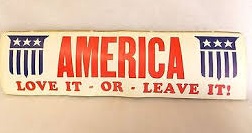
Remind you of anyone you know? I mean, who in public life expresses more contempt for America in the 21st century than the next President and his fans, the vocal minority that wants to make this country “great” (i.e. “white”) again? Maybe the Democrats should have revived those popular bumper stickers from the 1960s, the ones aimed at Volkswagen-driving hippies and protesters.  

download-4

Finally, here’s what Hofstadter said about the Republicans’ first pseudo-conservative Presidential nominee, Senator Barry Goldwater:

Unquestionably, Goldwater’s ideas do retain some shreds and scraps of genuine conservatism, but the main course of his career puts him closer to the right-wing ideologues who were essential to his success, who shaped his tactics, who responded to his line of argument… How are we to explain the character of a “conservative” whose whole political life has been spent urging a sharp break with the past, whose great moment as a party leader was marked by a repudiation of our traditional political ways, whose followers were so notable for their destructive and divisive energies, and whose public reputation was marked not with standpattism or excessive caution but with wayward impulse and recklessness? [“Goldwater and Pseudo-Conservative Politics”, 1964].

Again, remind you of anyone you know?

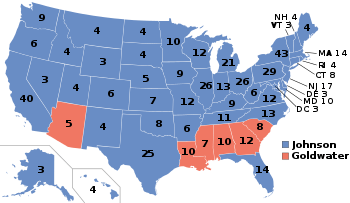
Fortunately, Lyndon Johnson beat Goldwater by 26 million votes (rather than 3 million) and by 61% to 27% (rather than 48% to 46%). Goldwater only won six states in the 1964 election: the five former slave states of the Deep South and his home state of Arizona. That gave him 52 electoral votes compared to Johnson’s 486. 

electoralcollege1964-svg

In addition to being a pseudo-conservative, Goldwater had no particular qualifications to be President. Before being elected to the Senate, he managed the family department store. In the Senate, he played no significant role. In Hofstadter’s words, “his main business there was simply to vote No”. He was still an “outsider” even after 12 years in Washington.

Goldwater’s extreme positions and lackluster qualifications contributed to his historic defeat. Fifty-two years later, due to a variety of circumstances, another pseudo-conservative, this time with no government experience at all, won narrow victories in enough states to win the White House. Given their appeal to the same sorts of voters, and given the fact that our next President is obviously suffering from a personality disorder (whereas Goldwater was relatively normal in that regard), it’s fair to say our democracy is showing signs of wear and tear that are beyond serious.

Addendum:

The journalist James Fallows recently reported the following conversation with a U.S. Senator:

Q:  How many of your colleagues know that there is something wrong with T***p?
A:  All of them, obviously.
Q:  Which Republican will be the first to say so?
A:  Ummmm….

It’s Supposed To Be One Person, One Vote

I can’t remember a less thankful Thanksgiving than last week’s. It’s hard to be grateful for ordinary well-being when the government’s executive branch is undergoing a hostile takeover. And it’s a hostile takeover by a gang of crooks, incompetents, bigots and cranks, otherwise known as the President-elect, his cabinet and his senior staff.

So it’s as good a time as any to review the rotten state of American democracy. We can even consider how we might fix it. (I say “we” because “they” live off the rot.)

British journalist Mehdi Hasan summarizes several ways in which our political system sucks:

#1:  We don’t have a national election. We have 51 separate elections. That’s how a woman who gets 65.0 million votes (and counting) can lose to a monster who gets 62.6 million. Those 51 contests result in 538 people being elected to the Electoral College. Those 538 people will select the new President on December 19.

#2: Our political campaigns take months and months and cost more per capita than in any other country. Most of the money goes to round-the-clock TV advertisements in key states (see #1). Those of who live in the rest of the country are taken for granted. 

#3: Relatively few of us vote. The last time 60% of the voting age population voted was in 1968. Most developed countries do much better.

#4: Rather than making it easier to vote, states run by Republicans are making it more difficult. The goal of this “voter suppression” is to stop as many Democrats as possible, especially African Americans, from voting. 

#5: Local politicians, not independent commissions, fix the boundaries of Congressional districts once every ten years. They put as many voters of the other party as possible in bizarrely-shaped districts while creating dependable majorities for their own party in the other districts. This process of “gerrymandering” – which the Republicans did so well in 2010 – helps explain why members of the House of Representatives hardly ever lose their jobs (97% were reelected this year). 

Mr. Hasan concludes:

Is this really what we define as democracy? Or is this, to quote the president-elect, a “rigged” system? Rigged not against Trump and the Republicans but against the poor, against ethnic minorities, against Democrats but, above all else, against basic democratic norms and principles and pretty simple notions of equality and fairness?

This isn’t a time for denial or deflection. The American political system is broken. Far from being the “world’s greatest democracy”, … representative democracy in the United States seems further hollowed out with every election cycle.

In fact, Mr. Hasan left out one of the worst failures of American politics. Some votes count more than others. We give lip service to the principle of One Person, One Vote, but the Constitution gives precedence to states with smaller populations. Small states are over-represented in the U.S. Senate, which determines who will be on the Supreme Court, and in the Electoral College, which determines who will be President.

Throw in the effects of geography and gerrymandering, and even the House of Representatives fails to meet the One Person, One Vote standard. This year, the Republicans beat the Democrats in House races by 61.5 million to 58.3 million. Ideally, that should translate into a slim 223-212 majority for the Republicans, not the 241-194 majority the Republicans will actually have. 

Not only do the residents of small states have excessive representation in the Federal government, but so do white voters. That’s because the smallest states have fewer minorities. From The Progressive:

The states with the fewest minorities (Idaho, New Hampshire, Nebraska, [etc.]) represent a total electoral college block of thirty-seven electoral votes. Based on their actual population, however, they should only be getting twenty electoral college votes…. 

Meanwhile, if we add up the ten states with the largest minority populations (California, Texas, Florida, [etc.]), we find that, based on population, they should be getting 276 electoral votes. In reality, though, they only get 240…

The problem is that not only do states vary greatly on who has access to the ballot box but, assuming you have successfully cleared the bureaucratic hurdles to get a voter ID card, waited in line for several hours, and cleared all the other voter suppression tactics and actually voted in your state, the [Federal] system itself is tilted in favor of certain states and certain voters.

So, borrowing a phrase from one or two Russian revolutionaries, what is to be done? How can we make America more democratic and, as a result, more Democratic? It sure won’t be easy. All right wing ideologies, from the 18th century on, have had a common theme. They fear that their power is at risk, so they fight like hell to maintain their position in the hierarchy. But let’s think about how we might reform the system anyway.  

A few years ago, the political scientist Norman Ornstein proposed a Voting Rights Act for the 21st century (that was soon after the Republicans on the Supreme Court gutted the Voting Rights Act for the 20th century). He recommended, among other things:

  • The Federal government would create a standardized, personalized ballot that everyone would use to vote for President and members of Congress.
  • The Social Security Administration would issue a modern photo ID to everyone with a Social Security number (which these days means every U.S. citizen). If you had one of these ID’s and were 18 or older, you would be eligible to vote.
  • The government would allow weekend voting at any local polling place, with early voting the week before [why not have polling stations in every U.S. post office, for example?].

Mr. Ornstein didn’t mention the problem of making sure votes are properly counted, but that would be an obvious improvement too. For example, David Dill, a professor of computer science, founded the Verified Voting Foundation. He explains here how easy it would be to interfere with one of our elections. Professor Dill proposes, therefore, that: 

We need to audit computers by manually examining randomly selected paper ballots and comparing the results to machine results. Audits require a voter-verified paper ballot, which the voter inspects to confirm that his or her selections have been correctly and indelibly recorded… Auditing methods have recently been devised that are much more efficient than those used in any state. It is important that audits be performed on every contest in every election, so that citizens do not have to request manual recounts to feel confident about election results. With high-quality audits, it is very unlikely that election fraud will go undetected whether perpetrated by another country or a political party.

There is no reason we can’t implement these measures before the 2020 elections. As a nation, we need to recognize the urgency of the task, to overcome the political and organizational obstacles that have impeded progress.

Finally, there are three other reforms that hardly need mentioning.

The Electoral College was meant to protect small states and slave-owning states back in the 18th century. It still has one valid purpose: the members of the Electoral College can stop a truly unqualified or dangerous person from becoming President. (Small states get more than enough protection from the U.S. Senate and the Supreme Court.) If, however, the Electoral College allows T—p to become President, there is no reason to think it will ever fulfill its remaining purpose. That means we need to either amend the Constitution to get rid of the Electoral College or make the damn thing superfluous (the latter option is the goal of the National Popular Vote Interstate Compact, which I wrote about earlier this month).

A second obvious reform is to institute a less partisan way of designing Congressional districts, that is, to limit the effect of gerrymandering. Yesterday, three Federal judges ordered North Carolina to redraw its legislative districts and hold a special, more representative election next year. Non-partisan commissions can do a better job at drawing district lines than politicians and their cronies. So can software, as described here, for example.

Of course, the last obvious change we need to make is campaign finance reform. Rich people and corporations should not exert exorbitant influence in a democracy. As the saying goes, it’s supposed to be One Person, One Vote, not One Dollar, One Vote.  Now all we have to do is convince, replace, out-vote or out-maneuver the right-wing reactionaries who stand in our way. 
Sgt. Joe Friday Lays It on the Line

A brief reference to the 1955 movie Pete Kelly’s Blues, which starred Jack Webb and Janet Leigh, and for which Peggy Lee received an Oscar nomination for Best Supporting Actress, inexorably led me to the following clip. It’s from an episode of Dragnet, the long-running TV show that featured Mr. Webb’s immortal performance as Sgt. Joe Friday of the Los Angeles Police Department.

In this scene, Sgt. Friday gives it straight to a smirking con man who’s been caught impersonating a member of the LAPD (it’s hard to imagine a more heinous crime in Sgt. Friday’s eyes):

As YouTube videos often do, this led to an idle thought:

Where’s Jack Webb now when we need him to give it straight to a certain smirking con man who’s hard to avoid these days?

It wasn’t long before an online pal responded under the heading: 

Where Jack Webb Is Department

13ca99924eaf4a6965c158e0c70f70c4

Proving once again, he pointed out: There’s never a cop around when you need one!

PS: Does anyone doubt that Mr. Bookman, the library cop on Seinfeld, enjoyed the occasional episode of Dragnet when he wasn’t out rousting book criminals?