Republicans and Liberty, Part 3 (It’s Doubled in Size!)

Having pondered the difference between so-called “civil” and “economic” libertarians for a few days now, and having analysed the issue summaries on Senator RP’s website beyond all reason, it’s now time for a few thoughts on the type of libertarians who tend to gravitate toward the Republican Party.

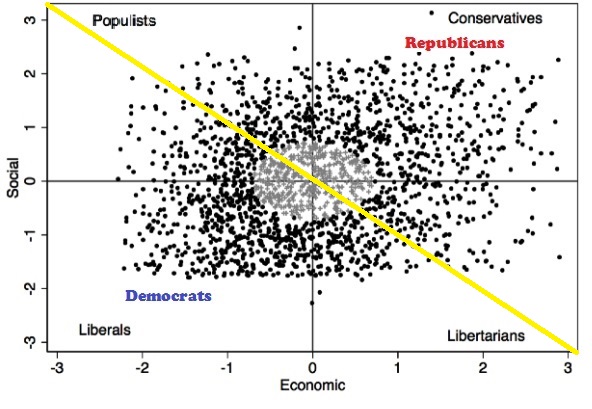
A few months ago, I posted the chart below, which was borrowed without permission from some political scientists who have studied the political ideologies of American voters.

Voters (the little dots) in the two rectangles on the left side of the chart are left-wingers on economic issues, e.g., in favor of increasing the minimum wage. Voters in the rectangles on the right side, however, are right-wingers on those issues, e.g., against increasing the minimum wage.

Going in the other direction, voters in the top rectangles are right-wingers on social issues, e.g. most likely against gay marriage. Those in the bottom two boxes are left-wingers on those issues, e.g. favoring gay marriage. (It’s a known fact that life is much simpler if you diagram it using x and y coordinates.)

Dems and Reps pops yellow

Now, however, the chart has some color to represent people who tend to vote for Democrats and those who tend to vote for Republicans. (Another interruption: did whoever picked blue for Democratic states pick that color instead of red — the traditional color of the left — because red would have suggested Democrats are a bunch of commies?)

Since we’ve only got two big political parties, the populists and libertarians who want to participate in elections often end up choosing between Democratic and Republican candidates. As a rule, the populists and libertarians to the right of the yellow line will vote for Republicans, while the populists and libertarians to the left of the yellow line will tend to vote for Democrats. In similar fashion, people who run for public office will generally join the Democratic or Republican party, depending on the relative strength of their various social and economic beliefs (putting aside any tactical reasons for running in one party or the other).

To use the standard terminology, the left-of-the-yellow-line libertarians tend to be “civil” libertarians (maybe even members of the ACLU), while the right-of-the-yellow-line libertarians tend to be “economic” libertarians (maybe they donate to the Cato Institute). 

Unfortunately, aside from allowing me to play with this great chart, the only point of this discussion so far is to emphasize that there are degrees of commitment to the four political ideologies the chart represents. Someone like Senator RP, for example, who is known for his libertarian tendencies, decided at some point to identify himself as a Republican, apparently because his left-wing, social, civil libertarian views (of which he seems to have some) were weaker than his right-wing, economic libertarian views (of which he definitely has some).

All of which serves, finally, as preface to some general remarks about Republican-leaning economic libertarians (which I’ve reorganized as Part 4, because Part 3 doubled in size, even corrected for inflation).

Republicans and Liberty, Part 2

In yesterday’s post, I asked whether libertarian Republicans support the work of the American Civil Liberties Union and decided that they generally don’t. That’s because libertarian Republicans are generally “economic” libertarians, not “civil” libertarians.

One way to understand the difference is to consider controversies like the recent one in Arizona. Should business people be allowed to refuse service because of a customer’s sexual orientation? A strict economic libertarian would say yes, arguing that the government shouldn’t compel one group of people to associate with any other group, while a civil libertarian would argue that everyone has an equal right to purchase goods and services regardless of their sexual orientation.

To better understand what economic libertarianism amounts to in practice, I visited the official website of Senator RP, today’s most famous Republican libertarian and a contender for the 2016 Republican presidential nomination.

Some of RP’s positions are simple platitudes. For example, he thinks we should only go to war if it’s necessary and the tax system should be simplified. The Senator may have interesting libertarian views on these subjects, but doesn’t mention them.   

Some of his other positions are clearly consistent with libertarian principles, although any economic libertarianism is muted. As expected, he thinks the federal government is too big (he also claims the federal government has doubled in size in the past decade — a statement that is ridiculously untrue; the real numbers are provided in a note at the bottom of this post).

In addition, he thinks the government has become too powerful and intrusive (apparently since 9/11). This opinion is the only one included under the category “Civil Liberties”. Lastly, he says the Affordable Care Act is bad because it expands the role of government. He doesn’t mention an alternative, although an economic libertarian would presumably prefer a completely private system in which healthcare is just another product, either freely donated or sold to people who could afford it. 

I’m obviously no expert on economic libertarianism, but his other positions seem questionable from that perspective: 

Life begins at conception, so abortion is unconstitutional – Even if we grant for the sake of argument that a fertilized egg is a person with constitutional rights, this would still be a case in which one individual’s single right take precedence over another individual’s various rights (without, of course, the latter’s consent). It’s certainly arguable that in this case, RP wants to impose his religious views on pregnant women, regardless of their own beliefs.

Our schools are suffering from too much government spending and interference – Some economic libertarians think mandatory public education is wrong. RP merely favors spending less money and exerting more local control. It isn’t clear in this context whether RP thinks school-age children have any rights at all, for example, the equal right to an education that will allow them to properly compete in the free market. 

We should increase domestic energy production even more than we already have – Encouraging energy efficiency (that would be government interference in the marketplace) and discouraging pollution (which affects us all, not just polluters) aren’t mentioned.

Illegal immigration is a threat to our national security – It isn’t explained why it’s dangerous for foreigners to participate in our free market. Some economic libertarians favor immigrant rights, apparently holding that people should be able to live and work where they want without government interference.

There should be no restrictions on gun ownership, except by irresponsible people and criminals – In practice, this means there should be very few restrictions and conflicts with other people’s right to be protected from violence (the main reason we have a government, according to economic libertarians).

Social Security covers more people than in the past and they’re living longer – No policy position is stated, although it’s implied that something is wrong. In particular, there is no mention of reducing benefits or cutting Social Security taxes, which would seem to be the obvious economic libertarian position.

Nobody should be allowed to serve in the Senate or the House for more than 12 years – This is despite the obvious fact that term limits infringe upon an individual’s fundamental right to engage in a law-abiding career of his or her choice for as long as he or she chooses.

Veterans should be given special assistance – It isn’t clear whether this means veterans should receive benefits beyond what was promised when they freely chose to enlist.

Based on the above, Senator RP’s libertarianism seems rather limited, perhaps because taking stronger libertarian positions would scare away voters. Cutting Social Security benefits and allowing more foreigners into the country aren’t popular positions. Legalizing drugs, which isn’t mentioned, is controversial, especially among Republicans. On the other hand, most Republicans favor forcing pregnant women to give birth, term limits and special benefits for veterans, none of which are clear libertarian positions.  

So, the impression I get from RP’s website is that he has some libertarian tendencies, but is just another right-wing politician. He’s found a home in the Republican Party even though Republicans tend to favor things like prayer and creationism in public schools, a worldwide military presence, government surveillance, harsh drug laws, farm subsidies and vote suppression, despite the fact that those positions seem to conflict with libertarianism of any kind.

I was planning to include some general thoughts on economic libertarianism today, but for now I’ll end with a related observation (author unknown) and that promised footnote):

There are two novels that can change a bookish fourteen-year old’s life: Tolkien’s “The Lord of the Rings” and Ayn Rand’s “Atlas Shrugged”. One is a childish fantasy that often engenders a lifelong obsession with its unbelievable heroes, leading to an emotionally stunted, socially crippled adulthood, unable to deal with the real world. The other, of course, involves orcs.


That promised (long) footnote: Has the federal government doubled in size in the past decade, as RP’s website claims?

The precise decade isn’t specified, but that’s not important, since the numbers are clear whichever recent 10-year period we choose. For example, starting in 2002 and ignoring inflation, total federal spending was 2.0 trillion dollars. In 2012, it was 3.5 trillion, a truly large increase of 75% (although less than 100%). However, corrected for inflation (using constant 2005 dollars), total spending went from 2.0 trillion to 3.0 trillion, an increase of 50% (well, it was a rough decade, what with the wars and the free-market financial crisis and the resulting unemployment).

Alternatively, as a percentage of the country’s Gross Domestic Product (a measure commonly used by economists, because it reflects the nation’s increasing economic activity), federal spending rose from 19% of GDP in 2002 to 24% of GDP in 2012, an increase of 26%.

Finally, there were 4.15 million people working for the federal government in 2002. In 2012, there were 4.31 million, an increase of only 3%.

So much for the size of the federal government doubling in the last decade. 

By the way, the other statistic cited to help us understand this supposed astonishing growth of more than 100% is an increase of roughly 40%. Quote: “To put this in perspective, the federal government spends more than $10,280 per person, over $3,000 more per individual than what we were spending in 2001”.
Republicans and Liberty, Part 1

It’s one of those enduring questions: why are there Republicans?

I don’t know the answer, but I’ve been thinking about the existence of one kind of Republican lately: the Libertarian. The principal libertarian Republican in the news these days is a Senator from Kentucky whose initials are RP. Some of the people who spend their time on Earth guessing about such things think RP is the front-runner for the 2016 Republican presidential nomination (even though the primaries and caucuses are still two years away). 

I started thinking about RP and other Republican libertarians when this question popped into my head: do Republican libertarians support the American Civil Liberties Union? The ACLU famously devotes itself to protecting various rights and liberties, especially those enumerated in the Bill of Rights. Shouldn’t Republican libertarians be in favor of their work? Yet that seemed unlikely, since the ACLU is a well-known “liberal” organization and we all know how Republicans feel about liberals.

A little bit of research suggests that Republican libertarians support some of the ACLU’s work, but definitely not all of it. The reason for this mixed attitude is that Republican libertarians are generally “economic” libertarians, while the libertarians at the ACLU are (as you might suppose) “civil” libertarians.

Economic libertarians believe the individual is supremely important, especially when it comes to private property and the fruits of one’s labor.They hold that government’s principal purpose is to protect the rest of us from criminals and foreign aggressors, not to provide for the general welfare. They believe we should all be allowed to do what we want so long as we don’t infringe on other people’s rights.

Hence, economic libertarians favor laissez-faire, the principle that private parties should be allowed to engage in economic activity with minimal government interference, involvement or assistance. The government should only tax, regulate or subsidize economic activity in order to insure the existence of a free market, in which all of us, being responsible for our own success or failure, can fairly compete.

The basic argument for economic libertarianism was strongly stated by the philosopher Robert Nozick (who borrowed some of it from Immanuel Kant) in his classic book Anarchy, State and Utopia: all human beings should be treated as ends, not means, so it’s wrong to take from one person to help another. Basically, my tax dollars should not benefit you without my consent. Otherwise I’ve been made a kind of slave.

To sum up, in the words of one self-described libertarian: “Real libertarians understand that freedom of speech and other civil liberties depend on the sanctity of private property – not its violation by anti-discrimination laws and other forms of government intervention.”

So, economic libertarians endorse some of the ACLU’s work, such as supporting freedom of speech and the right of assembly, but oppose a lot of it, such as the ACLU’s support for anti-discrimination laws (because an employer should be able to discriminate against potential employees on the basis of race or gender) and the supposed right of all children to an equal public education at taxpayer expense. 

Economic libertarians appear to disagree among themselves on other issues. One troublesome example is abortion rights, which the ACLU obviously supports. Economic libertarians would presumably support abortion rights too (it’s my body) but not if they think a fetus is already a person (in which case, the fetus already has rights that need to be protected). Voting rights is another interesting case. The ACLU strongly favors voting rights for all Americans, including ex-prisoners, but some economic libertarians think that committing a felony means you’ve forfeited your right to vote.

To test my understanding of the difference between economic and civil libertarians, and to see what that famous libertarian Republican has to say, I spent some time on Senator LP’s website. More about that tomorrow, as well as some thoughts on economic libertarianism in general.

Grasping at Flaws

Republicans are doing whatever they can to attack the Affordable Care Act by highlighting people who are supposedly victims of the new law. When reporters look into the details of these sad cases, it turns out that the supposed victims are either lying or ignorant. In one such case, the middle-aged woman described in one of the Republican responses to the State of the Union didn’t know she was eligible for cheaper insurance because she refused to visit one of those evil “Obamacare” websites. One right-wing character responded to this revelation by arguing that it’s mean and unfair to question the story of somebody with cancer.

As Paul Krugman explains (we should all get together and buy this guy a beer or a really nice meal), the ACA does help some people and hurt others. The law tends to help those who are sicker, older and poorer.  It tends to hurt people who are healthier, younger and richer (many of whom will one day be sicker, older and poorer). That’s why the right-wing is having such trouble finding real sympathetic subjects to use in their propaganda. Krugman suggests that when you hear a terribly sad anecdote or see a disturbing advertisement about a sick person who can’t afford treatment anymore or a poor family who can’t afford health insurance because of the ACA, keep in mind that it’s almost certainly right-wing nonsense.

The New Deal and the Same Old Deal

For those of us under 80 or so, the New Deal was basically President Franklin Roosevelt using the federal government in creative ways to address the Great Depression, which wasn’t fully tamed until World War II began, government spending rose even further and lots of working-age men joined the armed forces (there were 450,000 Americans in the military in 1940 and 12.5 million in 1945).

A recent book, Fear Itself: The New Deal and the Origins of Our Time, tells the story but leaves Roosevelt in the background. The New York Review of Books has a fairly long but excellent review by Nicholas Lemann, a professor of journalism at Columbia University, here. 

The author of Fear Itself is Ira Katznelson, a professor of political science and history, also at Columbia. According to the review, Katznelson considers the national legislature to be the most central political institution in a democracy. For that reason, he presents an account of the New Deal and its aftermath that pays little attention to Presidents Roosevelt and Truman:

Katznelson has no interest in their personal qualities or their methods of leadership. Instead his focus is on Congress and government agencies, and more broadly on political systems, voting, and interest groups. This gives Fear Itself the feeling of a fresh look at a familiar story.

In addition, Katznelson emphasizes the perilous situation the country faced in the 1930s. Germany and Italy had reacted to the Great Depression by turning to fascism. The diplomat George Kennan believed America’s government should become authoritarian. The respected journalist Walter Lippmann told President Roosevelt that he might have to become a dictator. New Deal policies were enacted in “an atmosphere of unremitting uncertainty about liberal democracy’s capacity and fate”.

Becase Katznelson focuses on Congress, the South has a major role in the story he tells. Since the Civil War, the South had been firmly Democratic. In the 1932 election, Democratic congressional candidates received 86% of the vote in the South. After that election, more than half of the committee chairmen were southern Democrats. As a result, Roosevelt needed southern support in order to get anything through Congress:

The South used its power to create de facto regional exceptions to many New Deal policies, either by exempting domestic and agricultural workers (meaning blacks) from them, or by placing administrative and policy control of them in the hands of state governments. To use the most obvious example, the 1935 law that created the Social Security system had both of these features...

It was specifically the South that blocked … the possibility of the New Deal’s moving further left in its policies. The New Deal wound up largely achieving one set of goals—an American welfare state, including retirement security and an empowered labor movement—but stopped far short of another, which would have involved creating, through democratic procedures, a more centrally planned economy….

It was Congress that blocked national planning, for reasons having to do with the southern bloc’s overriding concern with maintaining the regional racial order. The South, in Katznelson’s view, was willing to move left on economic issues as long as that didn’t threaten segregation. When economic policy and race began to seem intertwined, the South opted out on economic policy, and that defined the leftward boundary of the New Deal.

Reading this should remind us how little has changed since then. Much of our politics is the same old deal it’s always been. Since the compromise that resulted in slaves being counted as 3/5ths of a person in the Constitution, America has been politically divided between the North (now including western states like California) and the South (now including northern states like Idaho and Wyoming). 

Of course, after the passage of the Civil Rights Act in 1964 and the Voting Rights Act in 1965, the South switched to voting Republican. But progressive federal policies are still being watered down in order to accommodate southern sensibilities. For example, the Affordable Care Act allowed individual states, especially in the South, to avoid expanding Medicaid, thereby limiting benefits to poor people and low-paid workers (including, of course, poor and low-paid blacks).

Professor Lehmann, the author of the review, highlights other ways in which southern “conservatives” have affected federal policy since the New Deal: by supporting our entry into World War II (Southern politicians tend to favor the military and military activity); by encouraging the creation of our national security state (internment of the Japanese, loyalty oaths, FBI surveillance, the creation of the CIA and the House Un-American Activities Committee); by voting for a “defense” budget that has continued to grow even in peacetime; and by making life difficult for labor unions and people who want to vote.

For example, given the Republicans’ recent attacks on voting rights, this passage from the review is especially striking:  

Katznelson also reminds us that whites as well as blacks were substantially disenfranchised in the South, because of poll taxes. Voter turnout was shockingly low in the South—below 20 percent of eligible (meaning mainly white) voters, for example, in Georgia, Mississippi, Alabama, and South Carolina in the crucial presidential election of 1940. In the 1938 midterm elections, Mississippi, with a population of more than two million, had only 35,000 voters. 

There are few activities more troubling in a democracy than intentionally limiting the size of the electorate, although that’s now standard Republican policy, especially in the South.

Professor Lehmann thinks that the South described by Professor Katznelson is too homogeneous. Lehmann argues that there have been significant differences between Southern politicians regarding civil rights and economic issues. Nevertheless, if you want to understand where America is today, Lehmann’s review of Katznelson’s book is terrific reading. So, probably, is the book. 

(A personal note: when I was in college, I read something by a black author who claimed that the status of black people has been the central issue in the history of our country. Unfortunately, I haven’t been able to find the quotation or even identify the author. But I remember reading that statement some 40 years ago and being highly skeptical. The more I learn about American history, however, the more I’ve come to agree.)