Us, Them and Incentives Again, But Briefly

Remember when Clinton was President and the federal government briefly ran a surplus? The Republican response was: “Cut taxes!” Their justification was: “It’s our money, not the government’s!”. Since then, the surplus having been eliminated, the Republican response has been: “Cut taxes! That will lead to growth and reduce the deficit!” Which isn’t completely relevant to “Us, Them and Incentives”, but I’m getting there. It’s another example of how adherence to a political ideology can lead to inconsistency, especially when you try to justify what you already want to do. 

In writing about the Republican approach to incentives this week (less income for the rich will make them less productive, but less income for the poor will make them more productive), I may have been unfair. Maybe the Republican position makes sense based on the relative economic success of the rich and the poor.

After all, rich people are doing well, you might say, so they must be doing things right. Therefore, let’s reward them. That way they won’t get discouraged and stop doing things right. Poor people, however, aren’t doing well, so they must be doing things wrong. Obviously, we shouldn’t reward them for doing things wrong. And, if we don’t reward them, maybe they’ll start doing things right. In a capitalist nutshell, economic incentives should be given to productive people, and economic disincentives should be given to unproductive people.

This approach sounds an awful lot like social engineering, which the Republicans are supposed to be against. Putting that aside, however, the question is whether it’s a good idea to make life harder for people who are struggling and make it easier for people who aren’t. If you view life as a total morality play, in which good people prosper and bad people don’t, maybe it does makes sense. That is, we all know, the reason for heaven and hell (which St. Thomas Aquinas understood so perfectly).

But people are doing well or badly these days, economically-speaking, for lots of different reasons: skills, health, age, location, connections, work ethic, luck, education, competition and so on. In fact, one major hindrance to doing well economically is being poor to begin with (when you’re poor, it’s harder to get around, harder to fit in, harder to stay healthy, and so on). Once we view our fellow Americans as individuals with actual, often difficult lives, not simply as Us and Them, the reasonable response is to help the ones who are struggling, not the ones who are already getting ahead.

(Coming soon, “A Guide to Reality, Part 11”, I hope.)

Us and Them

Psychologists and others have been trying to figure out why people have opposing political views. Why are some of us stalwart liberals or progressives, and why are some of us “conservatives” or right-wing nincompoops?

Personally, I leaned right when I was a teenager, moved left in college and have maintained that position through thick and thin. The people who study this question aren’t interested in individual stories, however. They’re trying to explain why these different political perspectives exist at all and why they have such staying power.

The Washington Monthly has a long review by Chris Mooney of two books on the subject. These are the two key differences Mooney cites:

— Liberals tend to score higher on openness (the willingness to explore, try new things and meet new people), while conservatives score higher on conscientiousness (the desire for order and stability — and as I’ve read elsewhere, although the article doesn’t mention these characteristics — loyalty or a sense of duty).

— Conservatives pay more attention to negative stimuli than liberals. For example, when conservatives are shown images of alarming, threatening or disgusting things, they tend to look at the images more closely and have stronger physical reactions.

There is evidence of a partial genetic basis for these differences. Researchers suspect that:

What is ultimately being inherited is a set of core dispositions about how societies should resolve recurring problems: how to distribute resources (should we be individualistic or collectivist?); how to deal with outsiders and out-groups (are they threatening or enticing?); how to structure power relationships (should we be hierarchical or egalitarian?); and so on. These are, of course, problems that all human societies have had to grapple with…. Inheriting a core disposition on how to resolve them would naturally predispose one to a variety of specific issue stances in a given political context.

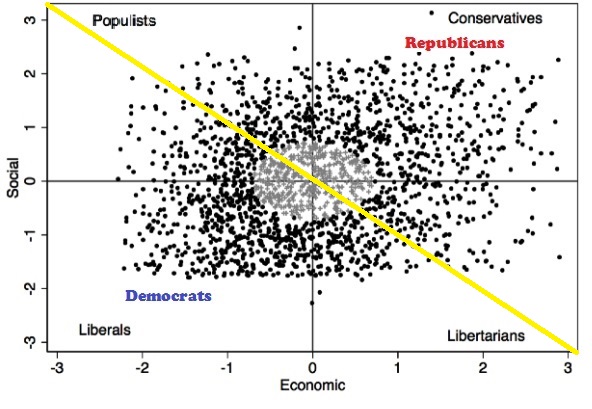
It’s possible, therefore, that the two-dimensional diagram posted here earlier this week that labels voters as populists, conservatives, libertarians or liberals based on their social and economic preferences may measure the underlying dispositions described above.

If it’s true that conservatives experience the world as more threatening than liberals do, there may be little point in trying to convince them otherwise, as Mooney points out. Their perception of the world is built-in to a great extent. Likewise, of course, if liberals perceive the world as less threatening, there is little point in trying to convince them it’s more dangerous than they think. Despite this apparent difficulty, Mooney ends his review with a call to action:

We run around shutting down governments and occupying city centers—behaviors that can only be driven by a combination of intense belief and equally intense emotion—with almost zero perspective on why we can be so passionate one way, even as our opponents are passionate in the other….Ideological diversity is clearly real, deeply rooted, and probably a core facet of human nature. Given this, we simply have no choice but to come up with a much better way to live with it.

I tend to be more skeptical. If these tendencies are actually so deeply-rooted, there’s probably little we can do to surmount them. In fact, the only option may be to keep pounding away at the facts, hoping to persuade people whose dispositions aren’t so deeply-rooted to move in our direction. And by our direction, I mean toward the perspective that is more open to new possibilities, less fearful of people who don’t belong to our tribe, and more egalitarian. 

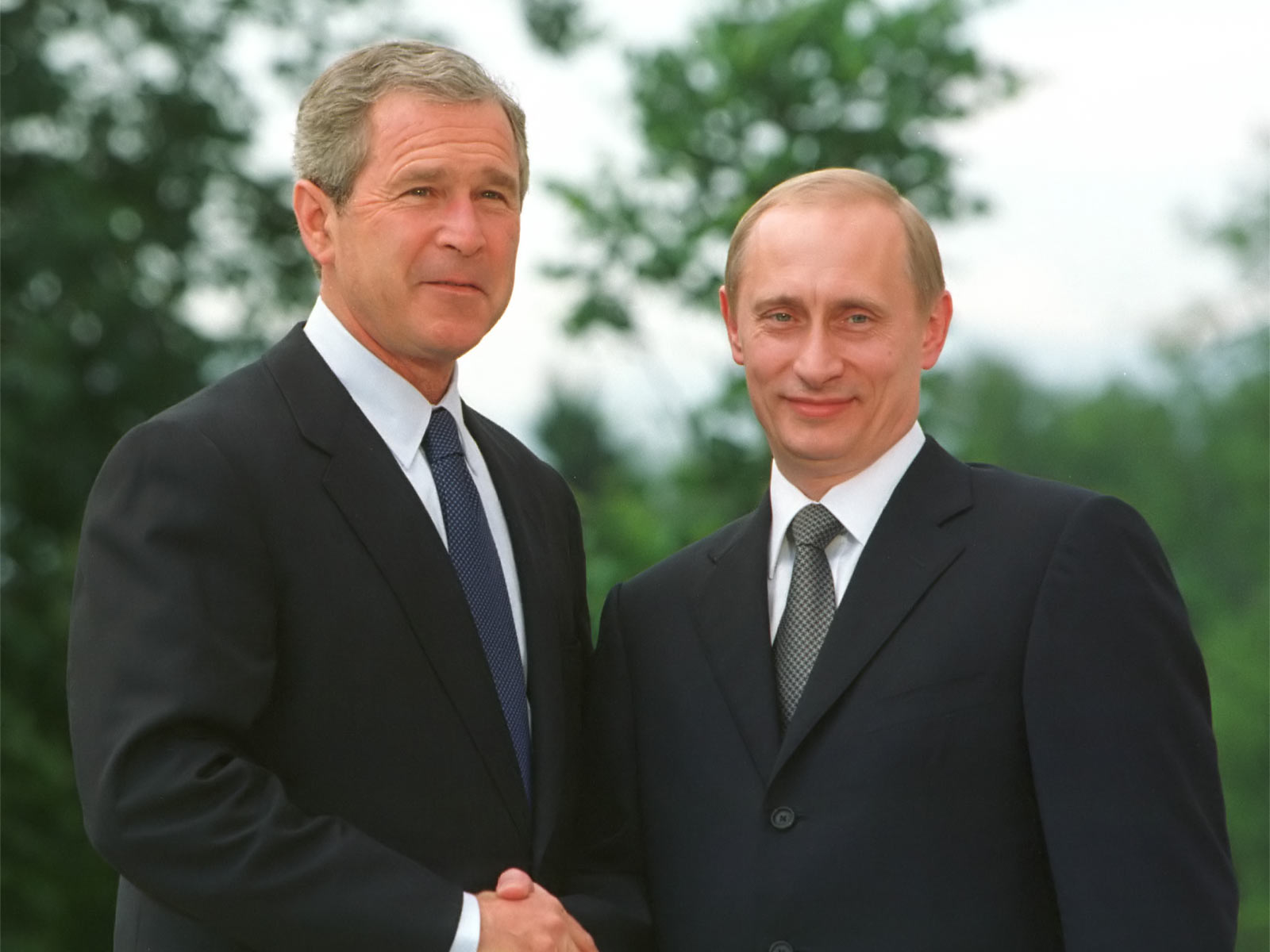
Our other option is to wait for evolution to do more work, for despite the fact that there are benefits to having people in your group who are more fearful and others who are more adventurous, it seems likely to me that human progress has partly consisted in liberal tendencies edging out conservative ones. These two specimens, for example, appear to be remnants of an earlier stage in human development:

putin-bush

Update:

As I was saying:  

Republican Senator Marco Rubio of Florida addressed the Conservative Political Action Conference today:

The presidential contender urged that “young people” in the crowd “extrapolate what the world would look like in ten years if [the current international situation] continues forward.” … “If you inherit a world where the Chinese get to decide who gets to ship products to the South China Sea and all the countries in that region are tributaries,” and “North Korea can blow up California” with nukes, and “Iran can reach the East Coast of the United States, and can wipe Israel off the face of the earth,” and “Russia continues to hold its neighbors hostage” through both its military and its oil.

The only thing we have to fear is everything.

Republicans and Liberty, Part 4 (the End?)

When I think of what it means to be a Republican economic libertarian, I think of someone I know — call him “Bob”. He is a very affluent periodontist who lives in an enormous house in a beautiful suburb. Some years ago, Bob expressed his outrage over being forced to pay property taxes in support of the local public schools, since his own children were being educated privately. That’s an attitude that perfectly captures the essence of economic libertarianism:

What’s mine is mine and the rest of you, the damn government, shouldn’t take it away from me for something I don’t care about and isn’t doing me any good!

If Bob had read a certain book by another Bob (the late Robert Nozick), he might have expressed his outrage with a brief argument: 

1) It’s the most fundamental principle of morality that people should be treated as ends in themselves, not as means toward achieving someone else’s goals or for someone else’s benefit.
(2) Taking my property against my will in order to benefit other people is treating me as a means, not an end.
(3) When the local government forces me to pay property taxes to fund the local school district, the government is taking my property against my will.
(4) Therefore, the government should not force me to pay taxes to support public schools.

What’s wrong with this argument?

One serious problem is that it depends on a hidden assumption: namely, that the first sentence is not merely an important principle of morality, but the supreme principle that overrides all other moral principles. That’s a questionable assumption. Life, for both philosophers and normal people, is too rambunctious to fit under a single ethical umbrella. There are always exceptions and additional considerations.

When we were teenagers, for example, didn’t we all joke that the Golden Rule doesn’t apply to masochists (you know, do unto others…)? Similarly, imagine an isolated town in Alaska that’s been hit by a dangerous epidemic. The local pharmacist has a drug that will attack the disease but insists on full payment (or 75% of the price or whatever) before distributing his supply. He’s not a bad person — maybe he needs the money because he’s deeply in debt and on the verge of losing his store.

If the single overriding principle of morality is that we should always treat everyone else as an end, not a means, the town’s residents should accept the situation and either come up with the cash or do a lot of praying. Or are they justified in confiscating the drug, distributing it among themselves and watching the pharmacist go bankrupt? Can we apply principle (1) all by itself to solve this problem? I don’t think so. Principle (1), the philosophical basis for economic libertarianism, doesn’t say whose ends are more important when they conflict.

Fortunately, there are other ethical rules that come into play in situations like this (even though those rules aren’t foolproof or all-encompassing either). The British utilitarian Jeremy Bentham, if he were available as an ethical consultant, would probably agree that treating everyone as a means, not an end, is a decent enough moral principle. But only because it tends to support a more important moral principle: “It is the greatest happiness of the greatest number that is the measure of right and wrong”. In other words, we should always do what will ultimately result in the most happiness for the most people (including a town full of sick Alaskans and kids going to public school in New Jersey). 

Here’s another problem with this argument. It’s incredibly self-centered. If it’s valid, the principle that people should be treated as ends, not means, applies to those kids at the public school just as much as it applies to my acquaintance Bob. But how can Bob treat those children as ends? A really excellent way would be to pay the taxes that will help them get an education.

In fact, if Bob refuses to help those kids, he seems to be treating them as means, not ends. Some of them will grow up and take jobs in the community, working in stores, or maintaining roads, or performing heart surgery. Will Bob benefit from their labor? It’s true he might directly pay for their services one day, but he’ll also benefit from living in a community that’s safe and prosperous because of the work performed by people he’ll never bump into.

Consider what his life would be like if the few people selling groceries in his town were the only people selling groceries in the state of New Jersey. His town would still be a great place to live if he could find food on the shelves and didn’t mind checkout lines that were 20 miles long.

There’s also a problem with how this argument seems to identify me with my property. How do people acquire property anyway? The French anarchist Proudhon had an opinion: “Property is theft!” How was the first piece of property acquired? It was a long time ago, so we don’t know. But we do know that not one of us begins life as a clean slate and grows up in perfect isolation. The argument above suggests that taking any of my property against my will is a violation of my humanity regardless of where my property came from. That probably sounds plausible to whoever wrote the sentence I quoted in an earlier post, the one that referred to “the sanctity of private property”.

But are property rights sacred? Are they more sacred than anything else, like kindness or compassion? Are property rights so sacred that the tax collector who takes part of your paycheck against your will — for purposes other than the common defense and the maintenance of a free market — is committing a sin or a crime against humanity? Maybe if you think every penny you earn is solely the result of your God-given wonderfulness and had nothing to do with your genes or your upbringing. Or if you identify yourself with your property.

Like it or not, as everyone knows, we are social animals who grow up and survive in communities. Economic libertarianism, however, is a radically individualistic doctrine. It’s also simplistic and atomistic (in the social sense, not the physical sense). It reeks of adolescence.

A teenager, usually a boy for some reason, trying to figure out how to navigate the world, in the process of breaking away from his parents, looks for words that will explain other people and help him feel good about himself. Maybe he makes the mistake of reading Atlas Shrugged instead of The Lord of the Rings or The Brothers Karamazov: 

“Pleasure is all that really matters.”
“Do unto others as you would have them do unto you.”
“Poor people are stupid or lazy”.
“If God doesn’t exist, all is permitted.”
“Asking for help shows you’re a loser.”
“When I earn money, I should be able to keep it.”

Taken to its extreme, in fact, economic libertarianism reeks of infancy. We all have to share. That’s what we’re supposed to learn before we get to kindergarten.

Of course, there are probably few economic libertarians who hold the doctrine in its purest form. No doubt there are some who debate the finer points, howeverlike Russian intellectuals who debated the finer points of communism before the revolution. A wonderful person can have libertarian tendencies along with common sense. It’s all a matter of degree. Where on that chart above should people reside? Where does Senator RP reside? Where do you reside? 

I’m not sure, but I’m proud to say I’m not a Republican or an economic libertarian. I’m also not a “social liberal and fiscal conservative”. That’s too often code for comfortable people who enjoy their station in life while consistently supporting right-wing candidates and policies, the kind that “comfort the comfortable and afflict the afflicted”, not the other way around.  

NOZICK 2

(Photo courtesy of Philosopher Shaming.)
Republicans and Liberty, Part 3 (It’s Doubled in Size!)

Having pondered the difference between so-called “civil” and “economic” libertarians for a few days now, and having analysed the issue summaries on Senator RP’s website beyond all reason, it’s now time for a few thoughts on the type of libertarians who tend to gravitate toward the Republican Party.

A few months ago, I posted the chart below, which was borrowed without permission from some political scientists who have studied the political ideologies of American voters.

Voters (the little dots) in the two rectangles on the left side of the chart are left-wingers on economic issues, e.g., in favor of increasing the minimum wage. Voters in the rectangles on the right side, however, are right-wingers on those issues, e.g., against increasing the minimum wage.

Going in the other direction, voters in the top rectangles are right-wingers on social issues, e.g. most likely against gay marriage. Those in the bottom two boxes are left-wingers on those issues, e.g. favoring gay marriage. (It’s a known fact that life is much simpler if you diagram it using x and y coordinates.)

Dems and Reps pops yellow

Now, however, the chart has some color to represent people who tend to vote for Democrats and those who tend to vote for Republicans. (Another interruption: did whoever picked blue for Democratic states pick that color instead of red — the traditional color of the left — because red would have suggested Democrats are a bunch of commies?)

Since we’ve only got two big political parties, the populists and libertarians who want to participate in elections often end up choosing between Democratic and Republican candidates. As a rule, the populists and libertarians to the right of the yellow line will vote for Republicans, while the populists and libertarians to the left of the yellow line will tend to vote for Democrats. In similar fashion, people who run for public office will generally join the Democratic or Republican party, depending on the relative strength of their various social and economic beliefs (putting aside any tactical reasons for running in one party or the other).

To use the standard terminology, the left-of-the-yellow-line libertarians tend to be “civil” libertarians (maybe even members of the ACLU), while the right-of-the-yellow-line libertarians tend to be “economic” libertarians (maybe they donate to the Cato Institute). 

Unfortunately, aside from allowing me to play with this great chart, the only point of this discussion so far is to emphasize that there are degrees of commitment to the four political ideologies the chart represents. Someone like Senator RP, for example, who is known for his libertarian tendencies, decided at some point to identify himself as a Republican, apparently because his left-wing, social, civil libertarian views (of which he seems to have some) were weaker than his right-wing, economic libertarian views (of which he definitely has some).

All of which serves, finally, as preface to some general remarks about Republican-leaning economic libertarians (which I’ve reorganized as Part 4, because Part 3 doubled in size, even corrected for inflation).