Police Reform and Fake Capitalism (They’re Not Related)

Calling the police can be dangerous. New Jersey is doing something about it. The state created a program called ARRIVE Together. A mental health professional accompanies the police when they go out on a call involving someone in mental distress. A study showed that in 342 such cases, only 3% resulted in the use of force and only 2% resulted in an arrest (usually because of an unrelated issue, such as an outstanding warrant). The program is being expanded and should serve as a model for police departments around the country (see this report from the Brookings Institution).

So much for some good news. Now back to harsh reality. From The Guardian:

One of the most deeply held and frequently heard propositions about capitalism is that it revolves around private companies and individuals taking risks. When, earlier this year, the US government arranged a rescue package for Silicon Valley Bank, for instance, among the many objections to it was the claim that the rescue contravened capitalism’s risk norms.

This view of the world directly informs wide swaths of economic policymaking today….But examine the economy, and it becomes clear: capitalism has become less and less about corporate risk-taking in recent decades. To be sure, many businesses do take significant risks. The independent small business owner who opens a new cafe in London generally faces intense competition and massive risk. But as political scientist Jacob Hacker has argued, business in general has been enormously skilled in recent times at offloading risk – principally by dumping it on those least able to bear it: ordinary households.

… The best example of a business usually regarded as being fundamentally about risk-taking, but which in fact is not, is … alternative asset management, an umbrella term for hedge funds, private equity and the like. (“Alternative” here means anything other than publicly listed stocks and bonds.) Asset managers are anything but marginal, exotic firms – they manage more than $100 trillion of clients’ money globally and control everything from [Benihana to PetSmart to Westinghouse].

But let’s look at what asset management companies in places like Britain and the US actually do. Three considerations are paramount.

First, there is the matter of whose capital is put at risk when alternative asset managers such as Citadel, Blackstone and KKR invest. In large part, it’s not theirs. The proportion of equity invested by a typical hedge or private equity fund that is the asset manager’s own is usually between 1% and 3%. The rest is that of their external investor clients (the “limited partners”), which include pension funds.

Second, consider how an asset manager’s investments are designed. For one thing, its own financial participation in, and management of, its investment funds is usually through a vehicle (the “general partnership”) that is constituted as a separate entity, precisely in order to insulate the firm and its professionals from liability risk.

Furthermore, the fund and its manager is generally distanced from underlying investments by a chain of intermediary holding companies that protect it from the risk inherent in those investments. In leveraged buyouts, where money is borrowed to help finance a deal,the debt goes on to the balance sheet of the company the fund has acquired. This means if trouble arises in repaying the debt, it is not the investment fund that is on the hook, still less its manager.

Third and last, fee structures also distance asset managers from risk. If a fund underperforms, they may earn no performance fee (based on fund profits), but they do have the considerable consolation – a form of risk insurance, if you like – of the guaranteed management fee, usually representing about 2% of limited partners’ committed capital, year after year. Essentially, management fees pay asset managers’ base salaries; performance fees pay bonuses.

In short, then, it would be far-fetched to suggest that what hedge funds and the like do amounts substantially to risk-taking. The only meaningful risk they themselves face is that of losing customers if fund returns prove underwhelming…. In reality, the business of alternative asset management is less about taking on risk than, in Hacker’s terms, moving it elsewhere. So when things go wrong, others bear the brunt….

Why does this matter? Because unless elected policymakers understand how risk is produced and distributed in modern economies, they will not be in a position to act appropriately and proportionately. That is why vague talk from politicians of being “pro-business” or “entrepreneurship” mean so little; the point is to learn from economic realities as they actually are, as opposed to how economics textbooks say they could or should be.

There is one very obvious policy recommendation for alternative asset management that flows from our understanding what they actually do with “risk”: taxing them more.

The main performance fee earned by alternative asset managers is “carried interest” – effectively, a profit share. In the UK and US, most asset management firms pay tax on this revenue at the capital gains rate, rather than the usually higher income tax rate. This is because the asset manager has typically been understood to be “taking on the entrepreneurial risk of the [investment]” – a standard justification for taxation as capital gain.

But as we have seen, this simply does not hold water. In 2017, the New York Times called the beneficial tax treatment of carried interest “a tax loophole for the rich that just won’t die”. It’s time to close it….

Note: To pass Biden’s Inflation Reduction Act last year, Democrats needed Sen. Kyrsten Sinema’s vote. But she wouldn’t vote for the bill unless Democrats dropped the provision that would have closed the carried interest loophole. She insisted on preserving the tax break that favors the securities and investment industry. Wouldn’t you know that hedge fund managers and private equity executives gave her more than $2 million between 2018 and 2022? Since then, she left the Democratic Party to run in Arizona as an “Independent” [CNBC].
What’s a Fusion Party?

Third political parties don’t do well in the US. What they usually do is take votes away from the major party they’re ideologically closest to. Thus, in the 2020 election, 1.8 million people voted for the Libertarian Party candidate, not the Republican, and 400,000 voted for the Green Party candidate, not the Democrat. In 2016, 4.5 million voted Libertarian and 1.5 million voted Green. Voting for a third party in America is a way to “send a message”, while helping to elect the Democrat or Republican you probably can’t stand. A classic case was Ralph Nader, noted progressive and consumer advocate, getting 97,000 votes in Florida, in an election with a final margin between Bush and Gore of 573 (thanks to the Supreme Court). Bush should have invited Nader to the White House, although Nader wouldn’t have shown up.

But some third parties make sense. They’re called “fusion” parties. A fusion party nominates the major party candidate they like best. All votes cast for the fusion party in the general election go to the Democrat or Republican they’ve nominated. Thus, in New York, where fusion parties are legal, the Working Families Party usually nominates the Democrat and the Conservative Party usually nominates the Republican. It may sound like a dumb idea (why not just vote for the Democratic or Republican nominee?), but it allows the fusion party to run its own campaign and allows fusion party voters to avoid thinking of themselves as Democrats or Republicans.

The most interesting case, however, is when the fusion party nominates a candidate they’d ordinarily oppose. That happens when the other major party candidate is so bad, the fusion party can’t support them. That’s what’s happening in New Jersey’s 7th Congressional District this year. Disaffected Republicans have created the Moderate Party and nominated the Democrat (who happens to be relatively moderate). They don’t want to support the Republican, because he’s an empty suit who’s aligned himself with the Make America Great Again crowd. They see the Moderate Party as a political home for Republicans or others who might ordinarily vote for a Republican, but can’t bring themselves to support an extremist.

As of now, however, fusion parties are illegal in New Jersey and most other states. They were popular in the 19th century and legal in New Jersey until 1920. For whatever reason, Democratic and Republican politicians have usually preferred the two-party system that put them in power. In 1997, the Supreme Court ruled that states have a strong interest in “the stability of the two-party system”, so although a third party could “endorse” a Democrat or a Republican, they could be prohibited from casting ballots for that candidate.

Assuming the state of New Jersey declines to recognize the Moderate Party, its organizers plan to sue. According to the New Jersey Globe:

The Moderate Party is expected to argue that fusion voting protects voter rights, free speech and equal protection for candidates and voters. Organizers say their group will include Republicans, Democrats and unaffiliated voters.

The Globe article cites two cases in which fusion parties made a difference:

Democrat Daniel Malloy was elected governor of Connecticut in 2010 by 6,500 votes after winning 26,000 votes as the candidate of the Connecticut Working Families Party.

In his 1980 U.S. Senate race in New York, Republican Alphonse D’Amato received 275,000 votes on the Conservative Party line and an additional 152,000 as the Right to Life Party candidate.  That enabled him to defeat Democrat Elizabeth Holtzman by 81,000 votes.

Now that the Republican Party has lost its collective mind, fusion parties would be a way to elect more Democrats. We’ll see if New Jersey’s Secretary of State and Supreme Court allow it to happen.

This Week’s Elections Don’t Mean the Sky Is Falling

Rachel Maddow is often an oasis of sanity in the barren wasteland of corporate media. Last night, she identified an historical pattern that nobody else seems to have paid much attention to (I recommend watching what she had to say, but I’m writing about it anyway).

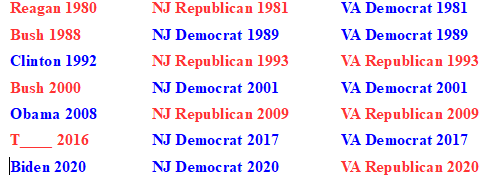
Here’s the pattern in pictorial form. The first column is a president’s first year in office. The second column is the winner of the New Jersey governor’s race later that year. The third column is the winner of the Virginia governor’s race held the same day.

Untitled

It’s an oddity of the political calendar that New Jersey and Virginia hold their elections for governor one year after presidential elections. That means when a new president is elected, like Reagan in 1980 and Biden in 2020, the governor’s races in New Jersey and Virginia are the first chance voters get to choose their state’s leader but also, less obviously, to react to there being a new person in the White House. This explains why NJ and VA governor’s elections are viewed as a referendum on a president’s first year in office. 

Looking at the chart, you’ll notice that in three of the seven years (1988, 2000 and 2016), when a  Republican won the presidency, his party lost the two governor’s races.

Likewise, in two of the seven years (1992 and 2008), when a Democrat won the presidency, his party also lost the two governor’s races.

It was only in 1981, and again this year, that a new president’s party won even one of the two governor’s races.

In other words, Biden and his party did better this week than any president has done since Ronald Reagan, forty years ago.

As a matter of fact, in 1981, with Reagan now in the White House, the Republican gubernatorial candidate beat the Democrat by fewer than 2,000 votes (an exception that almost proves the rule that the president’s party loses these elections). If the Democrat had done a bit better, Joe Biden would have been the first brand-new president to hold onto the NJ or VA governorship in 44 years. (Winning a second term makes NJ Governor Phil Murphy the first Democrat to win two elections since then. He currently leads his Republican opponent by 44,000 votes).

As Maddow pointed out, the New Jersey and Virginia governor’s races are the first opportunity for voters who opposed the new president to register their anger at the polls, while the voters who helped elect the new president are (less passionately) waiting to see what the new president can deliver. That’s why a new president’s party ordinarily loses both the New Jersey and Virginia governor races.

The fact that a Democrat won New Jersey this year is, therefore, a good sign, not a bad one. You wouldn’t know that from reading a paper or watching TV (maybe that’s because those in the media who comment on elections are surprised that Democrats don’t do even better, given the Republican Party’s descent into fascism).

Finally, Maddow also points out that in two special elections this year, Democrats did quite well. A Democrat was elected to Congress with 60% of the vote in New Mexico, even though Republicans claimed they had a great chance to win. Three months later, California’s Democratic governor won that ridiculous recall election, also with 60% of the vote. The 2022 election will almost certainly be difficult, but the sky is not falling based on this year’s results.

Keeping Yesterday’s Election in Perspective

A recent opinion poll suggested the Democratic governor of New Jersey, Phil Murphy, would easily win yesterday’s off-year election. But instead of winning 55% to 45%, as the poll indicated, it looks like he’ll win 50% to 49%. Why? Because all kinds of people answer opinion polls, but it’s the angry ones who tend to vote in low turnout elections. And who is angriest today (although their anger isn’t justified)?

Paul Waldman of The Washington Post explains and offers some advice to Biden and congressional Democrats:

One of the most pervasive biases among the political media is the bias toward dramatization, interpreting every event as startling, extraordinary, and signaling a reshaped political landscape.

That is how many are interpreting the results of Tuesday’s elections, especially Glenn Youngkin’s win in the Virginia gubernatorial race. The truth is more mundane — but its implications for how Democrats should think about their future are no less profound.

Let’s begin with the context in which these elections took place. First and most important, there’s a Democrat in the White House. It is impossible to overstate how that one simple fact puts Democrats in a position to lose and lose big, not just in this election but in next year’s midterms as well.

Here’s what happens when a president gets elected: He tries to do a bunch of things, some of them work out and some of them don’t, but nobody’s life is really transformed, at least in the short term. Meanwhile, the opposition party’s voters are utterly enraged by the mere fact that someone they hate is now running the country.

So at the first opportunity (and probably the second and the third), those opposition voters rush to the polls, while voters from the president’s party are not nearly so motivated.

Now add in the fact that we’re still in a pandemic, the delta variant has slowed the recovery, supply chain problems are producing inflation, and President Biden’s approval ratings are in the low 40s.

Given all that, it would have been absolutely stunning if Democrats hadn’t gotten their clocks cleaned in these elections, just as Republicans did in 2017 after D____ T____’s election and Democrats did in 2009 after Barack Obama’s election. The president’s party lost both the Virginia and New Jersey governor’s races in those years as well. Yes, the particulars of a campaign can make a difference at the margins — Republicans certainly waged a skillful if repugnant campaign in Virginia — but the basic pattern will hold.

Plenty of people will now tell you that a different strategy or a clever bit of rhetorical jujitsu could have changed the outcome in these races, and the fact that both were so close makes it at least possible, if unlikely. But here’s the reality for 2022: Only something truly earthshaking will prevent the almost inevitable outcome of Democrats losing the House and probably the Senate as well.

There were only two times in recent decades that the president’s party didn’t suffer significant losses in the midterms. The first was 1998, a year dominated by the Republican impeachment of Bill Clinton, which led to its own backlash against Republicans. Approval of the GOP plunged to depths only matched when they shut down the government five years later.

The second was 2002. Amid the aftermath of Sept. 11 the atmosphere of fear and panic reigned; President Bush’s approval ratings were in the 60s, and Republicans successfully argued that Democrats were terrorist-loving traitors who wanted Americans to die.

Could something that momentous happen in the next twelve months to turn the situation in Democrats’ favor, either defusing Republican anger or elevating Democratic anger to the point where more Democrats turn out than Republicans? It’s always possible.

But ordinary good news — the passage of important bills, the fading of the pandemic, a strong economic rebound — probably won’t be enough. All that would produce a situation in which Democratic voters say, “Things are going pretty well,” and Republican voters say, “I am enraged!”, if only because a Democrat is still president and Democrats still control Congress.

So when Democrats are told that they must pass the Build Back Better bill or some other piece of legislation to have any chance of holding the House and Senate, it isn’t exactly right. If they don’t pass worthwhile bills they’ll certainly lose, since their own supporters will see them as weak and ineffectual. But even if they do pass the bills, it [very likely!] won’t be enough.

So they have to widen their view beyond 2022. Accept that they have one more year to legislate, and ask: What can we accomplish in that time? How many people can we help? How much can we improve the basic conditions in which Americans lead their lives? How much progress can we make on our agenda, not because we think there will be short-term political dividends but because it’s the reason we got into politics in the first place. Or at least it should have been.

It’s not that there will be no political ramifications to what they do and don’t accomplish now. But many of them will take years to play out. For example, passing the Affordable Care Act only exacerbated the struggles they had in the 2010 midterms, since it became a focus of Republican anger and mobilization. But eventually it became a political advantage; eight years later, voters punished Republicans for trying to repeal it.

More importantly, imperfect though it was, the ACA helped enormous numbers of people. It eliminated the nightmare of being denied health coverage because of preexisting conditions, and gave millions of Americans insurance for the first time. It was an extraordinary achievement.

So Democrats should ask themselves: What can we do now that we’ll proudly tell our grandchildren about years from now? If we really only have a year to make a difference, what are we going to do with that time?

Unquote.

It’s highly likely the Democrats will lose the House of Representatives in 2022, since they have such a small majority today and House races are affected by gerrymandering, which Republicans are real good at. But the outlook for the Senate isn’t so bad. Democrats will be defending 14 seats, while Republicans will be defending 20, and 5 Republican senators have already announced they’re retiring. Democrats could conceivably pick up seats in Pennsylvania, North Carolina and Wisconsin, even if they’re likely to lose in Georgia. Gaining one seat would make either Manchin or Sinema less important. Gaining two would make both of them less important.

Identify This State

When we moved to the East Coast from California 30 years ago, I met someone who lived in New Jersey and told him that the state, from what I’d seen, was much nicer than I expected. He said “Yes, we like to keep that a secret”.

Of course, there are old cities and rundown neighborhoods, ugly factories and the challenging NJ Turnpike, but for such a small, densely-populated state (47th by size, 8th by population), there’s a lot of variety. We do have the most hazardous waste sites in the nation — a remnant of the state’s industrial past, when NJ also earned its nickname “The Garden State” because of the way NJ farms fed New York City and Philadelphia. New Jersey also has the 2nd highest income, 3rd highest percentage of college graduates and 3rd highest percentage of immigrants. Much of the Revolutionary War was fought here, Thomas Edison became “The Wizard of Menlo Park” here, researchers at Bell Labs developed radio astronomy, the transistor, the laser, the UNIX operating system and the C programming language here. Abbott met Costello here.

Much of the state away from New York City and Philadelphia is undeveloped. The coastline is beautiful. We’re in the top 10 in life expectancy. The public schools are highly rated. We get less back from Washington than any other state, compared to the federal taxes we pay (you’re welcome). And we avoid electing Republicans.

It was notable, therefore, that when 1,200 Americans were asked to choose America’s best states, New Jersey just barely beat Mississippi and Alabama, coming in 48th out of 50.

states-design-01

Maybe that’s because, according to generations of comedians, New Jersey is funny. “I’m from Joisey! You from Joisey? Which exit?”

Property taxes are too high. There are those toxic waste sites scattered around. And who knows whose remains are hidden in the Meadowlands, which is more swamp than meadow (and where the “New York” Giants and Jets play football, but won’t admit it)?

Fortunately, however, New Jersey and its state government have a sense of humor:

Ey4rj8fWUAArjtn

The state of New Jersey. A well-kept secret.