The U.S. Economy Is in Better Shape Than You Might Realize

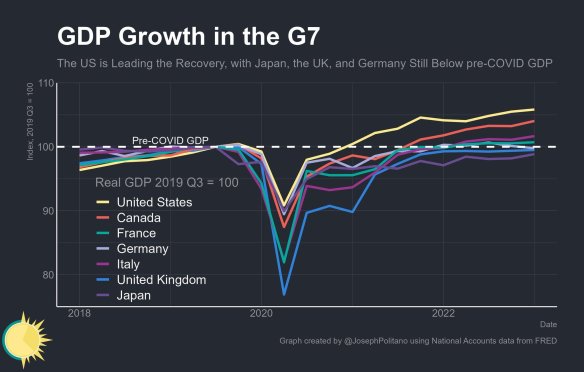
It isn’t commonly known, but we have the highest post-pandemic growth among the G7 nations, the group that includes the U.S., Canada, France, Germany, Italy, Japan and the United Kingdom.

Fzpz_smX0AIIZKt

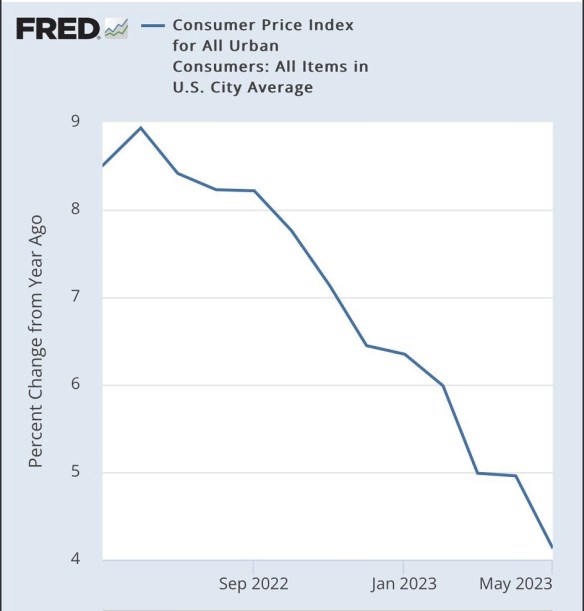
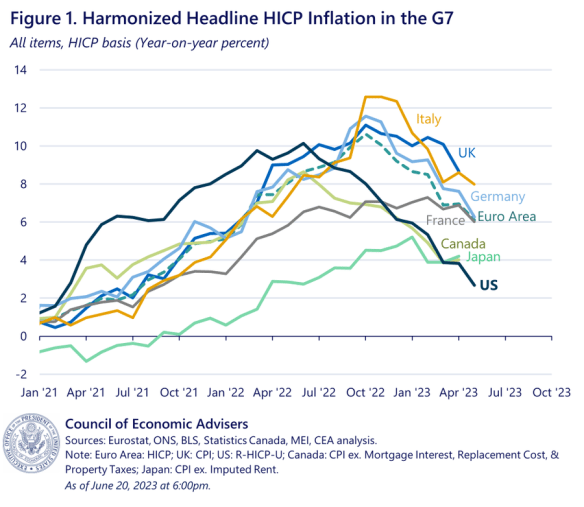
We also have the lowest inflation.

Fzpzxv1XsAIHUrJ

Could last year’s biggest piece of legislation, the Inflation Reduction Act — which passed with zero Republican support — have helped reduce inflation?

Fzp-2vsakAMzWMG

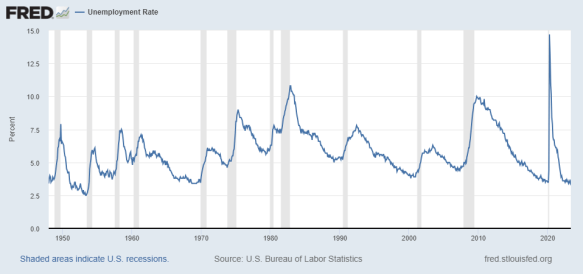
We also have our lowest unemployment rate since 1970, more than 50 years ago.

fredgraph

Perhaps more voters will understand how well the economy is doing by next year’s election — unless, of course, they’re locked into the right-wing media/propaganda bubble. For them, the country is in horrible shape and there is no hope for a better tomorrow unless their favorite felon is returned to office.

Truth vs. Fantasy in Today’s Politics

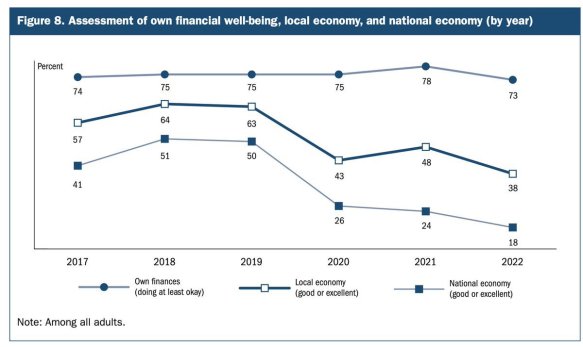
A recent poll showed that most Americans think they’re doing okay economically speaking, but think the national economy is in terrible shape. This chart is from a recent Federal Reserve report on the economic well-being of U.S. households.

FwxLu-9XoAAvEWr

The top line shows that around 75% of us have been relatively satisfied with our own finances since 2017, despite the pandemic. That 75% includes people who thought their own finances were “okay” or better. The bottom two lines, however, show that people’s opinion of their local economies and the national economy went down quite a bit during the pandemic, with lots of people thinking the country’s economy is even worse than where they live.

What’s very odd is that those negative sentiments from 2020 have lingered, or even gotten worse, even though the percentage of us who think our own finances are okay or better hasn’t changed much at all.

Another oddity is that, although people aren’t thrilled about their local economy — only 38% saying it’s good or excellent — hardly anybody likes the national economy — only 18% saying it’s good or excellent.

Why would so many of us think we ourselves aren’t suffering economically although people who live near us are and the nation as a whole is even worse off? The obvious answer is that the national media have convinced people that the country is in deep economic trouble, much worse than where they live and work, and despite the fact that they themselves are in pretty good shape. (It shouldn’t be a surprise that Republicans have the worst opinion of other people’s economic situation, given where they get their news and what their favorite politicians tell them.

This brings me to an article in The Washington Monthly: “Republicans Say Inflation, Crime, and Immigration Are Out of Control. The Numbers Disagree”.

The Republican presidential candidates are on the same page regarding Joe Biden: He’s a disaster on inflation, immigration, and crime.

“We have no borders. We have inflation. We have everything going wrong,” said [their leading candidate] … in his apocalyptic fashion…. “Everybody is being murdered.”

Former Vice President Mike Pence … began a CNN-hosted town hall event with a pithy critique: “Literally, we have a crisis at our border. We have inflation at a 40-year high. We have a crime wave in our cities.” Pence suggested Biden’s border policies are to blame for “a flood of fentanyl coming into every city.” 

There’s one problem with this Republican portrayal of a Democratic president presiding over chaos: None of it is true.  

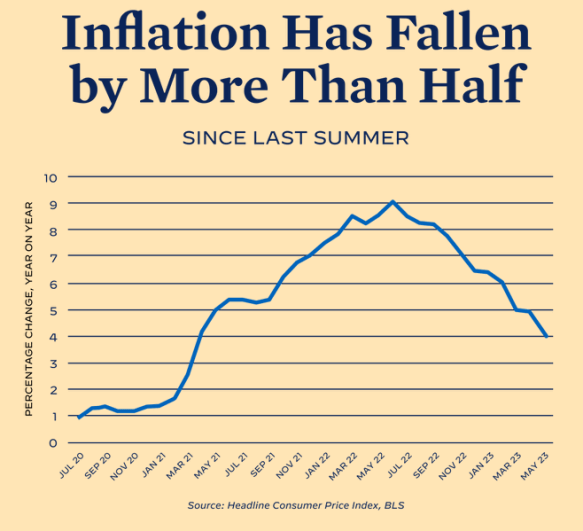
Inflation was at a 40-year high. During 2022, the inflation rate started at 7.5 percent, peaked in June at 9.1 percent, and ended the year at 6.5 percent, a mark that hadn’t been cleared since June 1982.  

But 2023 is a different story. The inflation rate for May is down to 4 percent, less than half of the June 2022 peak. But even back in March, when it fell to 5 percent, the “40-year high” talking point was obsolete. In July 2008, during the George W. Bush administration, inflation was 5.6 percent. And in October and November 1990, during the George H. W. Bush administration, it was 6.3 percent.

From the Bureau of Labor Statistics:

Fyg2RC_XoAU7ydL

As we get further away from the pandemic and the Federal Reserve keeps raising interest rates, the rate of inflation should continue to fall (despite the fact that corporations have used inflation as an excuse to increase their prices and profits even more than they needed to, as reported by The New York Times). Back to the article:

Has southern border security collapsed? Hardly. Unlawful entries have dropped by 70 percent in the last few weeks, according to the Department of Homeland Security, after Biden implemented a new border management policy.  

… Border crossings spiked just before Biden ended “Title 42,” the public health emergency rules that Txxxx enacted in 2020, using the COVID-19 pandemic to expedite the removal of asylum-seekers…. Many skeptics … assumed that the end of Title 42 would prompt a surge of migrants. The opposite happened. 

If the current pace of border crossings—about 3,700 per day—remains stable throughout June, the monthly total would be 111,000, … somewhat higher than the 93,000 in the last full month of Txxxx’s presidency.  

When assessing those numbers, remember that while Title 42 made it easier for the Border Patrol to send back asylum seekers, it did nothing to prevent those removed from trying again. In turn, many of the illegal crossings in Biden’s first two and a half years—under policies designed by Txxxx—were made by repeat offenders. Between 2019 and 2022, the recidivism rate jumped from 20 to 49 percent.

In Biden’s new system, those illegally crossing the border can be banned from applying for asylum for five years and risk jail time if they violate the ban. We saw a spike in crossings just before the administration implemented the smart new policy because migrants hoped to avoid the Biden ban.To tame an unruly border, Biden is steering asylum seekers away from treacherous desert treks and towards a more orderly online application process.

What about fentanyl coming over the southern border? … Biden’s administration has intercepted more fentanyl than Txxxx’s ever did…. According to PolitiFact, Biden deserves partial credit for the higher seizure numbers because his administration is employing more and better detection technology at the border. Besides, immigration across the southern border has little to do with the fentanyl crisis. Eighty-six percent of people arrested for trafficking fentanyl are American citizens, as “the vast majority of fentanyl being smuggled in comes through ports of entry, not people trying to sneak into the country.”  

Republicans may talk up crime, and there are no shortages of alarming anecdotes, but there is no Biden crime wave. “Murder is down about 12 percent year-to-date in more than 90 cities that have released data for 2023, compared with data as of the same date in 2022,” according to …The Atlantic, a trend that could lead to “one of the largest annual percent changes in murder ever recorded.” … In fact, over the past five years, the worst month for homicides was July 2020—when Txxxx  was president.  

Another set of promising data comes from the Violent Crime Survey by the Major Cities Chiefs Association, which looked at data from 70 cities. During the first quarter of 2023, homicides, rapes, and robberies dropped about 8 percent from the first quarter of 2022….  

Where Republicans have the best argument is in the category of stolen cars: up 21 percent from 2021 and a whopping 59 percent from 2019. But they haven’t argued that we’re only suffering from a wave of car thefts. They assert America is suffering a collapse of law and order, on every front, solely on Biden’s watch. That’s not true. A mixed picture is not a crime wave.  

Republicans are not updating their talking points to reflect this new data, preferring to insist that America is falling apart. They’re betting that either the data trajectories will reverse course, belatedly validating Republican attack lines, or Americans will be so convinced everything is terrible that additional positive data won’t “feel” true, and voters will disregard it. At least, that is the Republican hope….

We can’t know what these metrics will be in the run-up to Election Day. But in the meantime, reporters and voters should not allow Republican candidates to paint a dystopian picture of America without being forced to address the numbers that don’t fit their narrative. 

November 5, 2024, is more than 500 days away. Let’s hope more of the good news sinks in by then.

It’s a Global Problem — They’d Make It Worse

I’m avoiding polls and speculation about the upcoming midterm election and don’t see political advertisements, but political news and commentary does get through. Today, Paul Krugman discussed the state of the economy and pointed out that Republican politicians don’t have a plan to address what they say is the country’s biggest problem (since the climate crisis isn’t real, women shouldn’t have equal rights and democracy is overrated):

Few things I’ve written in recent years have generated as much hate mail as a relatively low-key, somewhat nerdy newsletter I put out just before the release of data on gross domestic product for the second quarter of 2022. In that newsletter I explained why, despite a lot of misinformation in the news media, a recession is not defined as two quarters of declining G.D.P. and the first half of 2022 was unlikely to meet the actual, multidimensional criteria used by the committee that determines whether a recession has started.

The reason for the hate mail was, of course, that Republicans were eager to declare a “Biden recession” and falsely accused the administration of a double standard when it said that we were not, in fact, in a recession.

Well, Thursday’s advance G.D.P. report for the third quarter of 2022 showed why a recession call based on two quarters of somewhat bizarre data would have been all wrong. Economic growth has rebounded, back up to 2.6 percent at an annual rate — putting G.D.P. back in line with strong employment growth, which has continued throughout the year. Do you really want to say that we were in a recession from January through June but have miraculously recovered?

… Suffice it to say, we weren’t in a recession earlier this year and aren’t in a recession now, although we could find ourselves in one in the future as delayed effects of rising interest rates kick in.

Politically, however, it may not matter much, because Republicans have largely given up on the recession story. Instead, their economic attacks, in both debates and campaign ads, have been focused overwhelmingly on inflation, especially gas prices.

It therefore seems worth pointing out that the Republican Party doesn’t have a plan to fight inflation. Actually, it doesn’t have any coherent economic plan at all. But to the extent that Republicans have laid out what they will try to do if they win the midterms, their policies would make inflation worse, not better.

When pressed about how, exactly, they would reduce inflation, Republicans often fall back on some version of “Gas was only $2 a gallon when Trump left office!” So let’s talk about that comparison.

First, it’s remarkable how the right has reimagined January 2021 as a golden moment for America. At the time, about 20,000 Americans were dying from Covid every week; there were still nine million fewer jobs than there had been before the pandemic. Indeed, the still-depressed state of major economies, including that of the United States, was the main reason world oil prices were unusually low, which in turn was the main reason gas was cheap.

A better comparison would be with 2019, the year before the pandemic, when gas averaged $2.60 a gallon. Bear in mind that average wages have risen about 15 percent over the past three years, so gas would be as affordable now as it was in 2019 if its current average price were $2.99. As of Wednesday, it was $3.75. So yes, gas has become less affordable, but not by nearly as much as Republicans claim.

And despite Republican rhetoric, Biden administration policies have had little impact on gas prices, which have been driven by events affecting world markets — notably Russia’s invasion of Ukraine — and to some extent by bottlenecks in refining, which grew worse for several weeks starting in mid-September but have eased again.

So what is the Republican plan to bring gas prices down? There isn’t one.

What about inflation more generally? You can make the case that large deficit spending early in the Biden presidency fed inflation (although it had little effect on the most politically salient prices, for energy and food, which have soared around the world).

If you’re worried about the inflationary impact of budget deficits, however, you should know that almost the only concrete economic policy idea we’re hearing from Republicans is that they want to extend the Trump tax cuts, which would 
 substantially increase the deficit.

It’s true that many Republicans adhere to an economic ideology that doesn’t see deficits caused by tax cuts as a problem, either because they believe — in the teeth of all the evidence — that tax cuts somehow pay for themselves, or because they believe that government spending, not deficits per se, is what causes problems.

But if you believe that cutting taxes without any plausible plan for offsetting spending cuts isn’t a problem even in a time of inflation, markets beg to disagree. Look at what happened to the pound and British interest rates after Liz Truss, the quickly deposed prime minister, announced an economic plan that, broadly speaking, looks a lot like what Republicans are proposing here. (There’s more to it than that, but still.)

The bottom line is that while the G.O.P.’s election strategy is all about blaming the Biden administration for inflation, the Republican Party doesn’t actually have any plan to reduce inflation. To the extent it has an economic plan at all, it would make inflation worse.

Unquote.

I’ll add that inflation is a global problem (it’s higher in Europe than in the Us) and oil companies are making tremendous profits with gas prices this high. What would a Republican Congress do to restrain oil company profiteering? The question answers itself.

The Dumbest Timeline

When did we stumble into the dumbest timeline? Maybe we did it in 1914 when the European powers blundered into a devastating world war. Maybe it was in 1964 when Barry Goldwater accepted the Republican nomination for president while claiming that “extremism in defense of liberty is no vice”. Or maybe it wasn’t until 2016 when a demagogic con man eked out a victory in the Electoral College. Regardless of when we got here, there’s strong evidence that that’s where (or when) we are. Jonathan Chait of New York Magazine offers two pieces of evidence:

First, the demise of Biden’s social policy agenda:

The most depressing thing about the demise of the Biden administration’s social-policy agenda — other than the demise itself, of course — is the atmosphere of sheer economic illiteracy that surrounded it. Critics of the measure, ultimately including Joe Manchin, made arguments against it that were not so much misguided as lacking any elemental grasp of the basic principles involved (“not even wrong”).

The main argument used against Biden’s plan was that it would worsen inflation, with conservatives scolding Biden for ignoring the sage insights of Larry Summers. To take just one example, pundit Marc Thiessen wrote that Biden signed an economic stimulus in March 2021 “despite warnings from even liberal economists, such as former Treasury secretary Lawrence H. Summers…. But instead of trying to tamp down the flames, Biden keeps trying to pour gasoline on the inferno, with more spending and more free money from Washington.” The tone of this column, like many of the right-wing polemics, is one of incredulous condescension: Biden is such a blithering idiot that he is ignoring the obvious conclusion and instead digging holes and pouring gasoline or whatever.

Whatever the case against Build Back Better, this was not it. The American Rescue Plan did contribute to inflation; its purpose was to stimulate demand by injecting deficit-financed spending into the economy. Build Back Better had a different purpose: to address social needs over a long period of time and finance that spending through taxation.

Spending financed by new taxes is not inflationary. That is why Summers himself endorsed Build Back Better. Yet [reactionaries] spent the better part of a year citing Summers as the authority on why Biden’s long-term plans would cause inflation, oblivious to the fact that any economist, very much including Summers, would say otherwise.

In deference to public concerns about inflation, Manchin ultimately reshaped the last version of the bill as an anti-inflationary measure. The plan would have raised $1 trillion in new revenue (or reduced spending) and used half the proceeds for deficit reduction. This would not have had a large effect on inflation, but there is no question that … it would place downward pressure on prices.

[Republicans] simply refused to acknowledge this aspect of the plan at all. In the end, even Manchin himself abandoned his own plan, which was designed in part to reduce inflation, on account of inflation, which is like deciding not to cut greenhouse-gas emissions because it’s too hot.

… When the 9.1% inflation number was released, Manchin [supposedly] said to Schumer, “Why can’t we wait a month to see if the numbers come down? How do you pour $1 trillion on that tempo with inflation?

Remember, $1 trillion is not the size of the spending in the bill; $1 trillion is the size of the revenue. That’s the pay-for aspect of the bill Manchin insisted on maintaining in order to fight inflation. The $1 trillion would not be poured onto economic growth. It would be poured out of economic growth.

In the end, Biden’s attempt to enact permanent social change died in an atmosphere in which the most ignorant fallacies carried the day.

Next, incoherence and derangement on gay marriage:

In 2004, the Republican Party was united in anger at the idea that judges would seize the issue of gay marriage from its rightful place in the legislative arena…..“The only question is whether the constitutional status of marriage will be determined by unelected judges or the American people,” claimed the Alliance for Marriage.

[Republicans] may finally get their wish. The matter of gay marriage is finally coming for a vote before what they have always insisted is its rightful venue: Congress. And yet, far from expressing gratitude that Congress is finally exerting its sacred Article III powers, conservatives are angry that elected officials are now meddling in business properly settled by the courts…..The old danger of activist judges has passed, and now conservative principle requires the party to take a stand against activist 
 legislators.

Congress is voting to codify same-sex marriage because the Supreme Court’s decision overturning Roe v. Wade undercut the main legal theory that supported other unenumerated rights, including marriage equality….

It wasn’t long ago that opposition to gay marriage held pride of place atop the ideals of the right-wing firmament, second only to the strategic genius of the Bush administration’s “global war on terror” strategy. Conservatives thundered daily against the horrific terrors that would ensue if gay people were permitted to wed each other….

After their heroic stand at the gates of civilization failed, essentially none of the things conservatives warned would happen actually transpired. The cycle of failed prophecy is a familiar one for American conservatism. Every new social or economic reform, from the abolition of child labor to the establishment of Social Security to Obamacare, brings hysterical predictions of collapse that eventually give way to silent acceptance without any stage of reconsidering the failed mental model that produced the erroneous fears in the first place.

At the moment, the case against gay marriage has reached an awkward phase. Marriage equality has enough broad acceptance (around 70 percent support) that the party doesn’t wish to emphasize the issue. But the minority in opposition forms a large enough portion of their base that few Republicans wish to renounce their old stance completely.

Hence the incentive to declare the matter an improper subject for public debate. Unable to take a stand either in favor or against the marriage-equality bill, Republicans are instead directing their arguments … against the Democrats for bringing it up at all….

Finally, an exchange on Twitter between a right-wing blogger and a history professor:

Blogger: Remember when they spent years telling us to panic over the hole in the ozone layer and then suddenly just stopped talking about it and nobody ever mentioned the ozone layer again? This was also back during the time when they scared school children into believing “acid rain” was a real and urgent threat.

Professor: The ozone hole and acid rain. Two things that were LITERALLY fixed by science-led, globally-coordinated, long-term, concrete international action. It’s like being held hostage by the world’s stupidest serial-killer.
I Suppose This Is a Hobby

I retired almost thirteen years ago and have rarely thought about getting a job, even a part-time job, since. But it appears I’ve settled on a hobby, without really intending to. This blog has been part of it for twelve years. Another part is a philosophical “book” about perspective (or points of view) I’ve been “working on” for almost ten years. The other part is lots and lots of comments I’ve spread around the internet.

Many of these comments have been deposited at an interesting site called Three Quarks Daily. It’s mainly an aggregator. They link to articles of intellectual interest at other sites. They also have a Monday Magazine, which features original content.

Untitled

The site is free, although a “one-time donation” or “small monthly payment” makes advertisements disappear. Most of us don’t need more to read on the internet or elsewhere, but I highly recommend 3 Quarks Daily.

What led me to writing this post is that I spent part of last night and most of this afternoon responding to four articles at 3 Quarks (which is more than average output for me).

The first was a response to a Guardian article called “The Federal Reserve Says Its Remedies For Inflation ‘Will Cause Pain’, But To Whom?”. At 3 Quarks, I merely quoted some of Sen. Elizabeth Warren’s recent dialogue with the Fed Chairman, Jerome Powell:

Warren asked Powell if Fed rate increases will lower gas prices, which have hit record highs this month. “I would not think so,” Powell said.

Warren asked if grocery prices will go down because of the Fed’s war on inflation. “I wouldn’t say so, no,” Powell said.

“Rate hikes won’t make Putin turn his tanks around and leave Ukraine,” Warren said, adding that they won’t break up corporate monopolies or stop Covid-19.

“Inflation is like an illness and the medicine needs to be tailored to the specific problem, otherwise you could make things a lot worse,” Warren said. ” … the Fed can slow demand by getting a lot of people fired and making families poorer.”

The Massachusetts Democrat urged Powell to proceed cautiously with further rate hikes.: “You know what’s worse than high inflation and low unemployment? It’s high inflation with a recession and millions of people out of work”.

Next was a response to an article at Aeon called “Armchair science: Thought experiments played a crucial role in the history of science. But do they tell us anything about the real world?”

I disagreed with one of the philosophers quoted in the article, James Robert Brown of the University of Toronto. He said he was extremely impressed with Galileo’s thoughts regarding falling objects. 

Suppose we connect the two objects [a musket-ball and a heavier cannonball] with a short, stiff rod. One could argue that the lighter musket-ball acts as a brake on the heavier cannonball, slowing its fall. Then again, one could also argue that the composite body, whose weight is equal to the sum of the two original bodies, must fall faster than either body alone. This is obviously a contradiction. The only solution, Galileo says, is that all bodies fall at the same rate, independent of their weight.

“I fell out of my chair when I heard it,” Brown said. ‘”It was the most wonderful intellectual experience perhaps of my entire life.” Brown went on to become a leading authority on thought experiments.

At Three Quarks Daily, I expressed skepticism, concluding that Galileo’s thought experiments didn’t prove anything except that it was worth getting empirical evidence on the question (trying it out) before reaching a conclusion.

Number 3 concerned an original article at Three Quarks written by Thomas R. Wells, a “British academic philosopher living in the Netherlands”. He called his article “We Should Fix Climate Change, But We Should Not Regret It”.

Mr. Wells argues that the climate crisis began with the Industrial Revolution, but we shouldn’t regret the Industrial Revolution because of what it’s led to. I’m not sure any sane environmentalists actually regret the Industrial Revolution. I left the fifth comment:

We can agree the Industrial Revolution was a good thing, while also noting that climate change [is] the result of regrettable choices we made along the way, not by starting the Industrial Revolution, but by ignoring our effect on the climate, even though scientists discovered that effect decades ago.

We could have made this a “vastly better world for most people” without making it a vastly worse world for so many other living things. Not exactly coining a phrase, but other living things matter.

Finally, another Three Quarks contributor, Mike Bendzela, who I believe teaches in the English department at the University of South Maine, published an article today called “Abort All Thought That Life Begins”. He argues that there is no such thing as the “beginning of life”. Life has always developed as a gradual process without any particular beginning (its ending isn’t always clear either).

As you might expect, this article has elicited a variety of comments (they’re still landing). I responded to another reader this way:

Justice Blackmun, who wrote the Roe v Wade opinion, shared an internal memo with the other justices before the majority decision was published. He wrote “You will observe that I have concluded that the end of the first trimester is critical. This is arbitrary, but perhaps any other selected point, such as quickening or viability, is equally arbitrary.” [https://en.wikipedia.org/wi…]

… I believe the author … is making the point that any decision regarding a moment when there is “conversion from not human to human” is somewhat (or totally) arbitrary. I’d say the transition from “not human enough” to “human enough” is a matter of convention.

That’s how the five Republicans and two Democrats on the Court ruled in 1973 — they came to a nuanced agreement based on trimesters and viability. It was a reasonable compromise that worked well enough for 50 years, until the Court was corruptly (after Senatorial hypocrisy and lies told to the Judiciary committee) taken over by ideologues.

I see that the person I responded to has now responded to me. Once more unto the breach…

I’ve never read all of Roe v. Wade or the dissents, and I know some lawyers and scholars who oppose forced births (women who get pregnant being compelled by the state to eventually give birth) disagree with the Roe majority’s legal reasoning.

However, as others have pointed out, the 9th Amendment to the Constitution says: “The enumeration in the Constitution, of certain rights, shall not be construed to deny or disparage others retained by the people”. Even though the Constitution doesn’t mention a right to privacy, or pregnancy or abortion for that matter, I agree with Tim Quick above that we all have certain fundamental rights, including the ones he mentioned that justify women and their doctors sometimes ending a pregnancy without interference from the government.

If topics like these interest you, I recommend Three Quarks Daily. You don’t have to read the comments.