I Did the Reading, So Now I’m Sharing

I read too many articles on the internet about politics. Instead of having one subscription to a high-quality newspaper that used to land on our driveway every morning, I now subscribe to three quality newspapers that I read online. I also visit a number of websites that offer interesting political news and commentary. All you need to give them is your time (although that, of course, is more precious than your money).

Ordinarily, I wouldn’t spend so much time reading about politics, but I want to understand what the hell is going on, i.e., why America is so screwed up. And after I read something, I sometimes feel the need to share. This reading and sharing might be a big waste of time, but it feels like something I should do.  

This explains why I read three long-ish articles in the past few days that I’m now going to mention and very briefly describe. Then I’m going to share a funny video. And then I’m going to share a little good news for a change.

The first article I read was “Donald Trump and the Rise of Tribal Epistemology”. The title isn’t quite accurate, because epistemology is the philosophical theory or study of knowledge. The title should really be something like “Trump and the Rise of Right-Wing Propaganda as a Source of Supposed News for Millions of Americans and the Ill Effects Thereof”. Another title might be “Here’s Why Our Country Is So Screwed Up: Many Americans Don’t Trust the Only Institutions We Have That Do a Fairly Decent Job of Describing Reality, and Is There Anything We Can Do About It?”. I recommend reading the whole thing, which isn’t really seven million words long, despite what the author says.

A link in that article led me to a 2016, pre-election article called “The Rise of American Authoritarianism”. It’s about people with authoritarian personalities, and how they aren’t necessarily bigots or stupid, but how they tend to be afraid of strangers and change, and when they’re especially afraid, they look for “strong” leaders who will protect them by building walls, putting people in jail and blowing things up. There are more of these authoritarians than you might expect and they’re the strongest supporters of the current President, for obvious reasons (“I alone can fix it”).

An interesting point is that the social scientists cited in the article don’t identify people with authoritarian tendencies by asking them about politics. They ask them about child-rearing, posing questions like these:

  • Please tell me which one you think is more important for a child to have: independence or respect for elders?
  • Please tell me which one you think is more important for a child to have: obedience or self-reliance?
  • Please tell me which one you think is more important for a child to have: to be considerate or to be well-behaved?
  • Please tell me which one you think is more important for a child to have: curiosity or good manners?

Authoritarians tend to answer these questions differently than the rest of us. Furthermore, they supposedly tell the truth when asked about raising children, which they might not do if asked about politics.

Another point made in the article is that many people have authoritarian tendencies, but those tendencies only come into play when these potential authoritarians are sufficiently scared, and sufficiently scared by people whom they think are dangerous in some way, either dangerous to their physical persons or to their preferred way of life. 

The importance of the fear factor leads to the third article, “How Fox News Changed American Media and Political Dynamics”. I confess I didn’t read the whole thing, because it was too depressing. It was written two years ago by a former Republican and is mostly historical. It describes the undoing of the Federal Communications Commission’s Fairness Doctrine, the rise of right-wing talk radio and the amazing success of Fox News, the result being that your authoritarian cousin and your potentially authoritarian plumber are convinced that liberals, scientists, the “mainstream media” and other lowlifes are out to destroy America. That makes your cousin and your plumber very angry and/or very, very afraid. 

So here’s the funny video: Randy Rainbow singing “Covfefe: The Broadway Medley”! If nothing else, watching it will mean that, for four glorious minutes, you won’t be reading about politics on the internet. 

I’ve watched this video many times, because, aside from the pleasure of watching and listening to Mr. Rainbow, and hearing those wonderful melodies again, if you do anything for four minutes, over and over again, it does add up. 

Lastly, the good news:  “Nevada Is Considering a Revolutionary Healthcare Experiment”. The Nevada legislature has passed a bill that would allow anyone in the state who doesn’t have health insurance to buy in to the state’s Medicaid program. Details need to be worked out and the Governor might not sign the bill, but it’s an encouraging sign that America might turn the corner one day.

“Covfefe, I just met a girl named Covfefe…”

In America, Christianity Ain’t What It Used To Be

If you want to understand how America got this way, reading Chris Lehmann’s book The Money Cult: Capitalism, Christianity and the Unmaking of the American Dream might help. This is from a review by Barrett Swanson at Dissent:

Though few contemporary Christians would likely admit it, many of the American colonies were built upon the idea of redistribution. Those dour Puritans who first populated the territories of New England were not lured by the promise of windfall profits. Nor had they endured months of seasickness and disease for the chance to start a small business. Instead, they were hopeless utopians, runaway apostates of the established church who yearned to embrace a higher manner of being, one founded upon a system of communitarian ethics.

John Winthrop, the Puritan governor of the Massachusetts Bay Colony, sketched the tenets of this new society in a sermon called “A Model of Christian Charity,” which he delivered in 1630 while on board a British ship headed across the Atlantic. A gusty ode to American exceptionalism, the homily christened the new continent “The City Upon a Hill,” a metaphor that Ronald Reagan would make a watchword for Republicans some three-hundred-and-fifty years later. But in Winthrop’s eyes what gave the New World its luster were the egalitarian principles of the Protestant gospel, central among them the commitment to redistributing wealth on the basis of individual need. “We must be willing,” Winthrop said, “to abridge ourselves of our superfluities for the sakes of others’ necessities . . . we must bear one another’s burdens.”

It is stupefying to consider how, over the course of four centuries, American Christianity would forsake these humble sentiments for the telegenic hucksterism of preachers like Joel Osteen. This Pentecostal quack with a garish smile doesn’t tout the spiritual benefits of communal interdependence. Nor does he acknowledge the ethical requirements of the Christian social contract. Instead, like so many stewards of the “prosperity gospel,” Osteen thinks individual wealth is a hallmark of Christian virtue and urges his followers to reach inside themselves to unlock their hidden potential…. “It doesn’t please God for us to drag through life feeling like miserable failures,” Osteen warns. “God wants you to succeed; He created you to live abundantly.”

How we got from Winthrop to Osteen is the subject of Chris Lehmann’s new book, The Money Cult. Lehmann is interested in how the communitarian spirit of mainline Protestantism was eventually tarnished by the logic of private enterprise. But in the end what he discovers is that, far from being pious victims of a rapacious economic system, mainline churches were very much complicit in “the gradual sanctification of the market.” In fact, throughout the history of the United States, Christian theology was routinely contorted to fit within the narrow priorities of capitalism.

One of the reasons Christianity caught on in the Roman world was that it functioned as a mutual aid society. Helping one’s fellow Christians made a difference in people’s lives, because Rome wasn’t big on universal healthcare or unemployment insurance. But neither was 17th century England. So it makes sense that redistribution (something along the lines of “from each according to his ability, to each according to his needs”) was a guiding principle for the Christians who founded Plymouth Colony.

Today, of course, our fellow citizens who call the U.S. a “Christian” nation think that “redistribution” is a dirty word. A headline in The Washington Post earlier this month noted that “the debate over the Affordable Care Act is really a debate over wealth redistribution”. From Karen Tumulty’s article:

Redistribution of wealth — one of the most radioactive subjects in American politics — has moved from being a subtext in the national debate over health care to being the core of it….

[There is] a bedrock philosophical and ideological question that has always been in the background of any argument about the government’s role in health care: What is the minimum that society should provide for its poorest, most vulnerable citizens, and how much should be taken from the rich and powerful to do it?

…There [are] many ways that Obamacare [redistributes] the burden of medical costs — from the sick to the healthy, with provisions such as the one denying insurers the ability to refuse coverage to people with preexisting conditions; from the old to the young, with a mandate that everyone have coverage or pay a penalty; from the rich to the poor, with an array of new taxes.

It’s almost as if right-wing opponents of the ACA don’t understand what insurance, including health insurance, is. Tumulty quotes economic historian Bruce Bartlett:

“Republicans argue that redistribution is inherently immoral without acknowledging that the very nature of insurance is redistributive. You’re taking money from people whose houses don’t burn down to give it to the people whose houses do burn down.”

As far as I know, Jesus never talked about health insurance and neither did the Puritans. But Christianity in its pure form is clearly pro-redistribution. Any preacher or politician who says otherwise shouldn’t claim to follow Jesus.

If you’re interested in reading more about Christianity as it’s frequently practiced today, I recommend a long article from 2014 by the journalist Kurt Eichenwald. It’s called “The Bible: So Misunderstood It’s a Sin”: 

…With politicians, social leaders and even some clergy invoking a book they seem to have never read and whose phrases they don’t understand, America is being besieged by Biblical illiteracy.

The Bible is not the book many American fundamentalists and political opportunists think it is, or more precisely, what they want it to be. Their lack of knowledge about the Bible is well-established. A Pew Research poll in 2010 found that evangelicals ranked only a smidgen higher than atheists in familiarity with the New Testament and Jesus’s teachings. “Americans revere the Bible—but, by and large, they don’t read it,’’ wrote … pollsters and researchers whose work focused on religion in the United States. The Barna Group, a Christian polling firm, found in 2012 that evangelicals accepted the attitudes and beliefs of the Pharisees—religious leaders depicted throughout the New Testament as opposing Christ and his message—more than they accepted the teachings of Jesus.

No doubt, Paul Ryan would beg to differ. But who sounds more like Jesus? Was it Ryan when he said the healthy shouldn’t be taxed to help the sick, or John Winthrop when he said “we must bear one another’s burdens”? Here’s a hint from the Gospel of Mark, chapter 10:  

“One thing you lack,” he said. “Go, sell everything you have and give to the poor, and you will have treasure in heaven. Then come, follow me.” At this the man’s face fell. He went away sad, because he had great wealth. Jesus looked around and said to his disciples, “How hard it is for the rich to enter the kingdom of God!”

What’s Their Deal With Health Insurance Anyway?

It feels odd to write about anything else now that a senseless, malevolent being has taken control of the White House, but here goes anyway:

Four years ago, Dr. Ben Carson, who is expected to be the U.S. Secretary of Housing and Urban Development in the new administration, compared the Affordable Care Act to slavery:

“You know, Obamacare is really I think the worst thing that has happened in this nation since slavery,” Carson … said … in remarks at the Values Voter Summit in Washington. “And it is in a way, it is slavery in a way, because it is making all of us subservient to the government, and it was never about health care. It was about control…”

“And why did [the Obama administration] want to pass it so badly? Well, as I said the other night on television, Vladimir Lenin … said that socialized medicine is the keystone to the establishment of a socialist state.”

As we might expect, there is no evidence that Lenin said any such thing. The “socialized medicine” quote attributed to him by Carson and others was fabricated for a 1949 brochure issued by the American Medical Association. That’s back when the AMA was fighting President Truman’s proposal for national health insurance (and years before they opposed Medicare). But Carson telling that tall tale helps explain why the Republican Party is so opposed to the Affordable Care Act.

The ACA requires individuals to have health insurance (or pay more income tax) and employers of a certain size to offer health insurance to their employees (or pay more income tax). It also requires that health insurance plans meet specific requirements in order to qualify as health insurance for purposes of the law. So that’s one reason Republicans want to repeal the ACA. The law requires that we do something for our own benefit or for the benefit of others. It limits our freedom to do whatever the hell we want. That makes it a prime example of government overreach, or what the right-wing calls the “Nanny State”.

But since Republicans are forced to buy insurance for their houses and cars without making a fuss (let alone bringing up slavery or Nazi Germany), being forced to buy insurance for their bodies (or their employees’ bodies) can’t be the only reason they’re against the ACA.

A second reason is simply political. After decades of trying, a Democratic President finally got a bill passed that takes us closer to universal health insurance. But whatever Obama was for, the Republicans were against. They immediately labeled the ACA as “Obamacare” to help convince right-wingers to oppose the law, even if they didn’t know what the law did (and even if the law would improve their own lives). 

That’s despite the fact that the ACA adopted the conservative approach to universal healthcare that Republicans had been advocating since the 1970s. It’s pretty amazing. A letter to the editor in The Chicago Tribune tells the disheartening story:

Obamacare is virtually the same privatized mandate plan [the Republican Party] pushed since President Richard Nixon first proposed the National Health Strategy in 1971, then again in 1974. Then the GOP revived its privatized mandate plan again in 1993 with … the [HEART] act … an alternative to the [Clinton] single-payer plan… 

Obama — as a compromise to have basic health reform passed — used this same GOP blueprint with one significant change: adding a public option alongside the GOP’s privatized mandate plan … 

Eventually the public option was stripped out of the 2010 ACA bill as a further compromise to attract bipartisan support for the bill, leaving in its place the very plan that the GOP wanted and pushed for decades. Unfortunately, the ACA did not receive a single vote from the Republican Party that created the plan’s primary concepts as an alternative to a single-payer — “Medicare for all” — type of system.

No wonder the Republicans have had so much trouble coming up with a replacement for “Obamacare”. The law they’re so against is the law they used to be for.

A third reason the Republicans oppose the ACA is that it’s the kind of Robin Hood economic redistribution Republicans hate. It takes from the rich and gives to the poor. Paul Krugman explains in a blog post called “Health Care Fundamentals”:

Providing health care to those previously denied it is, necessarily, a matter of redistributing from the lucky to the unlucky. And, of course, reversing a policy that expanded health care is redistribution in reverse. You can’t make this reality go away.

Left to its own devices, a market economy won’t care for the sick unless they can pay for it; insurance can help up to a point, but insurance companies have no interest in covering people they suspect will get sick. So unfettered markets mean that health care goes only to those who are wealthy and/or healthy enough that they won’t need it often, and hence can get insurance….

The thing is, however, that guaranteeing health care comes with a cost. You can tell insurance companies that they can’t discriminate based on medical history, but that means higher premiums for the healthy — and you also create an incentive to stay uninsured until … you get sick, which pushes premiums even higher. So you have to regulate individuals as well as insurers, requiring that everyone sign up — the mandate. And since some people won’t be able to obey such a mandate, you need subsidies, which must be paid for out of taxes…

What [the Republicans] are left with is … voodoo: they’ll invoke the magic of the market to somehow provide insurance so cheap that everyone will be able to afford it whatever their income and medical status. This is obvious nonsense [but] it’s all they’ve got.

The redistribution is related to a fourth reason they’re against the ACA and it might be their biggest reason of all. Not only did the ACA impose fines in the form of tax increases on taxpayers who wouldn’t buy health insurance, it included a separate, relatively large tax increase on the richest Americans. As everyone knows, that‘s anathema to Republican politicians. Repealing the ACA, therefore, would mean a big tax cut for the Republicans’ favorite people. From Slate:

One of the core, very simple things [the ACA] did was raise taxes on the wealthy in order to fund subsidized health care for more Americans. Couples earning more than $250,000 saw a 0.9 percent increase in their top Medicare tax rate, as well as a new, 3.8 percent Medicare surtax on investment income.

If Republicans have their way and successfully repeal the Affordable Care Act, those two taxes will be toast—which will mean a substantial break for some of the country’s wealthiest families. The liberal Center on Budget and Policy Priorities estimates that millionaires would see 80 percent of the benefits from those tax reductions. Based on the most recent IRS data, the think tank roughly projects that the 400 highest income households—which earned an average of more than $300 million each in 2014—would see a $2.8 billion annual tax cut, worth about $7 million on average per filer.

So that’s at least four reasons why Republicans want to scrap the Affordable Care Act:

1) It’s what they call the “Nanny State” in action. 

2) It was an important Obama accomplishment.

3) It’s the kind of redistribution Robin Hood was for and the bad guys were against.

4) It raised taxes, especially for the rich.

In conclusion, Republicans don’t necessarily want millions of Americans suffering and dying without medical treatment. Being concerned about that kind of thing is simply low on their list of priorities.

I Wish I’d Said It This Well

Paul Waldman writes for The Washington Post. His new column echoes much of what I posted yesterday with the title “On the Bright Side, ACA-Wise”.

Only Mr. Waldman writes for a living and has an editor, so you might want to take a look. His piece is somewhat optimistically called “Donald T___ may have just destroyed the Republican effort to repeal Obamacare”. Please don’t tell him or his paper that most of it is available here. I’m going to have enough trouble because of this:

trump-msg

Quoting Mr. Waldman:

When even the most committed Republicans came around to support Donald T___ in 2016, they made a kind of bet. It wouldn’t matter much that T___ had no apparent fealty to conservative ideology or that he was a complete ignoramus about policy, because he’d be leaving all that boring stuff to them. The Republican Congress would pass its agenda, he’d sign whatever they put in front of him, and they’d all live happily ever after.

But now it’s not looking so simple. In fact, T___ just dealt a huge blow to their top priority: repealing the Affordable Care Act. Accomplishing repeal without causing the GOP a political calamity is an extremely delicate enterprise, and the last thing they want is to have him popping off at the mouth and promising things they can’t deliver. Which is what he just did:

President-elect Donald T___ said in a weekend interview that he is nearing completion of a plan to replace President Obama’s signature health-care law with the goal of “insurance for everybody”….

“We’re going to have insurance for everybody,” T___ said. “There was a philosophy in some circles that if you can’t pay for it, you don’t get it. That’s not going to happen with us.” People covered under the law “can expect to have great health care. It will be in a much simplified form. Much less expensive and much better”.

We should begin with the assumption that nothing T___ says can be taken at face value; the “plan” that he claims is being devised could be no more real than the secret plan to defeat the Islamic State he used to claim that he had formulated. But that’s not the point. What matters is this: Donald T___ just emphatically promised universal health coverage. That’s an absolutely gigantic promise, and it’s one that Republicans have no intention of keeping.

But now they’re stuck with it. Democrats will be saying, “President T___ promised that everyone would be covered!” every day for as long as this debate goes on. Every time a congressional Republican is interviewed on this topic, they’ll be asked, “President T___ said that everyone would be covered. Does your plan do that?”, and they’ll have to bob and weave as they try to avoid admitting the truth.

That’s because the Republican plan, in whatever final form it takes, will absolutely, positively not cover everyone. Universal coverage isn’t even one of their goals. Republicans believe it’s much more important to get government as far away from health care as possible. In place of the ACA’s expansion of Medicaid and subsidies for the purchase of insurance that have extended coverage to 20 million more people…, they’ll be offering some tax credits and health savings accounts, which would be very good for the healthy and wealthy, but not so great for other people.

They call this “universal access,” which is meant to sound like “universal coverage” but is actually nothing of the sort. The truth is that there are really only two ways you can achieve universal coverage: by having the government cover everyone in some form of single-payer, or with a set of extremely coercive mandates to carry coverage, much more coercive than the ones in the ACA. Republicans would rather pluck out their own eyes than agree to either one of those. So the trick is to make the public think they won’t take away coverage from tens of millions of people, while doing just that.

That requires some rhetorical subtlety, which is something T___ is just not capable of…. T___ says whatever comes into his head, and whatever seems like it might be popular. People hate out-of-pocket costs, so he promises low deductibles. People don’t like the idea of tens of millions losing their coverage, so he promises that everyone will be covered.

And now, congressional Republicans are going to have to answer for breaking a promise they didn’t even make. At a moment when opposition to the repeal of the ACA is gathering strength, this was the last thing they needed.

I don’t know if it will be so hard for Republicans to admit they’re not offering universal healthcare or “insurance for everybody”. Making stuff up is part of T___’s act and they can always say he “misspoke”. In addition, they’ll claim that their plan will insure almost everyone through the miracle of untrammeled competition (sure, competition between giant corporations that avoid price competition if at all possible). And T___ will keep saying he’s solved the healthcare problem even though it’s obvious he hasn’t.

But it still seems like a good thing that he keeps saying he wants what we want and what sleazeballs like Sen. Mitch McConnell and Speaker Paul Ryan don’t. In parlous times, we must thank the Lord for small favors.

On the Bright Side, ACA-Wise

There is only one sure thing when it comes to predicting what President Donnie will do. He’ll always do what he thinks will serve his interests. It might not actually serve his interests, but he will believe it does. Otherwise he wouldn’t do it. That’s because he doesn’t have an altruistic gene or self-sacrificing neural pathway in his body. Not one. He is 100% self-centered and selfish. 

The possibly good news is that Donnie has promised not to cut Medicare and Medicaid (and Social Security):

trump-msg

Plus, there’s this:

…T***p told the Wall Street Journal he would consider keeping two of [the ACA’s] most popular provisions — one that allows adult children to stay on their parents’ health insurance plans, and another that would forbid insurance companies from refusing to cover “pre-existing conditions.”

“I like those very much,” the newspaper quoted Trump as saying [on Nov. 11th].

Furthermore, although he has parroted the standard Republican line about quickly repealing the Affordable Care Act, he’s said it should immediately be replaced with something “terrific”. In his case, of course, “terrific” usually means either expensive or fraudulent, but let’s assume he wants the ACA replacement to be popular. It’s true that he’s so mendacious, ignorant and/or stupid that he recently said it will take about a week to design and approve a terrific replacement, but put that aside too. Perhaps he sees an opportunity to feed his narcissism by doing something that will make most of America admire him (as unlikely as that will ever be). 

It shouldn’t have been a surprise, therefore, that Donnie told “The Washington Post” yesterday that he will shortly unveil a plan that offers “insurance for everybody”!

(By the way, before I forget, whoever is responsible for childishly defacing that picture up there from Donnie’s Twitter account is going to be in big, big trouble on January 20th.)

Of course, given that the President-elect’s entire career outside reality TV has been based on telling suckers what they want to hear, his promises are less than worthless. But at least we know that protecting Medicare and Medicaid; limiting the ruthlessness of insurance companies; and making sure we all have health insurance are ideas he’s heard of.

There are a few other reasons for a tiny bit of extremely cautious optimism:

(1) Most of us don’t want the ACA repealed and nobody wants to lose what they already have, so there has been a huge negative response to the Republican “plans”, with websites like Faces of the ACA , articles like “Without Obamacare, I’ll Get Sicker, Faster, Until I Die” and “Here’s What One Cancer Survivor Wants You To Know About Obamacare” and constant reminders that it’s “Time to Turn Up the Heat: Senate Staffers Are Complaining About the Avalanche of Angry Calls”. The anti-ACA repeal movement is also getting support (some of it lukewarm) from unlikely sources, including Republican governors, hospital administrators, insurance companies and the American Medical Association. 

(2) The House of Representatives almost always follows its leader, the odious Paul Ryan, but the Senate is much less predictable. Even in the House, the most reactionary Republicans sometimes vote against their leader because a proposed piece of legislation doesn’t harm enough people. In fact, recent history shows that Republicans find it much easier to agree on what they’re against than on what they’re for. On top of that, nobody knows how  Pres. Donnie will react to legislation that doesn’t obviously satisfy his greed or narcissism. For a helpful summary of the procedural hurdles Congressional Republicans are up against, see “Everything Republicans Will Have To Do To Actually Repeal and Replace Obamacare” (subtitle: “It Won’t Be Easy”). 

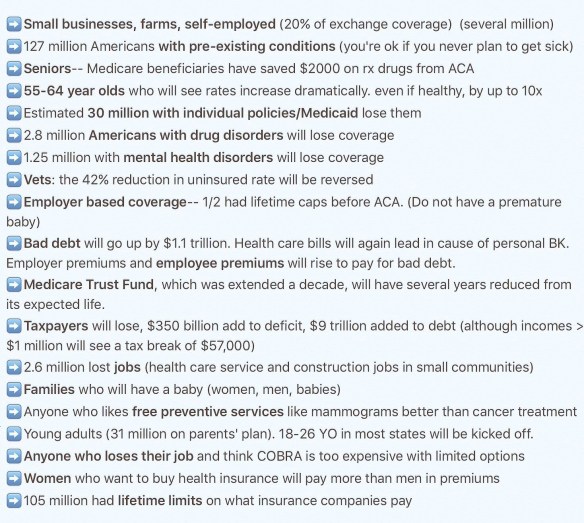
(3) It’s been reported that there is more opposition to “Obamacare” than to the Affordable Care Act. The more people learn what the ACA actually does, the more they like it. So, once President Obama becomes a fond memory, and despite well-funded Republican efforts to confuse the issue, it’s possible that support for the ACA will increase. Andy Slavitt, the acting administrator of the Centers for Medicare and Medicaid Services, prepared a list of everyone who will be negatively affected by repeal of the ACA (without, of course, a terrific replacement):

c2k_w0xwqaad8d4

And let’s not forget this bit of good news:

c2esrmzusaadfg9-1

Will spreading the good news about the ACA and bad news about its repeal have an effect on the right-wing ideologues in Congress and the orange person in the White House? We don’t know, but it’s worth a try.

One last thought for now. One of the phrases that comes up in arguments about our healthcare system is “socialized medicine”. It’s used to attack the idea that the government should control or bear responsibility for healthcare. When you think about it, however, it’s clear that healthcare does have a very strong social aspect. If we don’t want poor people dying in the streets or dread diseases spreading through the population, we need society, including the government, to make sure people get medical treatment. This is why people who arrive at emergency rooms at the edge of death get medical treatment, even if they don’t have a health insurance card or a suitcase full of cash.

The idea that healthcare is a social good fits nicely with the standard Democratic view that “we are all in this together”. Most of us don’t want to live in a dog eat dog world. 

Republicans, however, lean toward the “every man for himself” or “not my brother’s keeper” model. That’s not all bad. Almost everyone puts themselves, their family and their friends ahead of strangers. But in the Republicans’ case, that fundamental attitude easily translates into less for the poor and sick and more for the rich and healthy. That’s the underlying message behind Paul Ryan’s recent statement that he favors “high risk pools” for people with “pre-existing conditions”. He was answering a question from a cancer patient whose life was saved by the ACA:

So we, obviously, want to have a system where they can get affordable coverage without going bankrupt because they get sick. But, we can do that without destroying the rest of the healthcare system for everybody else. That’s the point I’m trying to make. What we should have done was fix what was broken in health care without breaking what was working in healthcare, and that’s what, unfortunately, Obamacare did. So, by financing state high-risk pools to guarantee people get affordable coverage when they have a pre-existing condition, like yourself, what you’re doing is, you’re dramatically lowering the price of insurance for everybody else [PoliticsUSA].

Doing this won’t work, of course, unless those unlucky sick people are wealthy enough to pay sky-high premiums, the government (meaning the rest of us) pays their bills or they simply give up, drop out of the insurance market and take their chances. That’s how “high risk pools”, also known as “insurance ghettos”, have always worked, i.e. failed, in the past.

A closing comment from the PoliticsUSA site:

… Ryan thinks cancer patients and other pre-existing conditions are ruining healthcare for everyone else…The true evil in [Ryan’s] plan is that by separating out the high-risk patients from everyone else, Ryan … can keep costs down by underfunding the pool for people who need healthcare the most…

That’s the attitude we’re up against. The news isn’t all bad, but it’s not going to be easy.