Cutting the Cord (the Saga Begins)

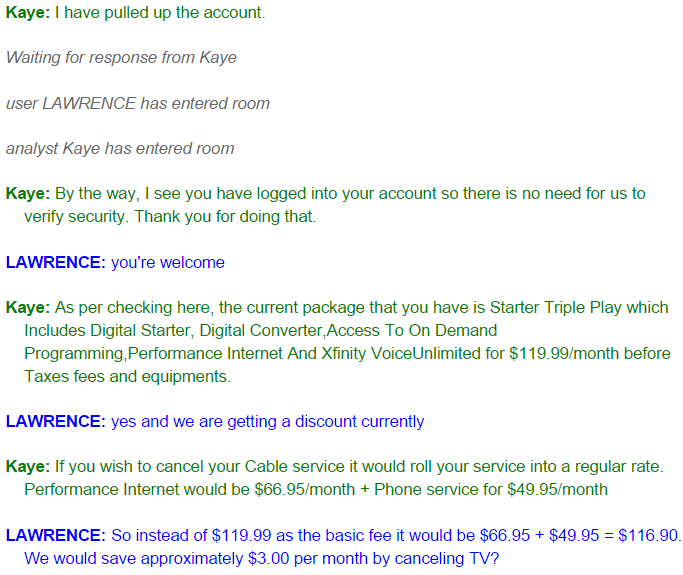
I didn’t think it would be possible via an online chat to give Comcast less money, but decided to start there anyway.

com 1com 2

com 000

Twenty minutes and one reconnect later:

com 4

com 5com 6Well, I didn’t expect anything else. But sometimes it’s good to get confirmation.

In fact, I’m very familiar with everything you can do at this site: http://customer.comcast.com. For one thing, you can add services but you can’t cancel them….

Meanwhile, In Gun News

It’s been reported recently that the US government doesn’t keep track of how many people are killed by the police. The FBI relies on individual police departments to report “justifiable homicides” they commit, but a study by The Wall Street Journal found that “hundreds of police killings are uncounted in federal stats”.

That’s why The Guardian created “The Counted”. It’s an attempt to document everyone killed by America’s police departments during 2015. The database includes people shot to death, as well as those who died under other circumstances, such as the 15 people hit by police cars. As of today, the database contains 506 deaths, 442 by gunshot. You can look at the database and see brief accounts of each incident here.

In a related Guardian article, it’s pointed out that:

… police in the US often contend with much more violent situations and more heavily armed individuals than police in other developed democratic societies. Still, looking at our data for the US against admittedly less reliable information on police killings elsewhere paints a dramatic portrait … : the US is not just some outlier in terms of police violence when compared with countries of similar economic and political standing. America is the outlier … [my emphasis].

One way to reduce both the number of violent situations the police confront and the number of people they kill would be to reduce the number of firearms in circulation. (If you want to get shot by a police officer, the most efficient way is to acquire a gun and then point it at a cop, like David Schwalm did last month.)

And one way to reduce the number of firearms in circulation would be to enforce something like Connecticut’s “permit to purchase” law. From Salon:

Connecticut’s “permit to purchase” law, in effect for two decades, requires residents to undergo background checks, complete a safety course and apply in-person for a permit before they can buy a handgun. The law applies to both private sellers and licensed gun dealers.

Researchers at Johns Hopkins reviewed the homicide rate in the 10 years before the law was implemented and compared it to longitudinal estimates of what the rate would have been had the law not be enacted. The study found a 40 percent reduction in gun-related homicides….there was no similar drop in non-firearm homicides.

The relationship between tighter regulations around handguns and fewer gun-related homicides is in keeping with previous research out of Johns Hopkins on what happened after Missouri repealed its own permit law.

When Missouri repealed its permit law, the number of homicides went up, which shouldn’t have been a surprise. The John Hopkins researchers found a 23% increase in gun-related homicides in the five years after the law was repealed.

A Few Reasons We’re Getting Screwed

It’s one thing to get screwed. It’s another thing to know why. From recent reading:

Instead of raising wages, hiring more workers or investing in research and new equipment, corporations are increasingly accumulating cash and buying their own stock. This raises the corporation’s stock price, enriching the people in charge (who receive much of their compensation in the form of stock and stock options) and shareholders (who tend to be the wealthiest among us), but does little to improve the lives of most Americans. Some statistics from The Atlantic‘s “Stock Buybacks Are Killing the American Economy”:

Over the past decade, the companies that make up the S&P 500 have spent an astounding 54 percent of profits on stock buybacks. Last year alone, U.S. corporations spent about $700 billion, or roughly 4 percent of GDP, to prop up their share prices by repurchasing their own stock.

Instead of doing something productive.

The Atlantic article is by Nick Hanauer, a very successful capitalist who acknowledges that inequality is a problem that needs to be addressed. A poorly-named article from Salon called “Let’s All Screw the 1 Percent” cites an article Hanauer wrote last year about overtime pay.

We all know that wages have stagnated for many workers or even declined when adjusted for inflation. In order to have the same buying power it had in 1968, the federal minimum wage would have to be raised from $7.25 to almost $11.00 (see this attempt at myth-busting from the Department of Labor). What isn’t as well-understood and what Hanauer pointed out is that millions of workers would and should be receiving overtime pay, even though they aren’t paid by the hour (declaring workers to be “exempt” and giving them a salary is, of course, a great way to force people to work long hours without extra compensation). From the Salon article by Paul Rosenberg:

…there’s a wage level below which everyone qualifies for mandatory time-and-a-half overtime, even if they’re on a salary, and that level has only been raised once since 1975, with the result that only 11 percent of salaried Americans are covered today, compared to over 65 percent of them in 1975. If you make less than $23,660 a year as a salaried worker, you qualify for mandatory overtime—if not, you’re out of luck.  … Just adjusting the wage level for inflation since 1975—an act of restoration, not revolution—would be as significant an income increase for millions of middle-class Americans as a $10.10 or even $15 minimum wage is for low-wage workers.  It would cover an additional 6.1 million salaried workers (by one account) up to $970 per week, about $50,440 annually—the vast majority of those it was originally designed to protect, but who have slowly lost their protections since the 1970s. Hanauer proposes a slightly greater increase, intended to cover roughly all the workforce that was covered in 1975. That would raise the threshold to $69,000 annually, and would cover an added 10.4 million workers.

What was also surprising to me is that the President can raise the $23,660 threshold without the approval of Congress. Last year, in fact, President Obama promised to do just that. This website for Human Resources specialists predicts that the threshold for overtime pay will be increased in 2016, but only to around $45,000 (they also predict that the rules for declaring an employee to be “exempt” will be tightened, making more workers eligible for overtime pay).

In a related article at the Alternet site, a postal worker explains why the people delivering your mail during the week or a package from Amazon on Sunday may not look as official as they used to (jeans and a sweatshirt seem to have replaced those blue uniforms in my neighborhood). Paul Barbot says that he is a City Carrier Assistant:

City Carrier Assistants are a brand new classification of employee within the postal ranks; we are the low-wage, non-career, complement workforce at the USPS. Before [a 2013] reclassification, we were called Transitional Employees and made a respectable $23.52 hourly rate, only several dollars per hour less than what the average career employee made. But with the USPS management’s financial woes … a low-wage workforce was needed to help entice big business into choosing the postal service to partner up with. City Carrier Assistants now perform the same work they did when they were called [“Transitional Employees”], but now they get to do that work for 31 percent less pay ($16.68 per hour)….Newly hired CCAs will make even less —starting at $15 per hour.

Barbot argues that this lower-wage workforce helped the Postal Service and Amazon reach a “Negotiated Service Agreement” regarding special treatment for Amazon packages. 

And finally, The Guardian reports (no surprise) that:

Poor Americans are less likely to vote and more likely to distrust government, study shows… Political engagement, it appears, is a privilege for those who aren’t struggling to make ends meet…

while the right-wing Koch brothers, who aren’t struggling at all (not even with their consciences), plan to spend almost $900 million in 2016 in support of reactionary candidates, almost twice what they spent in 2012.

A Federal Judge Tells the Supreme Court to Shut the F*** Up

Judge Richard G. Kopf, presumably a Republican since he was appointed to the Federal bench by George H. W. Bush (the first one), reacts to the Hobby Lobby ruling:

In the Hobby Lobby cases, five male Justices of the Supreme Court, who are all members of the Catholic faith and who each were appointed by a President who hailed from the Republican party, decided that a huge corporation, with thousands of employees and gargantuan revenues, was a “person” entitled to assert a religious objection to the Affordable Care Act’s contraception mandate because that corporation was “closely held” by family members. To the average person, the result looks stupid and smells worse.

To most people, the decision looks stupid ’cause corporations are not persons, all the legal mumbo jumbo notwithstanding. The decision looks misogynist because the majority were all men. It looks partisan because all were appointed by a Republican. The decision looks religiously motivated because each member of the majority belongs to the Catholic church, and that religious organization is opposed to contraception. While “looks” don’t matter to the logic of the law (and I am not saying the Justices are actually motivated by such things), all of us know from experience that appearances matter to the public’s acceptance of the law….

Next term is the time for the Supreme Court to go quiescent – this term and several past terms has proven that the Court is now causing more harm (division) to our democracy than good by deciding hot button cases that the Court has the power to avoid. As the kids says, it is time for the Court to STFU. 

Being one of the “most people”, there is no doubt in my mind that the Hobby Lobby decision was stupid, partisan, misogynist and religiously-motivated, but it’s understandable that Judge Kopf expresses himself more judiciously.

There is a little more on the subject from the judge here:

Remembering Alexander Bickel’s passive virtues and the Hobby Lobby cases.

The Burdensome and Anti-Christian “EBSA Form 700”

As noted in the previous post, a majority of justices on the Supreme Court granted Wheaton College a temporary reprieve from having to fill out and distribute EBSA Form 700. That’s the form that’s supposed to be used by non-profit religious organizations to say they don’t want their employees’ health insurance to cover some or any forms of contraception.

Wheaton told the Supreme Court that Form 700 constituted a significant burden on their religious beliefs. They preferred writing their own letter to the government instead. Understandably, the three women on the Supreme Court thought that was crazy (I’m guessing that the other Democrat on the Court, Justice Breyer, agreed with Justices Sotomayor, Ginsburg and Kagan, but this isn’t the kind of issue that requires the whole Court to express an opinion. Maybe he was out of town or so fed up with some of his colleagues that he’s thinking of giving up the law.)

As government forms go, Form 700 is simplicity itself. Here are its key features:

This form is to be used to certify that the health coverage established or maintained or arranged by the organization listed below qualifies for an accommodation with respect to the federal requirement to cover certain contraceptive services without cost sharing…

[Enter name of objecting organization, individual authorized to make this certification, name and address, etc.]

I certify that, on account of religious objections, the organization opposes providing coverage for some or all of any contraceptive services that would otherwise be required to be covered; the organization is organized and operates as a nonprofit entity; and the organization holds itself out as a religious organization.

[Signature and date.]

The organization or its plan must provide a copy of this certification to the plan’s health insurance issuer (for insured health plans) or a third party administrator (for self-insured health plans) in order for the plan to be accommodated with respect to the contraceptive coverage requirement.

That’s basically it. The form doesn’t even ask for the name and address of the health insurance issuer/administrator, something I certainly would have included if I were the senior bureaucrat responsible for EBSA Form 700.

I think Wheaton objected to this form because they didn’t want to send a copy to their health insurance issuer or third party administrator. Apparently, they thought that doing so would amount to being too cooperative with the government in its anti-Christian effort to make sure health insurance covers contraception. Justice Sotomayor argued in her dissent that forcing the government to identify the issuer/administrator and then send them a copy would be wasting the government’s time, especially if such religious exemptions become common.

Her main point, however, was that it’s the Court’s job to determine whether a law is too burdensome on somebody, not simply take their word for it, as the majority on the Court did here. But the activist Republican judges on the Supreme Court are clearly making this stuff up as they go along.

The burdensome (?) and anti-Christian (?) EBSA Form 700 is available here.

The Court’s brief ruling and Justice Sotomayor’s lengthy dissent is here.