To Fight Against This Age: On Fascism and Humanism by Rob Riemen

The author is a Dutch writer and “cultural philosopher”. The dust jacket says To Fight Against This Age was an international best seller. The book has two parts: “The Eternal Return of Fascism” and “The Return of Europa”.

The first part argues convincingly that fascism is a recurring tendency in Western civilization. The second argues that a united Europe could be much more than it has turned out to be, which is “nothing other than an Economic Union, where the terms soul, culture, philosophy, and live in truth are as impossible as a palm tree on the moon” [167].

The situation in the United States being more urgent, I found the discussion of fascism more engaging. We hesitate to apply the word “fascist” to the right-wing extremists who have gained ground in America (and in some parts of Europe),  mainly because they haven’t taken total control of society and spread bloodshed in the manner of Hitler and Mussolini. Rieman, however, says we should use the term to make clear how extreme these movements are and also make it easier to stop them:

… the fascist bacillus will always remain virulent in the body of mass democracy. Denying this fact or calling it something else will not make us resistant to it…. If we want to put up a good fight, we first have to admit that it has become active in our social body again and call it by its name: “fascism” [34].

In the twenty-first century, no fascist would willingly be called a “fascist”. Fascists aren’t that stupid, and it fits with their mastery of the skill of lying. Contemporary fascists are recognizable partly through what they say, but just as important is how they operate…. Fascist techniques are identical everywhere: the presence of a charismatic leader; the use of populism to motivate the masses; the designation of the base group as victims (of crises, or elites, or of foreigners); and the direction of all resentment toward an “enemy”. Fascism has no need for a [small “d”] democratic party with members who are individually responsible; it needs an inspiring and authoritative leader who is believed to have superior instincts (making decisions that don’t require supporting arguments), a faction leader who can be obeyed and followed by the masses [83-84].

Sound familiar?

Family Lexicon by Natalia Ginzburg

Family Lexicon is an autobiographical novel, first published in 1963, by the Italian author Natalia Ginzburg. I read an article about it recently and since our local library had a copy, I brought it home. I almost stopped reading it two or three times but kept going.

It’s a strange book. It tells the story of the author’s family in the 1930s and ’40s. The author doesn’t say much about herself. For example, she only mentions in passing that she’s gotten married the two times it happens. Instead, she describes the personalities, activities and especially the conversations of her parents and four siblings. The rise of fascism and the war play a relatively small role (people are arrested by the fascists, or taken away by the Germans, but not much is said about it). Ginzburg concentrates instead on the day to day lives of her family and their friends. The book is often amusing, but you have to put up with a lot of numbing detail (my mother said this, my father said that, we took a walk, the maid got upset, the new apartment was nice).

Her father is a biology professor who tells most everyone around him that they are “jackasses” and “nitwits”. Her mother is an easy-going sort who tries to see the good in everyone and everything. Her sister and three brothers are less interesting and get less attention. It’s the distinctive way the characters, especially her father and mother, talk to each other that’s the most interesting thing about the book.

Family Lexicon has gotten renewed attention because of last year’s new translation. If you’re interested, you can read positive thoughts about it here, here, here, here and here.

A Selection of Stuff You’d Rather Not Read About

Four articles that made an impression this week, from least to most depressing, that didn’t even mention Jerusalem, Puerto Rico, healthcare or starving polar bears.

One hundred and eighty-seven people are facing felony charges for participating in a demonstration in Washington D.C. that turned violent. The demonstration was on the day Trump was inaugurated. A trial is now underway. The depressing aspect of this story is that none of the six defendants are accused of doing anything aside from being there:

What jurors haven’t heard, and prosecutors don’t intend to offer, is evidence that any of the six individuals currently on trial … actually engaged in any property damage or violence. Under the government’s theory of the case, in which anyone arrested in the group is part of a conspiracy and is responsible for any actions taken by others, the lack of individualized wrongdoing doesn’t matter.

Maybe the jury will have the sense to acquit everyone and convince the government to stop these prosecutions.

Elsewhere in Washington, Republicans from the House and Senate are trying to reconcile the terrible tax bills they’ve recently passed. Could any of them read this article from The New York Times and say they were proud of their efforts so far?

… for the first time since the United States adopted an income tax, a higher rate would be applied to employee wages and salaries than to income earned by proprietors, partnerships and closely held corporations….

“We’ve never had a tax system where wage earners were substantially penalized” relative to other types of income earners, said … a former Treasury Department official….

Indeed, economists and tax experts across the political spectrum warn that the proposed system would invite tax avoidance. The more the tax code distinguishes among types of earnings, personal characteristics or economic activities, the greater the incentive to label income artificially, restructure or switch categories in a hunt for lower rates….

“The more you look at any of the major rules, the more ambiguities, glitches, clearly unintended consequences and tax planning opportunities you see,” said Michael L. Schler, a lawyer in the tax department of Cravath, Swaine & Moore. He has written a 50-page summary of the more glaring problems …

From Georgia Southern University, a professor named Jared Yates Sexton, who grew up in the South, writes about the fascism that runs in his family.

Eventually I left for college and found my own people who didn’t express such fascist and ignorant beliefs. I visited for the occasional holiday, kept in decent enough touch, but I felt confident knowing that people like my family would never be in charge of the country they understood so poorly….

They hoard weapons, supplies, and daydream about the day the government will fall and they’ll be free to remake the country as they see fit.

I cannot say they are fascists, but I can definitely say they hold fascist ideas. This is why they hardly blink when Donald Trump quickly erodes the normal order of the government, why they’re not concerned when he undermines the Freedom of the Press or cozies up to authoritarian leaders. They love it when he tells policemen to be rough on suspects. They want someone who plays nuclear chicken with a despot while the lives of hundreds of million innocent people lie in the balance.

Finally, speaking of nuclear chicken, Jeffrey Lewis, a “scholar at the Middlebury Institute of International Studies”, shares some really scary thoughts in The Washington Post. He imagines how a confrontation between North and South Korea might escalate, helped along by a morning tweet from the president, into nuclear war.

And so, facing what he believed was a massive American military invasion, Kim gave the order. The thread of history winds along on twists of fate, like Archduke Ferdinand’s driver missing a turn…

The U.S. Missile Defense Agency would later say this was a sign that the system had worked well, downing about a third of the missiles — although experts would argue that the low intercept rate resulted from problems that the Los Angeles Times had reported in 2017…. It seemed more likely, the experts said, that five of the missiles had simply broken up as they reentered the earth’s atmosphere.

The remaining seven nuclear warheads landed in the United States. These missiles were no more accurate than the others — but with 200-kiloton warheads, 10 times the power of the bomb that destroyed Hiroshima, close was enough to count in most cases.

I told you so.
“Antifa” Stands for Anti-Fascist

Until a few days ago, I’d never heard the term “antifa”. It’s a word that refers to the anti-fascists, anti-racists who believe in direct action against fascists and racists, including violence at times. From an article in The Washington Post by the historian Mark Bray:

Antifa are autonomous anti-racist groups that monitor and track the activities of local neo-Nazis. They expose them to their neighbors and employers, they conduct public education campaigns, they support migrants and refugees and they pressure venues to cancel white power events.

The vast majority of anti-fascist organizing is nonviolent. But their willingness to physically defend themselves and others from white supremacist violence and preemptively shut down fascist organizing efforts before they turn deadly distinguishes them from liberal anti-racists.

Antifascists argue that. after the horrors of chattel slavery and the Holocaust, physical violence against white supremacists is both ethically justifiable and strategically effective. We should not, they argue, abstractly assess the ethical status of violence in the absence of the values and context behind it. Instead, they put forth an ethically consistent, historically informed argument for fighting Nazis before it’s too late… The first antifascists fought Benito Mussolini’s Blackshirts in the Italian countryside, exchanged fire with Adolf Hitler’s Brownshirts in the taverns and alleyways of Munich and defended Madrid from Francisco Franco’s insurgent nationalist army….

In the United States and Canada, activists of the Anti-Racist Action Network (ARA) doggedly pursued Klansmen, neo-Nazis and other assorted white supremacists from the late 1980s into the 2000s. Their motto was simple but bold: “We go where they go.” If Nazi skinheads handed out leaflets at a punk show in Indiana about how “Hitler was right,” ARA was there to show them the door. If fascists plastered downtown Alberta’s Edmonton with racist posters, ARA tore them down and replaced them with anti-racist slogans.

Responding to small fascist groups may seem trivial to some, but the rise of Hitler and Mussolini show that resistance is not a light switch that can simply be flipped on in a crisis. Once the Nazi and fascist parties gained control of government, it was too late to pull the emergency brake.

In retrospect, antifascists have concluded, it would have been much easier to stop Mussolini back in 1919 when his first fascist nucleus had 100 men. Or to stamp out the far-right German Workers’ Party, which had only 54 members when Hitler attended his first meeting, before he transformed it into the National Socialist German Workers’ Party (the Nazi Party). Though the regimes that inspired their original protests are long dead, antifascists have devoted themselves to treating small fascist and Nazi groups as if they could be the nucleus of a murderous movement or regime of the future….

Years before the alt-right even had a name, antifascists were spending thankless hours scouring seedy message boards and researching clandestine neo-Nazi gatherings. They were tracking those who planted the seeds of the death that we all witnessed in Charlottesville….Behind the masks, antifa are nurses, teachers, neighbors, and relatives of all races and genders who do not hesitate to put themselves on the line to shut down fascism by any means necessary.

At The Atlantic, another professor, Peter Beinart, expresses concern about antifa’s occasional use of violence and threats of violence, but points out that there is no equivalence between the antifa movement and the neo-nazis they fight:

Antifa activists are sincere. They genuinely believe that their actions protect vulnerable people from harm. Cornel West claims they did so in Charlottesville. But for all of antifa’s supposed anti-authoritarianism, there’s something fundamentally authoritarian about its claim that its activists … can decide whose views are too odious to be publicly expressed. That kind of undemocratic, illegitimate power corrupts. It leads to what happened this April in Portland, Oregon, where antifa activists threatened to disrupt the city’s Rose Festival parade if people wearing “red MAGA hats” marched alongside the local Republican Party….

But saying it’s a problem is vastly different than implying … that it’s a problem equal to white supremacism. Using the phrase “alt-left” suggests a moral equivalence that simply doesn’t exist.

For starters, while antifa perpetrates violence, it doesn’t perpetrate it on anything like the scale that white nationalists do. It’s no coincidence that it was a Nazi sympathizer—and not an antifa activist—who committed murder in Charlottesville. According to the Anti-Defamation League, right-wing extremists committed 74 percent of the 372 politically motivated murders recorded in the United States between 2007 and 2016. Left-wing extremists committed less than 2 percent.

Second, antifa activists don’t wield anything like the alt-right’s power. White, Christian supremacy has been government policy in the United States for much of American history. Anarchism has not. That’s why there are no statues of Mikhail Bakunin in America’s parks and government buildings. Antifa boasts no equivalent to Steve Bannon [or] to Attorney General Jefferson Beauregard Sessions III, who bears the middle name of a Confederate general and the first name of the Confederacy’s president, and who allegedly called the NAACP “un-American.” It boasts no equivalent to Alex Jones, who Donald Trump praised as “amazing.” Even if antifa’s vision of society were as noxious as the “alt-right’s,” it has vastly less power to make that vision a reality.

And antifa’s vision is not as noxious. Antifa activists do not celebrate regimes that committed genocide and enforced slavery. They’re mostly anarchists. Anarchism may not be a particularly practical ideology. But it’s not an ideology that depicts the members of a particular race or religion as subhuman.

CNN has an article with a brief video. The video includes a reporter talking to a group of masked antifa people in Oregon. It’s CNN, and I didn’t read the whole article, but their treatment of the movement seems even-handed. Democracy Now! has an extended interview with Mark Bray, who I quoted above. Part 1 is here. The second part is here.

The New York Times has an article too:

Last weekend, when a 27-year-old bike messenger showed up at the “Unite the Right” rally in Charlottesville, Va., he came ready for battle. He joined a human chain that stretched in front of Emancipation Park and linked his arms with others, blocking waves of white supremacists — some of them in full Nazi regalia — from entering.

“As soon as they got close,” said the young man, who declined to give his real name and goes by Frank SabatĂ© after the famous Spanish anarchist, “they started swinging clubs, fists, shields. I’m not embarrassed to say that we were not shy in defending ourselves”….

The closest thing antifa may have to a guiding principle is that ideologies it identifies as fascistic or based on a belief in genetic inferiority cannot be reasoned with and must be physically resisted. Its adherents express disdain for mainstream liberal politics, seeing it as inadequately muscular, and tend to fight the right through what they call “direct actions” rather than relying on government authorities.

“When you look at this grave and dangerous threat — and the violence it has already caused — is it more dangerous to do nothing and tolerate it, or should we confront it?” Frank SabatĂ© said. “Their existence itself is violent and dangerous, so I don’t think using force or violence to oppose them is unethical.”

By the way, ThinkProgress reports that, despite the widespread violence in Charlottesville last weekend, only eight people were arrested in connection with the white supremacist rally. That’s two more than were arrested for public drunkenness. A member of the antifa movement would almost certainly argue that those numbers show why we can’t rely on the authorities to fight fascism. 

Faces of Fascism

First, they came for the Mexicans and Muslims…

Michael Barbaro, The New York Times:

Mr. Trump made no real case for his qualifications to lead the world’s largest economy and strongest military. He is, he said, a very successful man who knows how to make it all better.

Inside the Quicken Loans Arena, a thicket of American flags behind him, he portrayed himself, over and over, as an almost messianic figure prepared to rescue the country from the ills of urban crime, illegal immigration and global terrorism.

“I alone,” he said, “can fix it.”

Adam Gopnik, The New Yorker:

It is no surprise that the American face of fascism would take on the forms of celebrity television and the casino greeter’s come-on…What all forms of fascism have in common is the glorification of the nation, and the exaggeration of its humiliations, with violence promised to its enemies, at home and abroad; the worship of power wherever it appears and whoever holds it; contempt for the rule of law and for reason; unashamed employment of repeated lies as a rhetorical strategy; and a promise of vengeance for those who feel themselves disempowered by history.

It promises to turn back time and take no prisoners. That it can appeal to those who do not understand its consequences is doubtless true. But the first job of those who do understand is to state what those consequences invariably are. Those who think that the underlying institutions of American government are immunized against it fail to understand history. In every historical situation where a leader of Trump’s kind comes to power, normal safeguards collapse. Ours are older and therefore stronger? Watching the rapid collapse of the Republican Party is not an encouraging rehearsal. Donald Trump has a chance to seize power.

Hillary Clinton … has her faults, easily described, often documented—though, for the most part, the worst accusations against her have turned out to be fiction. No reasonable person, no matter how opposed to her politics, can believe for a second that Clinton’s accession to power would be a threat to the Constitution or the continuation of American democracy. No reasonable person can believe that Trump’s accession to power would not be. 

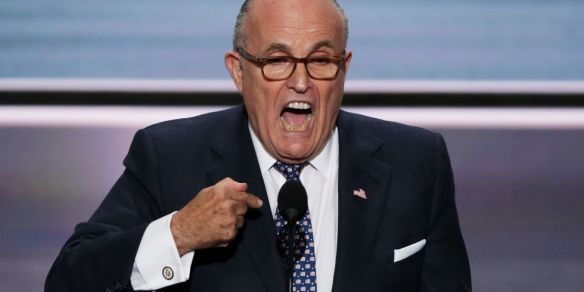
landscape-1468977724-rudy-giuliani

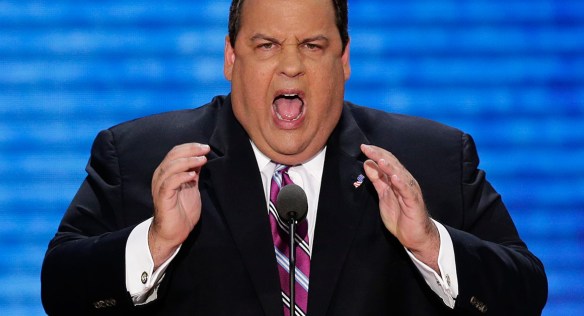
New Jersey Governor Chris Christie addresses the Republican National Convention in Tampa, Fla., on Tuesday, Aug. 28, 2012. (AP Photo/J. Scott Applewhite)

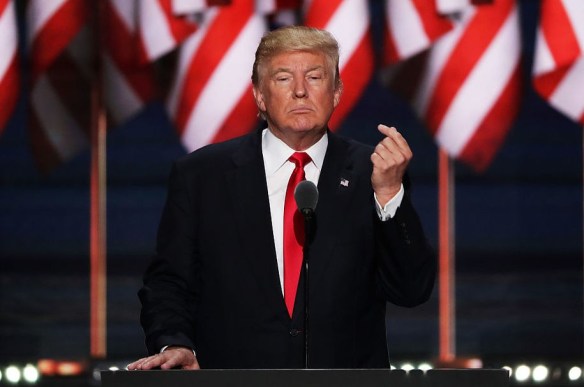
screen-shot-2016-07-21-at-50548-pm-1469135314

The Republican Party, Rush Limbaugh, Fox News, they all gave birth to Trump. Now we all have to get off our asses and vote a straight Democratic ticket in November. A Democratic President and a Democratic Congress are the only way to get our government working again and, therefore, the only way to stop the fire from spreading.

Because, yes, it could happen here.Â