Political Polarization and Us

The Pew Research Center has issued a study on America’s increasing political polarization. There’s been the usual disagreement about what the study really means, but it’s clear that Democrats and Republicans have moved further apart in recent years. And it shouldn’t be a surprise that 82% of “consistent liberals” say they believe in compromise, compared to 32% of “consistent [so-called] conservatives”.

Norman Ornstein discusses the Pew findings at The Atlantic. He’s absolutely right that Republican politicians and their media colleagues are most to blame for the increasing polarization of recent years, and that Democratic voters moving further to the left has mainly been a reaction to the increasingly insane behavior of the right.

He also responds to the notion that both sides are equally to blame:

Does it matter whether the polarization, and the deep dysfunction that follows from it, is equal or not, including to the average voter? The answer is a resounding yes. If bad behavior—using the nation’s full faith and credit as a hostage to political demands, shutting down the government, attempting to undermine policies that have been lawfully enacted, blocking nominees not on the basis of their qualifications but to nullify the policies they would pursue, using filibusters as weapons of mass obstruction—is to be discouraged or abandoned, those who engage in it have to be held accountable.

Saying both sides are equally responsible, insisting on equivalence as the mantra of mainstream journalism, leaves the average voter at sea, unable to identify and vote against those perpetrating the problem. The public is left with a deeper disdain for all politics and all politicians, and voters become more receptive to demagogues and those whose main qualification for office is that they have never served, won’t compromise, and see everything in stark black-and-white terms.

One solution to this problem might be to elect Democratic demagogues who won’t compromise, if we could find enough of them to make a difference. But a government composed of politicians on the left and right who won’t compromise would be even more dysfunctional than the government we already have.

That seems to leave electing more reasonable people as the best solution, so many reasonable people that the nuts can’t gum up the works. Until we have a Democratic President, a Democratic majority in the House and a Democratic supermajority in the Senate, we’re probably screwed. And even then we’ll have to worry about the damn Supreme Court.

(PS — So it was a hiatus after all.)

Analyzing Barack Obama

With less than three years remaining in his second term, President Obama has had three major accomplishments: he moved America closer to universal healthcare; he guided the country through the final months of the 2007-2009 financial crisis, keeping the American automobile industry functioning in the process; and he kept the White House out of Republican hands. He also cut the federal deficit by more than 50% — from 9.8% of Gross Domestic Product at the end of 2009 to 4.1% at the end of 2013 — but since it’s a bad idea to reduce the federal deficit when the economy is weak, that doesn’t really qualify as an accomplishment.

Clearly, the rabid Republican opposition in Congress has made it difficult for Obama to accomplish more, but it’s reasonable to ask whether a more gifted politician could have done better. In an article from TomDispatch reprinted at Salon, David Bromwich argues that Obama has accomplished too little because he views himself as “something like a benevolent monarch — a king in a mixed constitutional system, where the duties of the crown are largely ceremonial”.

According to Bromwich, Obama thinks that merely stating his preferences, calmly and eloquently, should be enough to lead the country away from polarization toward rational compromise, without his having to get his hands dirty making deals and confronting the opposition. It should work in the White House because it’s always worked before:

Extreme caution marked all of Obama’s early actions in public life….The law journal editor without a published article, the lawyer without a well-known case to his credit, the law professor whose learning was agreeably presented without a distinctive sense of his position on the large issues, the state senator with a minimal record of yes or no votes, and the U.S. senator who between 2005 and 2008 refrained from committing himself as the author of a single piece of significant legislation: this was the candidate who became president in January 2009.

It’s a good analysis, although it might be difficult to read if you’ve ever been one of the President’s big fans. I didn’t have that problem, because back in 2008, I voted for Hillary.

(Whether she lives up to her promise, we’ll probably find out starting in 2017.)

Republicans and Liberty, Part 3 (It’s Doubled in Size!)

Having pondered the difference between so-called “civil” and “economic” libertarians for a few days now, and having analysed the issue summaries on Senator RP’s website beyond all reason, it’s now time for a few thoughts on the type of libertarians who tend to gravitate toward the Republican Party.

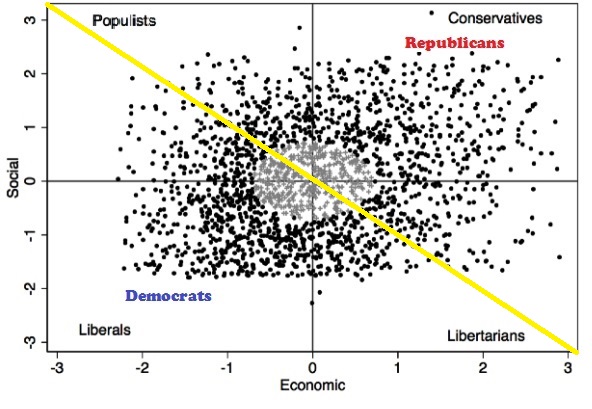
A few months ago, I posted the chart below, which was borrowed without permission from some political scientists who have studied the political ideologies of American voters.

Voters (the little dots) in the two rectangles on the left side of the chart are left-wingers on economic issues, e.g., in favor of increasing the minimum wage. Voters in the rectangles on the right side, however, are right-wingers on those issues, e.g., against increasing the minimum wage.

Going in the other direction, voters in the top rectangles are right-wingers on social issues, e.g. most likely against gay marriage. Those in the bottom two boxes are left-wingers on those issues, e.g. favoring gay marriage. (It’s a known fact that life is much simpler if you diagram it using x and y coordinates.)

Dems and Reps pops yellow

Now, however, the chart has some color to represent people who tend to vote for Democrats and those who tend to vote for Republicans. (Another interruption: did whoever picked blue for Democratic states pick that color instead of red — the traditional color of the left — because red would have suggested Democrats are a bunch of commies?)

Since we’ve only got two big political parties, the populists and libertarians who want to participate in elections often end up choosing between Democratic and Republican candidates. As a rule, the populists and libertarians to the right of the yellow line will vote for Republicans, while the populists and libertarians to the left of the yellow line will tend to vote for Democrats. In similar fashion, people who run for public office will generally join the Democratic or Republican party, depending on the relative strength of their various social and economic beliefs (putting aside any tactical reasons for running in one party or the other).

To use the standard terminology, the left-of-the-yellow-line libertarians tend to be “civil” libertarians (maybe even members of the ACLU), while the right-of-the-yellow-line libertarians tend to be “economic” libertarians (maybe they donate to the Cato Institute). 

Unfortunately, aside from allowing me to play with this great chart, the only point of this discussion so far is to emphasize that there are degrees of commitment to the four political ideologies the chart represents. Someone like Senator RP, for example, who is known for his libertarian tendencies, decided at some point to identify himself as a Republican, apparently because his left-wing, social, civil libertarian views (of which he seems to have some) were weaker than his right-wing, economic libertarian views (of which he definitely has some).

All of which serves, finally, as preface to some general remarks about Republican-leaning economic libertarians (which I’ve reorganized as Part 4, because Part 3 doubled in size, even corrected for inflation).

The New Deal and the Same Old Deal

For those of us under 80 or so, the New Deal was basically President Franklin Roosevelt using the federal government in creative ways to address the Great Depression, which wasn’t fully tamed until World War II began, government spending rose even further and lots of working-age men joined the armed forces (there were 450,000 Americans in the military in 1940 and 12.5 million in 1945).

A recent book, Fear Itself: The New Deal and the Origins of Our Time, tells the story but leaves Roosevelt in the background. The New York Review of Books has a fairly long but excellent review by Nicholas Lemann, a professor of journalism at Columbia University, here. 

The author of Fear Itself is Ira Katznelson, a professor of political science and history, also at Columbia. According to the review, Katznelson considers the national legislature to be the most central political institution in a democracy. For that reason, he presents an account of the New Deal and its aftermath that pays little attention to Presidents Roosevelt and Truman:

Katznelson has no interest in their personal qualities or their methods of leadership. Instead his focus is on Congress and government agencies, and more broadly on political systems, voting, and interest groups. This gives Fear Itself the feeling of a fresh look at a familiar story.

In addition, Katznelson emphasizes the perilous situation the country faced in the 1930s. Germany and Italy had reacted to the Great Depression by turning to fascism. The diplomat George Kennan believed America’s government should become authoritarian. The respected journalist Walter Lippmann told President Roosevelt that he might have to become a dictator. New Deal policies were enacted in “an atmosphere of unremitting uncertainty about liberal democracy’s capacity and fate”.

Becase Katznelson focuses on Congress, the South has a major role in the story he tells. Since the Civil War, the South had been firmly Democratic. In the 1932 election, Democratic congressional candidates received 86% of the vote in the South. After that election, more than half of the committee chairmen were southern Democrats. As a result, Roosevelt needed southern support in order to get anything through Congress:

The South used its power to create de facto regional exceptions to many New Deal policies, either by exempting domestic and agricultural workers (meaning blacks) from them, or by placing administrative and policy control of them in the hands of state governments. To use the most obvious example, the 1935 law that created the Social Security system had both of these features...

It was specifically the South that blocked … the possibility of the New Deal’s moving further left in its policies. The New Deal wound up largely achieving one set of goals—an American welfare state, including retirement security and an empowered labor movement—but stopped far short of another, which would have involved creating, through democratic procedures, a more centrally planned economy….

It was Congress that blocked national planning, for reasons having to do with the southern bloc’s overriding concern with maintaining the regional racial order. The South, in Katznelson’s view, was willing to move left on economic issues as long as that didn’t threaten segregation. When economic policy and race began to seem intertwined, the South opted out on economic policy, and that defined the leftward boundary of the New Deal.

Reading this should remind us how little has changed since then. Much of our politics is the same old deal it’s always been. Since the compromise that resulted in slaves being counted as 3/5ths of a person in the Constitution, America has been politically divided between the North (now including western states like California) and the South (now including northern states like Idaho and Wyoming). 

Of course, after the passage of the Civil Rights Act in 1964 and the Voting Rights Act in 1965, the South switched to voting Republican. But progressive federal policies are still being watered down in order to accommodate southern sensibilities. For example, the Affordable Care Act allowed individual states, especially in the South, to avoid expanding Medicaid, thereby limiting benefits to poor people and low-paid workers (including, of course, poor and low-paid blacks).

Professor Lehmann, the author of the review, highlights other ways in which southern “conservatives” have affected federal policy since the New Deal: by supporting our entry into World War II (Southern politicians tend to favor the military and military activity); by encouraging the creation of our national security state (internment of the Japanese, loyalty oaths, FBI surveillance, the creation of the CIA and the House Un-American Activities Committee); by voting for a “defense” budget that has continued to grow even in peacetime; and by making life difficult for labor unions and people who want to vote.

For example, given the Republicans’ recent attacks on voting rights, this passage from the review is especially striking:  

Katznelson also reminds us that whites as well as blacks were substantially disenfranchised in the South, because of poll taxes. Voter turnout was shockingly low in the South—below 20 percent of eligible (meaning mainly white) voters, for example, in Georgia, Mississippi, Alabama, and South Carolina in the crucial presidential election of 1940. In the 1938 midterm elections, Mississippi, with a population of more than two million, had only 35,000 voters. 

There are few activities more troubling in a democracy than intentionally limiting the size of the electorate, although that’s now standard Republican policy, especially in the South.

Professor Lehmann thinks that the South described by Professor Katznelson is too homogeneous. Lehmann argues that there have been significant differences between Southern politicians regarding civil rights and economic issues. Nevertheless, if you want to understand where America is today, Lehmann’s review of Katznelson’s book is terrific reading. So, probably, is the book. 

(A personal note: when I was in college, I read something by a black author who claimed that the status of black people has been the central issue in the history of our country. Unfortunately, I haven’t been able to find the quotation or even identify the author. But I remember reading that statement some 40 years ago and being highly skeptical. The more I learn about American history, however, the more I’ve come to agree.)
Score 1 for United Government

Something I wrote a few days ago has piqued the interest of a supporter of “divided” government (see We Should Expect Divided Government for a Long Time and associated comments below).

Coincidentally, I just read about President Lincoln addressing Congress after the attack on Fort Sumter. Lincoln had raised a volunteer army to defend the Union, but without Congressional approval, since Congress was out of session and not due back for months. He summoned Congress back for a summer session and made his case (I’m quoting from The Man Who Saved the Union by H. W. Brands):

“These measures, whether strictly legal or not, were ventured upon under what appeared to be a popular demand and a public necessity, trusting then as now that Congress would readily ratify them” He requested authority to expand the army to 400,000 men at a cost of 400 million dollars. “A right result, at this time, will be worth more to the world than ten times the men and ten times the money…”

“This issue embraces more than the fate of these United States. It presents to the whole family of man the question whether a constitutional republic, or a democracy – a government of the people, by the same people – can, or cannot maintain its territorial integrity against its domestic foes… Must a government, of necessity, be too strong for the liberties of its own people, or too weak to maintain its own existence?… It is now for them to demonstrate to the world that those who can fairly carry any election can also suppress a rebellion.”

Since the Democratic Party’s Southern wing had disappeared (i.e. joined the Confederacy) and its Northern wing had lost its leader (Stephen Douglas had recently died of typhoid fever), the Republicans now had a large majority in both houses. Congress immediately ratified Lincoln’s previous actions and approved his request for more men and money. In fact, they voted for 500,000 men and 500 million dollars, more than Lincoln asked for.