Facing the Truth about American Politics

Chris Hayes of MSNBC summed it up tonight:

Today, [House Minority Leader] Kevin McCarthy made a deeply humiliating, almost too awful to watch pilgrimage down to Mar-a-Lago to kiss the ring of the twice-impeached, possibly soon-to-be-indicted ex-president. Because there is no line to cross that goes too far for him or for them or for the party. This is where we are, folks, this is what everyone has to acknowledge. There will be no self-regulation. No self-governance. No, “Did we go too far?” No mea culpas. There will be no growth. This is what the contemporary Republican Party and conservative movement right now is, so now the question is, the question becomes “What do you do with that?” There are people like that who are part of the government of this country, who believe what they believe.

Paul Krugman expanded on the topic:

Here’s what we know about American politics: The Republican Party is stuck, probably irreversibly, in a doom loop of bizarro. If the Txxxx-incited Capitol insurrection didn’t snap the party back to sanity — and it didn’t — nothing will.

What isn’t clear yet is who, exactly, will end up facing doom. Will it be the [Republican Party] as a significant political force? Or will it be America as we know it? Unfortunately, we don’t know the answer. It depends a lot on how successful Republicans will be in suppressing votes.

Even I had some lingering hope that the Republican establishment might try to end Txxxxism. But such hopes died this week.

On Tuesday Mitch McConnell, the Senate minority leader, who has said that [the ex-president’s] role in fomenting the insurrection was impeachable, voted for a measure that would have declared [an impeachment] trial unconstitutional . . . 

On Thursday, the House minority leader — who still hasn’t conceded that Joe Biden legitimately won the presidency, but did declare that Txxxx “bears responsibility” for the attack on Congress . . . — visited Mar-a-Lago, presumably to make amends.

In other words, the G.O.P.’s national leadership, after briefly flirting with sense, has surrendered to the fantasies of the fringe. Cowardice rules.

And the fringe is consolidating its hold at the state level. The Arizona state party censured the Republican governor for the sin of belatedly trying to contain the coronavirus. The Texas G.O.P. has adopted the slogan “We are the storm,” which is associated with QAnon, although the party denies it intended any link. Oregon Republicans have endorsed the completely baseless claim, contradicted by the rioters themselves, that the attack on the Capitol was a left-wing false flag operation.

How did this happen to what was once the party of Dwight Eisenhower? Political scientists argue that traditional forces of moderation have been weakened by factors like the nationalization of politics and the rise of partisan media, notably Fox News.

This opens the door to a process of self-reinforcing extremism . . .  As hard-liners gain power within a group, they drive out moderates; what remains of the group is even more extreme, which drives out even more moderates; and so on. A party starts out complaining that taxes are too high; after a while it begins claiming that climate change is a giant hoax; it ends up believing that Democrats are Satanist pedophiles.

This process of radicalization began long before Dxxxx Txxxx; it goes back at least to Newt Gingrich’s takeover of Congress in 1994. But Txxxx’s reign of corruption and lies, followed by his refusal to concede and his attempt to overturn the election results, brought it to a head. And the cowardice of the Republican establishment has sealed the deal. One of America’s two major political parties has parted ways with facts, logic and democracy, and it’s not coming back.

What happens next? You might think that a party that goes off the deep end morally and intellectually would also find itself going off the deep end politically. And that has in fact happened in some states. Those fantasist Oregon Republicans, who have been shut out of power since 2013, seem to be going the way of their counterparts in California, a once-mighty party reduced to impotence in the face of a Democratic supermajority.

But it’s not at all clear that this will happen at a national level. True, as Republicans have become more extreme they have lost broad support; the G.O.P. has won the popular vote for president only once since 1988, and 2004 was an outlier influenced by the lingering rally-around-the-flag effects of 9/11.

Given the unrepresentative nature of our electoral system, however, Republicans can achieve power even while losing the popular vote. A majority of voters rejected Txxxx in 2016, but he became president anyway, and he came fairly close to pulling it out in 2020 despite a seven million vote deficit. The Senate is evenly divided even though Democratic members represent 41 million more people than Republicans.

And the Republican response to electoral defeat isn’t to change policies to win over voters; it is to try to rig the next election. Georgia has long been known for systematic suppression of Black voters . . . the Republicans who control the state are doubling down on disenfranchisement, with proposed new voter ID requirements and other measures to limit voting.

The bottom line is that we don’t know whether we’ve earned more than a temporary reprieve. A president who tried to retain power despite losing an election has been foiled. But a party that buys into bizarre conspiracy theories and denies the legitimacy of its opposition isn’t getting saner, and still has a good chance of taking complete power in four years.

Three more items:

Pennsylvania G.O.P. leaders have made loyalty to the defeated ex-president the sole organizing principle of the party, and would-be candidates are jockeying to prove they fought the hardest for him (NY Times).

After an election filled with misinformation and lies about fraud, Republicans have doubled down with a surge of bills to further restrict voting access in recent months, according to a new analysis . . .  There are currently 106 pending bills across 28 states that would restrict access to voting (The Guardian).

Arizona G.O.P. lawmaker introduces bill to give Legislature power to toss out election results (NBC News).

With the presidency and small majorities in the House and Senate, Democrats have an opportunity to deliver on many of their campaign promises, not just a few. That will almost certainly require ending or severely limiting the ability of the Republican minority in the Senate to kill legislation. If Democrats don’t have the foresight and courage to do that, we may be facing a very bleak future.
If You Ever Hear Anybody Say There’s No Difference Between Them

Ordinarily, Democrats and Republicans adopt a platform at their national conventions, setting forth the goals and priorities of their presidential nominee. This is one way for voters to compare the candidates and decide who to support. Last year, the Republicans didn’t really bother to produce a platform. They simply endorsed the platform from 2016:

RESOLVED, That the Republican Party has and will continue to enthusiastically support the President’s America-first agenda;

RESOVLVED, That the 2020 Republican National Convention will adjourn without adopting a new platform until the 2024 Republican National Convention;

RESOLVED, That any motion to amend the 2016 Platform or to adopt a new platform, including any motion to suspend the procedures that will allow doing so, will be ruled out of order.

In other words, we are in favor of whatever the president wants to do, whatever that might turn out to be. Four years have passed, we’re in the middle of a deadly pandemic and we have nothing new to say about anything.

This week, a new Republican congressman from North Carolina sent an email to his colleagues. It said “I have built my staff around comms [“communications”] rather than legislation”. He now has a job in our national legislature, but he’s more dedicated to doing interviews and issuing statements than being a legislator. The editors of The Charlotte Observer aren’t enthusiastic about their state’s new representative:

We’re all for public officials being attentive to the “public” part of their title. It’s good for everyone when elected representatives explain what they’re doing and why they’re doing it. But on behalf of a whole lot of North Carolinians, we have a request regarding one of those officials:

Can someone please keep Madison Cawthorn away from the cameras? And the microphones? And really, most situations in which he publicly tries to turn words into meaningful thoughts?

This is the context when Republican politicians demand that President Biden address some of their priorities. The natural question is: What priorities?

Jennifer Rubin of The Washington Post expands on the difference between the two parties:

The Biden administration has entered office with a whirlwind of activity. “Whole government” initiatives and executive orders on racial inequality and climate change are married with an ambitious covid-19 relief plan. There are briefings galore, with both experts and White House press secretary Jennifer Psaki, who on Wednesday gave us a peek into the sort of salesmanship the administration is employing to gain bipartisan support. The president, the vice president, the director of the National Economic Council, the domestic policy director, the chief of staff and the legislative affairs team are talking to individual lawmakers, the Problem Solvers Caucus, relevant committee members, mayors, governors and more to seek consensus on a covid-19 plan. There is no room for downtime, let alone complacency in this White House.

To many, it is stunning to see such energy, urgency and activity coming from the White House. Whereas Republicans are loath to even acknowledge crises for fear of indicting their own former president’s performance, Democrats have plans, executive orders and bills to address dozens of problems, not to mention a fleet of nominees waiting to get started.

And what are Republicans doing? Well, over in the Senate, Minority Leader Mitch McConnell (R-Ky.) took days to agree on an organizing resolution to get the new session underway. The vast majority of Senate Republicans said they do not want to have a trial to hold the instigator of a violent insurrection accountable. . . . They are stalling on the confirmation of a new homeland security secretary. They have no alternative relief package for covid-19. Most of their time seems to be absorbed whining about “censorship” or claiming Democrats are being “divisive.” They are offering no response to any of the multiple crises we face (e.g., climate change, the economy, health care, racial justice, domestic terrorism). Their “big idea” is to wait and see if the pandemic and economy get worse.

For years, the Republican Party has not been about policy or governance. It is certainly not about encouraging voting or expanding its party to reach new demographics. Instead, it has become a select club of malcontents. It has created a self-perpetuating grievance machine designed to further inflame their base.

Why do Republicans even want to hold power? Aside from appointing judges, the Senate has accomplished virtually nothing of significance since the 2017 tax cut. While running for reelection, the former president was continually stumped when asked what he would do in his second term.

The party’s antagonism toward the federal government has now morphed into hostility toward truth and governing at all. Its agenda is a list of buzzwords and lies to justify why it should do nothing (Climate hoax! Socialism!), culminating in the mother of all incendiary messages: the Big Lie that the election was stolen. The GOP seems to exist solely to promote resentment and to engage in performance art for intellectually dishonest and vapid right-wing media.

Maybe Republicans should give up running for office altogether because they have no interest in policy or governing. They can cut out the time-consuming task of showing up for their day jobs and devote all their time to what really drives them — raising money, stoking anger, tweeting and appearing on right-wing media. . . .

Go Big or Go Home

Eric Levitz of New York Magazine on the choice facing the Democratic Party:

The Electoral College now has a four-point pro-[Republican] bias, meaning that if Biden [or whoever] wins the two-way popular vote by “only” 3.9 percent in 2024, he will have a less than 50 percent chance of winning reelection, and (2) the Republican Party has grown more openly contemptuous of democracy since Txxxx’s defeat. If the GOP does gain full control of the federal government in 2024, there is a significant risk it will further entrench its structural advantages through anti-democratic measures, so as to insulate right-wing minority rule against the threat of demographic change.

To defy political gravity, and fortify U.S. democracy against the threat of authoritarian reaction, Democrats need to either rebalance the electoral playing field through the passage of structural reforms, or attain a degree of popularity that no in-power party has achieved in modern memory. If the filibuster remains in place, doing the former will be impossible and the latter highly unlikely.

The Constitution limits the Democrats’ capacity to correct the biases of America’s governing institutions. But the party could significantly reduce the overrepresentation of white rural America in the Senate by granting statehood to the District of Columbia, Puerto Rico, and any other U.S. territory that wants it. The party could also prohibit partisan redistricting, ban felon disenfranchisement, erode practical barriers to the political participation of working-class people and immigrants, make it easier for workers to form unions, grant citizenship to 11 million undocumented immigrants, and pack the Supreme Court if it interferes with the implementation of these reforms.

But none of those measures are going to attract ten Republican votes in the Senate. And none of them are achievable through the budget-reconciliation process.

If Democrats do not pass structural reforms, their odds of retaining both chambers of Congress in 2022 aren’t good. The president’s party almost always loses seats in midterms. . . .

All this said, Democrats could have some extraordinary winds at their back. Biden has a decent shot of presiding over a post-pandemic economic boom. To the extent that Democrats can juice that recovery with further growth and wage-boosting measures — while maintaining the enthusiasm of their core interest groups — they may pull off the unprecedented in 2022.

But it’s hard to see how the party can do that while leaving the filibuster fully intact. Democrats will be incapable of honoring their (now decade-old) IOUs to civil-rights organizations, labor unions, and immigrant communities if they allow the Senate’s 60-vote threshold to remain in place. . . .

In the immediate term, the Democrats’ internal conflict over the filibuster will move to the backburner. Joe Biden’s COVID-relief package and green-infrastructure “recovery” plan consist primarily of tax-and-spending measures that the party can advance through the budget-reconciliation process. And Schumer has signaled that he intends to bend the rules of that process as far as the Senate parliamentarian will let him, arguing that both a ban on new vehicles with internal-combustion engines and a $15 minimum wage are actually, primarily means of reducing government spending, when you really think about it.

But once reconciliation is done, attention will turn to the large stack of Democratic-coalition priorities that are currently subject to a 60-vote requirement. It will not be easy for Schumer to tell the NAACP that his caucus values a “Senate tradition” (that is anti-constitutional, historically associated with Jim Crow rule, and less than two decades old in its present form) more than it values a new Voting Rights Act. Nor will it be easy for the majority leader to tell organized labor that it will just have to wait until next time to see a $15 minimum wage (assuming that doesn’t get through reconciliation) or collective-bargaining reform. And it might be hard for Schumer to accept that he probably won’t ever wield majority power again after 2022 because his caucus would rather maintain the GOP’s structural advantage in the upper chamber than abolish the filibuster and add new states.

For these reasons, Schumer, Senate Democrat Whip Dick Durbin, and Delaware senator (and Biden confidant) Chris Coons have all telegraphed an intention to eliminate the filibuster if McConnell obstructs their coalition’s priorities. The apparent hope is that — while Manchin, Sinema, and a few others support the filibuster in the abstract — in the heat of a legislative battle over voting rights or a $15 minimum wage, they may consent to weakening the filibuster while lamenting what Mitch McConnell is making them do.

Sinema and Manchin have repeatedly insisted that they will not “eliminate” or “get rid of” the filibuster. But there are plenty of ways to erode the Senate’s 60-vote requirement that stop short of filibuster abolition. You could create new exemptions, modeled on budget reconciliation, that allow for the passage of certain categories of legislation by simple majority vote. Or you could restore the requirement for those mounting a filibuster to speak continuously from the Senate floor. Or you could throw every Democratic priority into a reconciliation bill and then let Kamala Harris overrule the parliamentarian when she objects.

But Manchin & Co.’s cooperation with this scheme is far from assured. The Democratic Party has a vital interest in passing sweeping reforms that gratify its base and mitigate its structural disadvantages. But Joe Manchin doesn’t necessarily have an interest in the institutional health of the Democratic Party.

Our Republic’s founders famously disdained political parties. And partisanship is a pejorative in contemporary American discourse. But our democracy’s present affliction lies in the weakness of its parties, not in their strength. Were the GOP a stronger institution, the Txxxx presidency would never have happened. Were the Democratic leadership capable of formulating and enforcing a party line, the filibuster would not be long for this Earth.

While the Constitution failed to stymie the advent of political parties, it has kept them weaker than their overseas analogs. The Democratic Party is more of a loose association of elected officeholders than a coherent mass-member organization. As such, it has limited capacity to dictate terms to any of its incumbent senators, let alone to those whose job security would be enhanced by becoming Republicans. . . .

Thus the Democrats’ existential interest in eroding the filibuster remains on a collision course with its moderate senators’ aversion to power. Anyone with a fondness for democracy must hope that, against all odds, the forces of partisanship will prevail.

It Has To Be Different This Time

Joe Biden’s proposed Covid-19 relief plan is a big deal. From Vox:

The proposal, called the American Rescue Plan, is divvied up into three buckets:

$400 billion for dealing with the coronavirus, including vaccines and testing;

$1 trillion in direct relief to families; and

$400 billion in aid to communities and businesses.

It includes money for testing, vaccines, and public health workers; $400 a week in extended federal unemployment insurance through September; rental assistance; emergency paid leave; and funding for reopening schools, among other items. And, as Democrats promised when campaigning in Georgia, Biden’s plan would send out another $1,400 in stimulus checks, bringing the total this year to $2,000.

Greg Sargent of The Washington Post discusses the relatively encouraging politics of the matter:

The sheer scale of the economic rescue package that Joe Biden has unveiled has surprised a lot of observers who were expecting the president-elect to offer something more in line with his centrist, incrementalist past.

In unveiling the new [roughly] $1.9 trillion package, Biden declared that rather than worry about “our debt situation,” it’s time to spend big “with interest rates at historic lows.” As Slate’s Jordan Weissmann put it: “I would not have anticipated that Joe Biden would become a clear and forceful advocate of deficit spending.”

What accounts for this ambition? Most obviously, this crisis is truly extraordinary. The new leadership must execute a massive vaccine-distribution operation amid a broader effort to tame a raging pandemic, while securing assistance to struggling Americans plus a big burst of stimulus spending to address a deepening economic crisis.

Another obvious answer is that the politics have shifted. The Democratic Party has moved left on fundamental economic questions, due in large part to advocacy from Sen. Bernie Sanders (I-Vt.), Sen. Elizabeth Warren (D-Mass.) and others.

But still another reason, one that has been less remarked-upon, is that many Democrats have lived through what happened when former president Barack Obama inherited another major economic crisis from another Republican president.

As has been endlessly hashed out, Obama opted for a stimulus that fell short of what was needed. Putting aside why that happened, what everyone now knows is that it was a serious mistake. Democrats lost the House in 2010 and spent the remainder of Obama’s presidency locked in brutal fiscal trench warfare with a GOP determined to starve the recovery with austerity to cripple his presidency under the guise of fake concerns about spending and deficits.

Many Democrats who lived through that, a lot of whom are still in Congress and some of whom are advising Biden — who himself lived through it as vice president — must be wary of a repeat.

Making them even more wary, one hopes, is the fact that Republican deficit concerns evaporated once a Republican became president. Indeed, the economy was good (at least until the coronavirus shattered it) precisely because it was fueled by stimulus.

As Neil Irwin reports, the Trump years have caused a change among economists, who are now more receptive to a hotter economy — with higher deficits and lower unemployment — and less wary of inflation than they traditionally have been. That has fueled a political shift toward tolerance of deficits, making Democrats less wary of bad-faith criticism for overspending.

But on top of that sea change, Democrats have to be feeling extra-burned by the fact that the GOP pivoted so abruptly from voicing phony deficit concerns under a Democratic president to not caring about them anymore under a Republican.

The lesson of those years is that Txxxx the political beneficiary of that chicanery. He consistently had high approval ratings on the economy, and he might have won reelection on the strength of that if the coronavirus hadn’t intervened.

Democrats appear to be learning from that lesson right now.

On still another front, the makeup of the Senate Democratic caucus is different. During the Obama years you had centrist old-liners chairing key committees . . . Expected to chair those respective committees in the new Senate now are Ron Wyden of Oregon, Sanders, and Sherrod Brown of Ohio. All are far more progressive than those previous Democratic chairs. . . .

Wyden, for his part, believes this combination of things — an awareness of getting played by phony GOP deficit concerns and more progressive Senate committee chairs — will make this time very different from 2009 and 2010.

“The key lessons we learned were the importance of not assuming there will be multiple bites at the apple and not taking your foot off the gas in the middle of economic recovery,” Wyden told me in a statement. “We cannot let a popular recovery agenda get derailed by fiscal fearmongering that we know is unjustified and phony.”

“Committee chairs are going to be aggressive, and want to get things done,” Wyden added. “Overall, I think the dynamics have changed a lot since 2009.”

To be sure, it still remains to be seen how big a package Biden will actually wrest from Congress. He has already announced he hopes to pursue bipartisan support in the Senate rather than try to get the legislation passed with a simple majority via the “reconciliation” process.

So it’s still possible that Biden could end up on a futile hunt for Republican support or end up compromising his stimulus package downward. But there is at least some reason for optimism that Democrats have learned from what happened last time. . . .

Fear vs. the White Male Effect

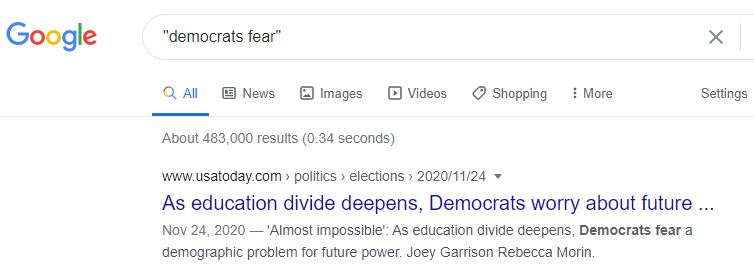
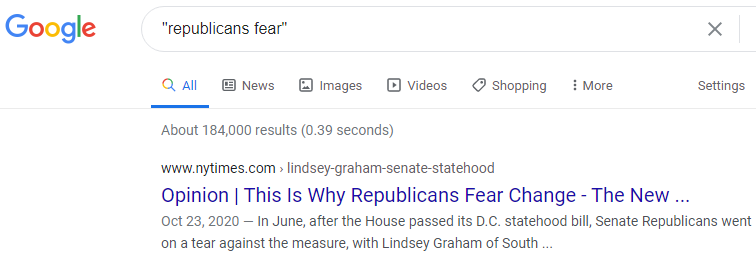
There was a story in the news a little while ago about a Democrat or two fearing that impeaching our criminal president again would cause more division in our beleaguered nation. So I decided to do a small, very unscientific study of a possible difference between Democrats and Republicans. My hypothesis was that Democrats are often said to be afraid of something, while Republicans rarely are. Here are the results (which may be hard to see, so I’ll summarize them below):

UntitledUntitled2

Google came back with 483,000 results for “democrats fear” but only 184,000 results for “republicans fear”. That’s an impressive difference.

To rule out the possibility that Google simply has more results about Democrats, I did another search. I compared “democrats refuse” and “republicans refuse” (simply because Republicans seem to say “no” a lot).

Untitled23Untitled234

As you may be able to see, there were equally striking results. There were 86,000 results for “democrats refuse” and 314,000 for “republicans refuse”. 

What does this tell us about the two parties? I’m not sure. Maybe Democrats are more concerned about consequences than Republicans are. They probably worry more. They are certainly more open to compromise, i.e. less likely to refuse. 

This brings me to two relevant articles. The first describes a significant difference between White men and everybody else. It’s called “The Science That Explains Trump’s Grip on White Males”:

Cognitive scientists long ago coined a term for the psychological forces that have given rise to the gendered and racialized political divide that we’re seeing today. That research, and decades of subsequent scholarly work, suggest that if you want to understand the Txxxx phenomenon, you’d do well to first understand the science of risk perception.

[In 1994] a group of researchers . . .  published a study that asked about 1,500 Americans across the country how they perceived different kinds of risks, notably environmental health risks. [They] found that White males differed from White women and non-White men and women in how they perceived risks. For every category of threat, White men saw risk as much smaller and much more acceptable than did other demographic groups. This is what they dubbed “the White male effect”. They also found that White women perceived risks, across the board, to be much higher than White men did, but this was not true of non-White women and men, who perceived risk at pretty much the same levels. . .  Eventually, expansions of this study would include a wide range of risks including handguns, abortion, nuclear threat, and capital punishment.

The perception of risk, of course, relates to fear. Where there is no risk, there is nothing to fear. There is scientific evidence, therefore, that Republicans (who tend to be White men) are less fearful than Democrats (who tend to be women and non-White).

The second article is “The Democrats’ Stark, Historic Choice”. The author argues that Democrats need to rise above their fears if we’re going to preserve (what remains of) our democracy:

For all the cant we’ll soon be drowned in about the soul of the nation and healing, the Democratic Party and the country now face what is ultimately a problem of public policy. Today, less than half our population controls 82 percent of the Senate’s seats. By 2040, given current demographic trends, the most conservative third of the country alone will control nearly 70 percent of its seats. All of this amounts to a permanent and growing advantage for a party whose leaders greeted the president with applause at its winter meeting after Wednesday’s attack.

The Democrats will soon have the presidency. They will have the House of Representatives. By the skin on the skin of their teeth, they will have the Senate. They will, in sum, be entering into an alignment of power in Washington that we have every reason to believe is becoming exceptionally rare. And every actor within that trifecta will have a choice to make. Should a party that mounted a crusade against a legitimate election and the democratic process—a party whose rhetoric has killed—continue to accrue structural power? Or should the Democratic Party work to curb it? 

The author goes on to argue that Democrats need to overcome their fear of institutional change and take aggressive advantage of their fragile Congressional majority. The legislative filibuster should be eliminated in order to pass a full restoration of the Voting Rights Act, expand the franchise, grant statehood to Washington, D.C., and Puerto Rico, and reform the Supreme Court.

As always, the Republicans will refuse to accept small-“d” democratic reforms. The Democrats shouldn’t fear doing whatever they can to achieve them.