We Need to Pay Attention, But That’s Not All

Senator Bernie Sanders was in Iowa at Drake University a few weeks ago. This paragraph from an account of his visit caught my eye:

At first it was unclear who the bigger enemy of the people were to Sanders — the Kardashians or the Koch brothers.  The Kardashians, or rather our public fascination with them, represents America’s apathy. Sanders was clear that nothing progressive can happen until people start paying attention.  Sanders told his audience that Americans are getting screwed, and that we had better pay attention and get off our asses.

What the Senator said about paying attention brings to mind one of his colleagues, Senator Elizabeth Warren. The journalist Matthew Yglesias wrote this about her under the heading “What Makes Elizabeth Warren So Great”:

At Janet Yellen’s monetary policy hearing, Warren took aim at the Federal Reserve’s General Counsel, Scott Alvarez. Alvarez is one of the people with the highest importance-to-fame ratios in the whole American government. His existence — to say nothing of his work — is incredibly obscure. But Warren used her considerable celebrity and her dorky charisma to shine a light on it.

And she has a unique knack among today’s elected officials for seizing on things that are languishing in obscurity and making them blow up. The greatest trick the special interests ever played was getting the world to stop paying attention. Warren makes people pay attention, and it’s great.

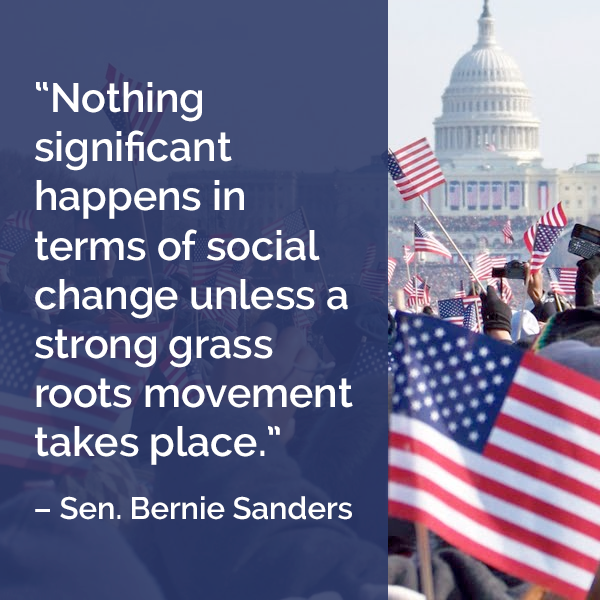
Senator Warren is terrific. We need more politicians who speak truth to power and are heard when they speak. But Senator Sanders makes a key point in an image on his Facebook page:

996123_10153117955982908_1042319750649523248_n

We need to both pay attention and get organized.

A Few Reasons We’re Getting Screwed

It’s one thing to get screwed. It’s another thing to know why. From recent reading:

Instead of raising wages, hiring more workers or investing in research and new equipment, corporations are increasingly accumulating cash and buying their own stock. This raises the corporation’s stock price, enriching the people in charge (who receive much of their compensation in the form of stock and stock options) and shareholders (who tend to be the wealthiest among us), but does little to improve the lives of most Americans. Some statistics from The Atlantic‘s “Stock Buybacks Are Killing the American Economy”:

Over the past decade, the companies that make up the S&P 500 have spent an astounding 54 percent of profits on stock buybacks. Last year alone, U.S. corporations spent about $700 billion, or roughly 4 percent of GDP, to prop up their share prices by repurchasing their own stock.

Instead of doing something productive.

The Atlantic article is by Nick Hanauer, a very successful capitalist who acknowledges that inequality is a problem that needs to be addressed. A poorly-named article from Salon called “Let’s All Screw the 1 Percent” cites an article Hanauer wrote last year about overtime pay.

We all know that wages have stagnated for many workers or even declined when adjusted for inflation. In order to have the same buying power it had in 1968, the federal minimum wage would have to be raised from $7.25 to almost $11.00 (see this attempt at myth-busting from the Department of Labor). What isn’t as well-understood and what Hanauer pointed out is that millions of workers would and should be receiving overtime pay, even though they aren’t paid by the hour (declaring workers to be “exempt” and giving them a salary is, of course, a great way to force people to work long hours without extra compensation). From the Salon article by Paul Rosenberg:

…there’s a wage level below which everyone qualifies for mandatory time-and-a-half overtime, even if they’re on a salary, and that level has only been raised once since 1975, with the result that only 11 percent of salaried Americans are covered today, compared to over 65 percent of them in 1975. If you make less than $23,660 a year as a salaried worker, you qualify for mandatory overtime—if not, you’re out of luck.  … Just adjusting the wage level for inflation since 1975—an act of restoration, not revolution—would be as significant an income increase for millions of middle-class Americans as a $10.10 or even $15 minimum wage is for low-wage workers.  It would cover an additional 6.1 million salaried workers (by one account) up to $970 per week, about $50,440 annually—the vast majority of those it was originally designed to protect, but who have slowly lost their protections since the 1970s. Hanauer proposes a slightly greater increase, intended to cover roughly all the workforce that was covered in 1975. That would raise the threshold to $69,000 annually, and would cover an added 10.4 million workers.

What was also surprising to me is that the President can raise the $23,660 threshold without the approval of Congress. Last year, in fact, President Obama promised to do just that. This website for Human Resources specialists predicts that the threshold for overtime pay will be increased in 2016, but only to around $45,000 (they also predict that the rules for declaring an employee to be “exempt” will be tightened, making more workers eligible for overtime pay).

In a related article at the Alternet site, a postal worker explains why the people delivering your mail during the week or a package from Amazon on Sunday may not look as official as they used to (jeans and a sweatshirt seem to have replaced those blue uniforms in my neighborhood). Paul Barbot says that he is a City Carrier Assistant:

City Carrier Assistants are a brand new classification of employee within the postal ranks; we are the low-wage, non-career, complement workforce at the USPS. Before [a 2013] reclassification, we were called Transitional Employees and made a respectable $23.52 hourly rate, only several dollars per hour less than what the average career employee made. But with the USPS management’s financial woes … a low-wage workforce was needed to help entice big business into choosing the postal service to partner up with. City Carrier Assistants now perform the same work they did when they were called [“Transitional Employees”], but now they get to do that work for 31 percent less pay ($16.68 per hour)….Newly hired CCAs will make even less —starting at $15 per hour.

Barbot argues that this lower-wage workforce helped the Postal Service and Amazon reach a “Negotiated Service Agreement” regarding special treatment for Amazon packages. 

And finally, The Guardian reports (no surprise) that:

Poor Americans are less likely to vote and more likely to distrust government, study shows… Political engagement, it appears, is a privilege for those who aren’t struggling to make ends meet…

while the right-wing Koch brothers, who aren’t struggling at all (not even with their consciences), plan to spend almost $900 million in 2016 in support of reactionary candidates, almost twice what they spent in 2012.
Is It Bad Enough Yet? Yes, It Is

“Is It Bad Enough Yet?” That’s a wonderful title for an article by Mark Bittman about where we are today:

The police killing unarmed civilians. Horrifying income inequality. Rotting infrastructure and an unsafe “safety net.” An inability to respond to climate, public health and environmental threats. An occasionally dysfunctional and even cruel government. A sizable segment of the population excluded from work and subject to near-random incarceration.

You get it: This is the United States, which, with the incoming Congress, might actually get worse….

The root of the anger is inequality, about which statistics are mind-boggling: From 2009 to 2012 (that’s the most recent data), some 95 percent of new income has gone to the top 1 percent…

Everything affects everything. It’s all tied together, and the starting place hardly matters: A just and righteous system will have a positive impact on everything we care about, just as an unjust, exploitative system makes everything worse….

When underpaid workers begin their strikes by saying “I can’t breathe,” or by holding their hands over their heads and chanting “Hands up, don’t shoot,” they’re recognizing that their struggle is the same as that of African-Americans demanding dignity, respect and indeed safety on their own streets….

Increasingly, it seems, there’s an appetite and even unity to take on the billionaire class. Let’s recognize that if we are seeing positive change now, it’s in part because elected officials respond to pressure, and let’s remember that that pressure must be maintained no matter who is in office. Even if Bernie Sanders were to become president, the need for pressure would continue.

“True citizenship,” says [Saru Jayaraman of U.C. Berkeley]— echoing Jefferson — “is people continually protesting.” Precisely.

So warmest congratulations to the fast food workers and Walmart employees demanding a living wage and to the thousands who have marched or stood silently in protest because black lives matter. It’s all connected.

And enough is enough. That’s what Senator Elizabeth Warren said this week. Listen to her talk about Citigroup’s stranglehold on the Federal government and why we need to break up the biggest banks. It’s only 10 minutes and it’s worth watching and sharing.

We can’t directly vote against Walmart or Citigroup, but we can boycott them. Don’t shop at Walmart until they institute a living wage and don’t use a Citigroup credit card or checking account until they’re small enough to fail, because, yes, it is bad enough. 

Political Postmortem and Forecast

Like many of us, I read some articles analyzing the recent election. None of them were very surprising. It was noted that, of the one-third of the electorate who voted, many were angry, scared old white people who don’t mirror the electorate as a whole and especially dislike our first black President; our midterm elections favor Republicans, and the electoral map was especially bad for Democrats this year; Americans insist on reelecting their own Senators and Representatives even though they hate Congress as a whole; the average voter is quite ignorant; negative advertising works; and 2016 will be better.

Of the articles I read, I thought this analysis by Andrew O’Hehir was worth sharing. It’s called “Democracy on the critical list: How do we escape this toxic political cycle?” After some painfully entertaining discussion of the election, O’Hehir concludes that “the upshot of all this is that nothing got done in the last Congress and nothing will get done in the next one, but this time the nothing will be a lot scarier to watch”.

He then asks:

Is there any plausible way out of this obsessive, recursive cycle, in which we can expect to see President Clinton 2.0 take office in January of 2017 with a feeble and ineffective Democratic majority, only to be punished for her feminist acts of treason by the resurgent angry white men in 2018, and so on, ad nauseam?

He considers four scenarios:

First, a charismatic, transformational leader will come along who can bring us together, much like some Democrats (apparently including Barack Obama himself) believed President Obama would do. You may remember this scenario from The Day the Earth Stood Still, in which the transformational leader came from another world.

THE_DAY_THE_EARTH_STOOD_STILL_SCREENSHOT_3

Second, the opposition will see the error of its ways and realize the other side was right all along. This is even less likely than scenario #1.

Third, our changing population will move our politics to the left. O’Hehir recognizes that American society is changing, but isn’t convinced our politics will change as a result. As more Hispanics do better economically, for example, they may move to the right. The same thing may happen with today’s younger voters as they grow older. (Personally, I wouldn’t rule this out. Politics tends to run in cycles and there may yet be a progressive reaction to the Age of Reagan.)

Fourth, some cataclysm will lead to the current system collapsing, leading to martial law, mass incarceration, revolution and so on. I think he’s joking when he mentions Senator Ted Cruz losing the Presidency and getting the South to secede. He also considers natural disasters and financial collapse. (One possibility he doesn’t mention is a really bad virus, like the one Obama was supposed to do something about. Its name eludes me.)

Instead of any of these alternatives, O’Hehir thinks it’s more likely that our democracy will simply fade away, as “tiny cadres of the ultra-rich squabble over control of the economy, [while] electoral politics is angrily contested over a narrow but contentious range of lifestyle issues, [driving] away all but the most committed culture warriors on either side….In due course the political stalemate between Republicans and Democrats stops mattering, stops existing and is gone with the wind”.

It’s hard to be optimistic about America’s future. O’Hehir certainly isn’t. The only answer I see is that more people have to start caring enough to pay attention to politics and actually vote. The system still allows for the government to represent the majority of Americans, but only if the majority of Americans wisely choose who their representatives will be.

To Vote Or Not To Vote – An Easy Question

I always vote and plan to keep voting until the Republicans find a way to stop me. It’s not that I think my single vote will make a difference. It’s almost guaranteed not to. But voting is a ritual of democracy – something we do to participate in and demonstrate our support for our (ailing) system of government. Even though it’s very likely a waste of time.

From Wikipedia:

A ritual “is a sequence of activities involving gestures, words, and objects, performed in a sequestered place, and performed according to set sequence”. Rituals may be prescribed by the traditions of a community, including a religious community. Rituals are characterized by formalism, traditionalism, invariance, rule-governance, sacral symbolism and performance….

The field of ritual studies has seen a number of conflicting definitions of the term. One given by Kyriakidis is that a ritual is an outsider’s … category for a set activity (or set of actions) that, to the outsider, seems irrational, non-contiguous, or illogical.

Nevertheless, it would be nice if we practiced more majority rule in this country. Here Ezra Klein answers the question: “How can Republicans be less popular than Democrats yet headed for a landslide?”.

A reasonable person might stay home after reading that, but Mr. Klein believes “There are 9 damn good reasons to go vote today”.

Plus there’s that other important reason he doesn’t mention: It’s a ritual of democracy!