Explanations and Actions

Yesterday, I cited election results showing how the United States is still divided by the Civil War and the western frontier: 

. . . Of the twenty-four states that stayed in the Union in the 1860s (the northern, border and Far West states), Biden won nineteen and lost five.

Of the twenty-six states that left the Union or weren’t fully part of the country in 1861 [i.e. the Wild West], Biden won seven and lost nineteen.

Paul Krugman thinks these divisions aren’t that important anymore:

For a long time, the geographic battle lines in US politics were pretty much the battle lines of the Civil War. That’s no longer true. Trump won Ohio by more than he won Texas; Biden appears to have won Georgia. 

What we’re seeing is that the divide in US politics now is more about education and metropolitan growth than traditional regional orientation. Thx to Atlanta, GA now more educated than most of the “blue wall”.

But why did Dems take GA and still have a shot at its Senate seats, while losing NC? Two words: Stacey Abrams. Organization matters! Also why low-education NV is blue: it’s the unions.

A writer for The Atlantic agrees:

The economist Jed Kolko calculated that, as of midday yesterday, large urban areas remained staunchly pro-Democrat as inner suburbs moved hard to the left. In the Northern Virginia suburb of Fairfax, just across the river from Washington, D.C., Biden won 70 percent of the votes in a county that George W. Bush carried in 2000. Meanwhile, Kolko found, Txxxx held on to a 40-point lead in rural America and carried low-density suburbs, such as Ocean, New Jersey, outside New York City. From coast to coast, inner suburbs are voting more like cities—that is, for Democrats—and outer suburbs are voting more like rural areas, for Republicans.

Driving both the polarization of place and the depolarization of race is the diploma divide. Non-college-educated Latino and Black Americans are voting a little bit more like non-college-educated white Americans, and these groups are disproportionately concentrated in sparser suburbs and small towns that reliably vote Republican. Meanwhile, low-income, college-educated 20-somethings, many of whom live in urban areas, are voting more like rich, college-educated people who tend to live in the inner suburbs that are moving left.

Demographics were never destiny. Density and diplomas form the most important divide in American politics. At least for now.

As always, there is no single explanation for a complex event. The 67% of us who voted this time all had our reasons. So did the 33% who didn’t.

History professor Akim Reinhardt offers his own take:

More than 70,000,000 people just voted for [him]. Again.

After four years of observing, on a near daily basis, his presidential grotesquerie. The racism, the sexism, the vindictiveness, the endless vitriol, the knee-jerk authoritarianism and ceaseless attacks on and erosion of American constitutional mechanisms and democratic norms.

The number plagues us like a cancerous tumor unfazed by chemotherapy or radiation, and too large for a scalpel to carve away without disfiguring the corpus: 70,000,000.

The selfish, the nasty, and the naive: seventy million of them without enough savvy to notice his dictatorial yearnings, without enough empathy to recognize his racism and sexism. Or, if they perceive any of it, without enough decency to care.

Okay, well, they had their reasons.

If you’d like to support the two Democrats still running for the Senate in Georgia, you can contribute to their campaigns and Stacey Abrams’s voter mobilization effort. It’s definitely not a sure thing, but two more Democrats joining the Senate would make a very big difference. Vice President Kamala Harris’s job would be much more important (she could break tie votes) and odious Sen. Turtle Face’s new designation would be “Senate MINORITY Leader”.

Donate now to elect Reverend Raphael Warnock and Jon Ossoff and help Democrats take back the Senate!

You might also consider telling Emily Murphy, the Republican political appointee who runs the General Services Administration in Washington, to begin the presidential transition process. The votes have been counted, so it’s time for her to obey the law by transferring funds to the Biden campaign (and begin her boss’s return to private life). Her email address is emily.murphy@gsa.gov.

Waking From A Nightmare

From Dana Milbank of The Washington Post:

. . . Americans have sent packing the man who made the lives of so many a hell for the past four years with constant chaos, unbridled vitriol and attacks on the foundations of democracy. There may be difficulty in the days ahead because of (gratuitous) court challenges and (baseless) claims of fraud. The rage he has induced in supporters and opponents alike will take time to dissipate. But for a moment, let us rejoice: Our democracy has survived.

Many of my colleagues in the press chatter about the disappointment Txxxx’s opponents must feel. The margin of victory wasn’t as big as polls predicted! Democrats didn’t win the Senate! Their House majority thinned! Divided America! Gridlock ahead!

But they don’t do justice to the historic victory that Democrats, independent voters and a brave few Republicans just pulled off. They denied a president a second term for the first time in 28 years — putting Txxxx in the company of Jimmy Carter and Herbert Hoover. President-elect Biden — just writing that brings relief — received more votes than any other presidential candidate in history, in an election with historically high voter turnout. A president who loves to apply superlatives can now claim a RECORD, HUGE and BIGGEST EVER defeat.

Biden likely will have flipped five states Txxxx won in 2016 plus part of Nebraska, and Vice-President-elect Kamala Harris will be the first woman, first African American and first Asian American in that role.

Ousting a demagogue with the loudest megaphone in the land is not an easy undertaking. Txxxx’s opponents had to overcome an unprecedented stream of disinformation and falsehoods from the president, even as his party normalized the assaults on truth, on facts, on science, on expertise. Txxxx’s opponents were up against a strongman who used the Justice Department, diplomats and the intelligence community to harass political opponents, who used federal police to suppress public demonstrations, who engaged in a massive campaign of voter intimidation and suppression, and who used government powers for political advantage: enlisting government employees to campaign for him, sabotaging postal operations, putting his name on taxpayer-funded checks, using the White House for a party convention. And Txxxx’s opponents had to contend with a Fox News cheering section and social-media landscape that insulated millions from reality.

Over time, the damage done to institutions, to alliances, to elections, to the federal workforce, to congressional power and to courts should be reversible. Had Txxxx won a second term, we may not have been able to recover. “I feel very confident the United States can repair after one term,” Txxxx’s former national security adviser John Bolton has said. “Two terms?”

The vitriol won’t vanish, but we won’t have a commander in chief fueling it at all hours. Crises will still come, but we won’t have a president fabricating them for his own ends. The highest office in the land won’t be a nightmarish daily reality show of self-dealing, racism, cruelty, insults, coddling of dictators, antagonizing of allies and authoritarian flourishes. . . .

There may be hard days ahead, depending on what Txxxx does. But there is so far little evidence that Americans, including most Txxxx supporters, have any enthusiasm for him disregarding the results of a free and fair election. Had he been given four more years to dismantle our institutions, there’s no telling what might have become of us. But history will record that in a dark hour for democracy, Americans [note: a substantial majority of American voters] rose to the moment and preserved their republic.

Democrats Have To Expand the Supreme Court

From Paul Waldman of The Washington Post:

Keep this image in your mind: Justice Amy Coney Barrett, standing with President Txxxx on a balcony at the White House, smiling in satisfaction as the crowd below them whoops and hollers with joy after Barrett was sworn in to the Supreme Court.

Barrett no longer needs to pretend that she’s anything other than what she is: a far-right judge, installed on the Supreme Court by a president who got fewer votes than his opponent and confirmed by a Republican majority that represents fewer voters than their Democratic colleagues, whose job it will be to do everything in her power to maintain minority GOP rule while carrying out a conservative judicial revolution.

That picture of Barrett and Txxxx reveling in their mutual triumph was so vivid that the Txxxx campaign literally turned it into an ad for the president’s reelection. A different person [Note: he means someone more like a judge] might have said, “Mr. President, it wouldn’t be appropriate for me to participate in such a nakedly political event.” But Barrett wasn’t concerned. She didn’t shout “MAGA 2020!” but she might as well have.

So now it is up to Democrats to recalibrate their understanding of just what is and isn’t appropriate — starting with expanding the Supreme Court as soon as they have the opportunity, which could come in January 2021.

This may be the single most important thing they have to remember: Their actions must not be determined by whether Republicans will complain.

Unfortunately, that’s how Democrats usually see things. If Republicans raise a stink — or even if they just assume Republicans might raise a stink — then Democrats shrink back in fear, lest the action they’re contemplating be considered inappropriate.

But by now they should understand that Republicans will say that everything they do, no matter how by-the-book it might be, is an egregious violation of propriety and good conduct. That’s how Republicans operate, precisely because they know Democrats are deeply concerned with whether processes are conducted in fair and reasonable ways.

But Democrats should listen to Sen. Mitch McConnell. Here’s part of what the Senate Majority Leader said Monday during the floor debate on Barrett’s nomination:

Our colleagues cannot point to a single Senate rule that’s been broken. They made one false claim about committee procedure which the parliamentarian dismissed.

The process comports entirely with the Constitution.

We don’t have any doubt, do we, that if the shoe was on the other foot, they would be confirming this nominee. And have no doubt if the shoe was on the other foot in 2016, they would have done the same thing. Why? Because they had the elections that made those decisions possible. The reason we were able to make the decision we did in 2016 is because we had become the majority in 2014.

The reason we were able to do what we did in 2016, 2018, and 2020 is because we had the majority. No rules were broken whatsoever.

To clarify, the dates McConnell refers to are when he and Republicans refused to hear President Barack Obama’s nomination of Merrick Garland (2016), changing the size of the court from nine to eight justices and then back again; the nomination of Brett M. Kavanaugh (2018); and Barrett’s nomination (2020). [Note: There is no way Democrats would have refused a vote on a Republican nominee in 2016, but that’s the kind of bullshit McConnell says when he wants to sound reasonable.]

“The reason we were able to do what we did … is because we had the majority.” It’s the rule McConnell has lived by: Whatever Republicans can do, they will do, if it gives them an advantage.

And he’s right that neither the Constitution nor the rules of the Senate were violated in any of those cases. Nor would it violate the Constitution for Democrats to say that just as Republicans changed the size of the court in 2016 (and as happened many times in the country’s early years), Democrats will now change the size of the court again.

They should do this not only to restore balance after the extraordinary actions McConnell and Republicans undertook, but also as part of a desperately needed effort to stop America’s slide into minority rule and restore something resembling democratic responsiveness to the entire system.

That goes along with eliminating the filibuster so the majority of senators can pass the agenda voters elected them to enact; granting statehood to the District of Columbia and Puerto Rico so the millions of Americans who live in those places can have representation in Congress; and passing a new Voting Rights Act that prevents GOP efforts to disenfranchise voters.

Whenever Democrats waver in their willingness to do what needs to be done to safeguard democracy, they should remember that McConnell is almost daring them to do it, precisely because he thinks they don’t have the guts.

“A lot of what we’ve done over the last four years will be undone, sooner or later, by the next election,” he said Sunday about Barrett’s nomination. “But they won’t be able to do much about this for a long time to come.”

But they can, and they should, no matter how much Republicans whine about it. If voters give them the White House and the Senate, they’ll have the legal right and the moral obligation to do so. Without it we won’t have a real democracy.

Unquote.

I still think adding three justices to balance the Court between Republicans and Democrats is a good idea. If President Biden creates a commission to study the matter, I’ll send them a postcard.

Five days.

When Our Votes Will Be Counted

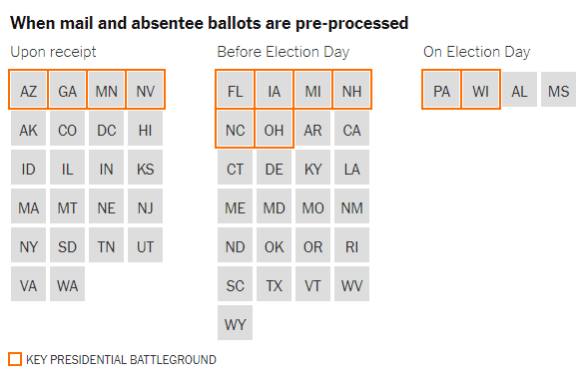
With so many ballots being mailed or otherwise submitted before Election Day, people are wondering when we’ll know the results. The good news is that only four states wait until Election Day to begin processing ballots. I think this means Election Night will provide some blessed relief, especially if states let us know what percentage of the ballots have been counted (the percentage of “precincts reported” probably won’t be as meaningful this year). Even if the result isn’t clear that night, it should be clear by the next day.

I say that because I’m convinced this election won’t be very close. Millions of voters gave the maniac the benefit of the doubt four years ago. Now they know what they had to lose (jobs, health, peace of mind, not hearing about a dangerous fool every day, etc.).

This is from The New York Times, which has more information about the process.

Untitled

E Pluribus Unum, For Better Or Worse

Perhaps you’ve looked at a map and thought it might be a good idea if the United States came apart at the seams. I have. If only we could make those other people go away!

Abraham Lincoln didn’t agree, of course, but he never met our current president or Mitch McConnell. 

Akim Reinhardt, a history professor in Maryland, says we should seriously consider the idea:

Is there anything more clichéd than some spoiled, petulant celebrity publicly threatening to move to Canada if the candidate they most despise wins an election? These tantrums have at least four problems:

1. As if Canada wants you. Please.
2. Mexico has way better weather and food than Canada. Why didn’t you threaten to move there? Is it because of all the brown people? No, you insist. Is it the language? Well then if you do make it to Canada, here’s hoping they stick you in Quebec.
3. New Zealand seems to be the hip new Canada. I’ve recently heard several people threaten to move there. News flash, Americans: New Zealand wants you even less than Canada does.
4. [Note: #4 isn’t really a problem so I’m leaving it out.]

. . . I’ve got a much better alternative: Stay put and begin a serious, adult conversation about disuniting the states.

If, through the vagaries of the Electoral College, 45% of U.S. voters really do run this nation into an authoritarian kleptocratic, dystopian ditch, then instead of fleeing with your gilded tail between your legs, stay and help us reconfigure the nation. It might be the sanest alternative to living in Txxxx’s tyranny of the minority, in which racism and sexism are overtly embraced, the economy is in shambles, the pandemic rages unabated, and abortion may soon be illegal in most states as an ever more conservative Supreme Court genuflects to corporate interests and religious extremists.

And of course it cuts both ways. Should current polls hold and Joe Biden manage to win the election with just over half the popular vote, those on the losing side will be every bit as upset. So upset that they too would likely open to a conversation about remaking an America.

Indeed, no matter how this turns out, about half the nation will feel like they can no longer live with what America is becoming, even as they live in it. The losing side, whichever it may be, will want to wrest this country back from those who seem increasingly alien to them. So perhaps national salvation comes when the winning side remains open to a discussion the losers will launch about radically redesigning the United States. . . .

It is time for the rest of us to begin a serious discussion about national disincorporation. About disuniting the states. Because no matter who wins, about half the nation will not want to live with it. Tens of millions of Americans on the losing side will not trust the winner to govern fairly, competently, or with the nation’s best interests at heart.

It’s a recipe for disaster. We need to get ahead of this discussion. . . .

Let me be clear. I am not advocating a unilateral declaration of secession and military assault on federal installations like the treasonous, Confederate slave-owners did in 1861. Rather, I am advocating serious discussions about untangling this fractured nation. For finding a peaceful, constitutional solution that either dissolves or drastically reconfigures the United States.

I believe it may be the most sensible and mature approach to dealing with a deeply riven partisan divide that has done nothing but worsen these last forty years, and increasingly breeds mutual frustration and resentment among tens of millions of Americans. The U.S. constitutional system is predicated on compromise, and the Republican Party has spent the last quarter-century working against compromise with increasing fervency. That’s not a smear, it’s a statement of fact. It’s a central tenet of their politics. Republicans are openly dismiss compromise and try to get everything they want and accept nothing they don’t.

It has become dysfunctional. And it’s not going to change anytime soon. . . .

Though perhaps unfathomable at first glance, we may actually be nearing the point where a majority of Americans are ready to call it quits on our current national incarnation. . . .

After all, in the world of national governments, 231 years is a really long time. And it wouldn’t even be our first rodeo.

We have done this before. The Constitution, drafted in 1787 and ratified in 1789, peacefully replaced an earlier form of United States national government organized under the Articles of Confederation. Yes, drafting the Constitution and getting the nation to adopt it over the Articles were difficult processes, hardly perfect, and engendered a fair bit of acrimony at the time. But it came about, peacefully (for the most part), and led to something that’s lasted well over two centuries.

Is it so impossible then to imagine the United States reconfiguring itself once again?

Of course a new United States could take many shapes. . . .

But regardless of what shape it might take, perhaps the most important thing is to have the conversation. Like adults. To talk about what it means to share national governance; how it’s working to our satisfaction, and how it’s not; and what we might do to improve it. . . .

Or perhaps, irony wins the day. Maybe serious discussion about disunion actually help decrease partisan tensions. Simply broaching the topic in a serious manner may force many Americans to recognize how close we are to losing we’ve always known.

Or perhaps such discussions really do lead many Americans to decide that it’s time to replace We the People, with You and Us the People.

Unquote.

Prof. Reinhardt has a few ideas about how this dismemberment might be accomplished. We might become two or three nations; change the Constitution to give more power to individual states; combine states or divide them up, etc. To use two old phrases, thinking about dividing the U.S. is a parlor game and a pipe dream.

Here’s one reason. Although we think of blue states and red states, some of them are purple. In addition, if you drill down further, America is an even greater mixture of blue and red. This is a map with counties marked blue or red depending on how they voted in 2016, with each county assigned space on the map based on its population.

countycartrb512

Assigning either blue, red or purple to each county based on the percentage that voted one way or the other would make it even harder to separate us by our political leanings.

I think a better and more practical solution will be to reinstate majority rule in the United States by making the Electoral College obsolete, getting rid of the filibuster in the Senate and granting statehood to Puerto Rico and Washington D.C. That would allow the federal government to pursue more progressive policies, which would help the economy, allow more social ills to be addressed and reduce inequality.

We also need to remove some of the emotion surrounding three issues: abortion, gun control and the Supreme Court. Abortions are already becoming more rare; putting more emphasis on education and birth control would reduce them further. Private ownership of guns is here to stay; but somehow we need to do what the majority of Americans want, i.e.  institute sensible gun control. A revised, clarified Second Amendment might allow us to do that while protecting a citizen’s “right to bear arms”. The Supreme Court has become too political. I’d add three seats, so we’d have 12 justices evenly divided between Republicans and Democrats. No more 5-4 decisions. If a ruling can’t get a majority, let the lower court decision stand. 

Maybe thinking about how we could make America a better country for people on the right and left and in the middle is also a parlor game and a pipe dream. It seems to me, however, that a more perfect union is within our grasp if we make the effort. It would be much harder to make those other people go away.