Numbers

New Jersey (where I live) has had the most Covid cases and most deaths per capita of any state, mainly because it hit northern NJ and New York City hardest early on, when nobody had experience treating it and there were no vaccines.

12,200 cases per 100,000 residents

302 deaths per 100,000

Mississippi, home to lots of Republicans and poor people, is now in 2nd place with 278 deaths per capita, even though few people got it there early on. (Paul Krugman)

Far from New Jersey, the total evacuated by US/coalition partners since August 14: 111,900

When the effort began, US officials estimated there were 6,000 Americans and up to 65,000 Afghan allies they wanted to get out. (John Harwood/CNN)

The Problem Is Facebook and Twitter Themselves

From The Washington Post:

Facebook said Saturday evening that an article raising concerns that the coronavirus vaccine could lead to death was the top performing link in the United States on its platform from January through March of this year, acknowledging the widespread reach of such material for the first time. It also said another site that pushed covid-19 misinformation was also among the top 20 most visited pages on the platform.

In related news, the German Marshall Fund issued a study of interactions on Facebook. The study found that sites that share news in misleading ways attracted a record-level percentage of Facebook users:

More than 1 in 5 interactions — such as shares, likes or comments — with U.S. sites from April to June happened on “outlets that gather and present information irresponsibly,” according to [the study].

This includes outlets such as the Daily Wire, TMZ, the Epoch Times and Breitbart that researchers say “distort or misrepresent information to make an argument or report on a subject,” a metric determined by NewsGuard, a website cited in the study that rates the credibility of news sources. Researchers say these sources, which they argue spread subtler but still harmful forms of misinformation, are decidedly different from sites that publish overtly false news.

“These are the kinds of sites that will cherry pick anecdotes and are giving rise to vaccine hesitancy and other kinds of conspiracy theories,” said [the study’s director].

Researchers highlighted articles that they say “disproportionately amplify vaccine-hesitant voices over experts” and “fail to mention risks of not being vaccinated against covid-19″ . . .

While platforms have cracked down on black-and-white cases of fiction masquerading as fact, they are still grappling with how to handle murky yet wide-reaching cases that stop short of falsehood. . . . 

The ratio of misleading content marks a five-year high for Facebook, where “false content producers” have received a higher share of engagement in the past, according to the findings (The Washington Post).

Unquote.

What should we do about a company like Facebook that seems hell-bent on spreading harmful misinformation? One answer is to prosecute Mark Zuckerberg and his ilk as dangers to public health.

However, Vinay Prasad, a professor at the University of California medical school, suggests a more measured approach: we should deal with social media companies the way we dealt with tobacco companies thirty years ago. From Medpage Today

Many Americans, and especially healthcare providers, are frustrated as we watch yet another rise in COVID-19 cases. Severely ill and hospitalized patients are often unvaccinated, which is particularly disheartening, given the widespread availability — surplus — of mRNA vaccines in the U.S. . . .

One potential reason why a sizable fraction of Americans are reluctant to be vaccinated is the widespread availability of inaccurate, unbalanced, or irrational rhetoric. This speech falls across a spectrum from overtly delusional — vaccines contain microchips so Bill Gates can track you — to lesser degrees of pejorative and doubtful comments. . . .

[But] regulating or policing medical misinformation is doomed. It’s easy for most (sensible) people to recognize that mRNA vaccines do not contain microchips that allow Bill Gates to track you. But very quickly we find statements about vaccines that are unknown, disputed, and worthy of further dialogue. Lines between legitimate debate and misinformation become scientifically impossible to draw. . . .

Even on a social media website for medical professionals that restricts who can comment and regulates comments, as Doximity does, there are a number of erroneous statements, mis-statements and ill-informed comments, suggesting that regulating speakers is not an effective solution either. Some doctors may say incorrect things, and some lay people may be spot on. Policing speakers can’t solve the content issue.

. . . It is easy to feel that some erroneous views should not be permitted on social media, but the hard part is to define what should not be allowed. Notably, despite the Surgeon General’s report and much debate on the issue, no one has actually delineated what counts as misinformation. I suspect that it cannot be done. No one can create a rule book that separates black and white because the world we live in is only gray. You can’t outlaw what you can’t define.

The problem is Facebook and Twitter themselves.

In 50 years, social media in 2021 will look like the tobacco industry in 1960 — they knowingly offered an addictive product, and, worse, hid the damage the addiction caused, while actively tried to deepen the dependency. Social media companies try to keep you using the platform longer, baiting you with content to trigger your rage, disgust, lust, or hatred. These companies offer products that have been linked to anxiety and depression among users. . . .
When it comes to information, social media does three things.

First, it drives people into irrational poles. On one side are folks who think SARS-CoV-2 is not real or just another seasonal flu. These individuals are often suspicious of vaccination as a path out of the pandemic. On the other side are folks who believe we should lock down until there isn’t a single case of COVID left. . . . The very nature of social media drives individuals into further extreme positions, possibly aided by bots, sock-puppet accounts, or foreign intelligence agencies. The middle ground is lost.

Second, a good or bad idea on these platforms can reach millions of individuals. An anecdote (of dubious validity) of a vaccinated individual suffering a bizarre harm, or one of an unvaccinated person begging for vaccination before the endotracheal tube is placed . . . are both powerful psychological stories that reach millions. This is heroin of the mind.

Third, social media causes deterioration of discourse and harsh proposals. . . . We no longer see individuals with whom we have policy disagreements as people.

The solution is inevitable. Social media of 2021 must be dismantled and crippled like the tobacco industry. These digital tools have hijacked our neurotransmitters, just like tobacco. Denying the pernicious role of these platforms on our society is similar to those who denied the harms of tobacco. Just like tobacco, social media offers pleasures. But, just like tobacco, the industry that supports it has pushed too far, lusting for profits and domination.

. . . Our leaders offer toothless solutions like policing or removing information they view as particularly egregious. This introduces countless problems and immense potential for abuse. . . .

Instead, the platforms need to be crushed, broken up, and regulated. Rather than just censoring specific ideas, measuring attention and trying to capture more of it must be prohibited. . . . The platforms must be brought to their knees, just like Big Tobacco, while human ideas — good, bad, sublime, horrible, true, false, and everything in – between must be free.
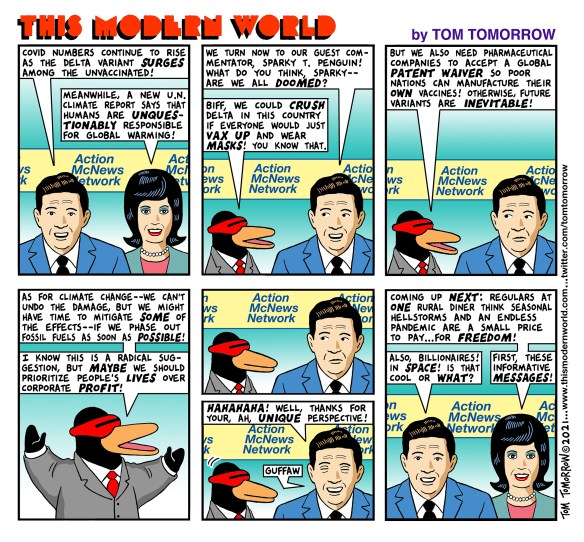
The Penguin Makes a Lot of Sense

Hot off the internet, Tom Tomorrow’s latest commentary:

TMW2021-08-18colorXL

You can support Mr. Tomorrow’s valuable work by subscribing to Sparky’s List for a small sum (Sparky is the penguin).

Preparing for a Worse Pandemic

It looks like the Gulf Stream will eventually collapse, leading to a climate catastrophe, but maybe it will take centuries, not months, so let’s consider a different catastrophe instead. Eric Lander, the administration’s top science adviser, explains what we need to do to avoid a much worse pandemic:

Coronavirus vaccines can end the current pandemic if enough people choose to protect themselves and their loved ones by getting vaccinated. But . . .

New infectious diseases have been emerging at an accelerating pace, and they are spreading faster.

. . . That’s why President Biden has asked Congress to fund his plan to build on current scientific progress to keep new infectious-disease threats from turning into pandemics like covid-19.

. . . For the first time in our history, we have an opportunity not just to refill our stockpiles but also to transform our capabilities. However, if we don’t start preparing now for future pandemics, the window for action will close.

Covid-19 has been a catastrophe: The toll in the United States alone is more than 614,000 lives . . . A future pandemic could be even worse — unless we take steps now.

It’s important to remember that the virus behind covid-19 is far less deadly than the 1918 influenza. The virus also belongs to a well-understood family, coronaviruses. It was possible to design vaccines within days of knowing the virus’s genetic code because 20 years of basic scientific research had revealed which protein to target and how to stabilize it. And while the current virus spins off variants, its mutation rate is slower than that of most viruses.

Unfortunately, most of the 26 families of viruses that infect humans are less well understood or harder to control. We have a great deal of work still ahead.

The development of mRNA vaccine technology — thanks to more than a decade of foresighted basic research — was a game-changer. It shortened the time needed to design and test vaccines to less than a year — far faster than for any previous vaccine. And it’s been surprisingly effective against covid-19.

Still, there’s much more to do. We don’t yet know how mRNA vaccines will perform against other viruses down the road. And when the next pandemic breaks out, we’ll want to be able to respond even faster.

Fortunately, the scientific community has been developing a bold plan to keep future viruses from becoming pandemics.

Here are a few of the goals we should shoot for:

The capability to design, test and approve safe and effective vaccines within 100 days of detecting a pandemic threat (for covid-19, that would have meant May 2020); manufacture enough doses to supply the world within 200 days; and speed vaccination campaigns by replacing sterile injections with skin patches.

Diagnostics simple and cheap enough for daily home testing to limit spread and target medical care.

Early-warning systems to spot new biological threats anywhere in the world soon after they emerge and monitor them thereafter.

We desperately need to strengthen our public health system — from expanding the workforce to modernizing labs and data systems — including to ensure that vulnerable populations are protected.

And we need to coordinate actions with our international partners, because pandemics know no borders.

These goals are ambitious, but they’re feasible — provided the work is managed with the seriousness, focus and accountability of NASA’s Apollo Program, which sent humans to the moon.

Importantly, these capabilities won’t just prepare us for future pandemics; they’ll also improve public health and medical care for infectious diseases today.

Preparing for threats is a core national responsibility. . . . The White House will put forward a detailed plan this month to ensure that the United States can fully prepare before the next outbreak. It’s hard to imagine a higher economic or human return on national investment.

Pandemic Cash Made a Difference

Millions needed help and got it. From The New York Times:

In offering most Americans two more rounds of stimulus [or relief] checks in the past six months, totaling $2,000 a person, the federal government effectively conducted a huge experiment in safety net policy. Supporters said a quick, broad outpouring of cash would ease the economic hardships caused by the coronavirus pandemic. Skeptics called the policy wasteful and expensive.

The aid followed an earlier round of stimulus checks, sent a year ago, and the results are being scrutinized for lessons on how to help the needy in less extraordinary times.

A new analysis of Census Bureau surveys argues that the two latest rounds of aid significantly improved Americans’ ability to buy food and pay household bills and reduced anxiety and depression, with the largest benefits going to the poorest households and those with children. The analysis offers the fullest look at hardship reduction under the stimulus aid.

Among households with children, reports of food shortages fell 42 percent from January through April. A broader gauge of financial instability fell 43 percent. Among all households, frequent anxiety and depression fell by more than 20 percent.

While the economic rebound and other forms of aid no doubt also helped, the largest declines in measures of hardship coincided with the $600 checks that reached most people in January and the $1,400 checks mostly distributed in April.

“We see an immediate decline among multiple lines of hardship concentrated among the most disadvantaged families,” said H. Luke Shaefer, a professor at the University of Michigan who co-authored the study . . .

Given the scale of the stimulus aid — a total of $585 billion — a reduction in hardship may seem like a given, and there is no clear way to measure whether the benefits were worth the costs. . . . Still, the aggressive use of stimulus checks coincides with growing interest in broad cash payments as a tool in social policy, and the evidence that they can have an immediate effect on the economic strains afflicting many households could influence that debate.

Starting in July, the government will mail up to $300 a month per child to all but the most affluent families in a yearlong expansion of the child tax credit that Democrats want to make permanent. . . .

“Cash aid offers families great flexibility to address their most pressing problems, and getting it out quickly is something the government knows how to do,” Mr. Shaefer said. Extrapolating from the survey data, he concluded that 5.2 million children had escaped food insufficiency since the start of the year, a figure he called dramatic.

The experience of [Chenetta Ray], a warehouse worker at a recycling company in Houston, captures the hardships that the pandemic imposed and the varied ways that struggling families have used stimulus checks to address them. Earning $13 an hour, Ms. Ray had an unforgiving budget even before business closures reduced trash collection and cut her hours by a third.

Her car insurance lapsed. Her lights were shut off. She skipped meals, even with food pantry aid, and re-wore dirty work clothes to save on laundromat costs. When her daughter discovered that they owed thousands in rent, she offered to quit high school and work, which Ms. Ray forbid. A stimulus payment in January — $1,200 for the two of them — let her pay small parts of multiple bills and restock the freezer.

“It bridged a gap,” Ms. Ray said, while she waited for slower forms of assistance, like rental aid.

Then she got cancer. To confirm the diagnosis and guide her treatment, she had to contribute $600 to the cost of a CT scan, which she did with the help of a payment in April totaling $2,800.

In addition to providing for the test, Ms. Ray said, the checks brought hope. “I really got down and depressed,” she said. “Part of the benefit of the stimulus to me was God saying, ‘I got you.’ Spiritual and emotional reassurance. It took a lot of stress off me.”