The House Judiciary Committee Summarizes Its Findings

The House Judiciary Committee released a 180-page report yesterday explaining why the president should be removed from office (the document is 658 pages long because of other contents). Below, in 1,500 words, the Democratic majority summarizes the case against the president:

The House Committee on the Judiciary has completed the consideration of two articles of impeachment against President Donald J. Trump. The first article charges that the President used the powers of his office to solicit and pressure a foreign government, Ukraine, to investigate his domestic political rival and interfere in the upcoming United States Presidential elections. The second article charges that the President categorically obstructed the Congressional impeachment inquiry into his conduct. Taken together, the articles charge that President Trump has placed his personal, political interests above our national security, our free and fair elections, and our system of checks and balances. He has engaged in a pattern of misconduct that will continue if left unchecked. Accordingly, President Trump should be impeached and removed from office.

This report proceeds in four parts.

FIRST, it describes the process by which the Committee came to recommend that the House impeach the President of the United States. From start to finish, the House conducted its inquiry with a commitment to transparency, efficiency, and fairness. The Minority was present and able to participate at every stage. From September to November of this year, the House Permanent Select Committee on Intelligence, in coordination with the Committee on Oversight and Reform and the Committee on Foreign Affairs, collected evidence related to the charges against President Trump. The House Permanent Select Committee on Intelligence held public hearings to develop the evidence and share it with the American people. The committees then transmitted their evidence to the Judiciary Committee, together with a nearly 300-page public report and 123 pages of Minority views.

Consistent with House precedent, after the evidence arrived at the Judiciary Committee, the Committee invited President Trump and his counsel to participate in the process. Notably, and unlike past Presidents, President Trump declined to attend any hearings, question any witnesses, or recommend that the Committee call additional witnesses in his defense.

SECOND, the report discusses the standard for impeachment under the Constitution. The Framers were careful students of history and knew that threats to democracy could take many forms. Therefore, they adopted a standard for impeachment that captured a range of misconduct: “Treason, Bribery, or other high Crimes and Misdemeanors.” A clear theme unified these constitutional wrongs: officials who abused, abandoned, or sought personal benefit from their public trust—and who threatened the rule of law if left in power—faced impeachment and removal. The Framers principally intended “other high Crimes and Misdemeanors” to include three forms of Presidential wrongdoing: (1) abuse of power, (2) betrayal of the national interest through foreign entanglements, and (3) corruption of office and elections. Any one of these violations of the public trust justifies impeachment. When combined in a single course of conduct, as is the case here, they state a powerful case for impeachment and removal from office.

THIRD, the report examines the facts underlying the first charge against President Trump: abuse of power. On July 25, 2019, when he spoke by telephone to President Zelensky of Ukraine, President Trump had the upper hand. President Zelensky had been recently elected. Ukraine was locked in an 3 existential battle with Russia, which had invaded and illegally occupied eastern Ukraine more than five years earlier. The conflict was continuing and Ukraine needed our help—both in the form of vital military aid, which had already been appropriated by Congress because of our security interests in the region, and also in the form of an Oval Office meeting, to show the world that the United States continues to stand with our ally in resisting the aggression of our adversary.

On that July 25 call, President Zelensky expressed gratitude for past American defense support and indicated that he was ready to buy more anti-tank weapons from the United States. In response, President Trump immediately asked President Zelensky to “do us a favor, though.” He asked Ukraine to announce two bogus investigations: one into former Vice President Joseph R. Biden, Jr., then his leading opponent in the 2020 election, and another to advance a conspiracy theory that Ukraine, not Russia, attacked our elections in 2016. One investigation was designed to help him gain an advantage in the 2020 election. The other was intended to help President Trump conceal the truth about the 2016 election. Neither investigation was supported by the evidence or premised on any legitimate national security or foreign policy interest.

After the call with President Zelensky, President Trump ratcheted up the pressure. He continued to dangle the offer of the Oval Office meeting and to withhold the $391 million in military aid. The evidence shows that, on the same day that the call took place, Ukrainian officials became aware that funding had been withheld. The President also deployed his private attorney and other agents, some acting outside the official and regular channels of diplomacy, to make his desires known.

These facts establish impeachable abuse of power. To the founding generation, abuse of power was a specific, well-defined offense. It occurs when a President exercises the powers of his office to obtain an improper personal benefit while injuring and ignoring the national interest. The evidence shows that President Trump leveraged his office to solicit and pressure Ukraine for a personal favor.

This unquestionably constitutes an impeachable offense, but the first article of impeachment also identifies two aggravating factors. When President Trump asked President Zelensky for a favor, he did so at the expense of both our national security and the integrity of our elections. As to the first, America has a vital national security interest in countering Russian aggression, and our strategic partner Ukraine is quite literally at the front line of resisting that aggression. When the President weakens a partner who advances American security interests, the President weakens America. As to election integrity, American democracy above all rests upon elections that are free and fair. When the President demands that a foreign government announce investigations targeting his domestic political rival, he corrupts our elections. To the Founders, this kind of corruption was especially pernicious, and plainly merited impeachment. American elections should be for Americans only.

FOURTH and finally, the report describes the second charge against President Trump: obstruction of Congress. President Trump did everything in his power to obstruct the House’s impeachment inquiry. Following his direction not to cooperate with the inquiry, the White House and other agencies refused to produce a single document in response to Congressional subpoenas. President Trump also attempted to muzzle witnesses, threatening to damage their careers if they agreed to testify, and even attacked one witness during her live testimony before Congress. To their great credit, many witnesses 4 from across government–including from the National Security Council, the Department of State, and the Department of Defense–ignored the President’s unlawful orders and cooperated with the inquiry. In the end, however, nine senior officials followed President Trump’s direction and continue to defy duly authorized Congressional subpoenas. Other Presidents have recognized their obligation to provide information to Congress under these circumstances. President Trump’s stonewall, by contrast, was categorical, indiscriminate, and without precedent in American history.

The Constitution grants the “sole Power of Impeachment” to the House of Representatives. Within our system of checks and balances, the President may not decide what constitutes a valid impeachment inquiry. Nor may he ignore lawful subpoenas for evidence and testimony or direct others to do so. If a President had such authority, he could block Congress from learning facts bearing upon impeachment in the House or trial in the Senate and could thus control a power that exists to restrain his own abuses. The evidence shows clearly that President Trump has assumed this power for himself and, left unchecked, the President will continue to obstruct Congress through unlawful means.

Although the 2020 election is less than a year away, Congress cannot wait for the next election to address the President’s misconduct. President Trump has fallen into a pattern of behavior: this is not the first time he has solicited foreign interference in an election, been exposed, and attempted to obstruct the resulting investigation. He will almost certainly continue on this course. Indeed, in the same week that the Committee considered these articles of impeachment, the President’s private attorney was back in Ukraine to promote the same sham investigations into the President’s political rivals and, upon returning to the United States, rapidly made his way to the White House. We cannot rely on the next election as a remedy for presidential misconduct when the President is seeking to threaten the very integrity of that election. We must act immediately.

The Committee now transmits these articles of impeachment to the full House. By his actions, President Trump betrayed his office. His high crimes and misdemeanors undermine the Constitution. His conduct continues to jeopardize our national security and the integrity of our elections, presenting great urgency for the House to act. His actions warrant his impeachment and trial, his removal from office, and his disqualification to hold and enjoy any office of honor, trust, or profit under the United States.

Unquote.

The actual text of the two Articles of Impeachment are near the beginning of the document in very small print. They’re in larger print here.

The full House of Representatives will vote to impeach the president this week. Whether the matter proceeds to a trial in the Senate probably depends on whether the Republicans agree to conduct a fair trial with specific procedures laid out in advance. Since Senate Republicans are coordinating their approach to a trial with the White House, it’s hard to believe they’ll agree to reasonable procedures. That would allow the House to continue its investigations and add more charges before sending anything to the Senate. There is no question more charges could and should be brought. David Leonhardt of the New York Times recommends eight:

  1. Obstruction of Justice
  2. Contempt of Congress
  3. Abuse of Power
  4. Impairing the Administration of Justice
  5. Acceptance of Emoluments
  6. Corruption of Elections
  7. Abuse of Pardons
  8. Conduct Grossly Incompatible with the Presidency
Are We Indeed Better Than That?

Two parts of today’s impeachment inquiry stood out. The first was the opening statement of Dr. Fiona Hill, the former White House expert on Russia. The second was Chairman Adam Schiff’s closing remarks. Together they add up to less than 29 minutes. They are worth watching in full. In the end, you may ask yourself if Rep. Schiff is right. Are we Americans better than that?

A High Crime or Misdemeanor If Ever There Was One

Federal law says that a public official (such as the President) who, directly or indirectly, corruptly demands, seeks, receives, accepts, or agrees to receive or accept anything of value (such as the announcement of a criminal investigation into a prospective political opponent) in return for being influenced in the performance of any official act (such as inviting a foreign leader to the White House or delivering military aid to that foreign leader’s country) is guilty of bribery.

The Constitution says the President, Vice President and all civil officers of the United States shall be removed from office on impeachment for, and conviction of treason, bribery or other high crimes and misdemeanors.

Our president directly, indirectly and secretly demanded something of value to his political campaign in return for performing official actions. That’s one solid reason he should be impeached and removed from office.

It makes no difference that the foreign criminal investigation was never announced and never took place. It makes no difference that the military aid was ultimately delivered (after the president’s corruption was revealed). The president made it clear to his subordinates and his lawyer that he wanted to bribe the president of Ukraine. Attempted bribery, even if discovered in time to be interfered with, counts as bribery.

There are other reasons he should be removed from office, including the fact that a grand jury would have indicted him for obstruction of justice if the Department of Justice had chosen to prosecute, and the fact that he is knowingly receiving “emoluments” (i.e. cash) from foreign governments while in office, something the Constitution forbids. But bribery is the offense the Democrats are investigating and publicizing at the moment.

Representative Adam Schiff, chairman of the House Intelligence Committee, summarized today’s testimony by Ambassador Gordon Sondland in thirteen minutes. It’s worth watching.

What the House Decided This Week

Sean Casten is a Democrat who represents the 6th Congressional District of Illinois. He went on Twitter this week to explain what the House of Representatives did regarding impeachment:

A brief thread is in order on what we decided to do yesterday, as there seems to be some confusion about what is in [House Resolution] 660:

First, please read the bill. Rather than relying on shoddy journalists or self-interested partisans, go to the original source material: congress.gov/bill/116th-con…

On the substance, let’s first state the obvious: we did not vote to impeach the President yesterday, nor did we vote to initiate an impeachment inquiry, nor did we vote on articles of impeachment. We voted to set the rules for the next (open) phase of the process.

The question we were all asked yesterday was not whether we should move forward, but whether we agree to move forward subject to a specific set of rules.

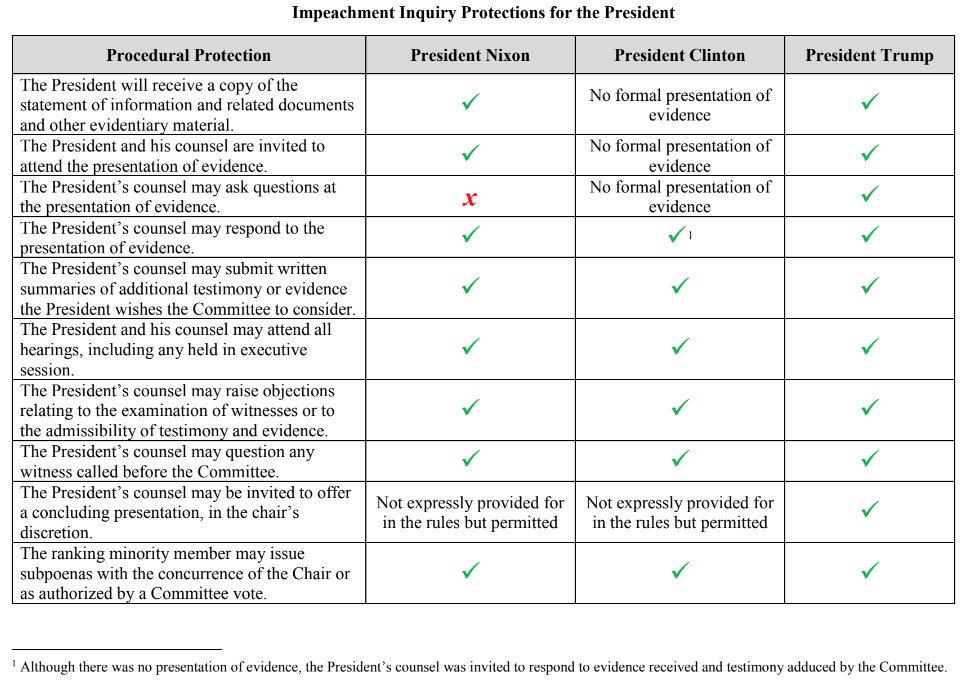
The rules we passed were not only fair, but in some cases more generous to the President than the rules that were passed for the Nixon and Clinton processes.

There is a very important point to be noted in that prior table. The protections afforded by this process are to the President, not his political party. As is appropriate, since he is the subject of our inquiry.

This weird narrative that the minority party deserves greater protection implicitly presumes that the minority party is on trial. No one is making that argument, except perhaps for those who doth protest too much.

So it’s worth asking the question why someone would vote “no” on yesterday’s resolution. There are only three logically possible reasons:

(a) Because you want greater protections to the President in this process than has ever been granted in prior processes

(b) Because you are opposed to majoritarian democracies where the actions of a legislative body require the consent of >50% of the members, or

(c) Because you think the Congress should not inquire as to whether the President should be impeached under any circumstances

That’s the extent of the logical objections. That’s not to say that there can’t be illogical objections of course… so let’s examine some of those.

Some have suggested that the prior phase should have been open. That’s irrelevant to what we do next. History is behind us.

However, the approach taken was fully appropriate given the circumstances.

In the Clinton and Nixon cases, impeachment hearings came AFTER the [Attorney General’s] office had led closed hearings to ensure that witnesses could not coordinate their stories. Barr’s failure to do so, and his efforts to distort the Mueller report forced a different process this time.

Others have suggested that the prior process required a vote of the house. That argument is silly, and unfounded. Every committee in Congress has the right to set their own agenda, subject to the majoritarian opinion of their members.

For example, no one would argue that the Science Committee cannot hold hearings on ocean acidification prior to a full vote of the House.

In the same fashion, it makes no sense to argue that the Intel, Oversight, Judiciary, Ways & Means, Financial Services or Foreign Affairs committees cannot hold hearings subject to their jurisdiction prior to a full vote of the House.

Indeed, if we DID require a full vote of the House to approve the agenda of any committee, the House would never get anything done. Every member of Congress knows that. But some are hoping the public doesn’t. That is irresponsible.

So what happens next? We wrap up closed sessions as soon as we can, and then move into open hearings subject to these rules. We do so with open minds and no pre-determined verdict.

I am sorry – and in many ways, angry – that not a single Republican saw fit to vote in favor of these rules. Their obedience and deference to the Executive branch is an abdication of their responsibilities.

But we – and by we, I mean all of us – cannot allow their obedience to conclude that a partisan vote is bad policy.

With heavy hearts, we move forward. No member of Congress celebrates this moment. But yesterday, I’m glad to at least report that the majority of us voted not to shirk our responsibility.

Unquote. 

I don’t know about the “heavy hearts”. I assume the Congressman means he’d rather not have a president like the Toddler who so clearly deserves to be impeached and removed from office.

I also wonder how many in Congress don’t know how they will vote. There is so much evidence of corruption and abuse of power that having to make up one’s mind now would betray a lack of attention.

There should be several articles of impeachment, not limited to the Ukraine scandal, and each article should include a list of “whereas he did this” and “whereas he did that”. If they can’t come up with 20 pages of “whereas” clauses for each article, they won’t be trying.

Presenting the evidence in detail would make it harder for some of the Toddler’s supporters and some of the nation’s voters to deny the harsh reality of the situation.

One Step Forward, A Half Step Back?

A few days ago, the leading Democrat in the House of Representatives finally said the word “impeachment”. That was a big step forward. She announced that several committees will decide whether the president has committed “high crimes and misdemeanors” that fall within their jurisdiction. Now, however, it appears that House Democrats want to focus their efforts on the Ukraine scandal, possibly voting whether to impeach the president in a matter of weeks.

Brian Beutler of Crooked Media summarized the situation in two columns this week. Here is some of his commentary:

Donald Trump entered the White House uniquely vulnerable to impeachment, the owner of an opaque web of private companies who obtained the office through criminal and corrupt means. Over the next two and a half years he piled increasingly brazen offenses on to that bill of particulars, emboldened at each juncture by Congresses—one Republican, one Democrat—that were determined for different reasons not to set an impeachment process in motion.

In the days after Special Counsel Robert Mueller produced a report showing Trump encouraged and expected to benefit from a foreign attack on the 2016 election, then abused his powers of office to obstruct the ensuing investigation, one of the few Democrats who recognized that taking impeachment off the table would create an unacceptable level of moral hazard was Sen. Elizabeth Warren (D-MA). She warned, “If Donald Trump can do all that he tried to do to impede an investigation into his own wrongdoing and an attack by a foreign government,” and Congress takes no action, “then it gives license to the next president, and the next president, and the next president to do the same thing.”

The only thing her analysis missed is that Congress’s inaction also gave Donald Trump license to commit the same crimes all over again, this time with the awesome powers of the presidency at his fingertips.

And that is exactly what happened.

Members of the Trump campaign escaped indictment for cooperating with Russia’s attack on the election by the skins of their teeth. Trump himself escaped indictment for obstruction of justice only because the Justice Department prohibits its prosecutors from indicting sitting presidents. In lieu of an indictment, Mueller effectively referred Trump to Congress for impeachment, and in the face of hard evidence that he’d committed grave impeachable offenses, Congress took a pass….

It is probably no coincidence that Trump involved himself directly in the Ukraine extortion scheme the day after Mueller’s valedictory testimony to Congress, when it was clear Democratic leaders remained intractably opposed to impeachment. Had they treated the report with the seriousness it deserved, and unified their caucus behind impeachment, they might have discouraged Trump from inviting another foreign power to interfere in our election….

And it’s not as though Trump’s recent conduct is so different from his past offenses that the case for impeachment has changed dramatically. To the contrary, the arguments now prevailing are the very same ones impeachment supporters have been screaming themselves hoarse about for months—since before Democrats won back the House: That impeachment is the only way for Congress to alert the public to the seriousness of the threat Trump poses, and deny his enablers veto power over accountability; that it’s the only way to force all Republicans to vote on whether they think Trump’s crimes are acceptable; that a president who faces no consequences for law breaking will eventually discover that an election is nothing but a patchwork of laws, and begin to break them.


What we know today that we didn’t before hasn’t changed much either…. [The] plot to coerce Ukraine to involve itself in the 2020 election came to light before the summer. The vicissitudes of politics—a whistleblower who decided to take matters into his or her own hands; the existence of a corroborated complaint becoming public; Trump’s effort to cover it up—have made it easier for Democrats to step up now…. But Trump is only incrementally more deserving of impeachment now than he was two weeks ago. What’s changed is that the untenable nature of doing nothing has become impossible to deny. Having pulled their heads out of the sand, Democrats [could] now breathe again.

[However], as the political world processed the gravity of President Trump’s efforts to force Ukraine to interfere in the 2020 election, and to cover it up, House Democrats debated among themselves whether to limit their impeachment inquiry, then less than 24 hours old, to the issue of Ukraine, and even whether they should aim to complete the impeachment process by the end of October….

What we’ve learned should quiet the Democrats’ anxious desire to rush articles of impeachment to the Senate, because the Ukraine scandal turns out to be much larger than it appeared…. Running it all to ground will take time, and may lead us back to the other areas of corruption these Democrats had apparently hoped to sideline….

The Ukraine scandal might thus be a single thread in a web of corruption and criminality that implicates a large number Trump officials and connects back to other impeachable offenses that seem unrelated until you zoom out far enough.

It’s difficult to imagine that Democrats will have plumbed the full depths of this misconduct by late October, and that should serve as a reminder to those Democrats who, for whatever reason, instinctually want to get this all over with as quickly as possible: artificially limiting the probe will place most of Trump’s misconduct beyond the reach of accountability and provide Republicans a road map for weathering the deluge….Shutting avenues of inquiry out of the impeachment process makes no sense….

Democrats must recognize that if they rush articles of impeachment over to the Senate before the fullest-possible accounting of Trump’s corruption is complete, Republicans will likely acquit Trump as quickly as possible, and not only will the impeachment process come to an end but all regular oversight investigations of Trump’s corruption will as well. There will not be a second impeachment process; Democrats had to be browbeaten into launching this one, would be even more reluctant to launch another, and if they did Senate Republicans would shut it down with the simple argument that the House shouldn’t be allowed to commandeer the Senate into putting the president on trial over and over again.

The same House Democrats who were determined to avoid an impeachment process altogether now want to dispose of the one that’s working wonderfully as quickly as possible, and their judgment hasn’t improved much …. since they relented.

It is possible that the Ukraine matter is such a raging fire of corruption that it starves other parts of the inquiry of media oxygen, but those investigations should continue, as forcefully as possible, until they run dry.

In the unlikely event that Republicans signal a willingness to remove Trump from office, it’d be irresponsible of Democrats not to … end this emergency as quickly as possible. But short of that, their lodestar has to be maximizing the political value of the process, which includes both public hearings and a trial. Now is the time for chairs of the relevant committees to accelerate their inquiries, not dial them back, to bombard Trump with subpoenas, and enforce them aggressively, not to let their subpoena power lay fallow. Now, moreover, is the time for officials up and down the government with undisclosed knowledge of impeachable offenses to approach Congress, and for Congress to welcome them, and bring any credible allegations they make too light.

Only when that part of the process is complete should the House force the Senate into a trial. If Republicans intend to protect Trump from the penalty of removal then the only source of accountability available to Democrats is the thorough airing of his abuses—with respect to Ukraine, yes, but also with respect to his obstruction of justice, acceptance of bribes, lies, and attempts to use federal power to punish his enemies….

It’s one big story. But members of the public deserves to know all of it, and we’ll only have one chance to tell it to them.

Unquote. 

Don’t forget that the leading Democrat in the House of Representatives is very easy to email by clicking right here.