Whereof One Can Speak đŸ‡ș🇩

Nothing special, one post at a time since 2012

Humanity Continues To Screw Itself and Others

From The Guardian:

The climate crisis has driven the world to the brink of multiple “disastrous” tipping points, according to a major study.

It shows five dangerous tipping points may already have been passed due to the 1.1 C (2 F) of global heating caused by humanity to date.

These include the collapse of Greenland’s ice cap, eventually producing a huge sea level rise, the collapse of a key current in the north Atlantic, disrupting rain upon which billions of people depend for food, and an abrupt melting of carbon-rich permafrost.

At 1.5 C of heating, the minimum rise now expected, four of the five tipping points move from being possible to likely, the analysis said. Also at 1.5 C, an additional five tipping points become possible, including changes to vast northern forests and the loss of almost all mountain glaciers.

In total, the researchers found evidence for 16 tipping points, with the final six requiring global heating of at least 2 C to be triggered, according to the scientists’ estimations….

“The Earth may have left a ‘safe’ climate state beyond 1 C global warming,” the researchers concluded, with the whole of human civilisation having developed in temperatures below this level. Passing one tipping point is often likely to help trigger others, producing cascades. But this is still being studied and was not included, meaning the analysis may present the minimum danger.

Prof Johan Rockström, the director of the Potsdam Institute for Climate Impact Research, who was part of the study team, said: “The world is heading towards 2-3 C of global warming.

“This sets Earth on course to cross multiple dangerous tipping points that will be disastrous for people across the world. To maintain liveable conditions on Earth and enable stable societies, we must do everything possible to prevent crossing tipping points.”

Dr David Armstrong McKay at the University of Exeter, a lead author of the study, said: “It’s really worrying. There are grounds for grief, but there are also still grounds for hope.

“The study really underpins why the Paris agreement goal of 1.5 C is so important and must be fought for.”

“We’re not saying that, because we’re probably going to hit some tipping points, everything is lost and it’s game over. Every fraction of a degree that we stop beyond 1.5 C reduces the likelihood of hitting more tipping points.”

The analysis, published in the journal Science, assessed more than 200 previous studies on past tipping points, climate observations and modelling studies. A tipping point is when a temperature threshold is passed, leading to unstoppable change in a climate system, even if global heating ends….

Prof Tim Lenton at the University of Exeter, a co-author of the analysis, said: “Since I first assessed tipping points in 2008, the list has grown and our assessment of the risk they pose has increased dramatically.

“Our new work provides compelling evidence that the world must radically accelerate decarbonising the economy. To achieve that, we need to trigger positive social tipping points.”

Finally

With Vice President Kamala Harris casting the tie-breaking vote, Senate Democrats accomplished something important today, over the solid opposition of their Republican colleagues. It’s a big deal. The Democratic majority in the House of Representatives now needs to approve the bill. It’s hard to imagine that won’t happen.

First, however, it should be noted that news people can’t resist attaching a dollar amount to a bill like this. The Guardian, for example, has this headline:

Senate passes $739bn healthcare and climate bill after months of wrangling.

You have to read the article to figure out what the $739 billion refers to. Is it what the government will spend? Over what period of time? Or is it what the government will collect in new taxes? When will that happen? It’s a really dumb way to point out that it’s a big piece of legislation.

Much more helpfully, here’s how The Washington Post began its analysis of the bill:

Major changes to the Affordable Care Act. The nation’s biggest-ever climate bill. The largest tax hike on corporations in decades. And dozens of lesser-known provisions that will affect millions of Americans.

The legislation Democrats muscled through the Senate on Sunday would represent one of the most consequential pieces of economic policy in recent U.S. history.

The article includes the Congressional Budget Office’s most recent analysis of what the bill will do in coming years.

There will be new spending and tax breaks amounting to $385 billion on green energy and the climate crisis (including rebates for electric vehicles and other technology) and $100 billion for improved healthcare.

There will be increased taxes and other revenue totaling $470 billion from a new 15% minimum tax on corporations, a tax on companies buying their own stock, and a strengthened IRS, plus $320 billion in mostly drug-related healthcare savings (including allowing Medicare to negotiate drug prices).

$485 billion in spending and tax breaks and $790 billion in revenue and savings (roughly the Guardian’s number) equates to a reduction of $305 billion in the federal deficit. Lowering the federal deficit and lower prices on things like prescription drugs and green technology justified calling it the Inflation Reduction Act, although “Deficit and Inflation Reduction” would have been more accurate.

For now, a few comments. From Paul Krugman:

This was a victory for urgently needed policy. Democrats came into power with a three-part agenda: climate, infrastructure, and social programs [they delivered on infrastructure with a bit of Republican help last year].

They just delivered on the first, which was the most crucial — and no, it wasn’t far less than they sought. It accomplished most of the original objective [it’s estimated that this bill delivers about 80% of the cumulative emissions reductions over 10 years that that Biden’s original  Build Back Better plan would have].

What got lost were the extensive social programs. That’s a tragedy; we could have virtually eliminated child poverty, among other things [except Sen. Joe Manchin was opposed to doing that]. Even there, this bill expanded the enhanced subsidies that have helped bring the percentage of the uninsured to a record low.

But overall, it’s a remarkable record for a party with 50 senators and a relentlessly obstructionist opposition [and two obstructive Democrats, Manchin and Sinema].

From a Washington Post reporter:

Sen. Brian Schatz of Hawaii is visibly emotional and wiping away tears after final passage of the Inflation Reduction Act. “This is a planetary emergency, and this is the first time the federal government has taken action that is worthy of the moment,” he tells reporters. “Now I can look my kids in the eye.”

And just to keep in mind who Republican politicians represent, this is from Rolling Stone:

“Republicans have just gone on the record in favor of expensive insulin,” Sen. Ron Wyden said after Republicans voted to remove an insulin price cap from the Inflation Reduction Act. “After years of tough talk about taking on insulin makers, Republicans have once against wilted in the face of heat from Big Pharma.”

Democrats needed 60 votes, according to Senate math, in order to keep the private insurance cap in the Inflation Reduction Act. While seven Republicans voted to retain the cap, that was still three senators short of the 60 needed.

Around 37.3 million Americans, 11.3 percent of the population, have diabetes. … Insulin is a “catastrophic” expense for 14 percent of the seven million Americans who need it daily, according to a Yale University study. That means those 14 percent are spending at least 40 percent of their monthly income (after paying for food and housing) on insulin.

The goods news is that the bill — at least for the moment — maintained a $35 per month cap on insulin costs for people on Medicare.

Need I mention there’s an election in three months? Make sure you’re registered and vote for Democrats up and down the ballot!

A Tax Break That Will Never Die: Part 2 (Humorous Edition)

A few minutes ago, Senate Majority Leader Charles Schumer began the process of passing the Democrats’ Inflation Reduction Act. Among other things, it will make the tax system fairer and give more Americans access to healthcare. It also includes provisions dealing with the climate crisis that are big enough to please Al Gore:

The Inflation Reduction Act has the potential to be a historic turning point. It represents the single largest investment in climate solutions & environmental justice in US history. Decades of tireless work by climate advocates across the country led to this moment.

No deal is perfect and we need many more actions to solve the climate crisis. Yet, this bill is a long overdue and necessary step to ensure the US takes decisive action on the climate crisis that helps our economy and provides leadership for the world by example.

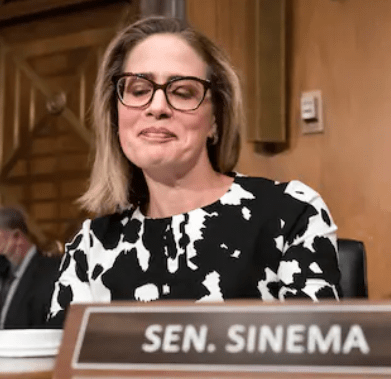
But Al Gore isn’t very funny. Alexandra Petri, who writes for The Washington Post, is. Yesterday, she channeled Krysten Sinema, the “Democratic” senator from Arizona with a unique approach to legislation:

Just to be clear: I do want to reform the carried interest tax loophole! I am so excited to work on it. Sounds bad! Seems bad! It is a no-good, rotten thing, and I don’t want it to keep existing. I look forward to legislating it away. That being said, if you remove it right now, in this Inflation Reduction Act, I will vote against it, and I will torpedo the whole bill.

Why? Whimsy! I just wanted to leave my own special Kyrsten Sinema touch on the bill!

I am a manic pixie dream senator who wants to make this bill slow down and embrace life! Everyone else is sitting there in their penguin outfits in neutral tones! Their idea of a fun, whimsical thing to do is a vote-a-rama! At most, they will go sit on a yacht for a brief time. Not me; I’m different! And I’m here to make sure this bill is different, too.

Inflation Reduction Act, why are you so staid and straightforward? Look at you, sitting there just closing tax loopholes for hedge funds! And you’ve got that across-the-board 15 percent tax on corporations. Don’t you know that corporations can sometimes be friends? Maybe not all corporations deserve an across-the-board tax. Some corporations are really chill, actually, and other corporations are donors and sometimes a private equity firm has a whole other side you might not have expected, if you just give it a chance!

Maybe, you’re so busy closing loopholes that you forgot how to be open. Maybe you need to open up, actually, those loopholes, please. That’s why I’m here: Someone’s got to be just that little bit random, conveniently in a way that consistently involves decreasing the amount of money corporations and the absurdly wealthy pay in taxes.

Sometimes you see a bill and you see how hard that bill is working to do good. That poor bill looks exhausted, doing so much! Reducing carbon emissions and decreasing the deficit and lowering ACA premiums and — and — and! And you’re like, “Bill! Relax! You don’t need to do it all! What you need to do is to stop and smell the roses. Or the rosĂ©s, like at the private equity-adjacent winery where I interned in 2020 — while serving as senator! Unrelatedly, do we really need to close the carried-interest tax loophole now? Maybe, actually, we need to live a little.”

I can be the friend this bill needs to urge it to run through a sprinkler at dusk and spin around on a beach listening to the Shins. It’ll be like Amelie, but if instead of freeing garden gnomes from people’s yards, we liberated them from pesky taxes, and if instead of gnomes, those were the account books of private equity firms! You know what they say: Is it really quirky and spontaneous if it doesn’t coincidentally also happen to benefit corporations and hedge funds? Maybe, but we can’t take that chance!

Think about who stands to gain from this bill: Lots of people! People who want to have a nice habitable planet in the future! People who want to pay lower health-care premiums! People who want lower inflation! But now think about the people whom this bill will make sad: hedge funders!

Doesn’t that make you sad? Can’t we do something nice for the hedge funders, too, just — ’cause? We’d better, though, or I won’t support it.

Come, bill! Come put your toes in the grass and run through the rain with me, and also, just for fun, let’s make certain that the new 15 percent minimum tax on corporations doesn’t affect that particular corporation! Or that one! Or that one! I’m pointing randomly, I swear! Just from whimsy, again, my driving feature! But I am finding exemptions — a lot of them!

I don’t know what life is all about, but it’s too short not to do what you can to prevent wealthy corporations and private equity firms from paying taxes. And then we’ll go dance in the moonlight and make a sound nobody has heard before.

Ready? I’ll start, by saying a sentence that has never been said: “I think this loophole that allows private equity firms to pay less than their fair share in taxes should be left open!” Hahaha, wow, I can’t believe I just said that! Maybe no one will ever say it again! Except me. Who knows? I might say it lots of times!

Untitled

I Suppose This Is a Hobby

I retired almost thirteen years ago and have rarely thought about getting a job, even a part-time job, since. But it appears I’ve settled on a hobby, without really intending to. This blog has been part of it for twelve years. Another part is a philosophical “book” about perspective (or points of view) I’ve been “working on” for almost ten years. The other part is lots and lots of comments I’ve spread around the internet.

Many of these comments have been deposited at an interesting site called Three Quarks Daily. It’s mainly an aggregator. They link to articles of intellectual interest at other sites. They also have a Monday Magazine, which features original content.

Untitled

The site is free, although a “one-time donation” or “small monthly payment” makes advertisements disappear. Most of us don’t need more to read on the internet or elsewhere, but I highly recommend 3 Quarks Daily.

What led me to writing this post is that I spent part of last night and most of this afternoon responding to four articles at 3 Quarks (which is more than average output for me).

The first was a response to a Guardian article called “The Federal Reserve Says Its Remedies For Inflation ‘Will Cause Pain’, But To Whom?”. At 3 Quarks, I merely quoted some of Sen. Elizabeth Warren’s recent dialogue with the Fed Chairman, Jerome Powell:

Warren asked Powell if Fed rate increases will lower gas prices, which have hit record highs this month. “I would not think so,” Powell said.

Warren asked if grocery prices will go down because of the Fed’s war on inflation. “I wouldn’t say so, no,” Powell said.

“Rate hikes won’t make Putin turn his tanks around and leave Ukraine,” Warren said, adding that they won’t break up corporate monopolies or stop Covid-19.

“Inflation is like an illness and the medicine needs to be tailored to the specific problem, otherwise you could make things a lot worse,” Warren said. ” … the Fed can slow demand by getting a lot of people fired and making families poorer.”

The Massachusetts Democrat urged Powell to proceed cautiously with further rate hikes.: “You know what’s worse than high inflation and low unemployment? It’s high inflation with a recession and millions of people out of work”.

Next was a response to an article at Aeon called “Armchair science: Thought experiments played a crucial role in the history of science. But do they tell us anything about the real world?”

I disagreed with one of the philosophers quoted in the article, James Robert Brown of the University of Toronto. He said he was extremely impressed with Galileo’s thoughts regarding falling objects. 

Suppose we connect the two objects [a musket-ball and a heavier cannonball] with a short, stiff rod. One could argue that the lighter musket-ball acts as a brake on the heavier cannonball, slowing its fall. Then again, one could also argue that the composite body, whose weight is equal to the sum of the two original bodies, must fall faster than either body alone. This is obviously a contradiction. The only solution, Galileo says, is that all bodies fall at the same rate, independent of their weight.

“I fell out of my chair when I heard it,” Brown said. ‘”It was the most wonderful intellectual experience perhaps of my entire life.” Brown went on to become a leading authority on thought experiments.

At Three Quarks Daily, I expressed skepticism, concluding that Galileo’s thought experiments didn’t prove anything except that it was worth getting empirical evidence on the question (trying it out) before reaching a conclusion.

Number 3 concerned an original article at Three Quarks written by Thomas R. Wells, a “British academic philosopher living in the Netherlands”. He called his article “We Should Fix Climate Change, But We Should Not Regret It”.

Mr. Wells argues that the climate crisis began with the Industrial Revolution, but we shouldn’t regret the Industrial Revolution because of what it’s led to. I’m not sure any sane environmentalists actually regret the Industrial Revolution. I left the fifth comment:

We can agree the Industrial Revolution was a good thing, while also noting that climate change [is] the result of regrettable choices we made along the way, not by starting the Industrial Revolution, but by ignoring our effect on the climate, even though scientists discovered that effect decades ago.

We could have made this a “vastly better world for most people” without making it a vastly worse world for so many other living things. Not exactly coining a phrase, but other living things matter.

Finally, another Three Quarks contributor, Mike Bendzela, who I believe teaches in the English department at the University of South Maine, published an article today called “Abort All Thought That Life Begins”. He argues that there is no such thing as the “beginning of life”. Life has always developed as a gradual process without any particular beginning (its ending isn’t always clear either).

As you might expect, this article has elicited a variety of comments (they’re still landing). I responded to another reader this way:

Justice Blackmun, who wrote the Roe v Wade opinion, shared an internal memo with the other justices before the majority decision was published. He wrote “You will observe that I have concluded that the end of the first trimester is critical. This is arbitrary, but perhaps any other selected point, such as quickening or viability, is equally arbitrary.” [https://en.wikipedia.org/wi…]

… I believe the author … is making the point that any decision regarding a moment when there is “conversion from not human to human” is somewhat (or totally) arbitrary. I’d say the transition from “not human enough” to “human enough” is a matter of convention.

That’s how the five Republicans and two Democrats on the Court ruled in 1973 — they came to a nuanced agreement based on trimesters and viability. It was a reasonable compromise that worked well enough for 50 years, until the Court was corruptly (after Senatorial hypocrisy and lies told to the Judiciary committee) taken over by ideologues.

I see that the person I responded to has now responded to me. Once more unto the breach…

I’ve never read all of Roe v. Wade or the dissents, and I know some lawyers and scholars who oppose forced births (women who get pregnant being compelled by the state to eventually give birth) disagree with the Roe majority’s legal reasoning.

However, as others have pointed out, the 9th Amendment to the Constitution says: “The enumeration in the Constitution, of certain rights, shall not be construed to deny or disparage others retained by the people”. Even though the Constitution doesn’t mention a right to privacy, or pregnancy or abortion for that matter, I agree with Tim Quick above that we all have certain fundamental rights, including the ones he mentioned that justify women and their doctors sometimes ending a pregnancy without interference from the government.

If topics like these interest you, I recommend Three Quarks Daily. You don’t have to read the comments.

Will the Future Be Electric?

Should anybody be optimistic about the climate crisis? Noted environmentalist Bill McKibben reviews a new book, Electrify: An Optimist’s Playbook for Our Clean Energy Future by Saul Griffith, an engineer and inventor. The title of the review is “The Future Is Electric”. Here’s McKibben’s summary of Griffith’s playbook: 

Electrification is to climate change as the vaccine is to Covid-19—perhaps not a total solution, but an essential one. [Griffith] begins by pointing out that in the United States, combustion of fossil fuels accounts for 75 percent of our contribution to climate change, with agriculture accounting for much of the rest. . . . The US uses about 101 quadrillion BTUs (or “quads”) of energy a year. . . .

Our homes use about a fifth of all energy [or 20 quads]; half of that is for heating and cooling, and another quarter for heating water. “The pride of the suburbs, the single-family detached home, dominates energy use, with large apartments in a distant second place,” Griffith writes.

The industrial sector uses more energy—about 30 quads—but a surprisingly large percentage of that is spent “finding, mining, and refining fossil fuels.” A much smaller amount is spent running the data centers that store most of the Internet’s data . . .

Transportation uses even larger amounts of energy [40 quads?] —and for all the focus on air travel, passenger cars and trucks use ten times as much.

The commercial sector—everything from office buildings and schools to the “cold chain” that keeps our perishables from perishing—accounts for the rest of our energy use [10 quads?].

If we are to cut emissions in half this decade—an imperative—we’ve got to cut fossil fuel use in big chunks, not small ones. For Griffith, this means leaving behind “1970s thinking” about efficiency: don’t waste time telling people to turn down the thermostat a degree or two, or buy somewhat smaller cars, or drive less. Such measures, he says, can slow the growth rate of our energy consumption, but “you can’t ‘efficiency’ your way to zero”:

Let’s stop imagining that we can buy enough sustainably harvested fish, use enough public transportation, and purchase enough stainless steel water bottles to improve the climate situation. Let’s release ourselves from purchasing paralysis and constant guilt at every small decision we make so that we can make the big decisions well.

“A lot of Americans,” he insists, “won’t agree to anything if they believe it will make them uncomfortable or take away their stuff,” so instead you have to let them keep that stuff, just powered by technology that does less damage.

By “big decisions” he means mandates for electric vehicles (EVs), which could save 15 percent of our energy use. Or electrifying the heat used in houses and buildings: the electric heat pump is the EV of the basement and would cut total energy use 5 to 7 percent if implemented nationwide. LED lighting gets us another 1 or 2 percent. Because electricity is so much more efficient than combustion, totally electrifying our country would cut primary energy use about in half. (And simply not having to find, mine, and refine fossil fuels would reduce energy use by 11 percent.)

Of course, replacing all those gas-powered pickups and oil-fired furnaces with electric vehicles and appliances would mean dramatically increasing the amount of electricity we need to produce overall—in fact, we’d have to more than triple it. We’ve already dammed most of the rivers that can produce hydropower (about 7 percent of our current electric supply); if we’re going to replace coal and natural gas and simultaneously ramp up our supply of electricity, we have three main options: solar, wind, and nuclear power, and according to Griffith “solar and wind will do the heavy lifting.”

That’s primarily because renewable energy sources have become so inexpensive over the past decade. They are now the cheapest ways to generate power, an advantage that will grow as we install more panels and turbines. (By contrast, the price of fossil fuel can only grow: we’ve already dug up all the coal and oil that’s cheap to get at.) According to Griffith’s math, nuclear power is more expensive than renewables, and new plants “take decades to plan and build,” decades we don’t have.

It’s a mistake to shut down existing nuclear plants that are running safely—or as safely as current technology allows—and it’s possible that new designs now on the drawing board will produce smaller, cheaper reactors that eat waste instead of producing it. But for the most part Griffith sides with Mark Jacobson, the environmental engineering professor at Stanford whose team showed a decade ago that the future lay with cheap renewables, an estimation that, though highly controversial at the time, has been borne out by the steady fall in the price of solar and wind power, as well as by the increasing efficiency of batteries to store it.

Griffith devotes more attention to batteries than almost any other topic in this book, and that’s wise: people’s fear of the “intermittency” of renewables (the fact that the sun goes down and the wind can drop) remains a major stumbling block to conceiving of a clean-energy future. Contrary to these fears, each month brings new advances in battery technology. The Wall Street Journal recently reported on the super-cheap batteries being developed that use iron instead of pricey lithium and can store energy for days at a time, making them workhorses for utilities, which will need them to replace backup plants that run on natural gas.

Griffith is good at analogies: we’d need the equivalent of 60 billion batteries a year roughly the size of the AAs in your flashlight. That sounds like a lot, but actually it’s “similar to the 90 billion bullets manufactured globally today. We need batteries, not bullets.”

This renewable economy, as Griffith demonstrates, will save money, both for the nation as a whole and for households—and that’s before any calculation of how much runaway global warming would cost. Already the lifetime costs of an electric vehicle are lower than those of gas-powered cars: Consumer Reports estimates they’ll save the average driver $6,000 to $10,000 over the life of a vehicle. Though they cost a little more up front, at least for now, the difference could be overcome with a reasonably small subsidy. And since most people buy a new car every six to seven years, the transition should be relatively smooth, which is why in August President Biden and the Big Three automakers announced their plans for 40 to 50 percent of new sales to be electric by 2030.

That’s still not fast enough—as Griffith makes clear, we’re already at the point where we need every new replacement of any equipment to be electric—but it’s likely to happen much quicker with cars than anything else. A gas furnace lasts twice as long as a car, for instance. And putting solar panels on your roof remains an expensive initial investment, partly because of regulations and paperwork. (Griffith notes that in his native Australia such “soft costs” are less than half of what they are in the US.)

Happily, he provides the formula for success. The federal government needs to do for home and business energy retrofits in this decade what Freddie Mac and Fannie Mae did for homeownership in the last century, except this time accessible to all applicants, not just white ones: provide government-backed mortgages that make it affordable for everyone to acquire this money-saving and hence wealth-building capacity, and in the process jump-start an economy that would create vast numbers of good jobs. “A mortgage is really a time machine that lets you have the tomorrow you want, today,” Griffith writes. “We want a clean energy future and a livable planet, so let’s borrow the money.”

In short, Griffith has drawn a road map for what seems like the only serious chance at rapid progress. His plan won’t please everyone: he has no patience at all with NIMBY opposition to wind turbines and transmission lines. But I don’t think anyone else has quite so credibly laid out a realistic plan for swift action in the face of an existential crisis.