Analyzing Barack Obama

With less than three years remaining in his second term, President Obama has had three major accomplishments: he moved America closer to universal healthcare; he guided the country through the final months of the 2007-2009 financial crisis, keeping the American automobile industry functioning in the process; and he kept the White House out of Republican hands. He also cut the federal deficit by more than 50% — from 9.8% of Gross Domestic Product at the end of 2009 to 4.1% at the end of 2013 — but since it’s a bad idea to reduce the federal deficit when the economy is weak, that doesn’t really qualify as an accomplishment.

Clearly, the rabid Republican opposition in Congress has made it difficult for Obama to accomplish more, but it’s reasonable to ask whether a more gifted politician could have done better. In an article from TomDispatch reprinted at Salon, David Bromwich argues that Obama has accomplished too little because he views himself as “something like a benevolent monarch — a king in a mixed constitutional system, where the duties of the crown are largely ceremonial”.

According to Bromwich, Obama thinks that merely stating his preferences, calmly and eloquently, should be enough to lead the country away from polarization toward rational compromise, without his having to get his hands dirty making deals and confronting the opposition. It should work in the White House because it’s always worked before:

Extreme caution marked all of Obama’s early actions in public life….The law journal editor without a published article, the lawyer without a well-known case to his credit, the law professor whose learning was agreeably presented without a distinctive sense of his position on the large issues, the state senator with a minimal record of yes or no votes, and the U.S. senator who between 2005 and 2008 refrained from committing himself as the author of a single piece of significant legislation: this was the candidate who became president in January 2009.

It’s a good analysis, although it might be difficult to read if you’ve ever been one of the President’s big fans. I didn’t have that problem, because back in 2008, I voted for Hillary.

(Whether she lives up to her promise, we’ll probably find out starting in 2017.)
Blogging Made Very, Very Easy (Political Economy Edition)

I could just quote Paul Krugman. With appropriate attribution, of course:

But how can the effects of redistribution on growth be benign? Doesn’t generous aid to the poor reduce their incentive to work? Don’t taxes on the rich reduce their incentive to get even richer? Yes and yes — but incentives aren’t the only things that matter. Resources matter too — and in a highly unequal society, many people don’t have them.

Think, in particular, about the ever-popular slogan that we should seek equality of opportunity, not equality of outcomes. That may sound good to people with no idea what life is like for tens of millions of Americans; but for those with any reality sense, it’s a cruel joke. Almost 40 percent of American children live in poverty or near-poverty. Do you really think they have the same access to education and jobs as the children of the affluent?

… This isn’t just bad for those unlucky enough to be born to the wrong parents; it represents a huge and growing waste of human potential — a waste that surely acts as a powerful if invisible drag on economic growth.

Now, I don’t want to claim that addressing income inequality would help everyone. The very affluent would lose more from higher taxes than they gained from better economic growth. But it’s pretty clear that taking on inequality would be good, not just for the poor, but for the middle class….

In short, what’s good for the 1 percent isn’t good for America. And we don’t have to keep living in a new Gilded Age if we don’t want to.

One of the comments at the Times website suggested we should stop talking about equality and talk about fairness instead. When we talk about equality, the right-wing response is “but people aren’t all the same  — what you want to do is punish success”. That’s not true but it’s a clever response. The natural response to talking about fairness is “life isn’t fair”. No, but we could and should make it more fair than it is. Not just for ethical reasons, but, as Krugman points out, for pragmatic reasons as well.

Us, Them and Incentives Again, But Briefly

Remember when Clinton was President and the federal government briefly ran a surplus? The Republican response was: “Cut taxes!” Their justification was: “It’s our money, not the government’s!”. Since then, the surplus having been eliminated, the Republican response has been: “Cut taxes! That will lead to growth and reduce the deficit!” Which isn’t completely relevant to “Us, Them and Incentives”, but I’m getting there. It’s another example of how adherence to a political ideology can lead to inconsistency, especially when you try to justify what you already want to do. 

In writing about the Republican approach to incentives this week (less income for the rich will make them less productive, but less income for the poor will make them more productive), I may have been unfair. Maybe the Republican position makes sense based on the relative economic success of the rich and the poor.

After all, rich people are doing well, you might say, so they must be doing things right. Therefore, let’s reward them. That way they won’t get discouraged and stop doing things right. Poor people, however, aren’t doing well, so they must be doing things wrong. Obviously, we shouldn’t reward them for doing things wrong. And, if we don’t reward them, maybe they’ll start doing things right. In a capitalist nutshell, economic incentives should be given to productive people, and economic disincentives should be given to unproductive people.

This approach sounds an awful lot like social engineering, which the Republicans are supposed to be against. Putting that aside, however, the question is whether it’s a good idea to make life harder for people who are struggling and make it easier for people who aren’t. If you view life as a total morality play, in which good people prosper and bad people don’t, maybe it does makes sense. That is, we all know, the reason for heaven and hell (which St. Thomas Aquinas understood so perfectly).

But people are doing well or badly these days, economically-speaking, for lots of different reasons: skills, health, age, location, connections, work ethic, luck, education, competition and so on. In fact, one major hindrance to doing well economically is being poor to begin with (when you’re poor, it’s harder to get around, harder to fit in, harder to stay healthy, and so on). Once we view our fellow Americans as individuals with actual, often difficult lives, not simply as Us and Them, the reasonable response is to help the ones who are struggling, not the ones who are already getting ahead.

(Coming soon, “A Guide to Reality, Part 11”, I hope.)

Us and Them Again

As noted in an update to the post below, the Conservative Political Action Conference (CPAC) is having their annual convention, which means leading Republican politicians are getting the chance to express their deepest thoughts. So Senator Rubio of Florida got the opportunity to explain why Franklin Roosevelt had it all wrong — we should be very, very afraid.

Also today, Congressman Paul Ryan highlighted the difference between the right and the left by telling the story of a Wisconsin kid who’d prefer bringing his own lunch to school instead of mooching off the rest of us by getting a lunch at taxpayer expense.

Juliet Lapidos of the New York Times points out Congressman Ryan’s underlying, contradictory assumption:

[Ryan] argued that Americans want to work — every bit as much as the Republican Party wants them to work. “People don’t just want a life of comfort,” he said. “They want a life of dignity. They want a life of self-determination”….

In Mr. Ryan’s view, Americans would rather depend on themselves, or their families, than on the government. And yet, in Mr. Ryan’s view, if these same Americans gain access to government programs, they’ll jump at the chance to abandon their responsibilities, effectively exchanging a “life of dignity” for a “life of comfort.”

That doesn’t make sense. If all or most Americans, like the kid in Wisconsin, want their own lunch rather than a government lunch, then the prospect of a government lunch won’t change their behavior.

Ryan doesn’t notice the contradiction, since he thinks of his fellow citizens as Us and Them. On one hand, there are the honorable, hard-working Americans who hate the idea of getting help from the government (you know who they are). On the other hand, there are the dishonorable, lazy Americans who want nothing more than to live off government handouts (you know who they are too).

This is the same point I tried to make recently in a comment on another blog. There is a strange dichotomy between how Republicans expect poor people and rich people to respond to financial incentives:

— People who are struggling should receive as little financial assistance as possible, because helping them will only discourage them from becoming productive members of society. After all, they’re not really motivated to increase their incomes beyond the bare minimum. In their case, therefore, less income will translate into more work, and more income will translate into less work.

— People who aren’t struggling should receive as much financial assistance as possible, especially in the form of lower taxes, because helping them will encourage them to become even more productive members of society. In their case, more income will translate into more work, while less income will translate into less work!

It isn’t fun at all being poor or unemployed, but Republicans believe that making life as difficult as possible for the economy’s losers will convince them to do better. That’s because they’re not like us. They don’t care about improving their situations and they don’t respond to economic incentives the way normal people do.

Less money for the poor, so they will work harder; more money for the rich, so they will work harder. It makes perfect sense!

(Note: I’m going to try to lay off writing about right-wingers for a while. Maybe I’ll try fashion reporting. Or poetry! “There once was a girl from Nantucket, …”)

Republicans and Liberty, Part 3 (It’s Doubled in Size!)

Having pondered the difference between so-called “civil” and “economic” libertarians for a few days now, and having analysed the issue summaries on Senator RP’s website beyond all reason, it’s now time for a few thoughts on the type of libertarians who tend to gravitate toward the Republican Party.

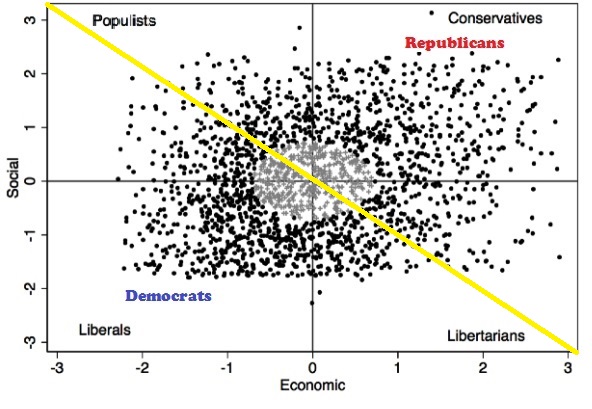
A few months ago, I posted the chart below, which was borrowed without permission from some political scientists who have studied the political ideologies of American voters.

Voters (the little dots) in the two rectangles on the left side of the chart are left-wingers on economic issues, e.g., in favor of increasing the minimum wage. Voters in the rectangles on the right side, however, are right-wingers on those issues, e.g., against increasing the minimum wage.

Going in the other direction, voters in the top rectangles are right-wingers on social issues, e.g. most likely against gay marriage. Those in the bottom two boxes are left-wingers on those issues, e.g. favoring gay marriage. (It’s a known fact that life is much simpler if you diagram it using x and y coordinates.)

Dems and Reps pops yellow

Now, however, the chart has some color to represent people who tend to vote for Democrats and those who tend to vote for Republicans. (Another interruption: did whoever picked blue for Democratic states pick that color instead of red — the traditional color of the left — because red would have suggested Democrats are a bunch of commies?)

Since we’ve only got two big political parties, the populists and libertarians who want to participate in elections often end up choosing between Democratic and Republican candidates. As a rule, the populists and libertarians to the right of the yellow line will vote for Republicans, while the populists and libertarians to the left of the yellow line will tend to vote for Democrats. In similar fashion, people who run for public office will generally join the Democratic or Republican party, depending on the relative strength of their various social and economic beliefs (putting aside any tactical reasons for running in one party or the other).

To use the standard terminology, the left-of-the-yellow-line libertarians tend to be “civil” libertarians (maybe even members of the ACLU), while the right-of-the-yellow-line libertarians tend to be “economic” libertarians (maybe they donate to the Cato Institute). 

Unfortunately, aside from allowing me to play with this great chart, the only point of this discussion so far is to emphasize that there are degrees of commitment to the four political ideologies the chart represents. Someone like Senator RP, for example, who is known for his libertarian tendencies, decided at some point to identify himself as a Republican, apparently because his left-wing, social, civil libertarian views (of which he seems to have some) were weaker than his right-wing, economic libertarian views (of which he definitely has some).

All of which serves, finally, as preface to some general remarks about Republican-leaning economic libertarians (which I’ve reorganized as Part 4, because Part 3 doubled in size, even corrected for inflation).