Brief Political Commentary

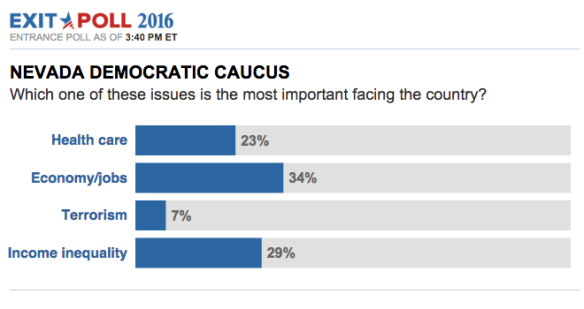
Voters who attended the Democratic caucuses in Nevada yesterday were asked to identify the most important issue facing America. 34% said the economy and jobs; 7% said terrorism.

NVDem_Issues_02202016

Voters in the Republican primary in South Carolina were asked the same question. 28% said the economy and jobs, but 32% said terrorism.

SGOP_IssuesV2_02202016I haven’t been able to determine whether the Democrats and Republicans were given the same list of issues to choose from, but it’s still remarkable that one-third of Republican voters chose terrorism as the most important issue we face. In fact, it’s remarkable that 7% of the Democrats said the same thing.

Unless these people think there is a strong chance that terrorists (of whatever political persuasion, not just Islamic fundamentalists) will attack America with nuclear or biological weapons, it’s silly to put terrorism at the top of the list. (In fact, given how silly it is, I have to wonder – mostly facetiously – whether some of those Democrats were devious Republicans attending the Democratic caucuses in order to make trouble, something the rules in Nevada allowed).

Here in New Jersey, we don’t get to participate in the nomination process until June, when it won’t matter what we think or how we vote. But if anyone asked me, I’d put global warming first, because of its possibly catastrophic consequences. After that, it would be hard to choose between the economy and jobs; money in politics; and the number of Americans who have lost their minds and vote for Republicans.

Bias or Good Sense?

Now that I’ve finished going through all but the philosophy books, I can get back to exercising my fingers and your patience here at WOCS.

So Vox has an article about the increasing animosity between Democrats and Republicans. According to opinion polls, most Americans used to be relatively tolerant toward other political beliefs. For example, back in 1960, only 4 or 5% of us said we’d care if our child married a member of that other (obviously misguided) party.

Then, beginning around 1980 (wasn’t there a Presidential election that year?), politics started getting more personal (why, as a matter of fact, there was!). In fact, by 2010, 33% of Republicans and 27% of Democrats admitted that such a marriage would make them uncomfortable. I bet the percentages have gone up since then.

Data like this suggests that our politics is becoming a bigger part of our personal identity. Whether you are a Republican or Democrat defines what kind of person you are. It particular, it defines you as the bad kind or the good kind.  

The Vox article implies that the degree of animosity one feels toward supporters of that other party reflects one’s bias. The more upset you would be if your child married a Democrat or a damn Republican, the more biased you are. 

Vox even allows you to take a little test to measure your bias. It’s one of those “implied bias” exercises that measures how quickly you associate something (in this case, a political party) with words like “good” and “bad”. Quick responses are said to indicate strong associations and fundamental beliefs; slow responses indicate the opposite. (I’ll wait here if you want to take the test. It’s right after the article’s third paragraph.)

I took the test myself and even accept the results. In fact, I was pleased by the results. I wear my “bias” as a badge of honor!

Here’s my score:

test 1

That’s me way over on the very far left. I’m basically off the chart in my animosity toward Republicans. But whether this demonstrates bias or good sense is a matter of opinion. (I lean toward “good sense”.)

Anyway, it seems as if we Americans are dividing into increasingly distinct political tribes, which will lead to more paralysis, discord and even discrimination. Unless, of course, a threat from a common enemy brings us together. That’s what happened in 1941 when Japan attacked Pearl Harbor, as discussed in an interesting book called Those Angry Days: Roosevelt, Lindbergh and America’s Fight Over World War II. 

The level of animosity between the “isolationists” (who desperately wanted us to avoid another war in Europe) and the “interventionists” (who wanted us to do whatever we could to stop Hitler) is amazing. Organizations were formed; mass meetings were held; national radio broadcasts were delivered. Insults were hurled. Friendships were destroyed. And suddenly, we all had somebody else to be angry with. When President Roosevelt asked for a declaration of war, even the isolationist Republicans in Congress gave him a standing ovation.

Unfortunately, I’m not sure we could even agree on what constitutes a paramount common enemy. Violent Muslim fundamentalists? Not dangerous enough. Global warming? Not quick enough. Maybe we’ll get lucky and Earth will be attacked by space ants or the rulers of Omicron Persei 8. But even that might not work

Automatic Weapons Again

A statistic from Vox:  More Americans have been killed with guns since 1968 than have died in all of our wars going back to 1776. 

Now, we all know that the purpose of “automatic” weapons is to disable or kill many people very quickly. Rational Americans understand that no private citizen should legally possess powerful weapons of this kind or the ammunition that goes with them. The Constitution doesn’t give us the right to bear any kind of “arms” no matter how dangerous. Making these weapons illegal does not require going down the slippery slope to banning all firearms. The United States isn’t going to invade Texas and even Texas isn’t the Wild West. More guns and more powerful guns means more innocent people being maimed and killed.  

But if law-abiding citizens don’t own such weapons, only criminals will! That’s exactly right. Police and the armed forces will have access to these weapons in case they’re needed. Anybody else who has an automatic weapon will be and should be a criminal.

From New York Times op-ed writer Timothy Egan’s article about our latest massacre:

A day after the California carnage, the Senate decided to do nothing, again, voting down a measure that would have made it more difficult for people on the terror watch list, felons and the mentally ill to buy guns.

Well, it wasn’t as if the whole Senate made that decision:

YEAs (Do Something) — 45
Baldwin (D-WI)
Bennet (D-CO)
Blumenthal (D-CT)
Booker (D-NJ)
Boxer (D-CA)
Brown (D-OH)
Cantwell (D-WA)
Cardin (D-MD)
Carper (D-DE)
Casey (D-PA)
Coons (D-DE)
Donnelly (D-IN)
Durbin (D-IL)
Feinstein (D-CA)
Franken (D-MN)
Gillibrand (D-NY)
Heinrich (D-NM)
Hirono (D-HI)
Kaine (D-VA)
King (I-ME)
Kirk (R-IL)
Klobuchar (D-MN)
Leahy (D-VT)
Manchin (D-WV)
Markey (D-MA)
McCaskill (D-MO)
Menendez (D-NJ)
Merkley (D-OR)
Mikulski (D-MD)
Murphy (D-CT)
Murray (D-WA)
Nelson (D-FL)
Peters (D-MI)
Reed (D-RI)
Reid (D-NV)
Sanders (I-VT)
Schatz (D-HI)
Schumer (D-NY)
Shaheen (D-NH)
Stabenow (D-MI)
Tester (D-MT)
Udall (D-NM)
Warren (D-MA)
Whitehouse (D-RI)
Wyden (D-OR)
NAYs (Do Nothing) — 54
Alexander (R-TN)
Ayotte (R-NH)
Barrasso (R-WY)
Blunt (R-MO)
Boozman (R-AR)
Burr (R-NC)
Capito (R-WV)
Cassidy (R-LA)
Coats (R-IN)
Cochran (R-MS)
Collins (R-ME)
Corker (R-TN)
Cornyn (R-TX)
Cotton (R-AR)
Crapo (R-ID)
Cruz (R-TX)
Daines (R-MT)
Enzi (R-WY)
Ernst (R-IA)
Fischer (R-NE)
Flake (R-AZ)
Gardner (R-CO)
Graham (R-SC)
Grassley (R-IA)
Hatch (R-UT)
Heitkamp (D-ND)
Heller (R-NV)
Hoeven (R-ND)
Inhofe (R-OK)
Isakson (R-GA)
Johnson (R-WI)
Lankford (R-OK)
Lee (R-UT)
McCain (R-AZ)
McConnell (R-KY)
Moran (R-KS)
Murkowski (R-AK)
Paul (R-KY)
Perdue (R-GA)
Portman (R-OH)
Risch (R-ID)
Roberts (R-KS)
Rounds (R-SD)
Rubio (R-FL)
Sasse (R-NE)
Scott (R-SC)
Sessions (R-AL)
Shelby (R-AL)
Sullivan (R-AK)
Thune (R-SD)
Tillis (R-NC)
Toomey (R-PA)
Vitter (R-LA)
Wicker (R-MS)

So, I have two recommendations. The first is for Democrats (D) and Independents (I): 

Support rational gun control, do what you can to make your position known and always vote, but never, ever vote for a Republican. 

The second is for Republicans (R):

Seek treatment from a qualified mental health professional. 

~~~~~

Times columnist Gail Collins describes some of the rationalizations offered by Republican politicians in support of doing nothing.

What Hath God Wrought: The Transformation of Ameria, 1815 -1848 by Daniel Walker Howe

What Hath God Wrought is an 850-page entry in a well-written series of books called “The Oxford History of the United States”. It covers the period between the War of 1812 and the Mexican War, part of our national history that is overshadowed by what came before and what came after.

In roughly thirty years, America became much more recognizably modern. Improved transportation (railroads) and communications (the telegraph) had widespread effects. Modern political parties were created and the population became more diverse as immigration increased. The population soared. The women’s rights movement began.

In fact, Howe points out that President James Polk, an obscure figure today, added more territory to the United States than any other President, even more than Jefferson added with the Louisiana Purchase. By the end of Polk’s four-year term, everything from the Pacific Ocean to the Rocky Mountains, as well as Texas, was American territory.

The principal lesson I took from this long book, however, was that the same political divisions we find today were already in evidence before the Civil War. The Whigs, as exemplified by John Quincy Adams and Henry Clay, were the progressive political party. They wanted slavery eliminated and federal money spent on infrastructure. Abraham Lincoln was elected to Congress as a Whig.

The Democrats, as exemplified by Andrew Jackson and Polk, were basically white supremacists. They preferred a weak federal government that wouldn’t interfere with slavery. Yet they supported territorial expansion by any means, including the extermination of the Indians and armed aggression against Mexico. 

In other words, the early Democrats (especially Jackson) were real bastards. The Whigs weren’t. But now we have the Republicans, the progressive successor to the Whigs, as the war-mongering, white-supremacist party, and the Democrats as the modern-day Whigs. The Republicans are now the real Party of Jackson, while the Democrats are the real Party of Lincoln.

If You Have To Ask (World Travel Edition)

If someone in your house subscribes to the National Geographic Society’s magazine and your zip code implies relative affluence, you probably received a very nice booklet in the mail entitled “National Geographic 2016/2017 Private Jet Expeditions”.

Ours came yesterday. It’s the kind of mail that has “recycling bin” all over it, but my curiosity was piqued. What the hell is a “private jet expedition”?

It turns out that National Geographic offers four such tours, each lasting about three weeks. One of them takes you around the world. You leave Orlando, Florida, and then visit places like Machu Picchu, Easter Island, Angkor Wat, the Serengeti and Marrakesh, before returning to Orlando. (They do let you off the plane to walk around and sleep in a nice bed – you’re not seeing everything from 20,000 feet.)

Another trip is advertised as “around the world”, but doesn’t quite make it. You board your private jet in Seattle, take a northern route, mostly across Asia, and are then deposited in Boston, 3,000 miles from where you started.

The other two trips are even more geographically limited. One begins and ends in London, with stops in places like Mongolia, Sri Lanka, Ethiopia and Israel. The other starts in Orlando and includes South America, the South Pacific, China and Japan, before inexplicably dropping you off in Seattle.

But how private is this jet anyway? I figured it must be one of those Gulfstream jobs that movie stars and titans of industry enjoy. They probably carry 10 or 20 people at most. 

Unfortunately, the National Geographic’s plane isn’t that private. You ride in “two-by-two VIP-style seats” that look really comfortable, but your “specially outfitted Boeing 757” has room for 75 other passengers.  

Thinking about this, I suppose I could handle the lack of exclusivity, but being on a tour with 75 other world travelers, plus the flight crew, plus the various guides and lecturers, plus the staff photographer, plus the on-call-24-hours-a-day physician, doesn’t seem exactly “private” to me.

Being familiar with that old expression “if you have to ask …”, I went ahead and asked (myself) anyway. The bad news is that the most expensive trip (the one that goes around the world and thoughtfully brings you back to where you started) costs $79,950. With sales tax, let’s call it $80,000. The cheapest trip goes for $67,950. But seriously, who would want to experience a bunch of exotic locations with a down-market group like that?

By the way, those prices are per person with double occupancy. If you don’t want company at night, it’s another $8,000 or so.

To sum up, if you and your significant other select one of these expeditions, your total bill will be around $150,000, maybe more, maybe less (hotel minibar and laundry, among other things, not included).

I don’t know why, but the booklet indicates that this is “sustainable travel”. Sadly, it doesn’t look like anything I’ll be sustaining any time soon. If you’re in the market, however, and you inadvertently recycled your booklet, you can get more information at National Geographic Expeditions. But if you’re as unimpressed by their definition of “travel by private jet” as I am, you might want to visit here instead.

So have a wonderful time, take lots of pictures, vaya con dios and don’t forget your yellow fever shot! Proof of inoculation is required.