A Smart, Informed Journalist Interviews Hillary Clinton

Ezra Klein, the editor-in-chief of Vox, interviewed Hillary Clinton for 51 minutes this week. I thought she avoided answering one question. It was something like, how would you rate American voters in general? Aside from that, I was tremendously impressed. It is a tragedy that she lost.

A few topics discussed:

16:00  How the media handled the presidential campaign

17:45  Healthcare, including the important distinction between universal care, which should be our goal, and single-payer, which is only one way, and probably not the best way, to get universal care

26:30  American politics today

36:00  The 2016 election

42:00  How women voted

44:50   The effect of the Comey letter plus the Electoral College, voter suppression and dangers ahead.


Reading About Hitler Makes Me Think of Someone Else

I’m about halfway through Hitler: Ascent 1889 – 1939 by the German historian Volker Ullrich. It’s 1932 and Hitler is on the verge of becoming the German chancellor. I’ve learned a lot about Hitler’s rise to power. At the same time, I can’t stop noticing similarities between Hitler and our president.

I wish I’d been taking notes all along, so I could be specific, but it’s hard not to be reminded of the president when reading about Hitler’s lies, exaggerations, insecurities, misconceptions, exorbitant promises and celebration of violence. There’s his successful use of the media, his ability to excite a crowd of admirers, his reliance on certain emotional catchphrases, his need for total loyalty, the way he pits his underlings against each other and, of course, his targeting of scapegoats to explain all of the world’s ills.

There is also the reaction of some contemporary observers to the possibility that a man like him might rule the nation. Paul von Hindenburg, a military commander in World War I, had been the German chancellor since 1925. He was 84 and ill when he agreed to seek the office again in 1932, partly because he was thought to be the only candidate who could beat Hitler. The left-wing Social Democrats didn’t even nominate a candidate. They threw their support to Hindenburg, even though Hindenburg was a right-winger, because they were so afraid of the alternative. From the Social Democratic Party’s newspaper:

Hitler in place of Hindenburg means chaos and panic in Germany and the whole of Europe, an extreme worsening of the economic crisis and of unemployment, and the most acute danger of bloodshed within our own people and abroad. Hitler in place of Hindenburg means the triumph of the reactionary part of the bourgeoisie over the progressive middle classes and the working class, the destruction of all civil liberties, of the press and of political, union and cultural organizations, increased exploitation and wage slavery.

The declaration ended with: “Defeat Hitler! Vote for Hindenburg!”

A journalist noted: 

What a bizarre country. Hindenburg as the pet of the pro-democracy camp. Years ago when I heard of his election … I threw up out of fear and horror. Today, in the face of the fascist threat, a democrat has to anxiously hope for Hindenburg’s re-election.

The Nazis attacked Hindenburg on the basis that leftists were supporting his candidacy (“Tell me who praises you and I’ll tell you who you are!”), as if the leftists truly admired Hindenburg and weren’t supporting him simply as the lesser of two evils. A leader of the Social Democrats responded: 

If there is one thing we admire about National Socialism, it’s the fact that it has succeeded, for the first time in German politics, in the complete mobilization of human stupidity.

That reminds me of the present moment too.

The Truth Still Matters

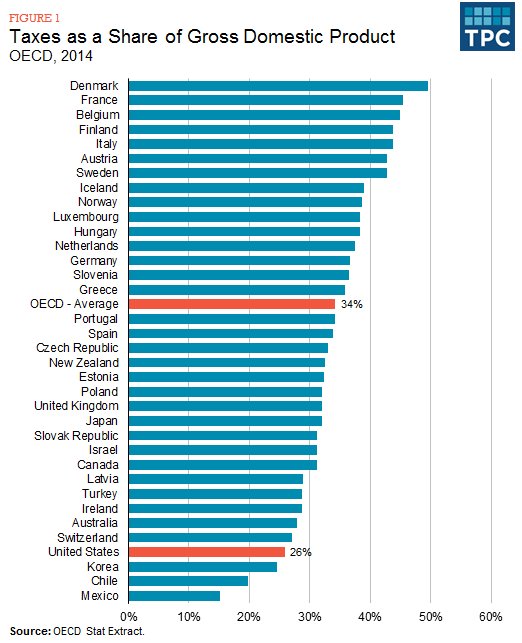
Will be going to North Dakota today to discuss tax reform and tax cuts. We are the highest taxed nation in the world – that will change.

— Donald J. Trump (@realDonaldTrump) September 6, 2017

But the truth still matters:
oecd tax burdens

The chart includes individual and corporate taxes, as well as local taxes, as reported by the 35-nation Organisation for Economic Co-operation and Development.

For some historical perspective, consider “When the Rich Said No to Getting Richer” by from David Leonhardt of The New York Times:

A half-century ago, a top automobile executive named George Romney — yes, Mitt’s father — turned down several big annual bonuses. He did so, he told his company’s board, because he believed that no executive should make more than $225,000 a year (which translates into almost $2 million today).

He worried that “the temptations of success” could distract people from more important matters, as he said to a biographer, T. George Harris. This belief seems to have stemmed from both Romney’s Mormon faith and a culture of financial restraint that was once commonplace in this country.

Romney didn’t try to make every dollar he could, or anywhere close to it. The same was true among many of his corporate peers. In the early 1960s, the typical chief executive at a large American company made only 20 times as much as the average worker, rather than the current 271-to-1 ratio. Today, some C.E.O.s make $2 million in a single month.

The old culture of restraint had multiple causes, but one of them was the tax code. When Romney was saying no to bonuses, the top marginal tax rate was 91 percent. Even if he had accepted the bonuses, he would have kept only a sliver of them.

The high tax rates, in other words, didn’t affect only the post-tax incomes of the wealthy. The tax code also affected pretax incomes. As the economist Gabriel Zucman says, “It’s not worth it to try to earn $50 million in income when 90 cents out of an extra dollar goes to the I.R.S.”

The tax rates helped create a culture in which Americans found gargantuan incomes to be bizarre.

A few years after Romney turned down his bonuses from the American Motors Corporation, Lyndon B. Johnson signed legislation that lowered the top marginal tax rate to 70 percent. Under Ronald Reagan, it dropped to 50 percent and kept falling. Since 1987, the top rate has hovered between 30 percent and 40 percent.

For more than 30 years now, the United States has lived with a top tax rate less than half as high as in George Romney’s day. And during those same three-plus decades, the pay of affluent Americans has soared. That’s not a coincidence. Corporate executives and others now have much more reason to fight for every last dollar.

And fight they do (it’s called “class warfare”).

Meanwhile, the president* is unnecessarily threatening hundreds of thousands of young people brought to this country by their parents and another extremely dangerous hurricane is on its way. This is further evidence that Republicans are evil and global temperatures are rising, but you already knew that.

Update:  John McCain, the Republican senator who talks a good game but can’t be relied on, has changed his mind about repealing the Affordable Care Act. He now says he’d vote Yes on what is “in may ways … the most radical” repeal bill yet. Further evidence for [see above]. 

2nd Update: McCain now says he would only vote for repeal if the legislation survived committee hearings and was subject to amendments proposed by both sides. That’s not what the 81-year old senator implied earlier today. This latest announcement is good news, because the repeal legislation is extremely unlikely to pass if it’s subject to “normal order” in the Senate instead of being rushed through. 

Authoritarian Americans Have Found Their Authoritarian

From Eric Levitz of New York Magazine:

[DT] won the GOP nomination, and then the presidency, as a different kind of Republican — one who backed radical restrictions to immigration, trade protectionism, infrastructure stimulus, universal health care, a Jacksonian foreign policy that spurned both nation-building and international law, and maintaining Social Security and Medicare at their current benefit levels. In his shambolic, improvisatory way, [he] had articulated a new vision for the American right, one that combined rabid nativism with welfare chauvinism, economic nationalism, and neo-isolationism.

Last night, [he] declared his support for prolonging America’s war in Afghanistan indefinitely. Last week, his administration’s lone proponent of a break with conservative economics was exiled from the White House. Over the last seven months, [the president*] has proven himself a loyal servant of the GOP Establishment’s agenda, as he’s pushed for draconian cuts to entitlement programs that he’d promised to protect; avoided trade wars, while dutifully prosecuting actual ones; let corporate interests dictate regulatory policy; and touted tax cuts for the rich as a panacea for all that ails the American economy….

The president may have abandoned most of his heterodox policy views, but he’s yet to back away from the true core of his political philosophy, a creed that can be summarized in two words: “Trump first.” And given the choice between the House GOP’s movement conservatism and the president’s maniacal narcissism, a lot of Republican voters are picking the latter. As Politico reports:

“Taxes, spending and even health care have taken a back seat to the most potent new litmus test in Republican primaries: allegiance to President Donald Trump.”

“… Loyalty to Trump has quickly become the most potent issue for the Republican base, according to a dozen candidates and strategists immersed in 2018 races. [Perceived disloyalty] has already put Sens. Jeff Flake and Dean Heller under pressure in their states, sparked bickering between GOP candidates in two of Republicans’ top 2018 targets, Indiana and West Virginia, and sunk one candidate running for Alabama’s open Senate seat.”

“… One Republican strategist said polling shows staunch support of Trump is the top attribute primary voters are seeking in candidates right now. At least one-third of GOP primary voters identify themselves as “Trump Republicans” (as opposed to “tea party Republicans” or “mainstream Republicans”) in state after state, according to internal polling conducted by a Republican group, with that number reaching 40 percent in some states.”

One could argue that most “Trump Republicans” root their political identity in an ideological stance — specifically, support for nativism. Immigration has always been the mogul’s signature issue, and one that genuinely divides the GOP’s “elites” from its grassroots.

But in Republican primaries this year, debates over loyalty to Trump have often been divorced from all policy questions, with candidates touting fealty to the president’s cult of personality as a defining value, in itself. 

They like him. They really like him. The minority of Americans who want a “strong leader” above all else, a President who will anger, punish or kill their perceived enemies – or at least promise to in “strong language” – have found their object of devotion. They won’t be argued out of their loyalty, even when he fails to deliver on his promises. When he fails, he will see it as the work of his enemies. That’s exactly how his devoted followers, the authoritarian minority among us, will see it too. 

If You’re a Russian Twitter Bot, What’s On Your Mind?

In 1972, the German government founded the German Marshall Fund of the United States (GMF), a foundation and think tank in Washington. It was a gift to the American people in recognition of how the Marshall Plan helped rebuild Germany after World War 2.

The GMF has now created Hamilton 68, a site that allows “tracking Russian influence operations on Twitter”. (The name refers to Alexander Hamilton’s Federalist Papers No. 68, in which he discussed foreign meddling in our elections.) If you visit the new Disinformation Dashboard, you can see what stories and topics Russia is pushing today. From today’s “Top Themes”:

The networks we track are engaged in disinformation. They amplify legitimate reporting when the content suits them, and they promote alternative media outlets that seemingly specialize in the production of disinformation, whether or not the outlets are controlled by the Kremlin. These outlets assemble stories from found objects – bits of information that may have some basis in reality. The final product will leap to conclusions the components of the story do not necessarily support, but which promote a distorted view of events to the Kremlin’s benefit. This past week we have seen Kremlin-oriented Twitter promoting content regarding non-lethal U.S. military assistance to Ukraine. Reality: the U.S. Navy is helping construct a naval operations center at Ochakiv. The promoted stories at Stalker Zone and Strategic Culture turn that into: “The Entire Black Sea Coast of Ukraine Will Become a U.S. Military Base” and “U.S. Military to be Permanently Stationed on [Ukraine] Soil” respectively. Such stories are produced continuously. Their effectiveness is based on cumulative impact.

Side note: A coherent response to events on the weekend in Charlottesville has not yet emerged (as of August 16), though we continue to watch for one.

They’re currently monitoring 600 Twitter users, “properly understood as a network of accounts linked to and participating in Russian influence campaigns”, officially or unofficially, knowingly or unknowingly. These include:

  • Accounts likely controlled by Russian government influence operations.
  • Accounts for “patriotic” pro-Russia users that are loosely connected or unconnected to the Russian government, but which amplify themes promoted by Russian government media.
  • Accounts for users who have been influenced by the first two groups and who are extremely active in amplifying Russian media themes. These users may or may not understand themselves to be part of a pro-Russian social network. 

Today’s top Russian tweet, according to the Disinformation Dashboard, happens to be from the government-run RT network (formerly Russia Today):

Twitter user avatar @RT_com
Petition urges Trump to recognize Antifa as terrorists, reaches 55,000 signatures in 2 days https://t.co/toDhxusjll https://t.co/SV3TfIxVUD
Retweeted 566 times

The top Russia hashtags for the past 48 hours have been “antifa” (anti-fascist), “maga” (Make America Great…), “boston”, “syria”, “isis” and “altleft”. 

By the way, according to something called TwitterAudit.com, roughly 40% of DT’s 36 million followers are automated (i.e. fake).

Shining light on Russia’s propaganda efforts is a good thing, but I’d feel better if the president* and his minions were doing something to protect our upcoming elections. They’re not, because Russia is on their side.

Dashboard

Note: Whoever designed this graphic for GMF showing Putin releasing all those Twitter birds might as well have left the birds blue. Russia isn’t a Communist country anymore. It’s a right-wing kleptocracy, which is why the president* and other right-wing fanatics are so pro-Russia now. Putin leads the kind of government they aspire to.