Suckers!

Although Trump voters, on average, had higher incomes than Clinton voters, many of his supporters were and continue to be working class or even poor (and predominantly white, of course). He may have been rich, the epitome of a city slicker, but millions of average people (also known as “suckers”) believed that he’d fight for them.

From Ezra Klein of Vox:

Tax cuts for wealthy Americans have long been the fulcrum atop which Republican Party politics rests. But Donald Trump was supposed to be a different kind of Republican. On 60 Minutes, for instance, Trump said he would raise taxes on “the very wealthy,” and warned that the plan would cost him “a fortune” in higher taxes.

“My whole life I’ve been greedy, greedy, greedy,” Trump said in January of 2016. “I’ve grabbed all the money I could get. I’m so greedy. But now I want to be greedy for the United States.”

The whole Trump pitch was that he was a cutthroat businessman who knew the tricks, had paid off the politicians, had made his billions, and now was going to use his accumulated knowledge to unrig the system, to make it benefit you, the little guy. American politics, he said, was corrupted — by special interests, by self-dealing politicians, by weak negotiators. He was going to fix it all. And many believed him.

In Trump’s inaugural address he said, “What truly matters is not which party controls our government, but whether our government is controlled by the people. January 20, 2017, will be remembered as the day the people became the rulers of this nation again. The forgotten men and women of our country will be forgotten no longer.”

This rhetoric continued after the election: Both Trump’s Treasury secretary and the director of his National Economic Council said the plan wouldn’t cut taxes on the rich. As recently as a few weeks ago, Trump told Senate Democrats, “The deal is so bad for rich people, I had to throw in the estate tax just to give them something.”

In reality, by 2027, 62.1 percent of the tax bill’s benefits go to the top 1 percent, and 42.3 percent of the benefits go to the top 0.1 percent [while millions of lower income taxpayers will see their taxes increase].

The moral of this story is: Never trust a con man when he says he’s on your side.

(But if you insist on trusting a con man, don’t inflict him on the rest of us.)

One of Those Charts

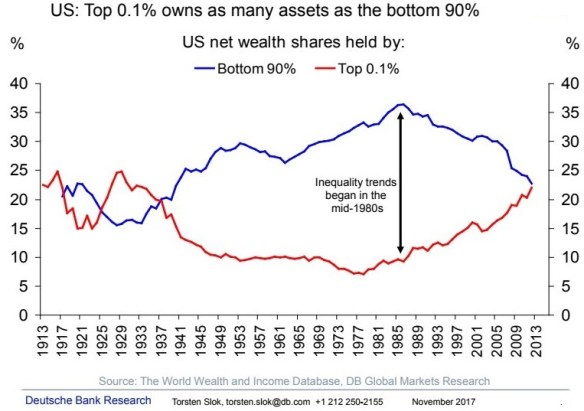
The last time we had a big overhaul of the federal tax code was in 1986. Back then, the poorest 90 percent of the population owned 3 1/2 times as much as the richest 1/10th of 1 percent. I’ll say that again. In 1986, the net worth of the least wealthy 90% of Americans was 3.5 times the net worth of the richest 0.1%.

That’s not the America we live in today. As of 2013, the richest 1/10th of 1 percent owned as much as the poorest 90 percent. To repeat: the net worth of the richest 0.1% was the same as the net worth of the poorest 90%. 

DQ9rJW2XcAAzXuK

I’m sure the red line goes even higher now and the blue line goes lower. We should keep this astounding economic inequality in mind when we have the opportunity to vote eleven months from now. That will be eleven months after the Republicans ram through another overhaul of the tax code, one that helps the richest Americans get even richer.

A Selection of Stuff You’d Rather Not Read About

Four articles that made an impression this week, from least to most depressing, that didn’t even mention Jerusalem, Puerto Rico, healthcare or starving polar bears.

One hundred and eighty-seven people are facing felony charges for participating in a demonstration in Washington D.C. that turned violent. The demonstration was on the day Trump was inaugurated. A trial is now underway. The depressing aspect of this story is that none of the six defendants are accused of doing anything aside from being there:

What jurors haven’t heard, and prosecutors don’t intend to offer, is evidence that any of the six individuals currently on trial … actually engaged in any property damage or violence. Under the government’s theory of the case, in which anyone arrested in the group is part of a conspiracy and is responsible for any actions taken by others, the lack of individualized wrongdoing doesn’t matter.

Maybe the jury will have the sense to acquit everyone and convince the government to stop these prosecutions.

Elsewhere in Washington, Republicans from the House and Senate are trying to reconcile the terrible tax bills they’ve recently passed. Could any of them read this article from The New York Times and say they were proud of their efforts so far?

… for the first time since the United States adopted an income tax, a higher rate would be applied to employee wages and salaries than to income earned by proprietors, partnerships and closely held corporations….

“We’ve never had a tax system where wage earners were substantially penalized” relative to other types of income earners, said … a former Treasury Department official….

Indeed, economists and tax experts across the political spectrum warn that the proposed system would invite tax avoidance. The more the tax code distinguishes among types of earnings, personal characteristics or economic activities, the greater the incentive to label income artificially, restructure or switch categories in a hunt for lower rates….

“The more you look at any of the major rules, the more ambiguities, glitches, clearly unintended consequences and tax planning opportunities you see,” said Michael L. Schler, a lawyer in the tax department of Cravath, Swaine & Moore. He has written a 50-page summary of the more glaring problems …

From Georgia Southern University, a professor named Jared Yates Sexton, who grew up in the South, writes about the fascism that runs in his family.

Eventually I left for college and found my own people who didn’t express such fascist and ignorant beliefs. I visited for the occasional holiday, kept in decent enough touch, but I felt confident knowing that people like my family would never be in charge of the country they understood so poorly….

They hoard weapons, supplies, and daydream about the day the government will fall and they’ll be free to remake the country as they see fit.

I cannot say they are fascists, but I can definitely say they hold fascist ideas. This is why they hardly blink when Donald Trump quickly erodes the normal order of the government, why they’re not concerned when he undermines the Freedom of the Press or cozies up to authoritarian leaders. They love it when he tells policemen to be rough on suspects. They want someone who plays nuclear chicken with a despot while the lives of hundreds of million innocent people lie in the balance.

Finally, speaking of nuclear chicken, Jeffrey Lewis, a “scholar at the Middlebury Institute of International Studies”, shares some really scary thoughts in The Washington Post. He imagines how a confrontation between North and South Korea might escalate, helped along by a morning tweet from the president, into nuclear war.

And so, facing what he believed was a massive American military invasion, Kim gave the order. The thread of history winds along on twists of fate, like Archduke Ferdinand’s driver missing a turn…

The U.S. Missile Defense Agency would later say this was a sign that the system had worked well, downing about a third of the missiles — although experts would argue that the low intercept rate resulted from problems that the Los Angeles Times had reported in 2017…. It seemed more likely, the experts said, that five of the missiles had simply broken up as they reentered the earth’s atmosphere.

The remaining seven nuclear warheads landed in the United States. These missiles were no more accurate than the others — but with 200-kiloton warheads, 10 times the power of the bomb that destroyed Hiroshima, close was enough to count in most cases.

I told you so.

My Country, ‘Tis of Thee

I was thinking about writing a post based on recent statements by Sen. Orrin Hatch (Republican, Utah) and Sen. Charles Grassley (Republican, Iowa), but an actual writer beat me to it.

From Paul Waldman of The Washington Post:

With Republicans well on their way to passing a dramatic overhaul of the tax code, they have presented to the public a sweeping, comprehensive vision not just of what taxes should look like, but of what government is there for, what our obligations are to one another, and even how each of us should think about our value as human beings. This is a moment of uncommon clarity.

…. Let’s start with Iowa’s Chuck Grassley, who made this comment on the estate tax:

“I think not having the estate tax recognizes the people that are investing,” Grassley said, “as opposed to those that are just spending every darn penny they have, whether it’s on booze or women or movies.”

Right now, the first $5.5 million of any estate is not subject to the tax. Because of that, fewer than one in 500 estates owes any tax at all. So Grassley is saying that 99.8 percent of Americans lead contemptible lives of waste and folly, while only that remaining sliver of the extra-wealthy have shown the virtue that should win their heirs the ability not to pay taxes on the fortunes bequeathed to them. The Senate bill would double the tax’s exemption, while the House bill would eliminate the tax entirely; depending on how the final version turns out, Eric Trump may finally be free of the fear that he’ll have to pay taxes on his inheritance.

Now let’s turn to Utah’s Orrin Hatch, who explained why, despite his support of a bill offering trillions of dollars in tax breaks to the wealthy and corporations, we absolutely must start slashing the social safety net immediately:

“I have a rough time wanting to spend billions and billions and trillions of dollars to help people who won’t help themselves, won’t lift a finger, and expect the federal government to do everything.”

… There isn’t much political advantage in saying that if you die with less than $5.5 million in assets, like nearly all Americans do, that means you were lazy and self-indulgent, while only the wealthy have proven their moral worth by the size of their bank accounts. So when someone says something like that, you can be pretty sure he’s expressing his actual beliefs….

Those are value judgments, rooted in how Republicans tend to view the worth of different people. They operate on the presumption that the economic system is fair, and the results of that system provide a measure of different people’s virtue. If you’re rich — even if you got rich by choosing the right parents — they presume that you deserve to be taxed as lightly as possible, while if you’re in need of the kinds of help we offer low-income people, then it reflects a moral failing. If we give you any help at all, it should be as grudging as possible, accompanied by stern lectures and even rituals of humiliation like drug tests.

Their tax bill, and their upcoming assault on the safety net, will weave these principles more deeply into our laws. And these principles are their real rationale; ignore all the practical claims they make about the explosion of economic growth these tax cuts will supposedly produce, and how the benefits will trickle down to everyone, and how it will all pay for itself. Those arguments are transparently bogus. A recent survey of 38 prominent economists found that only one said the tax bill would significantly increase growth…

Confronted with this comprehensive debunking of their practical claims, Republicans are undeterred and undaunted. That’s because they’re driven by a moral imperative, one that says that no matter what effect cutting taxes on the wealthy and corporations might have on the economy, it’s just the right thing to do. It rewards the virtuous, and you can tell who the virtuous are by how much money they have. If you’re asking why they wrote the bill the way they did, that’s just about all you need to know.

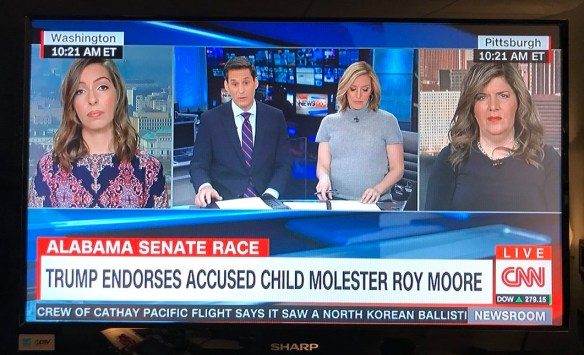
Meanwhile, our law-and-order president (sexual predator D. Trump) has endorsed former judge Roy Moore, who will probably join Grassley and Hatch in the Senate later this month:

DQNlvbQW0AEcCWY

My country, ’tis of thee,
Sweet land of liberty,
Of thee I sing….

If They Wanted Real Tax Reform

The big story in Washington this week is the Senate Republicans scrambling to pass a major tax bill that nobody but their donors and other members of the plutocracy likes. Assuming something like it eventually becomes law, it will give a temporary tax cut to most members of the middle class and raise taxes for others, while giving a permanent tax cut to rich people and corporations. It will also add more than a trillion dollars to the deficit while requiring billions of dollars to be cut from programs like Medicare. (There is a nice summary of the giant con here.)

Republicans and even some journalists are calling it “tax reform”, even though it will make our system of taxation worse than it already is.

Wondering what real reform would look like, I read a book called A Fine Mess: A Global Quest for a Simpler, Fairer and More Efficient Tax System. It’s by a journalist named T. R. Reid. After a lot of research and conversations with tax experts around the world, he reached the same conclusion most experts have. The simplest, fairest and most efficient system of taxation is based on the “Broad Base, Low Rate” (BBLR) model.

The BBLR idea is that countries should tax as much as possible while keeping rates as low as possible. So, in the case of income tax, it’s best to tax all kinds of income at the same low rate. That means getting rid of deductions, exemptions and credits, many of which benefit people with the highest incomes, while categorizing things like health insurance benefits from your employer as personal income. That’s the “broad base” part. Once you’ve broadened the base and made more income subject to taxation, you can then lower everyone’s rates (that, obviously, is the “low rate” part).

The BBLR approach has a number of benefits. Filing and auditing tax returns is far simpler. Since rates are low and everyone’s income is treated the same, fewer people are tempted to avoid or evade taxes. Also, decisions about things like buying a house or building a factory tend to be made on the merits, not on the basis of tax considerations.

Reid also thinks the U.S. should institute a Value Added Tax (VAT). It’s a kind of sales tax, but one that is applied at every step of the manufacturing or distribution process, i.e. whenever money changes hands. We are the only rich country in the world that doesn’t have a VAT. Since it’s a tax on consumption, not income or savings, a VAT apparently has beneficial effects on a nation’s economy. It’s also difficult to evade. That’s why everyone else has one.

Another change Reid recommends is to reduce taxes on corporations. The U.S. has a high corporate tax rate, which results in corporations devoting a lot of effort to reducing or even eliminating their taxes. He thinks it would be better if all of the income people receive from corporations, especially dividends and capital gains, were subject to the same tax rate as other income (today, supposedly in order to foster investment, that income is taxed at a lower rate, which again mainly helps the wealthy). In fact, in a very interesting article in The Washington Post earlier this month, Reid advocated eliminating the corporate tax altogether, since it doesn’t do what it’s supposed to do.

What surprised me most about A Fine Mess, however, was that some of the ideas Reid endorses are included in the Republican tax bill. (Seriously, it doesn’t happen very often that there is overlap between “Republican policy” and “good idea”.) For instance, the Republicans have talked about getting rid of the deductions for medical expenses, state and local taxes and interest on mortgages. They would try to offset the disappearance of those deductions by increasing the standard deduction and lowering everyone’s rates. The result would be that more income would be taxed, but at a lower rate (that’s BBLR). Another result, not so beneficial, would be that millions of average taxpayers, for example, those who have major medical expenses or live in states with high taxes or who have big mortgages, would get a tax increase, even if their tax rates were lowered.

Unfortunately, the Republicans want to combine their few good ideas with many bad ones. For example, they want to get rid of the estate tax, which only affects the truly wealthy, and give more favorable treatment to certain kinds of business income (it’s been said that the Republican tax plan could have been written by Trump’s accountant). They also want to reduce taxes on the rich so much that they’ll have to cut social programs like Medicare, while adding more than a trillion dollars to the deficit.

Reid points out that Congress tends to produce a major tax bill every 32 years. The last one was in 1986. Congress worked on it for two years. The bill had bipartisan support and actually deserved being called “tax reform”. This year, the Republicans are trying to pass their bill in a matter of weeks, without hearings and without input from the Democrats. That indicates how screwed up our government is and how far away we are from getting actual reform.