The Late Molly Ivins on Limbaugh

Talk radio blowhard Rush Limbaugh (1951-2021) is no longer taking calls from his devoted listeners. Texas writer Molly Ivins summed up Limbaugh for Mother Jones in 1995:

One of the things that concerns a lot of Americans lately is the increase in plain old nastiness in our political discussion. It comes from a number of sources, but Rush Limbaugh is a major carrier.

I should explain that I am not without bias in this matter. I have been attacked by Rush Limbaugh on the air, an experience somewhat akin to being gummed by a newt. It doesn’t actually hurt, but it leaves you with slimy stuff on your ankle.

I have a correspondent named Irwin Wingo in Weatherford, Texas. Irwin and some of the leading men of the town are in the habit of meeting about 10 every morning at the Chat’n’Chew Cafe to drink coffee and discuss the state of the world. One of their number is a dittohead, a Limbaugh listener. He came in one day, plopped himself down, and said, “I think Rush is right: Racism in this country is dead. I don’t know what the n____s will find to gripe about now.”

I wouldn’t say that dittoheads, as a group, lack the ability to reason. It’s just that whenever I run across one, he seems to be at a low ebb in reasoning skills. Poor ol’ Bill Sarpalius, one of our dimmer Panhandle congressmen, was once trying to explain to a town hall meeting of his constituents that Limbaugh was wrong when he convinced his listeners that Bill Clinton’s tax package contained a tax increase on the middle class. (It increased taxes only on the wealthiest 2 percent of Americans.) A dittohead in the crowd rose to protest: “We don’t send you to Washington to make responsible decisions. We send you there to represent us.”

[Note: If this sounds quite familiar, a Republican official from Pennsylvania was discussing Sen. Pat Toomey, one of the Republicans who voted to convict last week, and said: “We did not send him there to vote his conscience. We did not send him there to ‘do the right thing’ or whatever”. Now back to Molly Ivins.]

The kind of humor Limbaugh uses troubles me deeply, because I have spent much of my professional life making fun of politicians. I believe it is a great American tradition and should be encouraged. . . . So what right do I have to object because Limbaugh makes fun of different pols than I do?

I object because he consistently targets dead people, little girls, and the homeless—none of whom are in a particularly good position to answer back. Satire is a weapon, and it can be quite cruel. It has historically been the weapon of powerless people aimed at the powerful. When you use satire against powerless people, as Limbaugh does, it is not only cruel, it’s profoundly vulgar. It is like kicking a cripple.

On his TV show, early in the Clinton administration, Limbaugh put up a picture of Socks, the White House cat, and asked, “Did you know there’s a White House dog?” Then he put up a picture of Chelsea Clinton, who was 13 years old at the time and as far as I know had never done any harm to anyone.

When viewers objected, he claimed, in typical Limbaugh fashion, that the gag was an accident and that without his permission some technician had put up the picture of Chelsea—which I found as disgusting as his original attempt at humor. . . .

The reason I take Rush Limbaugh seriously is not because he’s offensive or right-wing, but because he is one of the few people addressing a large group of disaffected people in this country. And despite his frequent denials, Limbaugh does indeed have a somewhat cultlike effect on his dittoheads. They can listen to him for three and a half hours a day, five days a week, on radio and television. I can assure you that [cult leader] David Koresh did not harangue the Branch Davidians so long nor so often. But that is precisely what most cult leaders do—talk to their followers hour after hour after hour.

A large segment of Limbaugh’s audience consists of white males, 18 to 34 years old, without college education. Basically, a guy I know and grew up with named Bubba.

Bubba listens to Limbaugh because Limbaugh gives him someone to blame for the fact that Bubba is getting screwed. He’s working harder, getting paid less in constant dollars and falling further and further behind. Not only is Bubba never gonna be able to buy a house, he can barely afford a trailer. Hell, he can barely afford the payments on the pickup.

And because Bubba understands he’s being shafted, even if he doesn’t know why or how or by whom, he listens to Limbaugh. Limbaugh offers him scapegoats. It’s the “feminazis.” It’s the minorities. It’s the limousine liberals. It’s all these people with all these wacky social programs to help some silly, self-proclaimed bunch of victims. Bubba feels like a victim himself—and he is—but he never got any sympathy from liberals.

Psychologists often tell us there is a great deal of displaced anger in our emotional lives—your dad wallops you, but he’s too big to hit back, so you go clobber your little brother. Displaced anger is also common in our political life. We see it in this generation of young white men without much education and very little future. . . . Unfortunately, it is Limbaugh and the Republicans who are addressing the resentments of these folks, and aiming their anger in the wrong direction.

In my state, I have not seen so much hatred in politics since the heyday of the John Birch Society in the early 1960s. Used to be you couldn’t talk politics with a conservative without his getting all red in the face, arteries standing out in his neck, wattles aquiver with indignation—just like a pissed-off turkey gobbler. And now we’re seeing the same kind of anger again.

Fairness & Accuracy in Reporting [FAIR] . . . has a sweet, gentle faith that truth will triumph in the end, and thinks it is sufficient to point out that Limbaugh is wrong. I say it’s important to point out that he’s not just wrong but that he’s ridiculous, one of the silliest people in America. . . .

It’s important to show people that there is much more wrong with Limbaugh’s thinking than just his facts. Limbaugh specializes in ad hominem arguments, which are themselves ridiculously easy to expose. Ted Kennedy says, “America needs health care reform.” Limbaugh replies, “Ted Kennedy is fat.”

Rush Limbaugh’s pathetic abuse of logic, his absurd pomposity, his relentless self-promotion, his ridiculous ego—now those, friends, are appropriate targets for satire.
The Pandemic’s Economic Pain Hasn’t Been Shared

From The Associated Press:

In a stark sign of the economic inequality that has marked the pandemic recession and recovery, Americans as a whole are now earning the same amount in wages and salaries that they did before the virus struck — even with nearly 9 million fewer people working.

The turnaround in total wages underscores how disproportionately America’s job losses have afflicted workers in lower-income occupations rather than in higher-paying industries, where employees have actually gained jobs as well as income since early last year.

In February 2020, Americans earned $9.66 trillion in wages and salaries, at a seasonally adjusted annual rate, according to the Commerce Department data. By April, after the virus had flattened the U.S. economy, that figure had shrunk by 10%. It then gradually recovered before reaching $9.67 trillion in December, the latest period for which data is available.

Those dollar figures include only wages and salaries that people earned from jobs. They don’t include money that tens of millions of Americans have received from unemployment benefits or the Social Security and other aid that goes to many other households. The figures also don’t include investment income.

A separate measure tracked by the Labor Department shows the same result: Total labor income, excluding government workers, was 0.6% higher in January than it was a year earlier.

That is “pretty remarkable,” given the sharp drop in employment, said Michael Feroli, an economist at JPMorgan Chase.

The figures document that the vanished earnings from 8.9 million Americans who have lost jobs to the pandemic remain less than the combined salaries of new hires and the pay raises that the 150 million Americans who have kept their jobs have received.

The job cuts resulting from the pandemic recession have fallen heavily on lower-income workers across the service sector — from restaurants and hotels to retail stores and entertainment venues. By contrast, tens of millions of higher-income Americans, especially those able to work from home, have managed to keep or acquire jobs and continue to receive pay increases.

“We’ve never seen anything like that before,” said Richard Deitz, a senior economist at the Federal Reserve Bank of New York, referring to the concentration of job losses. “It’s a totally different kind of downturn than we’ve experienced in modern times.”

Of the nearly 10 million jobs that have been eliminated by the pandemic, 40% have been in restaurants, bars, hotels, arts, and entertainment. Retailers have lost nearly 400,000 jobs and many low-paying health care workers, such as nursing home attendants and home health care aides, have also been laid off.

On average, restaurant workers make just below $13 an hour, according to Labor Department data. Retail cashier pay is about the same. That’s less than half the economy-wide average of nearly $30 an hour.

“It tells the story of an economy that has really tanked for the most vulnerable,” said Elise Gould, an economist at the liberal Economic Policy Institute. “It’s shocking how small a dent that has made in the aggregate.”

The figures also underscore the unusually accelerated nature of this recession. . . . “This is one of the worst recessions we’ve ever had — compressed into one-tenth of the time that a normal recession would take,” said Ernie Tedeschi, policy economist at the investment bank Evercore ISI. . . .

The recovery in wages and salaries helps explain why some states haven’t suffered as sharp a drop in tax revenue as many had feared. That is especially true for states that rely on progressive taxes that fall more heavily on the rich. California, for example, said last month that it has a $15 billion budget surplus. Yet many cities are still struggling, and local transit agencies, such as New York City’s subway, have been hammered by the pandemic.

The wage and salary data also helps explain the steady gains in the stock market, which have been led by high-tech companies whose products are being heavily purchased and used by higher-income Americans . . .

This week, the New York Fed released research that underscored how focused the job losses have been. For people making less than $30,000 a year, employment has fallen 14% as of December. For those earning more than $85,000, it has actually risen slightly. For those in-between, employment has fallen 4%. . . .

Some companies have cut wages in this recession, but on the whole the many millions of Americans fortunate enough to keep their jobs have generally received pay raises at largely pre-recession rates. . . .

Unquote.

Another group that must have done relatively well is people who are retired. Social Security payments and pensions have stayed where they were and investment returns have generally been very good.

A Suggestion for Fixing America

Two professors writing for Foreign Policy see a way to simultaneously repair our country’s politics and economics (I’ve left out some of their analysis). Whether or not it succeeded, it wouldn’t hurt:

According to the Brookings Institution, Biden won 509 counties to [the other guy’s] 2,547—that’s over five times as many won by [the Republican]. But here’s the kicker. Biden’s counties constitute 71 percent of the country’s Gross Domestic Product, [the loser’s] less than 30 percent. Surely we must somehow factor this into how we think about why people vote the way they do? How does growth, or the lack thereof, determine elections?

What we see in U.S. politics today is the death and dissolution of a particular social coalition that dominated politics and economics and underwrote social peace for three generations; call it the carbon coalition.

The carbon coalition was an encompassing political coalition, built on a set of agreements negotiated between 1932 and 1950, that distributed the income generated by the industrial economy among groups within society. In the auto and steel industries, the most dynamic of that era, United Auto Workers and General Motors signed the 1950 Treaty of Detroit, which tied pay to productivity. This created a path to prosperity for two generations of workers in manufacturing.

Meanwhile, to bring rural areas into the coalition, the urban middle class paid higher prices for food and accepted permanent agricultural subsidies so that farmers could enjoy higher incomes. These agreements drew together labor, business, and farmers; the North and the South; the Great Plains and the Great Lakes into one settlement. This broadly inclusive distributive coalition in turn softened the sectional and partisan divisions that had roiled U.S. politics almost continuously since the 1890s.

. . . This political coalition was in fact entirely dependent on a particular growth model: an extremely fossil fuel-intensive agro-industrial economy.

It is only a slight exaggeration to suggest that the United States’ postwar economy was a massive machine that transformed oil, coal, and natural gas into income and food. Consider the following: In 1971, automobile production directly and indirectly provided 1 of every 6 jobs in the U.S. economy. Most of these jobs were unionized, or, if not, most workers enjoyed wages and benefits that spilled over from union agreements. Then add to these jobs others created by the interstate highway program, by the oil and gas industry, and by the retail sale of gasoline and the repair and maintenance of automobiles. And then throw in jobs in aviation, shipping, and agriculture, which became increasingly energy intensive due to the use of diesel-fueled equipment and through the use of natural gas to manufacture artificial fertilizer. Finally come jobs in plastics and petrochemicals.

The carbon coalition distributed the income generated by the carbon economy. Elections determined those distributions. That model is now dying and indeed, given climate change, must die. The politics it made possible are dying too.

The carbon economy has been in decline for decades, but the [political effects are only now becoming visible.

The center of economic dynamism and wealth generation in the United States now lies in knowledge-intensive (or at least high-value-added) industries, some of which, like pharmaceuticals, are research intensive and some of which, like various forms of media, are creative.

Although this knowledge economy is diverse, these activities share one overarching commonality: None require (much less depend on) fossil fuels. Indeed, their survival over the long haul depends on successfully switching out of carbon completely. Productivity in these activities doesn’t come from more energy and bigger machines applied to faster assembly lines but from improvements in our ability to manipulate, analyze, and monetize information.

The economy that drives U.S. GDP growth today is already post-carbon. And though many of its activities are energy intensive (server farms consume more than more than 2 percent of the world’s electricity use; financial services consume more electricity than any other industry in New York City), the energy they consume can come as readily from wind and solar as from coal and natural gas. This isn’t the case for the internal combustion engine, for the steel from which its constructed, and for the oil extraction, refining, and distribution systems that support it. Nor is it true for an ammonia plant or for cement or aviation. Farmers cannot substitute solar energy for artificial fertilizer.

The U.S. economy is thus now divided in two: a growing and potentially sustainable post-carbon economy that can adapt to the realities of climate change and a carbon economy in decline that is unsustainable. . . .

Americans no longer live in the same economy.  Rather, they live in two incompatible models of economic growth. Those who remain embedded in the carbon economy quite rationally want to defend and rejuvenate that model. In contrast, those who have found a spot in the post-carbon economy largely embrace the future. . . .

Today, the firms and sectors that make up each of the two growth models fund elections and determine the strategy of their parties.

The post-carbon coalition dominates the Democratic Party. This coalition brings together a West Coast variant composed of high-margin agriculture (think wine), Big Tech, entertainment, and digital and high-end services and an East Coast variant based largely on financial services. These post-carbonites embrace some variant of the Green New Deal, which identifies the climate crisis as the most critical issue the country faces and offers a coherent policy response.

The carbon economy coalition that dominates the Republican Party includes export agriculture, carbon extraction, refinement and production, steel and other declining traditional industrial sectors, as well as low-wage and low productivity services (think Walmart over Accenture). This fragment of the original carbon coalition remains committed to defending and rebooting the carbon economy; this is what “Make America Great Again” means. . . .

The United States’ two coalitions cannot be brought together. Indeed, they are existential threats to each other. And on a population scale, each electoral coalition has more or less the same number of potential voters. As a result, elections are decided by thin margins in a race to the death. . . .

For almost half of U.S. states, the Green New Deal, which is—sotto voce—at the center of Biden’s platform, spells the end of their existing strategies—think fracking, refining, plastics, mining, logging, and so on. And for the other half of the states that support the deal, scaling back its objectives to attract support from the carbon coalition threatens the post-carbon coastal communities. . . .

There is only one way to fix this mess. The post-carbon coalition has to bribe what’s left of [the carbon coalition] to make [a] transition. Non-coastal, largely Republican states must be the epicenter of the green transition and be the recipients of most of the investment. After all, they have the most assets to turn around and the most to lose if they are not compensated. If all they are offered is “you decarbonize/we keep the money,” then all they will give back is more [right-wing radicalism].

There are clear parallels in U.S. history, such as the massive bribe that the urban sector began paying to farmers in 1933 with the Agricultural Adjustment Act and two generations of generous farm bills . . . thereafter. Yet the bribe this time must involve more than a subsidy; it requires exiting the carbon economy. For it to work, green investment must extend well beyond energy capture (solar and wind farms) and downstream into industries that are powered by alternatives. Massive investments in electric vehicle production, for instance, to support a rapid turnover of the U.S. motor vehicle fleet with U.S.-built cars and trucks, are required. . . .

Elections in the United States are not being fought over rival principles and certainly not over median voters. They are contested over which parts of the country will grow and how and who will pay for it. Recognizing this is the first step to fixing the deeper problem of the carbon transition for the good of all Americans.

Ready To Be Led

One of today’s hot topics, in addition to the future of the Republican Party, is why millions of people who live in democracies are willing to be led by a Dear Leader. Below are three contributions to the discussion.

From The New York Review of Books: “Democracy’s Demagogues” 

In 1917, when Europe seemed to lie in ruins, Max Weber wrote an influential essay with the misleadingly dull title “Parliament and Government in a Reconstructed Germany.” In it he drew attention to the outbreak of “Caesarism” in nineteenth-century Europe, taking Otto von Bismarck as the prime example of a modern Caesar for Germany (and indeed for the entire continent). How brilliantly, according to Weber, the old Junker had reduced Parliament to a rubber stamp, what devastating use he had made of emergency legislation and popular appeals, how ruthlessly he had expanded the power of Germany and consolidated his own.

You might think that Weber goes on to tell us what a harmful thing this modern Caesarism is and how Parliament and the rule of law must be strengthened as bulwarks against its perils. And he does, but then he starts off on a new and more disquieting tack. Isn’t it possible, he muses, that demagoguery is actually inherent in modern democratic suffrage, just as it was in Periclean Athens? Apart from demagogos, ancient Greek had a dozen other words to describe “people-flattery” of one sort or another. Surely mass democracy had a tendency to Caesarism:

Every kind of direct popular election of the supreme ruler and, beyond that, every kind of political power that rests on the confidence of the masses and not of parliament
lies on the road to these “pure” forms of Caesarist acclamation. In particular, this is true of the position of the President of the United States, whose superiority over parliament derives from his (formally) democratic nomination and election.

When traveling the United States in the election year of 1904, Weber had been much impressed by Teddy Roosevelt’s boisterous campaigning style.

The miracle ingredient by which the demagogos acquires and retains power is what Weber calls “charisma.” It is Weber who first borrowed from the Epistles of Saint Paul the Greek word for “the gift of God’s grace” and gave it a new, entirely secular twist. But even his use of the term retains a heaven-sent aura. The man with charisma is “meant to be.” He comes to fulfill the destiny of the nation; he is the Man on the White Horse in the Book of Revelation. Hegel wrote, when he caught sight of Napoleon riding through Jena the day before the great battle against the Prussian army in 1806, that he had just seen “this World-Soul riding out of town.” That’s charisma.

Curiously then, Weber, this infinitely thoughtful and skeptical observer of human affairs, had come to agree with the mountebank Napoleon III—who named himself emperor of France in 1852—that “the nature of democracy is to personify itself in a man.” When he was consulted about the writing of the Weimar Constitution in 1918–1919, he proposed the direct election of the German president. Charismatic leadership by a single man, he maintained, was essential to cement the people’s loyalty and persuade them to accept the dull impersonal weight of modern bureaucracy, which was both universal and inescapable. Yes, there must also be vigorous political parties and accountability to Parliament. But a dollop of charisma was indispensable.

This might be described as the Weber Wobble, and an apparent exception to the general thesis for which he is celebrated: that the modern world is characterized by a turning away from magical ways of thinking, the once-for-all Entzauberung, or disenchantment. He recognized the necessity of charisma, but he remained uneasy and suspicious of it. He died a year later, in 1920, of the Spanish flu during the great pandemic, aged only fifty-six. If he had lived a couple of years longer, to witness Mussolini’s March on Rome, he would have been uneasier still.

In Men on Horseback, David A. Bell, a professor of history at Princeton, takes Weber’s conjecture a stage further. Democracies, he points out, are particularly suspicious of charismatic leaders:

Yet, paradoxically, the longing for such leaders acquired new importance, and a distinct new shape, during the very same period that witnessed the first stirrings of modern democracy: the eighteenth and early nineteenth centuries.

It was during that period of extraordinary intellectual ferment and then in the great revolutions that washed across much of the Western world between 1775 and 1820 that the powerful forms of political charisma we are familiar with today emerged. The coming of democracy transformed the relationship between the people and their leaders, and the personal magnetism of the leader electrified that relationship. Far from representing a backsliding toward older forms of government, the new Caesar, adored by the masses and personifying the new nation, was intrinsic to the modern world.

In fact, one might argue, it is only in our own time that we can see most clearly how it all works. The leader’s rallies, his broadcasts, his photo opportunities, his tweets—these do not simply decorate the serious business of governing; they are part and parcel of it. True, in the past and perhaps in the present too, charismatic leaders have often threatened constitutional orders, but they were crucial to the initial creation of those orders, not only by engineering the rupture with the ancien rĂ©gime but also by bonding the public to this strange new world. The charismatic leader breaks the rules not just because, he claims, the rules are harmful to the people, but because breaking the rules shows that he has charisma; he is beyond good and evil, and beyond a lot of other boring stuff too. . . . 

From Scientific American: “The Shared Psychosis of [a Leader] and His Loyalists”

The violent insurrection at the U.S. Capitol Building last week, incited by [the nation’s president], serves as the grimmest moment in one of the darkest chapters in the nation’s history. Yet the rioters’ actions—and [their leader’s] own role in, and response to, them—come as little surprise to many, particularly those who have been studying the president’s mental fitness and the psychology of his most ardent followers since he took office.

One such person is Bandy X. Lee, a forensic psychiatrist and president of the World Mental Health Coalition. . . . Scientific American asked Lee to comment on the psychology behind [the president’s] destructive behavior, what drives some of his followers—and how to free people from his grip . . .

Scientific American: What attracts people to [him]? What is their animus or driving force?

Lee: The reasons are multiple and varied, but in my recent public-service book, Profile of a Nation, I have outlined two major emotional drives: narcissistic symbiosis and shared psychosis. Narcissistic symbiosis refers to the developmental wounds that make the leader-follower relationship magnetically attractive. The leader, hungry for adulation to compensate for an inner lack of self-worth, projects grandiose omnipotence—while the followers, rendered needy by societal stress or developmental injury, yearn for a parental figure. When such wounded individuals are given positions of power, they arouse similar pathology in the population that creates a “lock and key” relationship.

“Shared psychosis”—which is also called “folie à millions” [“madness for millions”] when occurring at the national level or “induced delusions”—refers to the infectiousness of severe symptoms that goes beyond ordinary group psychology. When a highly symptomatic individual is placed in an influential position, the person’s symptoms can spread through the population through emotional bonds, heightening existing pathologies and inducing delusions, paranoia and propensity for violence—even in previously healthy individuals. The treatment is removal of exposure. . . . 

From conservative columnist Michael Gerson of The Washington Post: “The Rot Has Reached the Roots”

The dominant note of the day was . . . cowardice. The case presented by the House impeachment managers was so compelling and overwhelming that the extent of Republican cravenness was highlighted in neon. Republicans who knew better tried to hide behind thin technicalities. And most Republican senators did not seem to know better. In the end, we witnessed a historic collapse of moral and political leadership. And it was no less tragic for being expected. . . .

If T___pism were merely a set of proposals, there could be an antithesis. But the movement fully revealed by the Jan. 6 invasion of the U.S. Capitol is united by a belief that the White, Christian America of its imagination is on the verge of destruction, and that it must be preserved by any means necessary. This is less a political philosophy than a warped religious belief. There can be no compromise in a culture war. There can be no splitting of differences at Armageddon.

What has emerged within the Republican Party is a debate on the value of democracy itself. In the traditional American view, the democratic process has an essential nobility. It does not always produce the results we seek, yet, in the long run, it protects the rights we value. But the T___pian view of democracy is purely instrumental. With the stakes of politics so high — with socialists, multiculturalists and child rapists (as the QAnon fabulists would have it) intent on destroying American society — outcomes are the only things that really matter. Not truth. Not civility. Not electoral procedure. Just the gaining and maintenance of power.

A loss of faith in democratic structures does not lead to anarchy. It leads people to invest their hopes in someone who promises to defend their fragile way of life. In a January 2020 survey published in the Proceedings of the National Academy of Sciences, more than half of Republicans agreed that “the traditional American way of life is disappearing so fast that we may have to use force to save it.” More than 40 percent agreed that “a time will come when patriotic Americans have to take the law into their own hands.” This is as close as political theory comes to a mathematical principle: Tribalism plus desperation equals authoritarian thinking.

From one perspective, it is absurd that so many Americans have invested their hopes for the preservation of civilization in a fool. But [he] has been effective in promoting the tribalism of White grievance, as well as desperation about the fate of America. And, unlike any other president, he was happy to step into an authoritarian role, attempting to maintain power through intimidation and violence.

Can the [Republican Party] really have a productive debate between people who believe in democracy and those who have lost patience for it? Between those who view politics as a method to secure rough justice in a fallen world, and those who view it as a holy crusade against scheming infidels? Between those who try to serve conservative political ideals and those who engage (in [Senator] Sasse’s immortal words) in “the weird worship of one dude”?

As it stands, I am skeptical. There are scattered outposts of Republican sanity . . . But in most of the [party], the rot has reached the roots.

PS: A quote from economist Thorstein Veblen (1857-1929)

A degree of arrested spiritual and mental development is, in practical effect, no bar against entrance into public office. Indeed, a degree of puerile exuberance coupled with a certain truculent temper and boyish cunning is likely to command something of popular admiration and affection.

Lyrics, Dreams, the Internet, But No Politics

Yesterday on Twitter, somebody started a thread asking for people to post the best opening lyrics of a song. The first entry I saw was from “Thunder Road”, a wonderful song: “A screen door slams, Mary’s dress waves”. That’s a good opening line, but it doesn’t even rhyme with what comes next.

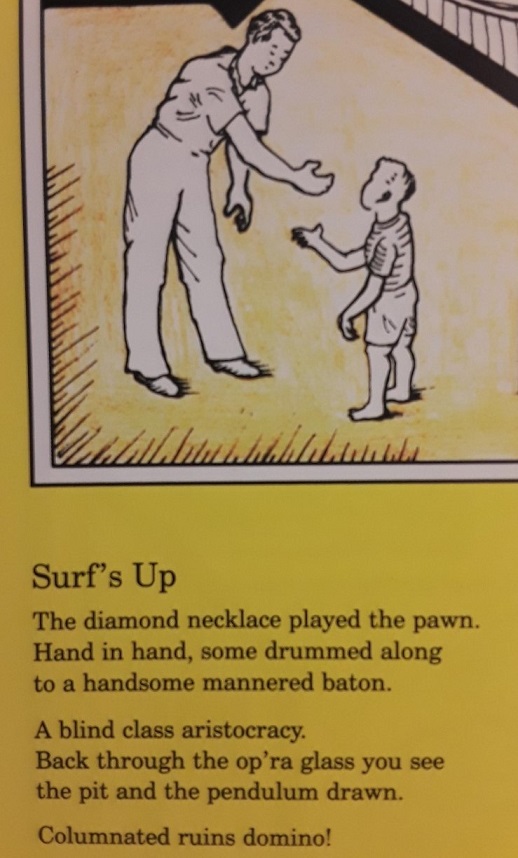
Idle hands and an idle mind led me to look at the opening lyrics for another wonderful song: “Surf’s Up” (which I didn’t put on Twitter). Van Dyke Parks wrote the words for Brian Wilson’s music:

A diamond necklace played the pawn
Hand and hand some drummed along, oh
To a handsome man and baton

But there was a problem. The Genius lyrics site shows the third line as:

To a handsome mannered baton

There’s a note that says these were the original lyrics. Somebody else marked that as “a stretch”. I quickly acquired an account on Genius and put in a correction, based on the fact that most people say it’s “a man and baton”, those are the words Carl Wilson seems to have sung on the original recording, and contemporaneous sources don’t disagree:

At home, as the black acetate dub turned on his bedroom hi-fi set, Wilson tried to explain the words. “It’s a man at a concert,” he said. “All around him there’s the audience, playing their roles, dressed up in fancy clothes, looking through opera glasses, but so far away from the drama, from life—‘Back through the opera glass you see the pit and the pendulum drawn.’”

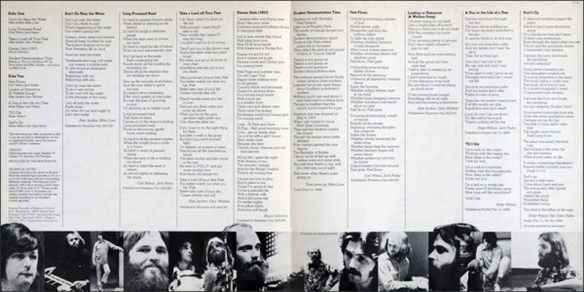
The 1971 Beach Boys LP had a lyrics sheet, but, having moved on from vinyl, I sold that album years ago. The other side of the lyrics sheet showed parched earth, counterintuitively for a group that still called themselves that and an album with a metaphorical reference to the ocean in its title. I didn’t have the old lyrics sheet, but the internet, as it so often does, came through:

beachboys-surfsup(insert-b)

Expanding the image revealed that, yes, it’s “a man and baton”. Victory was mine!

(The album was released at that brief moment in time when Mike Love, shown in the middle there, was willing to appear in public without a hat — the long beard compensated for his thinning on top.)

I thought that was the end of the matter (although scientific, historical and aesthetic matters never really end). Further research revealed that no, it’s not that clear what the lyrics are supposed to be.

Eight years ago, a contributor to a Beach Boys message board wrote:

For the record (pun intended) Carl got the lyrics wrong when he copied them down listening to Brian’s demo. It’s . . . “a mannered baton”.

And there it is, in the 2011 box set, The Smile Sessions:

thumbnail_20210215_172453 (2)

A handsome mannered baton! Victory is no longer mine!

But what are a song’s lyrics anyway? If there’s a conflict, are the lyrics what the composer originally had in mind? Or what was first performed for the public? Are the lyrics what was written on the original manuscript or what everybody sings today (such as this guy or this other guy)? There is no definitive answer.

Fortunately, in most cases, there is no conflict. Consider “The Star Spangled Banner”. Nobody argues whether it’s “bombs bursting in air” or “bombs bursting for air”. We all know the words (for the most part).

This brings me to a very brief account of last night’s dream. Two men with great voices were singing our national anthem in a big stadium. One of them made a mistake. He sang “bombs bursting for air”. That’s all I remembered when I woke up.

I mention this because there was an article this week called “For the love of America, stop playing the national anthem before sporting events”. The writer’s thesis is that “it’s not an act of genuine patriotism, it’s a ritual of joyless conformity”. The article was in response to a small controversy:

This week, Dallas Mavericks owner Mark Cuban confirmed that for the entirety of the current National Basketball Association’s season and preseason, the national anthem wasn’t played prior to his team’s home games. No one had noticed until Cuban confirmed it with The Athletic.

The NBA told The Athletic that given the bizarre and difficult circumstances of the pandemic era, they were fine with teams deciding how to conduct their pre-game operations. But after conservative pushback the league quickly relented, as did Cuban, and just like that we’re back to the business-as-usual of acting out a quasi-religious devotion to a tuneless song about war.

Personally, I like singing the national anthem with a big crowd. It’s one of the times I feel patriotic. And it’s always interesting to hear somebody sing it in public, wondering if they’ll remember the words.

The only reason I found this dream interesting and why I’m sharing it now is that it’s one of those times when it looks like a person’s brain put two and two together and came up with something else. My brain was apparently doing its nightly cleanup. It found a memory of an article about the national anthem and another memory about the questionable lyrics to a song and combined those fragments into a little story about somebody screwing up the lyrics in front of thousands of people (who could be the thousands of people who see stuff on the internet). Dreams don’t necessarily mean anything but it’s nice when they seem to.

beachboys-surfsup(insert-a)