Roads, Taxes and Rationality

There’s no shortage of news being made and problems to be addressed, but the world seems a bit quite these days. Maybe the president has something to do with it:

Biden’s words . . . have been counted along with his on-camera appearances and total one-third of those notched up by the previous president at the equivalent stage (The Guardian).

It clearly helps that there are rational people in charge of the federal government for a change, “rational” in the sense that they’re trying to fix problems instead of ignoring them or making them worse. 

An excellent example is the problem of America’s “crumbling infrastructure”. The two words, “crumbling” and “infrastructure”, have been tied together for decades, like “manicured lawns”, “well-heeled lobbyists”, “potent symbols” and “hot topics”. Everybody agrees the country’s roads, bridges, dams, school buildings, electrical grid, etc. need work and it will cost a lot of money to modernize them. I just typed in “infrastructure” and got:

The cost to fix America’s crumbling infrastructure? Nearly $2.6 trillion, engineers say (CNN).

So it isn’t a surprise that Biden is announcing a big infrastructure plan tomorrow (unlike his predecessor, the orange guy, who kept promising a tremendous infrastructure plan to go along with his miraculous health insurance plan, neither of which ever materialized.)

Nor is it a surprise that Republicans won’t want to pay for it. From the Washington Post’s “Plum Line” blog:

New details are emerging about the massive infrastructure plan that Democrats will present this week, and it poses a problem for Republicans. This is exactly kind of government spending voters from both parties support — every member of Congress would happily have a new bridge in their district.

But if it passes, it will be another victory for President Biden. So Republicans have to find a way to convince voters it’s a terrible idea, which they’ll attempt through a series of misleading arguments.

Here’s the latest on the package, from The Post:

Biden’s plan will include approximately $650 billion to rebuild the United States’ infrastructure, such as its roads, bridges, highways and ports, the people said. The plan will also include in the range of $400 billion toward care for the elderly and the disabled, $300 billion for housing infrastructure and $300 billion to revive U.S. manufacturing. It will also include hundreds of billions of dollars to bolster the nation’s electric grid, enact nationwide high-speed broadband and revamp the nation’s water systems to ensure clean drinking water, among other major investments, the people said.

Those all seem like worthy goals. So how will Republicans argue against them?

One way will revolve around fearmongering about deficits and tax hikes. Another will seek to cherry-pick from the package to portray it as stuffed with wasteful boondoggles.

On the first, Biden is expected to ask congressional Democrats to roll back parts of his predecessor’s tax cuts for the wealthy and corporations, and to increase taxes on profits that corporations shelter offshore.

And Senate Minority Leader Mitch McConnell (R-Ky.) is already balking. “If you want to do an infrastructure bill, let’s do an infrastructure bill,” is McConnell’s latest line. “Let’s don’t turn it into a massive effort to raise taxes on businesses and individuals” [i.e. corporations and rich people].

The Republican game runs as follows. They say they support infrastructure repair in principle (which is true of some). But, they add, they don’t support paying for it either by driving up the deficit or with tax hikes that will kill jobs (as McConnell suggested).

Never mind that Republicans exploded the deficit with the very tax cuts for the rich and corporations that Democrats want to partly reverse, or that Republicans are pretending doing this would raise taxes on workers, or that the claim that tax hikes kill jobs has been perpetually proven wrong. . . .

Meanwhile, you will surely hear the name “Solyndra” bandied about, in reference to what happened the last time a Democratic administration boosted green energy infrastructure (an even bigger component of Biden’s plan).

Republicans are already making the case that last time millions in taxpayer dollars were squandered on green energy jobs that never materialized. They are road-testing a new slogan about what’s coming: “Solyndra Syndrome.”

But that actually points to how Democrats should respond to this attack. Because the truth is very different from what Republicans would have you believe.

Solyndra was indeed a failure: As part of a federal program to support promising companies, the Obama administration gave a $535 million loan to the firm. But their solar panel technology struggled to compete against low-cost panels from China, and the company eventually went bankrupt.

But the whole point of the loan program was to take risks, in the knowledge that some of them wouldn’t work out. And other loans paid off spectacularly well.

You may have heard of another up-and-coming green tech company that got a $465 million loan at around the same time, enabling it to start making passenger cars. It’s called Tesla. It paid back its loan with interest, and today has more than 70,000 employees.

Republicans spent years trying to turn the Solyndra failure into a scandal. What they didn’t mention is that despite the loss the government took on it, the program that funded that loan quickly turned a profit, eventually earning billions.

So that part of the Obama Recovery Act was a success, even though Republicans convinced many people it was a failure. The reality tells the opposite story, and Democrats should say so.

Beyond all that, . . . Democrats have a good way to call the Republicans’ bluff: Renew the push for a boost in funding for the Internal Revenue Service, so it can start hauling in the huge piles of revenue that will likely to go uncollected in coming years — much from the wealthy and corporations.

Tax experts say that due to IRS budget cuts and resulting lax enforcement, as much as $7.5 trillion in revenue could go uncollected over the next decade, a good deal of it from wealthy actors who are well resourced to evade payments. They also say netting even a fraction of that could bring in gobs of new revenue.

Sen. Ron Wyden (D-Ore.), the chairman of the Finance Committee, says Democrats should renew this push, tied to the debate over infrastructure, by arguing for more funding for IRS enforcement, and for reforms improving its efficacy:

The absolute bare minimum Republicans should get behind is ensuring the IRS has resources and trained staff to collect taxes that are currently owed. They won’t have any credibility if their position is that not only can there be no new revenue, but we also can’t do significantly more to collect revenue that’s owed.

Unquote.

Republicans won’t have any credibility? That’s never bothered them before.
They’ve Got a Great Name for Voter Suppression and One Party Rule

From Fox News last month:

The Republican National Committee is launching a new panel on election integrity that it says is dedicated to restoring transparency and confidence to future elections.

The RNC announced their new Committee on Election Integrity on Wednesday, sharing the news first with Fox News.

Because everybody is in favor of election integrity.

From Greg Sargent of The Washington Post:

The New York Times has a remarkable new report that exposes the breadth of Republican voter suppression efforts. Party leaders and their conservative allies are seeking to coordinate the passage of bills — in multiple states — designed to make it harder to vote, justified by mythic voter fraud.

For instance, the Times reports, those efforts played a role in a radical package of bills moving forward in Georgia, which includes ending vote-by-mail for most voters and limiting Sunday voting drives, which are heavily utilized by African Americans.

Republican leaders and their allies plan to export statutory language restricting voting to other states, and in many of them, extensive such efforts are already underway.

“The widespread coordination underscores the extent to which the dogma of voter fraud is embedded in the Republican Party,” the Times reports, bluntly noting that the Republican “views its path to regaining a foothold in Washington” through “an intense focus on re-engineering the voting system in states where it holds control.”

The focus-grouped phrase justifying all this is “election integrity.” That’s the name of the new group, run by the Republican National Committee, that is developing more such proposals for export to states.

But [the former president] has already told us what standing for “election integrity” really means: making it harder to vote for the express purpose of making it easier for Republicans to win future elections.

[He] made this explicit during his Conservative Political Action Conference speech. He declared that the Republican must be the party of “election integrity” and that this means reversing efforts to make it easier to vote wherever possible and that this is an “urgent” matter facing the Republican. . . .

Importantly, this is not [their leader] projecting his own corrupt motives on to what Republicans are doing. Rather, it’s that Republicans are acting on precisely that very same [rationale]:

[According to the Times:]

To head its election integrity committee, the Republican National Committee tapped Joe Gruters, the Florida Republican Party chairman who in January used a #stopthesteal hashtag and advertised ways for Republicans to attend the Jan. 6 rally that ended with a riot at the Capitol. . . .

Like nearly all of the Republicans involved in the party’s voter integrity efforts, Mr. Gruters declined to characterize Mr. Biden’s victory as legitimate, despite there being no evidence of widespread fraud and multiple state audits reaffirming the results. “There are a lot of people who have a lot of questions about the 2020 race.”

The call for “election integrity” is now inseparable from the claim that the election was stolen from Trump. That’s a lie, but the fact that so many Republican base voters believe it — which Trump and Republican officials [got them to believe] — is itself the stated justification to continue.

But we are not obliged to pretend that these Republican officials actually believe their lies about the election. Once we liberate ourselves of that notion, the plain truth comes into view: The same justification used to incite an effort to violently subvert the 2020 election’s conclusion is now being used to manipulate future elections, by preventing as many Democratic-aligned voters, untold numbers of them African American, from voting as possible. . . .

Unquote.

Choosing a positive phrase to describe a blatant power grab is a great bit of marketing. Journalists will tend to adopt the Republican terminology, just like the authors of the Times article when they refer to the “election integrity committee” and “the party’s voter integrity efforts” in the quote above. We need to keep in mind that, in this case, “election integrity” means stuff like making it a crime in Georgia to give food or water to voters standing in line for hours to vote because there are so few polling places in their neighborhoods.

Politics vs. Reality at the Border

Headline from The Washington Post, March 20, 2021, for an article by three political reporters and one who covers immigration enforcement:

‘No end in sight’: Inside the Biden administration’s failure to contain the border surge

Headline from The Washington Post, March 23, 2021, for an article by three political scientists, one of whom heads the U.S. Immigration Policy Center at the University of California in San Diego:

There’s no migrant ‘surge’ at the U.S. southern border. Here’s the data [that] reveals the usual seasonal bump — plus some of the people who waited during the pandemic

From the article by the people who know what they’re talking about:

Last week, at the U.S. border with Mexico, House Minority Leader Kevin McCarthy (R-Calif.) declared that the recent increase in unaccompanied minors attempting to enter the United States was a “crisis … created by the presidential policies of this new administration.”

We looked at data from U.S. Customs and Border Protection to see whether there’s a “crisis” — or even a “surge,” as many news outlets have characterized it. We analyzed monthly CBP data from 2012 to now and found no crisis or surge that can be attributed to Biden administration policies. Rather, the current increase in apprehensions fits a predictable pattern of seasonal changes in undocumented immigration combined with a backlog of demand because of 2020’s coronavirus border closure.

IT’S NOT A SURGE. IT’S THE USUAL SEASONAL INCREASE.

The CBP reports monthly data on how many migrants its agents apprehend at the southern border, including unaccompanied minors. . . .

The CBP has recorded a 28 percent increase in migrants apprehended from January to February 2021, from 78,442 to 100,441. News outlets, pundits and politicians have been calling this a “surge” and a “crisis.”

But the CBP’s numbers reveal that undocumented immigration is seasonal, shifting upward this time of year. During fiscal year 2019, under the [previous] administration, total apprehensions increased 31 percent during the same period, a bigger jump than we’re seeing now. (We’re comparing fiscal year 2021 to 2019 because the pandemic changed the pattern in 2020.) In 2018, the increase is about 25 percent from February to March — somewhat smaller but still pronounced.

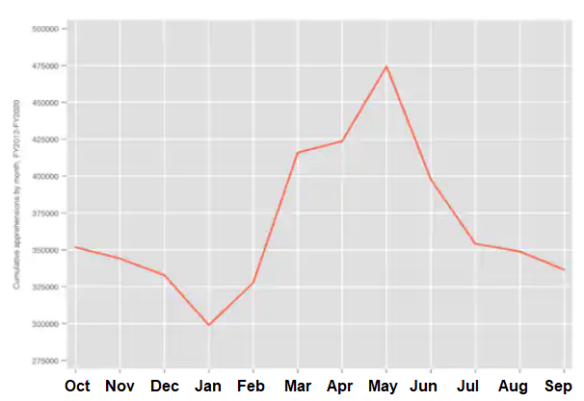
But was 2019 an aberration? In the figure below, we combine data from fiscal year 2012 to fiscal year 2020 to show the cumulative total number of apprehensions for each month over these eight years. As you can see, migrants start coming when winter ends and the weather gets a bit warmer. We see a regular increase not just from January to February, but from February to March, March to April, and April to May — and then a sharp drop-off, as migrants stop coming in the hotter summer months when the desert is deadly. That means we should expect decreases from May to June and June to July.

Untitled

What we’re seeing, in other words, isn’t a surge or crisis, but a predictable seasonal shift. When the numbers drop again in June and July, policymakers may be tempted to claim that their deterrence policies succeeded. But that will just be the usual seasonal drop.

SO WHY ARE WE SEEING MORE MIGRANTS SO FAR IN 2021?

The CBP has indeed reported apprehending more migrants in February 2021 than in the same month in previous years. But that too doesn’t mean it’s a surge or a crisis. . . .

2020 was the pandemic, when movement dropped dramatically. Countries around the world closed their borders. Here in the United States, the [previous] administration invoked Title 42, a provision from the 1944 Public Health Act, to summarily expel migrants attempting to enter the United States without proper documentation.

In other words, in fiscal year 2021, it appears that migrants are continuing to enter the United States in the same numbers as in fiscal year 2019 — plus the pent-up demand from people who would have come in fiscal year 2020, but for the pandemic. . . .

This suggests that Title 42 expulsions delayed prospective migrants rather than deterred them — and they’re arriving now.

That would be consistent with nearly three decades of research in political science. Much of this research has been done since President Bill Clinton’s administration ran Operation Gatekeeper, which tried to keep out migrants by increasing funding and staff for border enforcement. Scholars consistently find that border security policies do not necessarily deter migration; rather, they delay migrants’ decisions to travel, and change the routes they take.

REASSESSING OUR UNDERSTANDING OF UNDOCUMENTED IMMIGRATION

So have Biden administration policies caused a crisis at the southern border? Evidence suggests not. The [last] administration oversaw a record in apprehensions in fiscal year 2019, before the pandemic shut the border. This year looks like the usual seasonal increase plus migrants who would have come last year, but could not.

Focusing on month-to-month differences in apprehensions is misleading; given seasonal patterns, each month should be considered in relation to the same month in previous years. Knowing those patterns, policymakers may be better able to plan, prepare and to manage the border.

Unquote. Also, political reporters would avoid jumping on bandwagons being driven by politicians with their own agendas.

Will Bunch of The Philadelphia Inquirer summarizes:

The border situation is neither the first crisis facing the new administration nor close to the biggest — not with a pandemic that has killed more than 500,000 Americans and the related economic crisis leaving 10 million out of work — but it is the nation’s most visible problem that can be so easily demagogued by Republicans looking to score cheap political points against a popular president, or get lapped up by Beltway journalists eager to go back to the brunch of lazy punditry. Indeed, the Sunday morning talk shows — ABC even flew its panelists to an outdoor location at the border — seemed to openly salivate at a return to the days of swinging at Democrats with a club furnished by the Republican National Committee.

There is overcrowding at the border, partly because Biden’s predecessor left a mess behind him. The new administration is working on the problem, which is what we should expect.

When British Rule Became Intolerable

Historians tend to mark the stirrings of the American Revolution with events like the passage of the Stamp Act in 1765 and the Boston Massacre of 1770 (when British soldiers killed five Americans). In her new book, 1774: The Long Year of Revolution, Mary Beth Norton argues that it was only the aftermath of 1774’s Boston Tea Party that unified the colonies and led to revolution. One piece of evidence is how Americans referred to new laws passed by Parliament after the Tea Party as the “Intolerable Acts”.  Another is how residents of all thirteen colonies quickly joined together for the first time, creating the Continental Association (something I don’t remember ever hearing about).

This is from a review by T. H. Breen:

The most serious problem with the claim that the revolution resulted from a long-simmering sense of injustice is that ordinary Americans initially showed very little interest in confronting imperial authority. Resistance to the Stamp Act and the killing of civilians during the Boston Massacre certainly got attention, but even at the moment of greatest discontent, colonists hesitated to voice support for urban protest. In many places people feared that a few radicals were stoking a political crisis that could destabilize an imperial system responsible for widespread prosperity. . . .

The political landscape changed dramatically on the night of December 16, 1773, when the destruction in Boston Harbor of tea imported by the East India Company made the scattered protests that had gone before suddenly seem irrelevant. It took several months for the full implications of the Tea Party to play out in England and America. As Norton explains, the incident served as a political catalyst for the subsequent spread of popular resistance throughout the colonies.

To be sure, an outpouring of anger greeted the arrival of the tea. Everyone knew that by purchasing the imported tea, they would be compelled to pay a tax set by Parliament, a body in which they had no representation. . . .

As with the earlier protests, however, many Americans expressed reservations about what a group of men dressed crudely as Indians had done in Boston Harbor. They worried that extremists had taken protest to an unacceptable level. Of course, no colonists wanted to pay taxes on their favorite drink. But the tea was private property, and not a few people counseled the City of Boston to compensate the East India Company for the lost cargo. . . .

Everyone in Boston expected Parliament to punish the city for this brazen attack on private property. They assumed that negotiations with officials in London would result in censure, and then, after emotions had cooled, relations with the mother country would return to normal. That did not happen. As has occurred so often in the long history of imperial regimes, the leaders of Parliament decided to teach the troublesome Americans a lesson. A mere warning that they should behave themselves . . . would not serve the purpose. Obedience required a show of force.

Speakers in the House of Commons could hardly contain themselves. They insisted that it was time to crush the people of Boston for their audacity. One member of Parliament announced that . . . “the town of Boston ought to be knocked about their ears, and destroyed.” . . . Another MP observed that “the Americans were a strange set of People, and that it was in vain to expect any degree of reasoning from them.”

The punishment was far worse than anyone had anticipated. It was spelled out in four acts known in England as the Coercive Acts. Americans called them the Intolerable Acts. Richard Henry Lee, an influential Virginian, described the legislation as a “shock of Electricity,” causing universal “Astonishment, indignation, and concern.” The most vexing—the Boston Port Act—closed the city to all commerce; other acts restricted town meetings throughout Massachusetts to once per year and gave the royal governor of the colony enhanced authority over political appointments. Trade now had to flow through Salem, which greatly added to the cost of doing business. More disconcerting, the legislation created widespread unemployment in Boston, where many poorer residents worked on the docks.

Bostonians pointed out that it was grossly unfair to penalize the entire population of the city for a crime carried out by a small group, but British officials expressed no sympathy. They suspected that the Americans had absorbed a spirit of democracy. . . .

The show of force did not intimidate the colonists. British leaders greatly increased the chance that the situation in America would explode by appointing a military officer, Thomas Gage, as governor of Massachusetts. He seemed to possess the kind of toughness needed to pacify rebellious colonists. . . . He arrived in Boston on May 13, 1774, accompanied by a large contingent of troops. Not surprisingly, an army of occupation served only to further enflame the populace.

Within weeks imperial authority outside Boston collapsed. Officials appointed by the crown resigned; committees were formed throughout the colony to fill the administrative vacuum. Militiamen began to drill. Local bodies enforced a prohibition on drinking tea. The celebrated orator Edmund Burke had predicted this would be the result of the Coercive Acts. “Have you considered,” he asked the House of Commons, “whether you have troops and ships sufficient to enforce an universal proscription to the trade of the whole Continent of America?” When it became clear that his audience was determined to bring the Americans to heel, Burke concluded, “This is the day, then, that you will go to war with all America . . . ” No one listened.

During the summer of 1774, it became clear that the punitive policies championed by the North administration were stunningly counterproductive. . . . The suffering of Boston soon became the cause of colonists outside the city. They sensed that if they did not support resistance, they too might soon find themselves living under military occupation.

. . . People living in distant colonies sent food to the unemployed workers of Boston. . . . Britain’s show of toughness encouraged ordinary people from New Hampshire to Georgia to reach out to other Americans who before this moment had been total strangers. They began to talk of themselves as if they were no longer British, or at least not as British as they had been before Gage and his army arrived in Boston.

The spreading resistance movement persuaded political leaders of the various colonies to meet in Philadelphia in early September 1774. The first Continental Congress brought Americans of very different backgrounds together. . . . Prominent figures such as . . . the Speaker of the Pennsylvania Assembly presented powerful arguments for reconciliation. Some of his colleagues sensed, however, that the moment for constructive compromise had passed. The people needed direction. Otherwise the defense of American rights would fragment.

The Continental Congress devised a brilliant solution. On October 20, it authorized the creation of the Continental Association, which bound the thirteen colonies in order to bring additional pressure on Parliament by cutting off trade with Britain. Boycotts had been tried before, but because of local jealousies and competition among merchants, they had failed to achieve their purpose. The Continental Association was different. It established precise dates for the cessation of the importation of British goods. It also set down regulations for trade with the mother country. According to the Congress, the goal of the commercial regulations was “to obtain redress of these grievances which threaten destruction to the lives, liberty, and property of his majesty’s subjects in North America.”

The problem was how to enforce these regulations. How could the Congress unite thousands of small communities in a common effort? The answer appeared in the eleventh article of the Continental Association, which transformed the entire character of the resistance movement. A document of such fundamental significance in the history of the United States merits close reading:

That a committee be chosen in every county, city, and town, by those who are qualified to vote for representatives in the legislature, whose business it shall be attentively to observe the conduct of all persons touching this association; and when it shall be made to appear, to the satisfaction of a majority of any such committee, that any person within the limits of their appointment has violated this association, that such majority do forthwith cause the truth of the case to be published in the gazette; to the end, that all such foes to the rights of British-America may be publicly known, and universally contemned as the enemies of American liberty; and thenceforth we respectively will break off all dealings with him or her.

The association signaled the moment in a new revolutionary narrative when ordinary Americans realized that there was no turning back. At the time, almost no one was calling for independence. The groundwork for that break, however, was now in place. The crucial move was that the Continental Congress gave ordinary Americans the responsibility for monitoring commercial violations, but as one might have predicted, these local committees quickly assumed additional duties. By 1775 they were legitimizing popular resistance to imperial rule and channeling mobilization. The Continental Association did something even more important: it revealed the pressing need for some form of centralized authority to oversee the actions of thirteen very different colonies. Unity was essential to sustaining a common cause.

Norton accomplishes something more than a revision of the traditional story of the coming of the American Revolution. She reminds us that even when it seemed inevitable that continuing protest would lead to violent confrontation with British troops, there were intelligent, articulate people in America who wanted desperately to head off the crisis. . . .

It was hard for people such as the Reverend Thomas Bradbury Chandler, an Episcopal minister from New Jersey, to break with the comforting security of a monarchical regime. He wrote an immensely popular pamphlet called “The American Querist”, which consisted of one hundred questions designed to challenge assumptions driving the resistance movement. . . .

[But] writers of Chandler’s persuasion . . . were defending a social system that no longer made sense to many Americans.

The committees that enforced nonimportation seemed to Loyalists to invite anarchy. Mob rule, Chandler and his allies claimed, would destroy the ordered security of a monarchical world. The Reverend John Bullman, an Episcopal rector in Charleston, South Carolina, railed against the notion that ordinary men were capable of judging “the Fitness or Unfitness of all persons in power and Authority.” Bullman rejected the idea that a person “who cannot perhaps govern his own household, or pay the Debts of his own contracting,” should “dictate how the State should be governed.” Chandler shared this opinion. He asked, regarding “interested, designing men…or ignorant men, bred to the lowest occupations,” whether “any of them [were] qualified for the direction of political affairs, or ought to be trusted with it.” . . . . As the events of 1774 demonstrated, however, a great many Americans of the lowest occupations strongly disagreed.

One can appreciate why loyalists equated revolutionary change with disorder. [But] mobilization for the fight for independence did not promote anarchy. Americans followed the Continental Association’s regulations, sacrificing the imported consumer items that brought them so much pleasure. The revolutionaries who came forward in 1774 would have found it hard to understand modern Americans who define liberty as the right to do whatever they please during a time of national crisis, even though they know that their self-indulgence threatens the welfare of the larger community.

The Senate Moves Slowly. You Can See What They’re Doing.

Now that Democrats hold the White House and the House of Representatives, the locus of legislative action is the Senate. Democrats were able to pass the massive American Rescue Plan because a Senate rule allowed them to do so without Republican support. But so much more could be done without the filibuster rule that usually requires 60 out of 100 senators to vote Yes.

So I’ve been paying some attention to the Senate’s proceedings. The Senate has a leisurely schedule with sessions that start late in the day, long weekends and frequent vacations. I assume senators are doing something away from the Senate chamber, because it’s frequently empty. In fact, the Senate chamber is usually lightly populated even when business is being done (that’s apparently why they don’t allow the whole chamber to be shown on TV).

Like the House, the Senate has a website. You can click on Floor Proceedings to see what they did on previous days and then click on Live Proceedings to see if they’re doing anything at the moment.

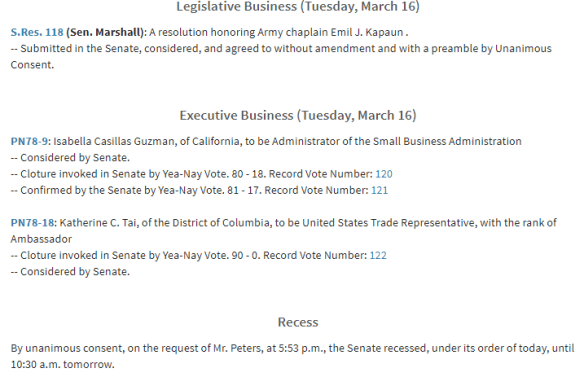
This is what the Senate accomplished on Tuesday: they honored an Army chaplain and advanced two of the president’s nominees.

Untitled

On Wednesday, they took action on two nominations again (one was from the previous day), honored the 100th anniversary of the birth of a baseball player, and approved a bill to allow the Department of Veterans Affairs to give Covid vaccines to some people not usually eligible for treatment.

On the video feed, you’ll sometimes see the Senate majority leader standing at a podium, reading from a stack of paper, uttering the same words over and over again, in order to get a few things done. The majority leader makes a motion and then the Senate’s president pro tem, who on most days is a random senator from the majority party, has a clerk read something about the motion. The president pro tem then asks for a roll call vote. The majority leader, apparently the only other senator in the room, says “aye”, the president pro tem says it appears the ayes have it, and announces that the motion is agreed to. Then they repeat the same song and dance on another motion. The Senate’s rules aren’t designed for efficiency. 

Of course, sometimes a motion is something important, so the whole Senate has to vote.  The senators come back to the chamber to tell the clerk how they’re voting. This takes quite a while, and unlike the House, the Senate doesn’t show a running total of the Yes and No votes.

In addition, senators sometimes make speeches, either regarding the motion under consideration or something else they want to talk about. You’re not allowed to see if there are any other senators present. Some of these speeches are very good. I happened to catch two excellent ones this week.

Senator Menendez, Democrat of New Jersey, made a speech condemning the stupid racist remarks of a Republican senator from Wisconsin, and Senator Warnock, Democrat of Georgia, called on the Senate to pass two bills that would reform our elections and protect voting rights (the For the People Act and the John Lewis Voting Rights Advancement Act). Both of these speeches were met with applause, but it was hard to see how many people were clapping or who they were.

I turned on the video when Menendez and Warnock were already talking, so would have missed their opening remarks, except that Vimeo has the official Senate video with the added benefit that you can scroll back to what happened earlier. Once the Senate is done for the day, both Vimeo and the Senate site make the whole day’s proceedings available. 

The Menendez and Warnock speeches are both on YouTube. Senator Menendez started by saying he took no pleasure in coming to the Senate floor to make these particular remarks, which suggested he was going to let loose on his Senate colleague. That’s what he did. Senator Warnock’s speech was his first as a senator. He pointed out that the entire Senate should support improving our democracy and helping people vote, the same way Republicans often did in the past. It’s not clear if there were any Republicans in the room when he spoke.