Looking for a United Working Class

One-third of Robert Kuttner’s “Dividends of a Just Economy” in the NY Review of Books:

Racism, in Gunnar Myrdal’s phrase, remains the American dilemma — and a special dilemma for Democrats. For a progressive majority to be built on common economic issues, it must be multiracial. There have been two great moments of American biracial coalition. They were separated by a century, and both ended badly. Lincoln’s was halted by his assassination; his intended legacy of racial inclusion was short-circuited by the ending of Reconstruction in 1876. Lyndon Johnson’s comment that passing the 1964 Civil Rights Act would destroy the Democratic Party in the South understated what followed. Republicans, repeating the tactics of the postbellum planter class and the anti-populists of the 1890s, have used race to destroy any solidarity between poor whites and blacks.

Heather McGhee’s The Sum of Us is a powerful call for racial alliance. More than a moral appeal, McGhee’s book provides a practical manual on how to bring it about. McGhee, a former president of the progressive think tank Demos, argues that the most effective form of antiracism is to embrace both race and class. Racism hurts Blacks disproportionately, but it also hurts whites who could benefit from activist policies precluded by the politics of racial division. “Black people and other people of color certainly lost out when we weren’t able to invest more in the aftermath of the Great Recession,” she writes. “But did white people win? No, for the most part they lost right along with the rest of us.” McGhee is out to challenge what she terms the “zero-sum paradigm”: the premise that if Blacks gain, it must be at the expense of whites, and vice versa.

McGhee quotes Hinton Helper, a white southerner who wrote a book in 1857 tallying all the ways that the planter class that governed the South shortchanged ordinary whites. Pennsylvania, Helper reported, had 393 public libraries; South Carolina 26. New Hampshire had 2,381 public schools; Mississippi 782. Plantation owners had a captive labor force. They didn’t need or want educated whites. As McGhee notes, the pattern carries on to this day. In 1959 the government of Montgomery, Alabama, paved over the city’s swimming pools, closed its parks, and even eliminated the zoo rather than see these public facilities integrated. Whites suffered along with Blacks. The states with the poorest and least educated populations and those with the most threadbare public services are still those in the South.

McGhee documents these realities with care: white people who can’t get affordable health insurance; white people bilked by mortgage fraudsters; white people no longer able to attend free public universities; employers who defeat union organizing by dividing workers by race. Each example reflects the absence of better policies for all, a possibility precluded by racial animus. McGhee is unsparing in describing how this version of America is harder still on Blacks. But the challenge is to make this story persuasive to white voters attracted by the likes of Trump, so that they shift their allegiance from racism to progressive economics.

From her reporting across America, McGhee points to case after case of cross-racial organizing for common betterment: the welcoming of refugees in Lewiston, Maine, as a way of repopulating empty storefronts and bringing new economic energy to a depressed town; a new wave of common efforts around the fight for a $15-per-hour minimum wage; union organizing of service workers, even in the Deep South. A transracial alliance, she writes, would produce a “solidarity dividend” of greater social protections for all races, the kind just demonstrated by Biden’s enactment of a universal child allowance using refundable tax credits. Playing off the story of Montgomery draining its public pools, McGhee calls for refilling “the pool of public goods.” Because of the greater legacy of Black poverty, public provision helps Blacks disproportionately, but aids whites as well, and cumulatively builds transracial affinity and alliance.

McGhee credits and builds on the work of Ian Haney López, whose most recent book, Merge Left, is a complementary call for racial coalition. Like McGhee, he is both nuanced and unflinching. “I had assumed that the main stumbling block to urging cross-racial solidarity would be convincing a majority of whites,” he writes. “Equally formidable, it turned out, was enlisting support from people directly focused on racial justice, overwhelmingly activists of color.”

Haney López is a law professor at Berkeley. His earlier scholarly work on race included pioneering research on how even the Supreme Court got pulled into determining who was white, because immigration in the nineteenth century was limited to whites, and “white” had to be defined.

His 2014 book, Dog Whistle Politics, is the definitive study of the use of language in veiled racist appeals going back to Richard Nixon.

In his latest book, Haney López uses his academic expertise in the service of his work as an organizer. He recounts his extensive meetings with groups ranging from white trade unionists fed up with the charge of racial insensitivity to Black militants who insist that antiracism must take precedence over making common cause with dubious allies. This work is as difficult as it is urgent. One white, who professes sympathy for the civil rights cause, says that Black talk about slavery is “a horrible crutch to not trying, not working, not fixing yourself.”

Haney López’s mission is to persuade both groups that they need each other, and to fashion language to further that political goal. “Many of the Right’s most debilitating stories about working people—including white working families,” he writes, citing the best-seller Hillbilly Elegy by J.D. Vance, “are recycled stereotypes about African Americans.”

One concrete result of his leadership is called the Race-Class Narrative Project, initiated in 2017 with the participation of pollsters, linguists, and diverse progressive activists including McGhee. It rigorously tested language in focus groups and larger meetings. These included both open-ended discussions of racially fraught issues and more explicit testing of different messages. The data confirmed Haney López’s intuition. Researchers found that presenting issues in combined appeals to race and class was more convincing to voters than “the dog whistle racial fear message,” and that race-class approaches that acknowledged the special challenges of race “were more convincing than colorblind economic populism.” Three quarters of respondents in a multiracial group agreed with this statement:

Instead of delivering for working people, politicians hand kickbacks to their donors who send jobs overseas. Then they turn around and blame new immigrants or people of color, to divide and distract us from the real source of our problems.

Haney López is mindful of the tightrope act, and he is resolute in his conclusion: we can’t duck race, but we need to talk about it in a way that builds transracial unity: “For centuries, our greatest heroes—radicals like W.E.B. Du Bois, Martin Luther King Jr., and César Chavez—have insisted that American salvation requires cross-racial alliances.”

Recent events affirm these arguments. Only because of the razor-thin electoral success of Democrats in Georgia, which turned two Senate seats, has Biden been able to get legislation through Congress and progressive officials confirmed. Some leaders grasped the power of the “race-class narrative” before it had a name. The success in Georgia was built on ten years of organizing led by Stacey Abrams, who has been a touchstone for Black mobilization but succeeded in building a deliberately multiracial movement. If Biden and Congress can block the latest round of outright racial voter suppression efforts, Georgia could prove a hopeful harbinger of what America can be.
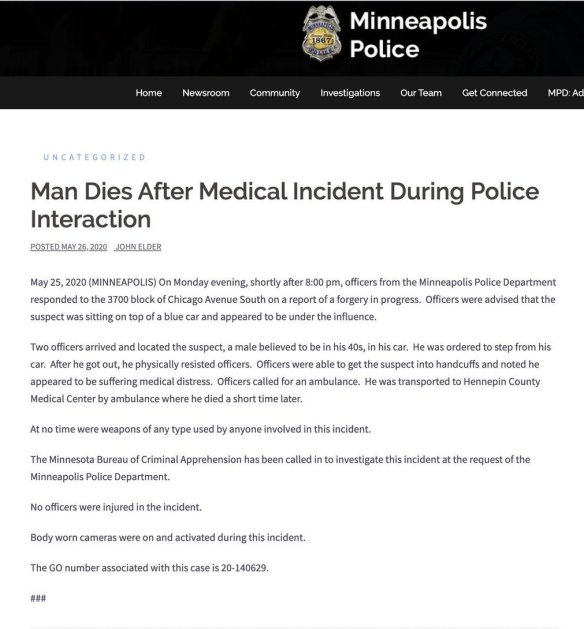

Police Said

The Minneapolis Police Department issued the following statement after a man being arrested died on May 25, 2020:

On Monday evening, shortly after 8:00 pm, officers from the Minneapolis Police Department responded to the 3700 block of Chicago Avenue South on a report of a forgery in progress. Officers were advised the the suspect was sitting on top of a blue car and appeared to be under the influence.

Two officers arrived and located the suspect, a male believed to be in his 40s, in his car. He was ordered to step from his car. After he got out, he physically resisted officers. Officers were able to get the suspect into handcuffs and noted he appeared to be suffering medical distress. Officers called for an ambulance. He was transported to Hennepin County Medical Center by ambulance where he died a short time later.

At no time were weapons of any type used by anyone involved in this incident.

The Minnesota Bureau of Criminal Apprehension has been called in to investigate this incident at the request of the Minneapolis Police Department.

No officers were injured in the incident.

Body warn cameras were on and activated during this incident.

EzcrJJcWQAAW9jj

“Police said”.

Of Course It Was Collusion

Which, yet again, is not the same as criminal conspiracy (although it was probably that as well). From The New York Times:

The Biden administration revealed on Thursday that a business associate of T____ campaign officials in 2016 provided campaign polling data to Russian intelligence services, the strongest evidence to date that Russian spies had penetrated the inner workings of the Trump campaign.

The revelation, made public in a Treasury Department document announcing new sanctions against Russia, established for the first time that private meetings and communications between the campaign officials, Paul Manafort and Rick Gates, and their business associate were a direct pipeline from the campaign to Russian spies at a time when the Kremlin was engaged in a covert effort to sabotage the 2016 presidential election.

Previous government investigations have identified the T____ aides’ associate, Konstantin V. Kilimnik, as a Russian intelligence operative, and Mr. Manafort’s decision to provide him with internal polling data was one of the mysteries that the special counsel, Robert S. Mueller III, sought to unravel during his two-year investigation into Russia’s election meddling.

“During the 2016 U.S. presidential election campaign, Kilimnik provided the Russian Intelligence Services with sensitive information on polling and campaign strategy,” the Treasury Department said in a news release. “Additionally, Kilimnik sought to promote the narrative that Ukraine, not Russia, had interfered in the 2016 U.S. presidential election.”

Rachel Maddow responded on her MSNBC program tonight:

We now know the T____ campaign secretly gave their own data to Russian intelligence in the middle of that attack, which again presumably helped what the Russians were doing. . . . 

What’s the definition of collusion again? Not just passively benefiting from somebody else’s crime, but actively helping them commit it? Is that what we call collusion? Tell me more about how the whole Russia thing is a hoax.

Maddow covered the topic for more than 20 minutes. As of this moment, the whole segment  is available on YouTube. Twelve minutes is available from MSNBC.

Does Consciousness Reside in the Brain’s Electromagnetic Field?

At bottom, it all seems to be a bunch of fields:

In the modern framework of the quantum theory of fields, a field occupies space, contains energy, and its presence precludes a classical “true vacuum”. This has led physicists to consider electromagnetic fields to be a physical entity, making the field concept a supporting paradigm of the edifice of modern physics [Wikipedia].

So maybe consciousness is a special type of field generated by brains. Johnjoe McFadden is a professor of molecular genetics in England. He’s written about his electromagnetic field theory of consciousness for Aeon:

Just how do the atoms and molecules that make up the neurons in our brain . . . manage to generate human awareness and the power of thought? In answering that longstanding question, most neurobiologists today would point to the information-processing performed by brain neurons. . . . This [begins] as soon as light and sound [reach the] eyes and ears, stimulating . . . neurons to fire in response to different aspects of [the] environment. . . .

Each ‘firing’ event involves the movement of electrically charged atoms called ions in and out of the neurons. That movement triggers a kind of chain reaction that travels from one nerve cell to another via logical rules, roughly analogous to the AND, OR and NOT Boolean operations performed by today’s computer gates, in order to generate outputs such as speech. So, within milliseconds of . . . glancing at [an object], the firing rate of millions of neurons in [the] brain [correlates] with thousands of visual features of the [object] and its [surroundings]. . . .

Yet information-processing clearly isn’t sufficient for conscious knowing. Computers process lots of information yet have not exhibited the slightest spark of consciousness [note: or so we believe]. Several decades ago, in an essay exploring the phenomenology of consciousness, the philosopher Thomas Nagel asked us to imagine what it’s like to be a bat. This feature of being-like-something, of having a perspective on the world, captures something about what it means to be a truly conscious ‘knower’. In [a] hospital room watching my son’s EEG, I wondered what it was like to be one of his neurons, processing the information [from] the slamming of a door [in the hall]. As far as we can tell, an individual neuron knows just one thing – its firing rate.

It fires or doesn’t fire based on its inputs, so the information it carries is pretty much equivalent to the zero or one of binary computer language. It thereby encodes just a single bit of information. The value of that bit, whether a zero or a one, might correlate with the slamming of a door, but it says nothing about the door’s shape, its colour, its use as a portal between rooms or the noise of its slamming – all features that I’m sure were part of my son’s conscious experience. I concluded that being a single neuron in my son’s brain would not feel like anything.

Of course, you could argue, as neurobiologists usually do, that although a single neuron might know next to nothing, the collection of 100 billion neurons in my son’s brain knew everything in his mind and would thereby feel like something. But this explanation bumps into what’s known as the binding problem, which asks how all the information in millions of widely distributed neurons in the brain come together to create a single complex yet unified conscious perception of, say, a room . . .

Watching those wiggly lines march across the EEG screen gave me the germ of a different idea, something that didn’t boil down to pure neuronal computation or information-processing. Every time a neuron fires, along with the matter-based signal that travels down its wire-like nerve fibre, it also projects a tiny electromagnetic (EM) pulse into the surrounding space, rather like the signal from your phone when you send a text. So when my son heard the door close, as well as triggering the firing of billions of nerves, its slamming would have projected billions of tiny pulses of electromagnetic energy into his brain. These pulses flow into each other to generate a kind of pool of EM energy that’s called an electromagnetic field – something that neurobiologists have neglected when probing the nature of consciousness.

Neurobiologists have known about the brain’s EM field for more than a century but have nearly always dismissed it as having no more relevance to its workings than the exhaust of a car has to its steering. Yet, since information is just correlation, I knew that the underlying brain EM field tremors that generated the spikes on the EEG screen knew the slamming of the hospital door, just as much as the neurons whose firing generated those tremors. However, I also had enough physics to know that there was a crucial difference between a million scattered neurons firing and the EM field generated by their firing. The information encoded by the million discrete bits of information in a million scattered neurons is physically unified within a single brain EM field.

The unity of EM fields is apparent whenever you use wifi. Perhaps you’re streaming a radio documentary . . . on your phone while another family member is watching a movie, and another is listening to streamed music. Remarkably, all this information, whether movies, pictures, messages or music, is instantly available to be downloaded from any point in the vicinity of your router. This is because – unlike the information encoded in discrete units of matter such as computer gates or neurons – EM field information is encoded as immaterial waves that travel at the speed of light from their source to their receiver. Between source and receiver, all those waves encoding different messages overlap and intermingle to become a single EM field of physically bound information with as much unity as a single photon or electron, and which can be downloaded from any point in the field. The field, and everything encoded in it, is everywhere.

While watching my son’s EEG marching across the screen, I wondered what it was like to be his brain’s EM field pulsing with physically bound information correlating with all of his sense perceptions. I guessed it would feel a lot like him.

Locating consciousness in the brain’s EM field might seem bizarre, but is it any more bizarre than believing that awareness resides in matter? Remember Albert Einstein’s equation, E = mc2. All it involves is moving from the matter-based right-hand side of the equation to energy located on the left-hand side. Both are physical, but whereas matter encodes information as discrete particles separated in space, energy information is encoded as overlapping fields in which information is bound up into single unified wholes. Locating the seat of consciousness in the brain’s EM field thereby solves the binding problem of understanding how information encoded in billions of distributed neurons is unified in our (EM field-based) conscious mind. It is a form of dualism, but a scientific dualism based on the difference between matter and energy, rather than matter and spirit.

Awareness is then what this joined-up EM field information feels like from the inside. So, for example, the experience of hearing a door slam is what an EM field perturbation in the brain that correlates with a door slamming, and all of its memory neuron-encoded associations, feels like, from the inside.

But why? Whether neurons are firing synchronously should make no difference to their information-processing operations. Synchrony makes no sense for a consciousness located in neurons – but if we place consciousness in the brain’s EM field, then its association with synchrony becomes inevitable.

Toss a handful of pebbles into a still pond and, where the peak of one wave meets the trough of another, they cancel out each other to cause destructive interference. However, when the peaks and troughs line up, then they reinforce each other to make a bigger wave: constructive interference. The same will happen in the brain. When millions of disparate neurons recording or processing features of my desk fire asynchronously, then their waves will cancel out each other to generate zero EM field. Yet when those same neurons fire synchronously, then their waves will line up to cause constructive interference to project a strong EM signal into my brain’s EM field, what I now call the conscious electromagnetic information (cemi) field. I will see my desk.

I’ve been publishing on cemi field theory since 2000, and recently published an update in 2020. A key component of the theory is its novel insight into the nature of what we call ‘free will’. . . . Most non-modern people . . . probably believed that [a] supernatural soul was the driver of . . . willed actions. When . . . secular philosophers and scientists exorcised the soul from the body, voluntary actions became just another motor output of neuronal computation – no different from those that drive non-conscious actions such as walking, blinking, chewing or forming grammatically correct sentences.

Then why do willed actions feel so different? In a 2002 paper, I proposed that free will is our experience of the cemi field acting on neurons to initiate voluntary actions. Back then, there wasn’t much evidence for EM fields influencing neural firing – but experiments by David McCormick at Yale University School of Medicine in 2010 and Christof Koch at Caltech in 2011 have demonstrated that neurons can indeed be perturbed by weak, brain-strength, EM fields. At the very least, their experiments suggest the plausibility of a wifi component of neuronal information processing, which I claim is experienced as ‘free will’.

The cemi field theory also accounts for why our non-conscious and conscious minds operate differently. One of the most striking differences between the two is that our non-conscious mind can do many things at once, but we are able to engage in only one conscious task at a time. [Try to] divide a number like 11,357 by 71 while concentrating on a game of chess. Our non-conscious mind appears to be a parallel processor, whereas our conscious mind is a serial processor that can operate only one task at a time.

The cemi field theory accounts for these two modes by first accepting that most brain information-processing – the non-conscious sort – goes solely through its neuronal ‘wires’ that don’t interact through EM fields. This allows different tasks to be allocated to different circuits. In our distant past, all neural computation likely took this parallel-processing neuronal route. . . . However, at some point in our evolutionary history, our ancestors’ skulls became packed with more and more neurons such that adjacent neurons started to interfere with each other through their EM field interactions. Mostly, the interference would have impaired function. Natural selection would then have kicked in to insulate neurons involved in these vital functions.

Occasionally, electrical interference might have been beneficial. For example, the EM field interactions might have conferred the ability to compute with complex joined-up packets of EM field information, rather than mere bits. When this happened, natural selection would have pulled in the other direction, to increase EM field sensitivity. Yet there was also a downside to this way of processing information. Remember the pebbles tossed into the pond: they interfere with one another. Different ideas dropped into the brain’s cemi field similarly interfere with one another. Our conscious cemi-field mind inevitably became a serial computer that can do only one thing at a time.

As America Changes, Reactionaries Will React

A political scientist at the University of Chicago seems to have confirmed something the January 6th insurrectionists had in common (in addition to the obvious factors, like being fans of the former president):

The Chicago Project on Security and Threats (CPOST), working with court records, has analyzed the demographics and home county characteristics of the 377 Americans, from 250 counties in 44 states, arrested or charged in the Capitol attack.

Those involved are, by and large, older and more professional than right-wing protesters we have surveyed in the past. They typically have no ties to existing right-wing groups. But like earlier protesters, they are 95 percent White and 85 percent male, and many live near and among Biden supporters in blue and purple counties. . . .

By far the most interesting characteristic common to the insurrectionists’ backgrounds has to do with changes in their local demographics: Counties with the most significant declines in the non-Hispanic White population are the most likely to produce insurrectionists who now face charges. . . .

All 36 of Texas’s rioters come from just 17 counties, each of which lost White population over the past five years. Three of those arrested or charged hail from Collin County north of Dallas, which has lost White population at the very brisk rate of 4.3 percent since 2015.

The same thing can be seen in New York state, home to 27 people charged or arrested after the riot, nearly all of whom come from 14 blue counties that Biden won in and around New York City. One of these, Putnam County (south of Poughkeepsie), is home to three of those arrested, and a county that saw its White population decline by 3.5 percent since 2015.

When compared with almost 2,900 other counties in the United States, our analysis of the 250 counties where those charged or arrested live reveals that the counties that had the greatest decline in White population had an 18 percent chance of sending an insurrectionist to D.C., while the counties that saw the least decline in the White population had only a 3 percent chance. This finding holds even when controlling for population size, distance to D.C., unemployment rate and urban/rural location. It also would occur by chance less than once in 1,000 times.

Put another way, the people alleged by authorities to have taken the law into their hands on Jan. 6 typically hail from places where non-White populations are growing fastest.

CPOST also conducted two independent surveys in February and March . . . to help understand the roots of this rage. One driver overwhelmingly stood out: fear of the “Great Replacement.”

Great Replacement theory has achieved iconic status with white nationalists and holds that minorities are progressively replacing White populations due to mass immigration policies and low birthrates. Extensive social media exposure is the second-biggest driver of this view, our surveys found. Replacement theory might help explain why such a high percentage of the rioters hail from counties with fast-rising, non-White populations. . . .

To ignore this movement and its potential would be akin to [the previous administration’s] response to Covid-19: We cannot presume it will blow over. The ingredients exist for future waves of political violence, from lone-wolf attacks to all-out assaults on democracy . . .

Paul Waldman of The Washington Post reacted to the study:

We’ve known for some time that many [Americans feel] a deep cultural anxiety, the sense that the world is changing in ways they don’t like and can’t control, and is leaving them behind. To a great degree, they’re right: Popular culture is far more diverse now than it was 20 or 30 years ago, and in many ways it reflects liberal values. If you think it’s an abomination for people of the same gender to marry, TV is going to make you feel very uncomfortable (as will your own kids’ opinions, in all likelihood).

And if you’re a White person living in a town that is steadily becoming less White, just like the country as a whole? Many such people will welcome that diversity, but some will see it as a threat to their status.

Status is complicated. It comes not only from your income, the prestige of your occupation or the esteem of your neighbors. It can also come from the feeling that you and people like you are in charge. . . .

As someone who spent a lifetime chasing status, [Biden’s predecessor] understood that the feeling of status threat could be turned into a powerful political weapon. For instance: The point of insisting Mexico would pay for his border wall wasn’t that we needed the money, but that we’d regain status and potency by dominating and humiliating that country. Vote for [him] and that status and potency would be restored, he claimed.

It is almost impossible to overstate the role that the conservative media plays in creating and sustaining the feeling that White people’s status is under threat — and that the appropriate response is resentment and fear. The encroachments of liberalism are a daily drumbeat on Fox News and conservative talk radio, as is the message that everything you cherish is on the verge of collapse. You may have thought a “Happy Holidays” sign at the department store was just a seasonal decoration, but Fox will tell you it’s actually part of a war to outlaw your religion, so you’d darn well better get mad.

After the past couple of decades, we should understand that there’s almost nothing Democrats can do to diffuse those feelings of cultural displacement. Fox is gonna Fox, and [Republican] politicians . . . are going to see culture war rabble-rousing as their key to rising within the party.

The degree to which Democrats “reach out” to guys in Midwestern diners or try to show them “respect” by paying homage to their cultural markers won’t make a difference. . . .

The degree to which Democrats “reach out” to guys in Midwestern diners or try to show them “respect” by paying homage to their cultural markers won’t make a difference. . . .

That rage still burns, because the forces of societal change that feed it continue inexorably, and some people will always try to profit from it, politically or financially. That’s true even if conservatives find it harder to loathe President Biden than they did Obama or Hillary Clinton.

Unquote.

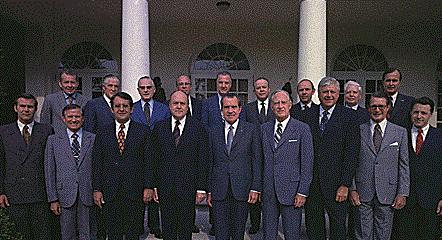
President Biden had his first cabinet meeting last week. The fact that the cabinet “looks like America” was a mark of progress.

Many of our neighbors would have been more comfortable if Biden’s looked like the Nixon cabinet in 1972. That’s not going to change any time soon.