If you could talk for eight minutes.
Jay Rosen teaches journalism at New York University. A foundation asked him to give an analysis of our politics to forty Germans. It’s an interesting, depressing eight minutes.
If you could talk for eight minutes.
Jay Rosen teaches journalism at New York University. A foundation asked him to give an analysis of our politics to forty Germans. It’s an interesting, depressing eight minutes.
The Bobby Fuller Four was a Texas rock band in the 60s who had one big hit. “I Fought the Law” (and the law won!) made the Top Ten in 1965. It was never a favorite of mine but I wouldn’t change the station when it came on.
Earlier that year, they released “Let Her Dance”. It only reached #133 on the national chart, but it was a minor hit in Los Angeles (#23 on KRLA, #19 on KFWB). I turned 14 when it was on the radio in Southern California, but if I heard it, it made no lasting impression.
Bobby Fuller died under mysterious circumstances a few months after “I Fought the Law”. That was the end of the Bobby Fuller Four.
Wes Anderson used “Let Her Dance” in his Fantastic Mr. Fox animated movie in 2009. I saw the movie but took no notice of the song.
Then, five years ago, I heard “Let Her Dance” on Brian Wilson’s site. (I know it was five years ago because it’s on the internet.) It’s not much of a song — it’s repetitious to say the least — but it immediately became a favorite. I’m still playing it five years later. I’m even writing about it.
Why do some songs appeal to us so much? Why do some songs we love not appeal to other people at all? I have no idea. Just let her dance.
From The Guardian: “The Short Life and Mysterious Death of Bobby Fuller, Rock ‘n Roll King of Texas”.
Two Democratic members of Congress are trying to stop big social media companies from doing so much damage:
Imagine clicking on a Facebook video alleging that a “deep-state cabal” of Satan-worshiping pedophiles stole the election from [a horrible person]. Moments later, your phone rings. The caller says, “Hey, it’s Freddie from Facebook. We noticed you just watched a cool video on our site, so we’ll send you a few dozen more videos about election-related conspiracy theories. As a bonus, we’ll connect you to some people who share your interest in ‘stopping the steal’. You guys should connect and explore your interest together!”
The scenario is, of course, made up. But it basically captures what social media platforms do every day. In the real world, “Freddie from Facebook” is not a person who calls you, but an algorithm that tracks you online, learns what content you spend the most time with and feeds you more of whatever maximizes your engagement — the time you spend on the platform. Greater engagement means that users see more ads, earning Facebook more revenue.
If you like cat videos, great; you’ll get an endless supply. But the same is true for the darkest content on the Web. Human nature being what it is, the content most likely to keep us glued to our screens is that which confirms our prejudices and triggers our basest emotions. Social media algorithms don’t have a conservative or liberal bias, but they know if we do. Their bias is to reinforce ours at the cost of making us more angry, anxious and afraid.
Facebook recently played down the role of its algorithms in exploiting users’ susceptibilities and enabling radicalization. The company says that users, not its product, are largely responsible for the extreme content showing up in their news feeds.
But Facebook knows how powerful its algorithms can be. In 2016, an internal Facebook study found that 64 percent of people who joined an extremist group on the platform did so only because its algorithm recommended it. Recently, a member of the Wolverine Watchmen, the militia accused of trying to kidnap Michigan Gov. Gretchen Whitmer (D), said he joined the group when it “popped up as a suggestion post” on Facebook because he interacted with pages supporting the Second Amendment.
Policymakers often focus on whether Facebook, YouTube and Twitter should take down hate speech and disinformation. This is important, but these questions are about putting out fires. The problem is that the product these companies make is flammable. It’s that their algorithms deliver to each of us what they think we want to hear, creating individually tailored realities for every American and often amplifying the same content they eventually might choose to take down.
In 1996, Congress passed Section 230 of the Communications Decency Act, which says that websites are not legally liable for content that users post (with some exceptions). While the law helped to enable the growth of the modern Internet economy, it was enacted 25 years ago when many of the challenges we currently face could not have been predicted. Large Internet platforms no longer function like community bulletin boards; instead, they use sophisticated, opaque algorithms to determine what content their users see. If companies such as Facebook push us to view certain posts or join certain groups, should they bear no responsibility if doing so leads to real-world violence?
We recently introduced a bill that would remove Section 230 protection from large social media companies if their algorithms amplify content that contributes to an act of terrorism or to a violation of civil rights statutes meant to combat extremist groups. Our bill would not force YouTube, Facebook or Twitter to censor or remove content. Instead, it would allow courts in cases involving extreme harm to consider victims’ arguments against the companies on the merits, as opposed to quickly tossing out lawsuits on Section 230 grounds as would happen today.
Liability would incentivize changes the companies know how to make. For example, last year Facebook tested a new system in which users rated posts on their news feeds as “good” or “bad” for the world. The algorithm then fed those users more content that they deemed good while demoting the bad. The experiment worked. The company’s engineers referred to the result as the “nicer news feed.” But there was one problem. The nicer news feed led to less time on Facebook (and thus less ad revenue), so the experiment died.
This is the fundamental issue: Engagement-based algorithms made social media giants some of the most lucrative companies on Earth. They won’t voluntarily change the underlying architecture of their networks if it threatens their bottom line. We must decide what’s more important: protecting their profits or our democracy.
Unquote.
The authors of the article are Rep. Tom Malinowski, who represents a traditionally Republican district in suburban New Jersey, and Rep. Anna Eshoo, who represents the part of California that includes Silicon Valley.
Tucker Carlson is a bow tie-wearing creep who peddles right-wing nonsense to his Fox News followers five nights a week. This is from Judd Legum’s Popular Information newsletter:
Tucker Carlson has lost virtually all of his advertisers. A typical broadcast includes no national brand advertisers, a few direct response ads from companies like MyPillow, and house ads promoting other Fox News shows.
Why have advertisers abandoned Carlson? In addition to the conduct described above, Carlson has:
Said that Black Lives Matter protests are “definitely not about black lives, and remember that when they come for you.”
Asserted that immigrants are making the country “poorer and dirtier“
Called the Derek Chauvin verdict “an attack on civilization” and falsely claimed George Floyd died of a drug overdose.
Spread misinformation and conspiracy theories about COVID-19 vaccines.
Carlson has the right to say whatever loathsome things he wishes. And Fox News can choose to broadcast those views on television. But Carlson and the Murdochs do not have a right to have those views subsidized by millions of Americans who never watch Fox News. But that’s exactly what is happening. And those dynamics have allowed Fox News and Carlson to weather a near-universal advertiser boycott.
Here’s how it works. Cable companies pay “carriage fees” to networks for the right to carry their channel. These fees are then passed on to users in their monthly bills. In 2020, Fox News made more money from carriage fees ($1.6 billion) than advertisements ($1.2 billion).
Other channels, of course, also receive carriage fees for their content. But the Murdochs have negotiated exorbitant fees for Fox News that are far greater than any other non-sports programming.
According to a survey conducted late last year, about 14% of cable TV subscribers watch Fox News regularly. But every cable TV subscriber pays an average of $1.72 a month to receive Fox News. In contrast, 31% of cable TV subscribers regularly watch FX (owned by Disney) but the channel adds just $0.81 to an average cable bill.
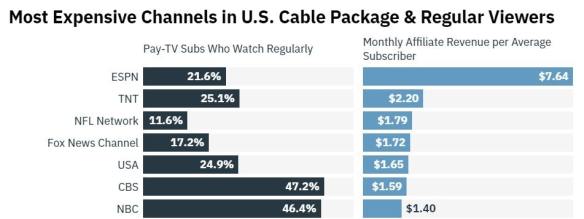
This means, for every actual viewer, Fox News receives a $7.75 subsidy from people who never watch Fox News. This is a higher subsidy than other non-sports channels, like FX ($1.79), CNN ($3.18), and TBS ($2.79), receive. And none of those channels regularly spreads white nationalist talking points to millions of viewers.
So how can Americans who don’t watch Fox News and find Carlson’s conduct repugnant stop subsidizing his $10 million salary? One option would be for major cable operators like Comcast, Spectrum, and AT&T to offer cable TV packages that exclude Fox News. This would allow people the choice of whether to pay for Fox News, just as people choose whether to pay for HBO.
But, for the moment, corporate America seems loathe to take on the Murdochs or alienate Fox News’ passionate fan base. So the only way to stop sending cash to the Murdochs is to “cut the cord” and find a combination of streaming services that doesn’t include Fox News.
Unquote.
If you want to stop paying for cable TV but still want your local stations (which include ABC, CBS, NBC, PBS and even Fox, but not Fox News), there’s a not-for-profit streaming service called Locast. It’s now available in 31 major TV markets around the country (plus Puerto Rico):
Get the local channels you love [note: or hate] without a monthly bill. Locast is a not for profit service offering users access to broadcast television stations over the internet. It’s time to shred those cable bills and contracts!
If you’re part of the international elite who rub shoulders with the odious, 90-year-old Rupert Murdoch and his evil spawn Lachlan, you can treat them with the disrespect they deserve. You might tell them to stop the propaganda and then spit in their soup.
Boston Review has the best article about politics I’ve read in a long time: “Polarization or Propaganda?” It was written by C. Thi Nguyen, a philosophy professor at the University of Utah. Here’s the beginning:
I would like to stage a fight between two different accounts of the current political landscape—what’s been called the “post-truth” era, the infodemic, the end of democracy, or perhaps most accurately, the total shitshow of the now.
According to one oft-told story, what’s going on is systemic polarization. Our once-peaceful society has been riven into polarized camps. Extremism and political separation are the core problems, and the fix is something like reconnection, intermingling, and friendship across party lines. (The sound of this story is somebody issuing a plea for civility “in these divisive times.”)
According to a very different story, what’s going on is propaganda. Certain bad actors are generating false and misleading information for political purposes. To fix it, we need to fight those bad actors.
These are two different accounts of our current political landscape: polarization and propaganda. Which is the best explanation?
Systemic polarization, as it is usually told, is a basically symmetrical story. Polarization arises from a social dynamic that afflicts almost everybody. The social forces at play—social mobility, online media bubbles, algorithmic filtering—are pervasive, and their effect is nearly universal. Like-minded individuals naturally clump together and end up boosting each others’ confidence unreasonably. Conservatives and progressives are approximately as vulnerable and approximately as blameworthy.
On the other hand, the propaganda story is usually told asymmetrically: one side is stuck in the propaganda machine, the other side fighting against it. It is certainly possible to tell the propaganda story about both sides, but symmetry isn’t baked into its core.
Nguyen compares two books that present the opposing views. The first is Overdoing Democracy by Robert Talisse, a professor at Vanderbilt. He argues that “our current political rift . . . arises from the profound mutual disrespect between the two sides”:
The fix is to . . . find our way back to respecting the other side . . . We need to see our political opponents as holding their values sincerely. . . . And that involves realizing that group polarization, and other rationality-undermining effects, don’t just affect the other side. We, too, are the products of group polarization. Our own political confidence, too, is significantly irrational and unsupported. . . .
Once we have repaired our tendency to utterly dismiss the other side, we should engage in non-political cooperative projects with them: picking up litter together, teaching somebody to read at the library, joining a bowling league. We need to engage in parts of life where politics is simply not part of the picture . . .
The other book is Network Propaganda by three authors associated with the Berkman Klein Center for Internet and Society at Harvard (their book is available for free online). They tell a very different story:
. . . A host of factors went into creating the political landscape around the [2016 election], but the dominant factor was propaganda. For these authors, propaganda means the intentional spread of false or misleading information for the sake of political power. . . . The prime movers in [their] story are Fox News, Breitbart, and their funders and allies among the political elite.
A key element of this account is an effect the authors call the “propaganda feedback loop.” Inside the loop, media outlets stop trying to present truths and to fact-check their fellow outlets. Instead, these outlets are out to confirm their followers’ worldview. And the more time they spend in the loop, the more these followers get used to the experience of constant confirmation and grow intolerant of any challenges to their belief system. . . . Communication becomes more about reinforcing agreement and shared identity than about finding the truth. . . .
At the heart of the analysis is a careful, empirical study of . . . the media consumption environment around the 2016 election, including the network structure of Twitter and Facebook activity. The basic structure of the rightwing media ecosystem, the authors say, was completely different from that of the rest of the media ecosystem. The right-wing network—centered around Fox News and Breitbart—exhibited all the features of a propaganda loop. It excluded members that conformed to standard norms of objective journalism. False and misleading claims could (and did) circulate and get amplified, without criticism from anywhere else in the trusted network.
The rest of the media ecosystem exhibited a very different dynamic—what the authors call a “reality check dynamic.” In this setting, media outlets are incentivized to check up on each other . . . Outlets are thus encouraged to aim for factually accurate reporting and police failures in accuracy.
According to the authors, this subset of the media constituted a single, large, interconnected network, which included mainstream, centrist media outlets, traditional liberal outlets, and more radically left-leaning online-native sites, from ABC News, CNN, MSNBC, and the New York Times to the Huffington Post, Daily Kos, Mother Jones, and Occupy Democrats. Despite the relative political diversity of this network, its various members treated themselves as beholden to one another. That is, a fact check from a more left-leaning outlet like Mother Jones would be treated seriously by a politically centrist, mainstream outlet like ABC News, and vice versa. And the typical user of this network, no matter where they were on the political spectrum, treated the whole network as interconnected—reading across the network, and taking seriously fact checks from sources across it.
Professor Nguyen’s article is 5,000 words long (all of which is worth reading). To make a long story short, he concludes that the evidence favors the right-wing propaganda explanation, not the “living separate lives” one:
Of course, you might think this whole discussion is quite self-serving. . . . I am a typical lefty—so maybe this is all just motivated reasoning. I’m giving just the kind of self-serving argument that people on the left would give to justify their beliefs. And perhaps I am drawn to such an argument precisely because I have already been brainwashed, my whole life spent in a like-minded enclave of lefty academics.
Talisse makes exactly such an accusation. He says that we tend to think group polarization affects the other side, but not us; we tend to “disregard our own vulnerability to the phenomenon.” But this disregard, he says, is itself the result of group polarization. If this view is right, all are guilty of irrational confidence, and we should all do a substantial amount of self-discrediting.
What Talisse misses is that this sort of argument applies equally to all comers. Motivated reasoning isn’t just for extremists and radicals: the worry applies just as well to those who might call for civility, preach for moderation, and disdain extremes. Group polarization can beset any enclave at any place on the political spectrum, and motivated reasoning can affect those who love civility and moderation just as well as it can affect the extremists. The temptation to accept a Talisse-style view of symmetrical group polarization could itself be a result of group polarization—one arising in a body of like-minded centrists who would love to believe that the real problem was in all those irrational, polarized extremists. In fact, [the authors of Network Propaganda] make such an accusation:
As we have repeatedly seen . . . the prominent outlets on the left and center simply do not exhibit a parallel structure, content, or vehement outrage that we observe on the right. These facts are as inconvenient to academics seeking a nonpartisan, neutral diagnosis of what is happening to us as they are to professional journalists who are institutionally committed to describe the game in a nonpartisan way. . . . But the facts we observe do not lend themselves to a natural, “both sides at fault” analysis.
This is not to dismiss either position out of hand. The point is that the position of advocating for moderation, civility, and civic friendship does not magically rise above the fray, rendering itself, by its peaceable face, immune to debunking arguments and accusations of motivated reasoning. We can point out that Network Propaganda is comforting to liberals and leftists, but we should also point out that Overdoing Democracy is comforting to centrists—to those wary of radical change, who long for the civility of a bygone era. Neutrality doesn’t give you a free pass from accusations of motivated reasoning.
Unquote.
The idea that polarization is the basic problem, not millions of our fellow citizens being under the influence of asymmetrical, right-wing propaganda, has always seemed like putting the cart before the horse. The propaganda explains the polarization, not the other way around. If living separate lives in separate environments was the key factor, the amount of propaganda on both sides would be comparable. But there is nothing on the left like the right-wing media bubble and its disregard for truth. Reactionaries respond by claiming that all other media outlets from Mother Jones to CBS News to the news pages of The Wall Street Journal, i.e. every purveyor of news and opinion that doesn’t support the Republican Party line, are the same. It’s nonsense.
As the Democratic Party has remained a standard, center-left party for decades, the Republican Party has morphed into a radical, right-wing outlier. That’s not because Americans don’t spend enough time together at PTA meetings or their local diners. It’s because one side has been riding a wave of bullshit for the past thirty years, and there’s no sign it’s slowing down.
By the way, Fox News celebrated its 19th anniversary this year with the following statement:
We are extremely proud that viewers have consistently tuned in to our slate of original programming for nearly two decades, choosing Fox News as their destination for not only breaking news coverage, but insightful analysis from a diversity of viewpoints.
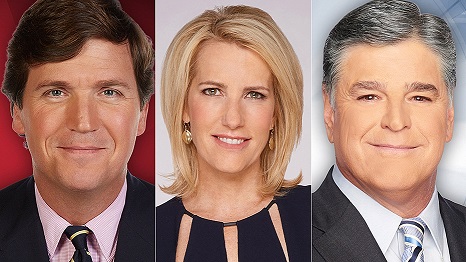
Demonstrating the diversity on offer, the statement was followed by a picture of Tucker Carlson, Laura Ingraham and Sean Hannity.
 Whereof One Can Speak 🇺🇦
You must be logged in to post a comment.