If You’ve Got At Least Five Votes, You Can Do Whatever You Want

The reactionary 2/3 of the Supreme Court announced today that the kind of affirmative action that favors black college applicants, simply because they’re black, is no longer legal. That’s not what earlier Supreme Courts thought, but legal precedent doesn’t matter if you’ve got enough votes.

Race-based affirmative action has always been controversial and even with the Court’s 6-3 decision today, what’s legal and what isn’t will remain murky. The Court now says race can be a factor in college admissions if it played a sufficiently significant role in the applicant’s life. Obviously, this isn’t the end of the matter.

The decision (full text here) talks a lot about the 14th Amendment to the Constitution. That’s the one that says “no state shall … deny to any person within its jurisdiction the equal protection of the laws”. The amendment was adopted after the Civil War to protect black Americans, especially former slaves, from discrimination.

But the notion of “equal protection” is vague. When a college admits somebody based on their athletic prowess, are applicants with no athletic skills being equally protected? How about the children of alumni or university staff? Are applicants whose parents never went to college or don’t work at the university in question equally protected?

I was trying to answer this question for myself when the internet led me to the Civil Rights Act of 1964. It famously prohibits discrimination on the basis of race, color, religion, sex or national origin. That seems to be a clearer, although not necessarily clear, rule to follow than the 14th Amendment’s equal protection clause. In fact, Wikipedia says the Civil Rights Act was enacted in order to clarify the meaning of “equal protection”.

Looking to see what today’s decision said about the Civil Rights Act, I found a concurring opinion from Justice Gorsuch (a prominent reactionary). This is what Gorsuch says:

For some time, [Harvard and the University of North Carolina] have decided which applicants to admit or reject based in part on race. Today, the Court holds that the Equal Protection Clause of the Fourteenth Amendment does not tolerate this practice. I write to emphasize that Title VI of the Civil Rights Act of 1964 does not either. [p. 107]

… a clear rule emerges. Title VI prohibits a recipient of federal funds from intentionally treating one person worse than another similarly situated person because of his race, color, or national origin. It does not matter if the recipient can point to “some other … factor” that contributed to its decision to disfavor that individual… It does not matter if the recipient discriminates in order to advance some further benign “intention” or “motivation”. [p. 109]

Gorsuch concludes that since the Civil Rights Act doesn’t mention, for example, athletic prowess or whether your parents ever went to college, it’s fine to discriminate against lousy athletes and applicants whose parents only finished high school. That makes a certain amount of sense, although there are devils in the details.

If you want to hire somebody to teach Chinese, it is discrimination if you favor somebody born in Shanghai over somebody born in Iowa? If the drama club is casting Hamlet, is it discrimination to lean toward a woman playing Ophelia instead of a man? The blunt language of the law suggests it would be illegal to do so.

Presumably, a college can still favor an applicant who grew up in Alabama or Compton over one from Darien, Connecticut, or Malibu. That’s one way to indirectly and haphazardly consider race in college admissions.

But this is why we have legislators and judges, to clarify such matters (it’s really too bad so many of them are Republicans).

Even though Gorsuch thinks the Civil Rights Act presents a clear rule — not simply a clearer one — the six reactionaries included this exception in their decision:

The United States [government] contends that race-based admissions programs further compelling interests at our Nation’s military academies….This opinion … does not address the issue, in light of the potentially distinct interests that military academies may present.

In other words, our military academies may continue to factor race into who they admit, the rationale for this exception being that the officer corps shouldn’t be a lot whiter than the regular troops. Yet having a racially diverse officer corps is just one of those “other factors” or “benign intentions or motivations” that Gorsuch says are irrelevant.

Is having a racially diverse student body a factor to be considered when deciding who gets to attend and graduate from our nation’s most prestigious universities? Apparently not.

So much for right-wing consistency (but, after all, they have the votes).

PS: The Court also issued a decision today in a case involving a Christian who worked for the post office. When the post office began making deliveries on Sundays, this employee told his supervisor that he couldn’t work that day of the week because of his religious beliefs (he sought a religious “accommodation”).

With Groff unwilling to work on Sundays, USPS made other arrangements. During the peak season, Sunday deliveries that would have otherwise been performed by Groff were carried out by the rest of the [local] staff, including the postmaster, whose job ordinarily does not involve delivering mail. During other months, Groff ’s Sunday assignments were redistributed to other carriers assigned to the [region]. Throughout this time, Groff continued to receive “progressive discipline” for failing to work on Sundays. Finally, he resigned.

He then sued the post office. The Supreme Court unanimously sent the case back to a lower court for further proceedings. But weren’t the non-Christian employees forced to work on Sunday being discriminated against for not being Christians? Wouldn’t their treatment violate the Civil Rights Act of 1964, which outlaws discrimination based on religion? Thank heavens we have distinguished jurists to answer these questions.
The U.S. Economy Is in Better Shape Than You Might Realize

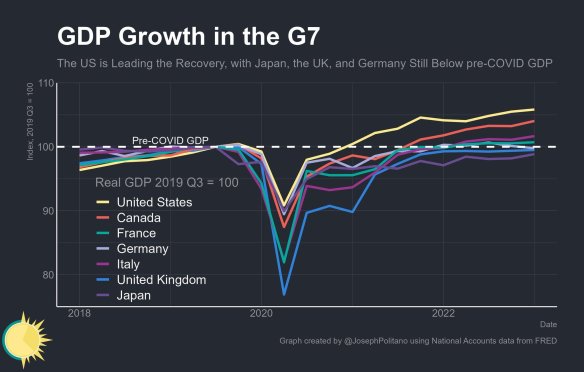
It isn’t commonly known, but we have the highest post-pandemic growth among the G7 nations, the group that includes the U.S., Canada, France, Germany, Italy, Japan and the United Kingdom.

Fzpz_smX0AIIZKt

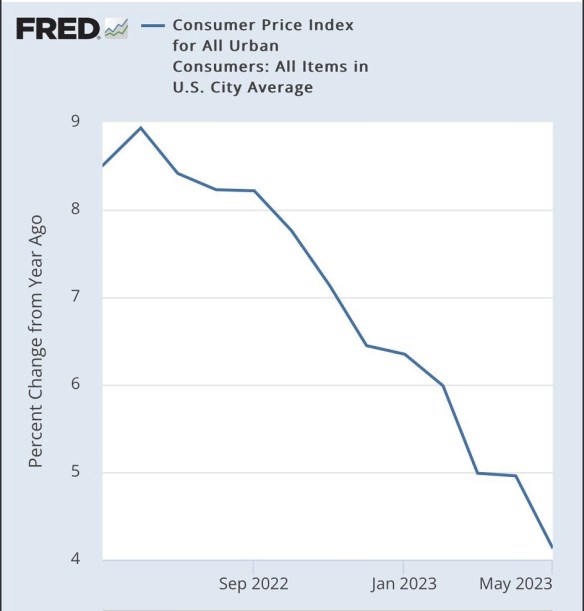
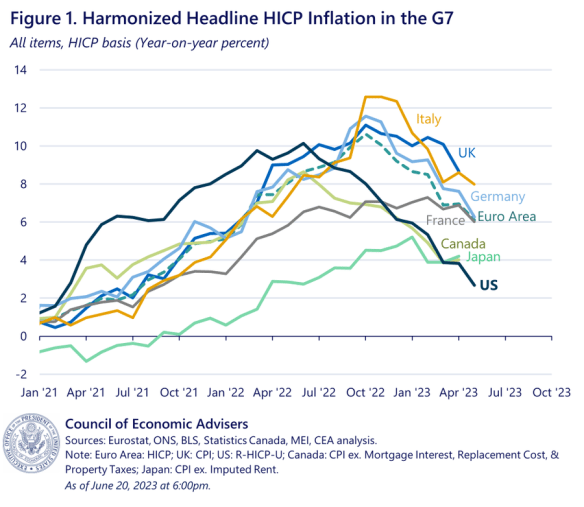
We also have the lowest inflation.

Fzpzxv1XsAIHUrJ

Could last year’s biggest piece of legislation, the Inflation Reduction Act — which passed with zero Republican support — have helped reduce inflation?

Fzp-2vsakAMzWMG

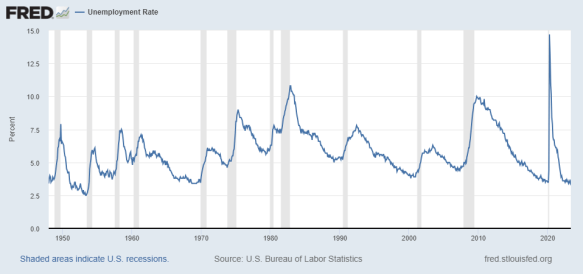
We also have our lowest unemployment rate since 1970, more than 50 years ago.

fredgraph

Perhaps more voters will understand how well the economy is doing by next year’s election — unless, of course, they’re locked into the right-wing media/propaganda bubble. For them, the country is in horrible shape and there is no hope for a better tomorrow unless their favorite felon is returned to office.

Police Reform and Fake Capitalism (They’re Not Related)

Calling the police can be dangerous. New Jersey is doing something about it. The state created a program called ARRIVE Together. A mental health professional accompanies the police when they go out on a call involving someone in mental distress. A study showed that in 342 such cases, only 3% resulted in the use of force and only 2% resulted in an arrest (usually because of an unrelated issue, such as an outstanding warrant). The program is being expanded and should serve as a model for police departments around the country (see this report from the Brookings Institution).

So much for some good news. Now back to harsh reality. From The Guardian:

One of the most deeply held and frequently heard propositions about capitalism is that it revolves around private companies and individuals taking risks. When, earlier this year, the US government arranged a rescue package for Silicon Valley Bank, for instance, among the many objections to it was the claim that the rescue contravened capitalism’s risk norms.

This view of the world directly informs wide swaths of economic policymaking today….But examine the economy, and it becomes clear: capitalism has become less and less about corporate risk-taking in recent decades. To be sure, many businesses do take significant risks. The independent small business owner who opens a new cafe in London generally faces intense competition and massive risk. But as political scientist Jacob Hacker has argued, business in general has been enormously skilled in recent times at offloading risk – principally by dumping it on those least able to bear it: ordinary households.

… The best example of a business usually regarded as being fundamentally about risk-taking, but which in fact is not, is … alternative asset management, an umbrella term for hedge funds, private equity and the like. (“Alternative” here means anything other than publicly listed stocks and bonds.) Asset managers are anything but marginal, exotic firms – they manage more than $100 trillion of clients’ money globally and control everything from [Benihana to PetSmart to Westinghouse].

But let’s look at what asset management companies in places like Britain and the US actually do. Three considerations are paramount.

First, there is the matter of whose capital is put at risk when alternative asset managers such as Citadel, Blackstone and KKR invest. In large part, it’s not theirs. The proportion of equity invested by a typical hedge or private equity fund that is the asset manager’s own is usually between 1% and 3%. The rest is that of their external investor clients (the “limited partners”), which include pension funds.

Second, consider how an asset manager’s investments are designed. For one thing, its own financial participation in, and management of, its investment funds is usually through a vehicle (the “general partnership”) that is constituted as a separate entity, precisely in order to insulate the firm and its professionals from liability risk.

Furthermore, the fund and its manager is generally distanced from underlying investments by a chain of intermediary holding companies that protect it from the risk inherent in those investments. In leveraged buyouts, where money is borrowed to help finance a deal,the debt goes on to the balance sheet of the company the fund has acquired. This means if trouble arises in repaying the debt, it is not the investment fund that is on the hook, still less its manager.

Third and last, fee structures also distance asset managers from risk. If a fund underperforms, they may earn no performance fee (based on fund profits), but they do have the considerable consolation – a form of risk insurance, if you like – of the guaranteed management fee, usually representing about 2% of limited partners’ committed capital, year after year. Essentially, management fees pay asset managers’ base salaries; performance fees pay bonuses.

In short, then, it would be far-fetched to suggest that what hedge funds and the like do amounts substantially to risk-taking. The only meaningful risk they themselves face is that of losing customers if fund returns prove underwhelming…. In reality, the business of alternative asset management is less about taking on risk than, in Hacker’s terms, moving it elsewhere. So when things go wrong, others bear the brunt….

Why does this matter? Because unless elected policymakers understand how risk is produced and distributed in modern economies, they will not be in a position to act appropriately and proportionately. That is why vague talk from politicians of being “pro-business” or “entrepreneurship” mean so little; the point is to learn from economic realities as they actually are, as opposed to how economics textbooks say they could or should be.

There is one very obvious policy recommendation for alternative asset management that flows from our understanding what they actually do with “risk”: taxing them more.

The main performance fee earned by alternative asset managers is “carried interest” – effectively, a profit share. In the UK and US, most asset management firms pay tax on this revenue at the capital gains rate, rather than the usually higher income tax rate. This is because the asset manager has typically been understood to be “taking on the entrepreneurial risk of the [investment]” – a standard justification for taxation as capital gain.

But as we have seen, this simply does not hold water. In 2017, the New York Times called the beneficial tax treatment of carried interest “a tax loophole for the rich that just won’t die”. It’s time to close it….

Note: To pass Biden’s Inflation Reduction Act last year, Democrats needed Sen. Kyrsten Sinema’s vote. But she wouldn’t vote for the bill unless Democrats dropped the provision that would have closed the carried interest loophole. She insisted on preserving the tax break that favors the securities and investment industry. Wouldn’t you know that hedge fund managers and private equity executives gave her more than $2 million between 2018 and 2022? Since then, she left the Democratic Party to run in Arizona as an “Independent” [CNBC].

Why They Stick With Him

What can stop the Republican Party’s slide into fascist insanity? The Murdochs and Fox “News” turning away from propaganda? Democrats finding a politician as popular as Franklin Roosevelt? Lots of un-American “patriots” and un-Christian “Christians” dying off? America’s most famous criminal defendant losing the power of speech?

History professor Thomas Zimmer doesn’t discuss those possibilities. Instead, he explains why they’re sticking with the crook:

Republican [politicians] are not simply cowards. It’s worse.

The least plausible answer that nevertheless features prominently in the political discourse is that … they don’t dare stand up to the demagogue, fearing his wrath and that of his supporters. Fear might certainly play a role in individual cases, … but as an overall explanation, the narrative that Republicans are just scared and cowardly is still highly problematic….

For the news media, the cowardice tale provides justification for clinging to the notion that the [Republican Party] is a “normal” party – just struggling with an authoritarian insurrection, with a hostile takeover engineered by a few extremists who don’t represent the party’s true nature. Liberals may find comfort in the idea that everyone is committed to democracy, that deep down, we really all want the same thing for the country, even when some are just too scared of the mean demagogue and his cult followers to act on their beliefs.

Such an approach is completely oblivious to – or deliberately tries to obscure – the fact that no such consensus exists, that there is no fundamental agreement on which to build. It is entirely misleading because it negates the actual nature of the conflict and what is at stake. And by conveniently ignoring the longstanding anti-democratic tendencies on the Right, we can tell a story that begins (and possibly ends!) with Txxxx.

If not cowardice, then what?

… Republican elites understand they can’t win without the base, and the base remains committed to Txxxx-ism. But there is more to consider than just opportunism. Almost every time the Right is at a crossroads, they choose the path of radicalization, even when it’s not at all clear that’s a reasonable choice from a purely electoral standpoint.

… It is crucial to grapple with the underlying ideas and dynamics that have animated the Republican Party’s path for a long time. They have led to a situation in which moments of brief uncertainty almost always result in a further radicalization … What happened after the 2012 election defeat that shook conservatives to the core is an instructive example: The Republican National Committee famously released an “Autopsy” report that called for moderation and outreach to traditionally marginalized groups. But instead, the [party] doubled down – and went with Txxxx-ism.

About a decade later, Republicans – elites and base alike – are so deep into the Txxxx experience, that it’s worth turning the question around: How could they not close ranks behind [him] now, no matter what happens, after all they have accepted, supported, justified, and condoned so far? … If you leave now, was it all for nothing? … And the people who you have painted as the radically “Un-American” enemy, … are you ultimately going to let them win?

… And so, they stick with Txxxx – and have to find ever more extreme justifications for why he is, at worst, the lesser evil compared to the “leftist” enemy. That is partly why rightwingers – politicians, reactionary intellectuals and pundits, media activists – are constantly playing up the threat of “woke” radicalism and the “illiberal Left.” It has become dogma on the Right to define “Us” (conservative white Christians) as the sole proponents of “real America” – and “Them” (Democrats, liberals, “the Left”) as a dangerous “Other.” The Democratic Party, in this understanding, is not just a political opponent, but an “Un-American” enemy – a fundamentally illegitimate political faction captured by the radical forces of leftism, liberalism, wokeism, and multiculturalism.

The Right [sees] the struggle between Republicans and Democrats … as an existential conflict over whether or not the only version of the country they are willing to accept as “America” will survive and endure. Rightwingers have decided that they *are* the country…. In that sense, choosing the Republican Party *is* choosing the country.
Within the confines of such a worldview, … it constantly privileges the more radical over the more “moderate” forces within the [party]…. There’s always permission to escalate, hardly ever to pull back.

This underlying permission structure is absolutely key: It states that “Real Americans” are constantly being victimized, made to suffer under the yoke of crazy leftist politics, besieged by “un-American” forces of leftism…. In the minds of conservatives, they are never the aggressors, always the ones under assault. Building up this supposedly totalitarian, violent threat from the “Left” allows them to justify their actions within the long-established framework of conservative self-victimization. It allowed them to support Dxxxx Txxxx in the first place.

Do Republicans *really* believe this – or is this all just a cynical game? … Many on the Right don’t necessarily believe in the specifics of this conspiracy theory or that chimera of stolen elections. But they are still “true believers” … in the political project Txxxx-sm stands for: the white grievance politics that seeks to forever preserve America as a place of traditional hierarchies of race, gender, religion, and wealth.

And so, the permission structure of conservative politics remained fully intact even after January 6, and it quickly allowed for a realignment behind Txxxx….

But wait, maybe it’s different this time? What about the Republicans – like Bill Barr, for instance, who plainly defended the indictment as “very, very damning” and made it clear that the “idea of presenting Txxxx as a victim here, a victim of a witch hunt, is ridiculous” – who have acknowledged the severity of his wrongdoing: Aren’t they taking the exit ramp?

… In fact, Bill Barr has in many ways provided the starkest example of how a perverted version of “patriotism,” of supposedly choosing loyalty to America, can serve as the justification for falling in line behind Txxxx despite personal misgivings: Because “the Left” is seen as the greater evil, and nothing has been able to change that…. When confronted with how he could possibly support another Txxxx presidency during his book promotion tour in 2022, Barr replied: “Because I believe that the greatest threat to the country is the progressive agenda being pushed by the Democratic Party.”

This is the perfect encapsulation of the permission structure that governs conservative politics: Anything is justified in defense against what they constantly play up as a radically “Un-American,” extremist “Left” that has supposedly taken over the Democratic party….

We are now at the point where an attack on the Capitol was not nearly enough to break this logic of escalation or dislodge Dxxxx Txxxx as the leader of the Republican Party. That dynamic continued to shape the Right after January 6 – and [continues] in June 2023… In moments when it looked like there could have been an alternative path, an exit ramp, Republicans radicalized instead. Until we get a lot of hard evidence that something drastic has changed, this should shape our expectations going forward and our understanding of what American democracy is up against.

Truth vs. Fantasy in Today’s Politics, Part 2

My previous post dealt with false talking points Republican presidential candidates are repeating over and over. It may not be a surprise that these clowns are ignoring reality regarding the economy, immigration and crime. But there are even bigger myths worth noting. Here are two big differences between reality and Republican bullshit.

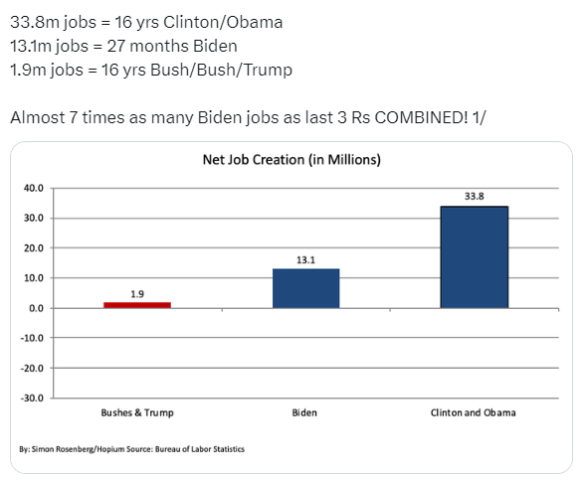
Republicans have convinced many voters that they’re better at handling the economy than Democrats. Is it because Republicans claim to love capitalism, especially big business, so much? Here’s the job growth under the most recent Democratic and Republican presidents. The difference is rather amazing and certainly not well-known. Under the last three Democrats, the economy added 46.9 million jobs. Under the last three Republican presidents, the ones who supposedly know how to nurture the economy, the increase was a pathetic 1.9 million (from the Bureau of Labor Statistics and Simon Rosenberg):

Untitledx

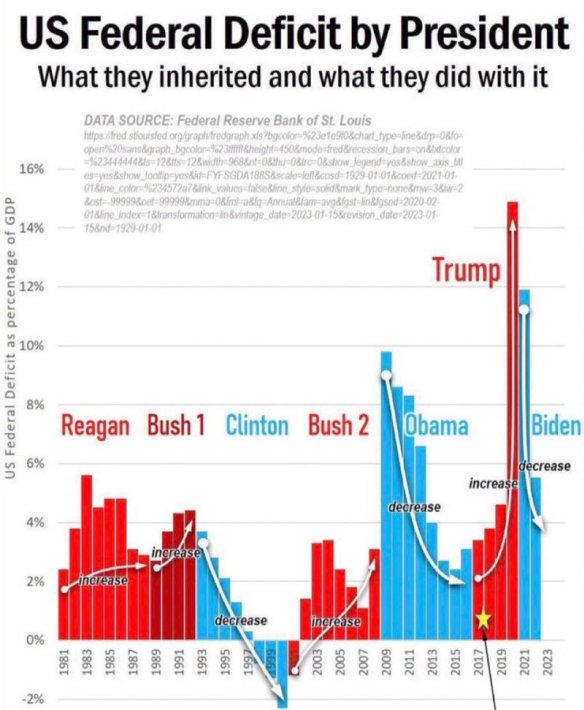
But wait! Does the economy grow under Democrats because they’re the party of “borrow and spend”? Hardly. It’s because Democrats try to spread the wealth, not concentrate it at the top. Since Reagan was president, Republicans have added red ink through reckless, unproductive tax cuts, while Democrats have restored fiscal sanity (from the Federal Reserve Bank of St. Louis and the Tennessee Holler site):

FxtUCW6WAAAeCuy

Deficits went up under Reagan, the two Bushes and the last guy. They’ve gone down under Clinton, Obama and Biden. It’s no surprise that cutting taxes for the rich and corporations increases the national debt but a healthier economy under Democratic presidents makes deficits go down.

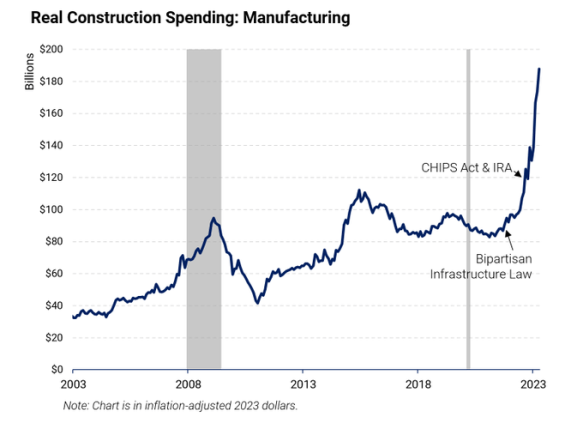
Here’s one last chart. Politicians have been talking about bringing back American manufacturing jobs for as long as I can remember. Now it looks like it’s actually happening. This chart shows spending on factory construction (adjusted for inflation). To the left is the second Bush presidency, showing factory construction increasing until the 2008 financial crisis (the vertical gray line) that started in Bush’s second term. Construction recovered in Obama’s first term, was stagnant or declined during the last president’s single term, and then took off with Biden in the White House.  From the Bureau of Labor Statistics, the Census Bureau and Steven Rattner:

Fx9O131XsBEDGif

From Yahoo Financial News:

President Obama tried to revitalize American manufacturing, with little to show for it. President Txxxx tried too, with similarly unimpressive results.

Under President Biden, however, a manufacturing boom finally seems to be getting started. Since the beginning of 2022, construction spending on new factories has more than doubled, from an annualized rate of $91 billion in January 2022 to $189 billion in April 2023, the latest data available. That’s the biggest jump, by far, in data going back to 2002….

Private-sector firms are building more US factories to cash in on an unprecedented spate of legislation Biden has signed providing federal funding and incentives for infrastructure development, a massive green-energy buildout, and a revitalized semiconductor industry. Three separate bills passed by the Democratic Congress in 2021 and 2022, and signed by Biden, will provide well over $1 trillion in federal spending, tax breaks, and other incentives meant to build more important products in the United States and reduce reliance on importers, mostly China.

Republicans would have you believe the American economy is in deep trouble and they’d do a better job with it than Democrats. The evidence says otherwise. Republican economic competence is a myth.