Hindsight on Afghanistan

From The Washington Post:

Twenty years ago, when the World Trade Center and the Pentagon were still smoldering, there was a sense among America’s warrior and diplomatic class that history was starting anew for the people of Afghanistan and much of the Muslim world.

“Every nation has a choice to make,” President George W. Bush said on the day that bombs began falling on Oct. 7, 2001. In private, senior U.S. diplomats were even more explicit. “For you and us, history starts today,” then-Deputy Secretary of State Richard L. Armitage told his Pakistani counterparts.

Earlier this month, as the Taliban raced across Afghanistan, retired Lt. Col. Jason Dempsey, a two-time veteran of the war, stumbled across Armitage’s words. To Dempsey, the sentiment was “the most American thing I’ve ever heard” and emblematic of the hubris and ignorance that he and so many others brought to the losing war.

“We assumed the rest of the world saw us as we saw ourselves,” he said. “And we believed that we could shape the world in our image using our guns and our money.” Both assumptions ignored Afghan culture, politics and history. Both, he said, were tragically wrong.

The near-collapse of the Afghan army in the space of just a few stunning weeks is prompting the military and Washington’s policymakers to reflect on their failures over the course of nearly two decades. To many, the roots of the disaster go back to the war’s earliest days, when the Taliban were first driven from power and the United States, still reeling from the shock of the 9/11 attacks, set about building a government in Kabul.

The Afghanistan Papers: Afghan security forces, despite years of training, were dogged by incompetence and corruption

Some two dozen prominent Afghans met in Bonn, Germany, with officials from the U.S. government, NATO and the United Nations to form a new Afghan government crafted in the image of the United States and its European allies.

“You look at the Afghan constitution that was created in Bonn and it was trying to create a Western democracy,” said Michèle Flournoy, one of the architects of President Barack Obama’s troop surge in Afghanistan in 2010. “In retrospect, the United States and its allies got it really wrong from the very beginning. The bar was set based on our democratic ideals, not on what was sustainable or workable in an Afghan context.”

Flournoy acknowledged in hindsight that the mistake was compounded across Republican and Democratic administrations, which continued with almost equal fervor to pursue goals that ran counter to decades — if not centuries — of the Afghan experience.

By 2009, when Obama took office, it was clear to just about everyone that the United States was losing the war.

To reverse Taliban momentum and give U.S. officials a chance to build up the Afghan government and security forces, Obama signed off on a surge of troops that more than doubled the size of the American force in Afghanistan.

Flournoy said she was initially hopeful that the plan could work. On trips to Afghanistan, she met frequently with young Afghans, including women’s groups, who shared America’s vision for the country. They wanted to send their daughters to school, serve in government, start businesses and nonprofits. They wanted women to be full participants in society and craved a predictable political and legal system. “We found all kinds of allies,” she said.

But those individuals were no match for the rot that had permeated the Afghan government. She and other U.S. officials understood that with all the U.S. money floating around in Afghanistan, there would be “petty corruption,” she said. What U.S. officials discovered in 2010, after the surge was already underway, was a corruption that ran far deeper than they had previously understood and that jeopardized their strategy, which depended on building the legitimacy of the Afghan government.

“We realized that this is not going to work,” Flournoy said. “We had made a big bet only to learn that our local partner was rotten.”

Now, as Taliban fighters race toward Kabul and the Afghan military crumbles, Flournoy said her thoughts often turn to the Americans who sacrificed for the mission and to those “wonderful allies” who shared the U.S. hopes for a democratic Afghanistan. “That’s what makes me so sick to my stomach,” she said. “We invested in this whole generation that is about to suffer through this very horrible chapter.”

As Taliban widens its grip, Afghans reckon with life under militant rule

Meanwhile, current and former U.S. officials are trying to make sense of why a government and security forces built over two decades at a cost of more than $100 billion dollars are collapsing so quickly.

Carter Malkasian, a longtime adviser to U.S. commanders in Afghanistan, has pegged the weakness of the Afghan forces on their lack of a unifying cause that resonates with Afghans, as well as their heavy dependence on the United States. By contrast, the Taliban were fighting for their culture and Islam. They “exemplified something that inspired, something that made them powerful in battle, something closely tied to what it meant to be an Afghan,” Malkasian writes in his new book, “The American War in Afghanistan.”

It’s an observation that speaks to the limits of American power and raises the broader question of how the catastrophic and embarrassing failure in Afghanistan might constrain U.S. foreign policy moving forward.

“We know what happens when we fall to imperial hubris. What does one do with imperial heartbreak?” asked John Gans, who served as a civilian in the Pentagon during the Obama administration.

So many of today’s rising military commanders and foreign policy experts were drawn into government service by the 9/11 attacks and the war in Afghanistan. After the relatively low-stakes peacekeeping missions of the 1990s, America and U.S. foreign policy suddenly seemed to be at the center of the world in the years after 2001. A whole generation of leaders driven “by ambition, ego and a desire to shape world events” ran toward the action, Gans said. . . .

It seems certain that in coming years the use of military force will be informed by this searing experience. U.S. foreign policy will be guided by more modest ambitions, especially when weighing the use of military power. Flournoy imagines a future in which military force is limited to more sharply defined objectives and informed by far greater humility when it comes to spreading democracy or changing societies.

In many cases, it’s a vision in which force is used to manage chronic problems, rather than solve them.

Another possibility is a U.S. foreign policy that is increasingly focused more on issues such as pandemics or climate change, which require U.S. leadership and a global response. Gans noted that more than 600,000 Americans have died of covid-19, far more than the number of U.S. lives lost to terrorism and war over the past 20 years.

For now, though, it seems unlikely that these threats will take center stage in U.S. foreign policy. The Pentagon, with its $740 billion budget, still sucks up a larger share of discretionary spending than any other government agency. Meanwhile, the foreign policy establishment has shifted its focus increasingly to the competition with the likes of Russia and China.

“After 9/11 everyone raced to become a Middle East or counterterrorism expert,” said Gans. “After covid, you don’t see many foreign policy people racing to become global health experts.”

On one subject most foreign policy experts agree: America needs to temper its faith in its armed forces. “We had so much faith in our military that we were inevitably going to overstep,” said Dempsey, the Afghanistan veteran. “A military bureaucracy unchecked never yields good outcomes.”
Too Long in Afghanistan

A Twitter thread about the U.S. and Afghanistan from David Rothkopf, a political scientist, etc.:

US policy in Afghanistan has been 20 yrs of bad decisions & bad execution in the face of an insoluble challenge. Our local allies were very flawed, our enemy was resolute & the last 3 US presidents have wanted out & knew what’s happening now would happen. But sure, it’s on Biden. 

The original sin and greatest blame goes to George W. Bush who got us involved in a protracted mission when the only right mission was to go in, get Al Qaeda & leave. That was compounded by the catastrophic decision to enter Iraq–an enormous distraction. 

Obama and T____ compounded the problem by failing to find a way to exit. Why didn’t they? Because their advisors knew that the center (the Afghan gov’t and forces) couldn’t hold and that ultimately collapse would follow the exit. Those advisors were right. 

Those who recommended staying indefinitely did so in the full knowledge that 20 years of massive expense and effort could not produce a stable central government or a secure Afghanistan. There is zero evidence any outside force ever could do that. None ever has. 

There are profound human rights issues–particularly women’s rights issues–that should be of great concern and a priority for the international community. But the answer is not a costly U.S. & allied military Band-Aid. 

The military is not the only tool in what Madeleine Albright would call our diplomatic toolbox. Moreover it is one that has proven wholly ineffective to produce lasting change in Afghanistan. We must shift to other tools–at the top of the list being multilateral diplomacy. 

Bringing together all the major powers with a stake in Afghanistan and institutions to communicate to the effective leaders of the country that if they respect the rights of women they will benefit and if they do not they will be severely penalized. 

Letting them know that they will be subject to military strikes if they harbor terrorists is also fair. The notion that the only path is continuing to do what hasn’t worked to date is ridiculous. And the costs & pitfalls of alternative paths aren’t worse than what hasn’t worked. 

Some suggest that Biden could have planned this better. First, Bush, Obama and T____ could have and should have planned and executed this better. Next, there is plenty to suggest that whenever the US decided to leave, what is happening would happen. 

The Taliban want to embarrass us and claim victory. They have known all along they would not get much resistance in most of the country from the central government. This was so predictable everyone predicted it–and no one, no one offered a viable alternative solution. 

Only one president has had the courage to do the right thing in Afghanistan. It is the same man who advised we do this in 2009 when he was Vice President. It takes courage because he knows that he will receive the critiques his opponents are heaping on him now. 

But doing the right thing even when it is likely to be politically controversial and even when it reveals uncomfortable realities is what strong leadership is about. 

Biden & his team have already committed to using other means to advance US interests in Afghanistan-as we should have done long, long ago. It’s fascinating that so many who opposed nation building, who do not believe the US should be the world’s sheriff are now criticizing Biden. 

America’s war in Afghanistan will rank alongside Vietnam as one of our great modern failures of strategy and execution. Many are to blame for that. Whatever arguments might be made that the US departure could have been better executed, one thing is absolutely clear. 

The bulk of the responsibility for that failure lies with past administrations and with the leadership in Kabul (and to some extent with Taliban enablers beyond the country’s borders). Biden is doing what is right and what must be done. It is time to turn the page. 

How the Minority Rules

I’ve only got my left hand for typing right now, but there’s always copy and paste. From THE GUARDIAN:

The United States is becoming a land filled with “democracy deserts”, where gerrymandering and voting restrictions are making voters powerless to make change. And this round of redistricting could make things even worse.

Since 2012, the Electoral Integrity Project at Harvard University has studied the quality of elections worldwide. It has also issued biannual reports that grade US states, on a scale of 1 through 100. In its most recent study of the 2020 elections, the integrity of Wisconsin’s electoral boundaries earned a 23 – worst in the nation, on par with Jordan, Bahrain and the Congo.

Why is Wisconsin so bad? Consider that, among other things, it’s a swing-state that helped decide the 2016 election. Control the outcome in Wisconsin, and you could control the nation. But Wisconsin isn’t the only democracy desert. Alabama (31), North Carolina (32), Michigan (37), Ohio (33), Texas (35), Florida (37) and Georgia (39) scored only marginally higher. Nations that join them in the 30s include Hungary, Turkey and Syria.

Representative democracy has been broken for the past decade in places like Wisconsin, North Carolina, Ohio, Pennsylvania, Michigan and Florida. When Republican lawmakers redistricted these states after the 2010 census, with the benefit of precise, granular voting data and the most sophisticated mapping software ever, they gerrymandered themselves into advantages that have held firm for the last decade – even when Democratic candidates win hundreds of thousands more statewide votes.

In Wisconsin, for example, voters handed Democrats every statewide race in 2018 and 203,000 more votes for the state assembly – but the tilted Republican map handed Republicans 63 of the 99 seats nevertheless. Democratic candidates have won more or nearly the same number of votes for Michigan’s state house for the last decade – but never once captured a majority of seats.

Now redistricting is upon us again. This week, the US Census Bureau will release the first round of population data to the states, and the decennial gerrymandering Olympics will begin in state capitols nationwide. And while there has been much coverage of the national stakes – Republicans could win more than the five seats they need to control of Congress next fall through redrawing Texas, Georgia, North Carolina and Florida alone, and they’ve made clear that’s their plan – much less alarm has been raised about the long-term consequences of entrenched Republican minority rule in the states.

It’s time for them to ring. The situation is dangerous.

Our democratic crisis is not just the stuff of academic studies. Who controls our states is increasingly a matter of life and death. Recent history is riddled with examples. For instance, the Flint water crisis began after a gerrymandered Michigan legislature reinstated an emergency manager provision even after voters repealed it in a statewide referendum.

When lawmakers in Texas ban mask mandates, or Florida politicians take away the power of local officials to require masks in schools, that’s the consequence of gerrymandering. And its impact can be measured in actual lives. When state lawmakers enact draconian restrictions on reproductive rights in Ohio, Georgia, Alabama and Missouri that opinion polls show are out of step with their own residents, that’s the power of gerrymandering. When Republican legislators strip emergency powers from Democratic governors, that’s yet another insidious effect. Our health, safety and wellbeing – our very lives – are in the hands of our state legislators. It is imperative that our votes decide who they are.

We know that when gerrymandering “packs” and “cracks” voters into districts for partisan advantage, it results in fewer districts that are competitive. And when districts are uncompetitive, fewer candidates have incentive to run – and those who do have little incentive to pay attention to any voters’ preferences outside of those who participate in low-turnout, base-driven primaries. This district uncompetitiveness, and the lack of incentives for legislators to listen and govern, is why our state and federal legislatures are so polarized.

And it can still get worse. Republicans hold complete control over redistricting in Texas, Georgia, Ohio, Florida and North Carolina. Democratic governors will have veto power over at least some tilted maps in Pennsylvania and Wisconsin, and a new commission will draw lines in Michigan. That should force some compromise in those states. But it also means that if Democrats lose the governor’s office in any of those states in 2022, Republicans might try to force a mid-decade redraw of maps. These entrenched lawmakers continue to show us how extreme they are, and demonstrate their willingness to demolish any traditional guardrail. We have already seen how legislators in those states have pushed for new voting restrictions, for sham “audits” of the 2020 results, and have even called for changes in how electoral college votes are awarded and certified.

Let’s be clear: D____ T____’s Big Lie was enabled by gerrymandering. Much of the success of the Big Lie is in its veneer of legitimacy, which has been perpetuated by Republican state legislators in places like Michigan, Georgia and Texas – whose very electoral successes were made possible by gerrymandering. And while the system held, barely, in 2020, there is no guarantee that the same thing happens next time, after another round of extreme redistricting and several more years of surgical laws designed to suppress the vote in closely contested states.

These are the stakes right now as redistricting begins anew. As we await the final census data this week, we must not allow redistricting to unfold quickly behind closed doors. We must keep this process transparent and mapmakers accountable. Find your state’s redistricting hearing schedule online, join the meetings (many will be held virtually) and consider submitting testimony about why fair maps matter. Tweet at journalists and your legislators. Mention it in every conversation you have with friends and family. Learn about and support organizations fighting for fair maps with people power on the ground. [WON’T THESE EFFORTS BE POINTLESS?. THIS IS RAW POWER AT WORK AND A FEW DEMOCRATIC SENATORS WHO COULD REFORM THE FILIBUSTER TO PROTECT VOTING RIGHTS ARE TOO STUPID AND/OR SELFISH TO ACT]

The process is going to move fast, and the next several weeks are critical. The stakes are much higher than just Congress. This is a fight for the future of our states, too. If you think that legislators will always be accountable to the people, or that autocracy can’t happen here, you aren’t paying attention. It already is.

THE AUTHORS:

Preparing for a Worse Pandemic

It looks like the Gulf Stream will eventually collapse, leading to a climate catastrophe, but maybe it will take centuries, not months, so let’s consider a different catastrophe instead. Eric Lander, the administration’s top science adviser, explains what we need to do to avoid a much worse pandemic:

Coronavirus vaccines can end the current pandemic if enough people choose to protect themselves and their loved ones by getting vaccinated. But . . .

New infectious diseases have been emerging at an accelerating pace, and they are spreading faster.

. . . That’s why President Biden has asked Congress to fund his plan to build on current scientific progress to keep new infectious-disease threats from turning into pandemics like covid-19.

. . . For the first time in our history, we have an opportunity not just to refill our stockpiles but also to transform our capabilities. However, if we don’t start preparing now for future pandemics, the window for action will close.

Covid-19 has been a catastrophe: The toll in the United States alone is more than 614,000 lives . . . A future pandemic could be even worse — unless we take steps now.

It’s important to remember that the virus behind covid-19 is far less deadly than the 1918 influenza. The virus also belongs to a well-understood family, coronaviruses. It was possible to design vaccines within days of knowing the virus’s genetic code because 20 years of basic scientific research had revealed which protein to target and how to stabilize it. And while the current virus spins off variants, its mutation rate is slower than that of most viruses.

Unfortunately, most of the 26 families of viruses that infect humans are less well understood or harder to control. We have a great deal of work still ahead.

The development of mRNA vaccine technology — thanks to more than a decade of foresighted basic research — was a game-changer. It shortened the time needed to design and test vaccines to less than a year — far faster than for any previous vaccine. And it’s been surprisingly effective against covid-19.

Still, there’s much more to do. We don’t yet know how mRNA vaccines will perform against other viruses down the road. And when the next pandemic breaks out, we’ll want to be able to respond even faster.

Fortunately, the scientific community has been developing a bold plan to keep future viruses from becoming pandemics.

Here are a few of the goals we should shoot for:

The capability to design, test and approve safe and effective vaccines within 100 days of detecting a pandemic threat (for covid-19, that would have meant May 2020); manufacture enough doses to supply the world within 200 days; and speed vaccination campaigns by replacing sterile injections with skin patches.

Diagnostics simple and cheap enough for daily home testing to limit spread and target medical care.

Early-warning systems to spot new biological threats anywhere in the world soon after they emerge and monitor them thereafter.

We desperately need to strengthen our public health system — from expanding the workforce to modernizing labs and data systems — including to ensure that vulnerable populations are protected.

And we need to coordinate actions with our international partners, because pandemics know no borders.

These goals are ambitious, but they’re feasible — provided the work is managed with the seriousness, focus and accountability of NASA’s Apollo Program, which sent humans to the moon.

Importantly, these capabilities won’t just prepare us for future pandemics; they’ll also improve public health and medical care for infectious diseases today.

Preparing for threats is a core national responsibility. . . . The White House will put forward a detailed plan this month to ensure that the United States can fully prepare before the next outbreak. It’s hard to imagine a higher economic or human return on national investment.

Reconstruction, the Gilded Age and Today

Having heretofore avoided reading a book about Reconstruction, one of the worst periods in American history, I decided to read a book about Reconstruction and the Gilded Age, two of the worst periods in American history (on the theory that reading a book about Reconstruction and something else would dilute the nevertheless disturbing account of Reconstruction).

The book was The Republic For Which It Stands: The United States During Reconstruction and the Gilded Age, 1865 – 1896, by Stanford University historian Richard White. It’s one of nine volumes in the Oxford History of the United States. It’s got 872 pages of text and weighs 3 1/2 pounds.

It wasn’t what you’d call a “fun read”. This is part of the publisher’s summary:

At the end of the Civil War the leaders and citizens of the victorious North envisioned the country’s future as a free-labor republic, with a homogenous citizenry, both black and white. The South and West were to be reconstructed in the image of the North. Thirty years later Americans occupied an unimagined world. The unity that the Civil War supposedly secured had proved ephemeral. The country was larger, richer, and more extensive, but also more diverse. Life spans were shorter, and physical well-being had diminished, due to disease and hazardous working conditions. Independent producers had become wage earners. The country was Catholic and Jewish as well as Protestant, and increasingly urban and industrial. The “dangerous” classes of the very rich and poor expanded, and deep differences — ethnic, racial, religious, economic, and political — divided society. The corruption that gave the Gilded Age its name was pervasive.

One thing that summary leaves out is that the period also included “taming the West”, more appropriately described as inflicting cultural devastation and mass murder on the American Indians. It also leaves out the horrors inflicted on former slaves (and some of their white supporters) in the South, the stunningly successful effort to undo the results of the Civil War using a biased legal system and more mass murder (there were places in states like Alabama and Mississippi where maybe 1% of black citizens cast ballots).

Two of the big political issues of this period were tariffs (what taxes should be applied to imports) and money (whether it should be based on gold or silver). Corruption in government, recurring financial panics and the economics of farming were also major concerns. But in some ways, American politics looked a lot like today, with inequality, the power of big business and limits on immigration being major issues. 

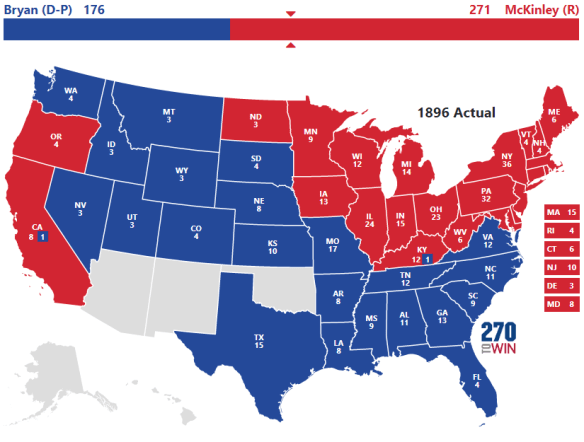
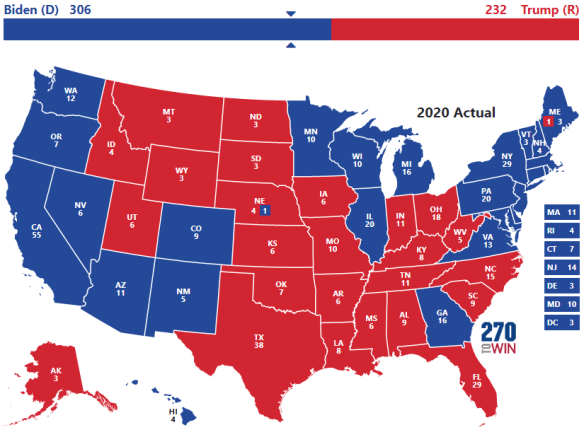
These two illustrations show something else that hasn’t changed. The first shows the presidential election of 1896; the second shows the one we had last year. 

1896_large 2020_large

The big difference between the two maps, of course, is that between 1896 and 2020 the two parties switched sides. Partly because of the Civil Rights Act of 1964, Southern racists became Republicans (not what you’d expect from the Party of Lincoln) and Northern and west coast liberals became Democrats.