When Will We Build Back Better? And What Will We Do?

“Build Back Better”. It’s not a great slogan, but Biden’s BBB bill will be passed eventually. It won’t be as sensible as what Biden originally proposed. A few “conservative” or flaky congressional Democrats insisted on making it worse. But it will make a difference in millions of lives when it finally becomes law.

Democrats in the House say they want to pass it this coming week, which means by Thursday, November 18. Then, however, both the House and Senate take another much needed break until the end of November. Assuming House Democrats do their job next week, Senate Democrats will then have two weeks to do theirs, before it’s break time again.  Unless Senate Democrats approve it by December 10, it won’t get done until 2022 (we really are living in the future). 

Almost all the news about BBB has been about the spending side of the bill, leaving out the popular offsetting taxes the bill would impose on corporations and people with plenty of cash to spare. The other thing the news has mostly ignored is what the bill would do. A relatively objective and nonpartisan group called the Committee for a Responsible Federal Budget has kindly provided the list below. The CFRB concludes it would have a small effect on the federal deficit in its present form. In the long run, they say it would have a bigger effect, assuming all the temporary parts of the bill are made permanent. But there’s no doubt whatsoever these things are worth doing and we can afford to do them (unlike the last Republican tax cut, for example, which wasn’t worth doing and made good things like BBB less easy to afford).

What’s in the Build Back Better Act?

Policy Cost/Savings (-)
Family Benefits  $585 billion
Provide universal pre-k & establish an affordable child care program (6 years) $390 billion
Establish a paid family and medical leave program $195 billion
Climate & Infrastructure  $555 billion
Invest in clean energy & climate resilience $220 billion
Establish or expand clean energy & electric tax credits $190 billion
Establish or expand clean fuel & vehicle tax credits $60 billion
Establish or expand other climate-related tax benefits $75 billion
Enact infrastructure & related tax breaks $10 billion
Individual Tax Credits & Cuts $210 billion
Extend Child Tax Credit (CTC) increase to $3,000 ($3,600 for kids under 6) for one year $130 billion
Make CTC fully refundable for 2023 & beyond $55 billion
Extend expanded Earned Income Tax Credit (EITC) for one year  $15 billion
Other individual tax changes $10 billon
Health Care  $335 billion
Strengthen Medicaid home- and community-based services $150 billion
Extend expanded Affordable Care Act (ACA) premium tax credits & make premium tax credits available to those in Medicaid coverage gap through 2025 $125 billion
Establish Medicare hearing benefit $30 billion
Invest in the health care workforce $30 billion
Other Spending & Tax Cuts  $310 billion
Build & support affordable housing $170 billion
Increase higher education & workforce spending $40 billion
Other spending & investments $100 billion
Reduce or Delay TCJA Base Broadening $290 billion
Increase SALT deduction cap to $80,000 through 2025 $285 billion+
Delay amortization of research & experimentation expenses until 2026 $5 billion’
Enact Immigration Reform  ~$100 billion
Subtotal, Build Back Better Act Spending & Tax Breaks  $2.4 trillion
Increase Corporate Taxes -$830 billion 
Impose a 15 percent domestic minimum tax on large corporations -$320 billion
Impose a 15 percent global minimum tax & reform international taxation -$280 billion
Impose a 1 percent surcharge on corporate stock buybacks -$125 billion
Enact other corporate tax reforms -$105 billion
Increase Individual Taxes on High Earners  -$640 billion
Expand the 3.8 percent Net Investment Income Tax -$250 billion
Impose a 5 percent surtax on income above $10 million & an 8 percent surtax on income above $25 million -$230 billion
Extend and expand limits on deductibility of business losses -$160 billion
Other Revenue -$170 billion
Reduce the tax gap by funding IRS & other measures -$125 billion*
Reinstate superfund taxes on oil -$25 billion
Expand nicotine taxes -$10 billion
Reform tax treatment of retirement accounts -$10 billion
Health Care -$250 billion
Repeal Trump Administration drug rebate rule -$150 billion
Reform Part D formula, cap drug price growth, & allow targeted drug price negotiations -$100 billion
Establish $80,000 SALT deduction cap from 2026 through 2030 & $10,000 cap in 2031 -$300 billion+
Subtotal, Build Back Better Act Offsets  -$2.2 trillion
Net Deficit Increase, House Build Back Better Act  ~$200 billion

Will the Future Be Electric?

Should anybody be optimistic about the climate crisis? Noted environmentalist Bill McKibben reviews a new book, Electrify: An Optimist’s Playbook for Our Clean Energy Future by Saul Griffith, an engineer and inventor. The title of the review is “The Future Is Electric”. Here’s McKibben’s summary of Griffith’s playbook: 

Electrification is to climate change as the vaccine is to Covid-19—perhaps not a total solution, but an essential one. [Griffith] begins by pointing out that in the United States, combustion of fossil fuels accounts for 75 percent of our contribution to climate change, with agriculture accounting for much of the rest. . . . The US uses about 101 quadrillion BTUs (or “quads”) of energy a year. . . .

Our homes use about a fifth of all energy [or 20 quads]; half of that is for heating and cooling, and another quarter for heating water. “The pride of the suburbs, the single-family detached home, dominates energy use, with large apartments in a distant second place,” Griffith writes.

The industrial sector uses more energy—about 30 quads—but a surprisingly large percentage of that is spent “finding, mining, and refining fossil fuels.” A much smaller amount is spent running the data centers that store most of the Internet’s data . . .

Transportation uses even larger amounts of energy [40 quads?] —and for all the focus on air travel, passenger cars and trucks use ten times as much.

The commercial sector—everything from office buildings and schools to the “cold chain” that keeps our perishables from perishing—accounts for the rest of our energy use [10 quads?].

If we are to cut emissions in half this decade—an imperative—we’ve got to cut fossil fuel use in big chunks, not small ones. For Griffith, this means leaving behind “1970s thinking” about efficiency: don’t waste time telling people to turn down the thermostat a degree or two, or buy somewhat smaller cars, or drive less. Such measures, he says, can slow the growth rate of our energy consumption, but “you can’t ‘efficiency’ your way to zero”:

Let’s stop imagining that we can buy enough sustainably harvested fish, use enough public transportation, and purchase enough stainless steel water bottles to improve the climate situation. Let’s release ourselves from purchasing paralysis and constant guilt at every small decision we make so that we can make the big decisions well.

“A lot of Americans,” he insists, “won’t agree to anything if they believe it will make them uncomfortable or take away their stuff,” so instead you have to let them keep that stuff, just powered by technology that does less damage.

By “big decisions” he means mandates for electric vehicles (EVs), which could save 15 percent of our energy use. Or electrifying the heat used in houses and buildings: the electric heat pump is the EV of the basement and would cut total energy use 5 to 7 percent if implemented nationwide. LED lighting gets us another 1 or 2 percent. Because electricity is so much more efficient than combustion, totally electrifying our country would cut primary energy use about in half. (And simply not having to find, mine, and refine fossil fuels would reduce energy use by 11 percent.)

Of course, replacing all those gas-powered pickups and oil-fired furnaces with electric vehicles and appliances would mean dramatically increasing the amount of electricity we need to produce overall—in fact, we’d have to more than triple it. We’ve already dammed most of the rivers that can produce hydropower (about 7 percent of our current electric supply); if we’re going to replace coal and natural gas and simultaneously ramp up our supply of electricity, we have three main options: solar, wind, and nuclear power, and according to Griffith “solar and wind will do the heavy lifting.”

That’s primarily because renewable energy sources have become so inexpensive over the past decade. They are now the cheapest ways to generate power, an advantage that will grow as we install more panels and turbines. (By contrast, the price of fossil fuel can only grow: we’ve already dug up all the coal and oil that’s cheap to get at.) According to Griffith’s math, nuclear power is more expensive than renewables, and new plants “take decades to plan and build,” decades we don’t have.

It’s a mistake to shut down existing nuclear plants that are running safely—or as safely as current technology allows—and it’s possible that new designs now on the drawing board will produce smaller, cheaper reactors that eat waste instead of producing it. But for the most part Griffith sides with Mark Jacobson, the environmental engineering professor at Stanford whose team showed a decade ago that the future lay with cheap renewables, an estimation that, though highly controversial at the time, has been borne out by the steady fall in the price of solar and wind power, as well as by the increasing efficiency of batteries to store it.

Griffith devotes more attention to batteries than almost any other topic in this book, and that’s wise: people’s fear of the “intermittency” of renewables (the fact that the sun goes down and the wind can drop) remains a major stumbling block to conceiving of a clean-energy future. Contrary to these fears, each month brings new advances in battery technology. The Wall Street Journal recently reported on the super-cheap batteries being developed that use iron instead of pricey lithium and can store energy for days at a time, making them workhorses for utilities, which will need them to replace backup plants that run on natural gas.

Griffith is good at analogies: we’d need the equivalent of 60 billion batteries a year roughly the size of the AAs in your flashlight. That sounds like a lot, but actually it’s “similar to the 90 billion bullets manufactured globally today. We need batteries, not bullets.”

This renewable economy, as Griffith demonstrates, will save money, both for the nation as a whole and for households—and that’s before any calculation of how much runaway global warming would cost. Already the lifetime costs of an electric vehicle are lower than those of gas-powered cars: Consumer Reports estimates they’ll save the average driver $6,000 to $10,000 over the life of a vehicle. Though they cost a little more up front, at least for now, the difference could be overcome with a reasonably small subsidy. And since most people buy a new car every six to seven years, the transition should be relatively smooth, which is why in August President Biden and the Big Three automakers announced their plans for 40 to 50 percent of new sales to be electric by 2030.

That’s still not fast enough—as Griffith makes clear, we’re already at the point where we need every new replacement of any equipment to be electric—but it’s likely to happen much quicker with cars than anything else. A gas furnace lasts twice as long as a car, for instance. And putting solar panels on your roof remains an expensive initial investment, partly because of regulations and paperwork. (Griffith notes that in his native Australia such “soft costs” are less than half of what they are in the US.)

Happily, he provides the formula for success. The federal government needs to do for home and business energy retrofits in this decade what Freddie Mac and Fannie Mae did for homeownership in the last century, except this time accessible to all applicants, not just white ones: provide government-backed mortgages that make it affordable for everyone to acquire this money-saving and hence wealth-building capacity, and in the process jump-start an economy that would create vast numbers of good jobs. “A mortgage is really a time machine that lets you have the tomorrow you want, today,” Griffith writes. “We want a clean energy future and a livable planet, so let’s borrow the money.”

In short, Griffith has drawn a road map for what seems like the only serious chance at rapid progress. His plan won’t please everyone: he has no patience at all with NIMBY opposition to wind turbines and transmission lines. But I don’t think anyone else has quite so credibly laid out a realistic plan for swift action in the face of an existential crisis.

Where We’re Heading

Ronald Reagan. They called him “the Great Communicator”, but he was a horrible president. When he was seeking a second term in 1984, one of his campaign ads began with the phrase: “It’s morning again in America”.

The idea was that after four years of his leadership, the US was in good shape again. The head of the Federal Reserve, Paul Volcker (a Democrat), had killed the high inflation of the late 70s by raising interest rates to stratospheric levels. And Republicans had juiced the economy by going on a tax-cutting and spending spree based on the ludicrous theory that massive tax cuts would pay for themselves (a doctrine famously labeled “Voodoo Economics” by a future, less dangerous Republican president).

But a poll taken two months ago showed only 29% of country think the US is on the right track.

Well, Democrats and the new media need to get the word out. Biden should reuse that famous phrase: “It’s morning again in America”.

In less than 10 months, the Democrats have have cut child poverty in half, added more than 5 million jobs, managed the most ambitious vaccine rollout in the nation’s history, and passed a $1.2 trillion investment in the water, roads, bridges and broadband. (The broadband provisions of the infrastructure bill will help some of the most conservative parts of America — rural areas that struggle with unreliable, expensive connectivity.)

1.44 million vaccinations were administered yesterday. 70% of adults are fully vaccinated.

Pfizer says its anti-viral pill reduces the risk of death or hospitalization by 89% in people who take it within three days of symptoms starting.

Progress:

  • January 2021: Unemployment rate is 6.3%.
  • February 2021: Nonpartisan Congressional Budget Office projects we will get to 4.6% unemployment by the end of 2023.
  • March 2021: Democrats pass the American Rescue Plan with ZERO REPUBLICAN VOTES.
  • October 2021: Economy reaches 4.6% unemployment two years ahead of schedule, declining more this year than any other year on record.

The initial August jobs number of 235,000 started a wave of economic panic in the press. It was actually 483,000. September’s 194,000, which signaled malaise, has been revised to 312,000.

531,000 jobs were added in October, beating all expectations. Leisure and hospitality gained 164,000 jobs, as restaurants continued to staff up amid the decrease in coronavirus cases. Professional and business services added 100,000 jobs, manufacturing added 60,000, construction 44,000, health care 37,000, and transportation and warehousing 54,000. . . .

The US has now added 5.5 million jobs since President Biden took office. Approximately 80% of the jobs lost during the pandemic have been recovered. The labor market is recovering much faster than it did after the 2008 recession.

The number of Americans applying for unemployment benefits fell to a new pandemic low.

Average wages are up $2 an hour. Wages for production workers are up 5.8% and 12.4% for restaurant workers.

Home values are up. Family debt is down. The S&P 500 is up 23% since Biden took office, 32% since he was elected (we’re still waiting for the crash the previous president predicted).

In October, consumer confidence, “the engine of the U.S. economy”, rose after months of decline. Consumers were also the most optimistic since 2000 about their own prospects to find jobs. 

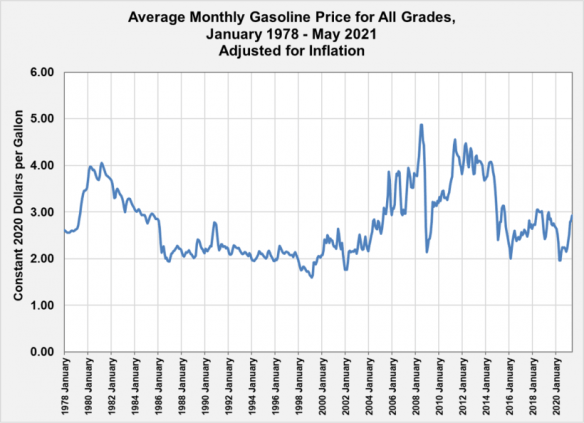
It’s true, the average price of gasoline has gone up. It always goes up and down, given the price of oil and how much people drive. It was almost $5.00 a gallon in 2008 (when a Republican was president) and $4.00 in 2014. It’s around $3.40 today.

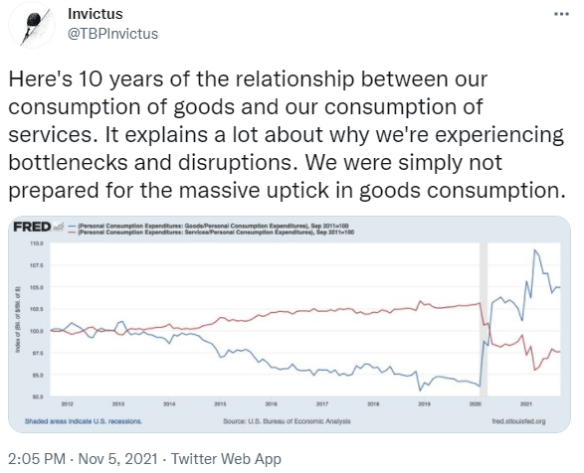
fotw1199Since we’re coming out of a pandemic-infused recession, problems should be expected.
Untitled

What’s next?

Democrats, again with ZERO REPUBLICAN VOTES, will pass parts of Biden’s “Build Back Better” social policy bill, fulfilling some of the promises he ran on in 2020 (not because  Alexandra Ocasio-Cortez has hypnotized him).

Biden describes it in two sentences, “The build back better framework lowers your bills for health care, child care, prescription drugs, and preschool. And families get a tax cut.”

Paul Krugman used one sentence: “Tax the rich, help America’s children”.

Democrats may — may — finally be about to agree on a revenue and spending plan. It will clearly be smaller than President Biden’s original proposal, and much smaller than what progressives wanted. It will, however, be infinitely bigger than what Republicans would have done, because if the G.O.P. controlled Congress, we would be doing nothing at all to invest in America’s future.

But what will the plan do? Far too much reporting has focused mainly on the headline spending number — $3.5 trillion, no, $1.5 trillion, whatever — without saying much about the policies this spending would support. . . 

So let me propose a one-liner: Tax the rich, help America’s children. This gets at much of what the legislation is likely to do: Reporting suggests that the final bill will include taxes on billionaires’ incomes and minimum taxes for corporations, along with a number of child-oriented programs. And action on climate change can, reasonably, be considered another way of helping future generations.

Republicans will, of course, denounce whatever Democrats come out with. But there are three things you should know about both taxing the rich and helping children: They’re very good ideas from an economic point of view. They’re extremely popular. And they’re very much in the American tradition.

I hope what comes soon after that is an all-out push to convince two or three misguided Democratic senators to reform the filibuster in order to protect voting rights, because, all around the country, Republicans are doing whatever they can to insure minority, right-wing rule.

Biden and his team are restoring reasonable regulations for business and trying to address the climate crisis. They’re reuniting immigrant families instead of tearing them apart. They had the guts to finally end our longest, stupidest war. They’re getting respect around the world, not losing it. They want women to control their bodies. They believe it should be easy for Americans to vote. 

Maybe him and other Democrats know what they’re doing. Maybe more of us will figure that out.

This Week’s Elections Don’t Mean the Sky Is Falling

Rachel Maddow is often an oasis of sanity in the barren wasteland of corporate media. Last night, she identified an historical pattern that nobody else seems to have paid much attention to (I recommend watching what she had to say, but I’m writing about it anyway).

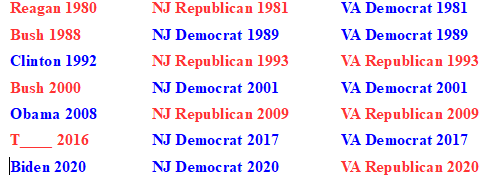
Here’s the pattern in pictorial form. The first column is a president’s first year in office. The second column is the winner of the New Jersey governor’s race later that year. The third column is the winner of the Virginia governor’s race held the same day.

Untitled

It’s an oddity of the political calendar that New Jersey and Virginia hold their elections for governor one year after presidential elections. That means when a new president is elected, like Reagan in 1980 and Biden in 2020, the governor’s races in New Jersey and Virginia are the first chance voters get to choose their state’s leader but also, less obviously, to react to there being a new person in the White House. This explains why NJ and VA governor’s elections are viewed as a referendum on a president’s first year in office. 

Looking at the chart, you’ll notice that in three of the seven years (1988, 2000 and 2016), when a  Republican won the presidency, his party lost the two governor’s races.

Likewise, in two of the seven years (1992 and 2008), when a Democrat won the presidency, his party also lost the two governor’s races.

It was only in 1981, and again this year, that a new president’s party won even one of the two governor’s races.

In other words, Biden and his party did better this week than any president has done since Ronald Reagan, forty years ago.

As a matter of fact, in 1981, with Reagan now in the White House, the Republican gubernatorial candidate beat the Democrat by fewer than 2,000 votes (an exception that almost proves the rule that the president’s party loses these elections). If the Democrat had done a bit better, Joe Biden would have been the first brand-new president to hold onto the NJ or VA governorship in 44 years. (Winning a second term makes NJ Governor Phil Murphy the first Democrat to win two elections since then. He currently leads his Republican opponent by 44,000 votes).

As Maddow pointed out, the New Jersey and Virginia governor’s races are the first opportunity for voters who opposed the new president to register their anger at the polls, while the voters who helped elect the new president are (less passionately) waiting to see what the new president can deliver. That’s why a new president’s party ordinarily loses both the New Jersey and Virginia governor races.

The fact that a Democrat won New Jersey this year is, therefore, a good sign, not a bad one. You wouldn’t know that from reading a paper or watching TV (maybe that’s because those in the media who comment on elections are surprised that Democrats don’t do even better, given the Republican Party’s descent into fascism).

Finally, Maddow also points out that in two special elections this year, Democrats did quite well. A Democrat was elected to Congress with 60% of the vote in New Mexico, even though Republicans claimed they had a great chance to win. Three months later, California’s Democratic governor won that ridiculous recall election, also with 60% of the vote. The 2022 election will almost certainly be difficult, but the sky is not falling based on this year’s results.

An Expert Says It’s Typical Fascism

Jason Stanley, a professor at Yale University and the author of How Fascism Works: The Politics of Us and Them, analyzes a new piece of fascist propaganda disseminated by Fox News:  

Patriot Purge, Tucker Carlson’s new three-part series, is propaganda built around D____ T____’s Big Lie of a stolen 2020 election and buttressed by a bizarro world, alt-right and alt-reality retelling of the January 6th insurrection. But Carlson’s message being profoundly dishonest doesn’t stop it from being profoundly dangerous: both because it contains kernels of tough truths the country has been scared to face, and because it follows a classic template of propaganda that has brought down democracies before.

The conceit of Patriot Purge is that the real “Americans” — the country’s greatest Patriots — were those who went to Washington on January 6 to join what was to be a peaceful rally protesting the supposed stealing of the 2020 US Presidential Election. They were a multi-racial group of patriotic Americans coming to the capital to voice their concerns. But then Antifa, apparently working in tandem with the FBI, disrupted the peaceful protests with agents provocateurs who urged participants into the capital building. The seditious “deep state” has in this way entrapped the country’s warriors, who are now the subject of government targeting that was honed during the War on Terror.

The message of the series is clear: a great wrong has been done. The government and media have engineered a false narrative directed in the first instance towards discrediting the patriots who seek to address it, and, ultimately, with the goal of hunting down and violently suppressing them. Our media’s complicity is demonstrated by their differential coverages of the BLM protests, which are here portrayed as senseless violent riots, and the events of January 6. The patriots are innocent Americans seeking only to preserve democracy in the face of a fraudulent election. The forces arrayed against them are almost impossibly powerful. It is a repeat of the war on terror, by the same forces who engineered it, but directed against the most representative of our citizens, the “real” Americans.

It is impossible to accept this message in total without taking it to justify violent mass action against the current government, or something like a police and military coup.

Carlson’s Patriot Purge finds a martyr for its movement in Ashli Babbitt, who was shot trying to get past a Capitol Police barrier near the House chamber. Her death, in great and gruesome detail, comprises the final shots of Part I.

Babbitt’s assigned role is familiar to anyone who has seen or studied Twentieth Century fascist propaganda. Martyrs are ideally pure and innocent, and killed in a noble attempt to defeat enemies of the nation. In fascist ideology, these enemies are communists and liberals, who are represented as subverting the will of the “true” people, whose only goal is to install their beloved leader, the true father of the nation. Honoring the memory of the martyr is to worship the leader, and give all in the quest to defeat his enemies and place him as the leader of the nation.

This series is a further contribution to the months long narrative construction of Babbitt as the T____ movement’s Horst Wessel, the Nazi stormtrooper killed in a brawl in 1930, most probably by communists (but for unclear reasons), and elevated to martyrdom status by Nazi propagandist Joseph Goebbels. In this case, the martyr is an innocent, patriotic white woman. . . .

The unquestioned premise of this series is the “Big lie”, that the election was stolen, and that T____ won. The Big Lie structures the entire narrative here. It is only on this assumption that we should grant a movement that promulgates this lie full political legitimacy, and equal weight in government decisions and media representation. It is only on this assumption that those who promulgate this lie can be represented as innocent victims.

Key to fascist propaganda is an overwhelming sense of danger, one that threatens to make the country’s dominant majority into a powerless and endangered minority. T____ loyalists in this series appear only as targeted victims, at existential peril, without representation in. any branch of government or media. Throughout, law is represented as merely an instrument in the service of power. The series does not discuss what these attitudes have justified – the wave of laws sweeping Republican dominated state governments enabling the mass disenfranchisement of minority voters on the basis of dubious claims of fraud, the stacking of election commissions by T___ loyalists, or the nationwide targeting of educators associated with Critical Race Theory or Black Lives Matter. The series does not mention the mass targeting of democratic institutions, from elections to schools, the curtailing of voting rights and speech, that are the calling card of the T____ist Republican Party in its current fascist phase. And the series does not, of course, discuss the fearsome power of Fox News.

In the inverted world of the series, those who support the authoritarian cult of the leader, his base, are the democratic patriots. Those who seek to preserve fair elections are the fascists. Fascist propaganda is relentless projection, justified by lies. Carlson has proven to be a master in its use. . . .

Throughout, Carlson is correct about several important matters. He is right about the dangers of mass surveillance. He is right about the moral obscenity of the war on terror, which has created an ugly toolkit that can be used to target relatively powerless American citizens. It is past time for these to be shared bipartisan assumptions. Embedding these truths within a larger framework in the service of destabilizing democracy makes it dangerous propaganda indeed. . . .

I share his view that ordinary fellow citizens who fall under the sway of propaganda should not be demonized. Our opprobrium should instead be directed at those leading the assault, billionaires . . . [like Rupert Murdoch], elite Ivy League-trained [politicians] like Ted Cruz and Josh Hawley, and, of course, wealthy and powerful mainstream media propagandists like Tucker Carlson.

Unquote.

Unlike Professor Stanley, however, I think the “ordinary” citizens who are so open to right-wing propaganda deserve plenty of opprobrium too. But our leaders aren’t comfortable saying that.